On This Page
Description
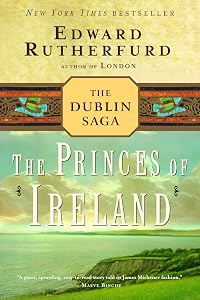
A sweeping panorama steeped in the tragedy and glory that is Ireland, epitomizes the power and richness of Rutherford's storytelling magic. The saga begins in tribal, pre-Christian Ireland during the reign of the fierce and mighty High kings at Tara, with the fate of two lovers, the princely Conall and the ravishing Deirdre, whose travails cleverly echo the ancient Celtic legend of Cuchulainn.Tags
Recommendations






Member Recommendations
Member Reviews
This book has been sitting on my bookshelf for 10 years waiting for me to get the time to tackle a 700+ page book of historical fiction that covers 1100 years of happenings in Ireland. It took a global pandemic for me to pull it off the shelf and finish it. Maybe there is a silver lining to all this enforced isolation.
This book starts in the year AD 430 which was before St. Patrick came to Ireland so the prevailing religion was druidic. Areas of the island were under the control of different chiefs and kings but there was one High King. The High King was chosen by the druids and he had to mate with a white female horse to show he had the necessary qualities. One did not disobey an edict from the druids or the High King but Deirdre, show more daughter of Fergus who controlled the crossing of the Liffey River near Dubh Lin (which means dark pool), and Conall, nephew of the High King, decided to run away together rather than let Deirdre become the High King's second wife. Conall paid the ultimate price for his disobedience but he impregnated Deidre before he was killed starting one of the clans that takes part in Irish history from then on. Other families are brought in throughout the book. Of course there is intermarrying and it was confusing at times to remember who was a descendent of whom. Fortunately there is a family tree at the beginning and I resorted to it often. There are also three maps at the start of the book: one of the whole island, one of the area surrounding Dublin and one of medieval Dublin itself. I also flipped back to them often. Another resource is the pronunciation guide at the back of the book which aided me in mentally saying the place names, peoples' names and phrases sprinkled throughout the book. I truly appreciated this reference material; that's how historical fiction should be.
If I have one complaint about this book it is that there is not much mention of other areas of Ireland besides the Dublin region. I suppose if Rutherfurd had included that the book would be even bigger. He has written a follow up to this book; I'll have to try to get it to see if it branches farther afield. show less
This book starts in the year AD 430 which was before St. Patrick came to Ireland so the prevailing religion was druidic. Areas of the island were under the control of different chiefs and kings but there was one High King. The High King was chosen by the druids and he had to mate with a white female horse to show he had the necessary qualities. One did not disobey an edict from the druids or the High King but Deirdre, show more daughter of Fergus who controlled the crossing of the Liffey River near Dubh Lin (which means dark pool), and Conall, nephew of the High King, decided to run away together rather than let Deirdre become the High King's second wife. Conall paid the ultimate price for his disobedience but he impregnated Deidre before he was killed starting one of the clans that takes part in Irish history from then on. Other families are brought in throughout the book. Of course there is intermarrying and it was confusing at times to remember who was a descendent of whom. Fortunately there is a family tree at the beginning and I resorted to it often. There are also three maps at the start of the book: one of the whole island, one of the area surrounding Dublin and one of medieval Dublin itself. I also flipped back to them often. Another resource is the pronunciation guide at the back of the book which aided me in mentally saying the place names, peoples' names and phrases sprinkled throughout the book. I truly appreciated this reference material; that's how historical fiction should be.
If I have one complaint about this book it is that there is not much mention of other areas of Ireland besides the Dublin region. I suppose if Rutherfurd had included that the book would be even bigger. He has written a follow up to this book; I'll have to try to get it to see if it branches farther afield. show less
I'm so glad that I decided to read the first book of the Dublin Saga as my annual summer read from Edward Rutherford, rather than one of his stand-alone novels (I have Russka and Sarum on my shelf as well), since it completely renewed my faith in his historical fiction. Last year I cheated a bit and read both London and the Forest, which, while interesting, lacked the same intruging characters and drive as Paris, but it's become clear to me that Rutherfurd's writing style has evolved and improved over the years. Obviously this makes me slightly concerned about how much I may enjoy (or not enjoy) reading Russka and Sarum, but hopefully they at least have some good qualities.
But back to the point - this first novel about the Irish city show more of Dublin (and the surrounding areas) was an absolute joy. It begins its story at a time when Ireland was pre-Christian, an era where druids held an important place in society, and while I'll refrain from referring to as the mists of Irish past or any other such whimsical description (even though it's hard not to be swept up in the mythology and mysticism of the largely unchronicled era). From these beginnings Rutherfurd traces a myriad of Irish families - many of whom don't startout as referring to themselves as Irish, but who came to Ireland as part of Viking, Danish, English, and Norman waves of conquerors and settlers - through time to the Tudor era. He covers the most famous Irish saint (Patrick) with a carefully constructed but plausible interaction with the pre-feudal rulers of Dublin, and gives much credence to the rise and influence of Christianity on the Emerald Isle. Even though I'm not one for Catholicism (or any organized relgion for that matter), the interactions and complicated motivations of the highly spiritual people of Ireland is fascinating - especially considering the differences between the Irish Church and the rest of Christianity. Tied into these religious themes are, of course, many others that drive the growth of any community (and nation) - family relationships, love and marriage, commerce and politics, and Ireland's complicated relationship with England. The finale of the book leave readers hanging a bit, with Ireland firmly in the grasp of Henry VIII and many of our families come to uneasy (but intriguing) alliances, so I'll be hard pressed to leave off reading the second book until next summer! show less
But back to the point - this first novel about the Irish city show more of Dublin (and the surrounding areas) was an absolute joy. It begins its story at a time when Ireland was pre-Christian, an era where druids held an important place in society, and while I'll refrain from referring to as the mists of Irish past or any other such whimsical description (even though it's hard not to be swept up in the mythology and mysticism of the largely unchronicled era). From these beginnings Rutherfurd traces a myriad of Irish families - many of whom don't startout as referring to themselves as Irish, but who came to Ireland as part of Viking, Danish, English, and Norman waves of conquerors and settlers - through time to the Tudor era. He covers the most famous Irish saint (Patrick) with a carefully constructed but plausible interaction with the pre-feudal rulers of Dublin, and gives much credence to the rise and influence of Christianity on the Emerald Isle. Even though I'm not one for Catholicism (or any organized relgion for that matter), the interactions and complicated motivations of the highly spiritual people of Ireland is fascinating - especially considering the differences between the Irish Church and the rest of Christianity. Tied into these religious themes are, of course, many others that drive the growth of any community (and nation) - family relationships, love and marriage, commerce and politics, and Ireland's complicated relationship with England. The finale of the book leave readers hanging a bit, with Ireland firmly in the grasp of Henry VIII and many of our families come to uneasy (but intriguing) alliances, so I'll be hard pressed to leave off reading the second book until next summer! show less
I have always been afraid to pick up a Rutherford book, so when I found this one at a used book sale for a buck I decided it was time.
This story begins in the time of St. Patrick in the city of Dublin and continues through the ages, following connected relatives. Seeing Dublin through the eyes of the mighty, the religious, the common man you get a beautiful, yet sometimes brutal portrait of the city and the people who lived there. At over 700 pages, you need to expect it to drag on at times. This is the only reason I could not offer up 5 stars. It appears that true fans of Rutherford find this book not one of their favorites. That alone urges me to continue reading this author. The Dublin Saga is 2 books, so I will move on to that one show more before venturing further. show less
This story begins in the time of St. Patrick in the city of Dublin and continues through the ages, following connected relatives. Seeing Dublin through the eyes of the mighty, the religious, the common man you get a beautiful, yet sometimes brutal portrait of the city and the people who lived there. At over 700 pages, you need to expect it to drag on at times. This is the only reason I could not offer up 5 stars. It appears that true fans of Rutherford find this book not one of their favorites. That alone urges me to continue reading this author. The Dublin Saga is 2 books, so I will move on to that one show more before venturing further. show less
I wanted something set in Ireland after the last couple of books I had read, and I have owned a copy of this for ages. Since it's gardening season I snagged an audio copy via Libby. It got off to an awesome start. In fact if I was only rating the first third of the book I would probably give it at least four stars. Alas the rest of the book was just not as interesting. The historical bits were worthy of attention, but the fiction wrapped around those bits just did not grab me. I do not think I will be continuing with this series despite the fact that I own the second book in a hard cover.
Rutherfurd's Princes of Ireland opens with a lesson in geography, anthropology, and history. I am always learning something new with historical fiction, like the difference between overlords and feudal lords. Did you know that Celtic warriors rode their horses naked? Kissing each other's nipples is a show of forgiveness? Clans buried their warriors standing up, facing their enemies camp, to keep an eye on them? So many customs and traditions and that is not even getting into the politics of the country!
Although I kept making comparisons to Thomas Flanagan's Irish series, Rutherfurd's Ireland is much rowdier than Flanagan's epic tale. People stealing horses for animalistic (pun intended) pleasures was a head scratcher for me. I have show more heard the rumors of men with sheep, but horses? Mythology and rituals abound. As an example, the success of the season's harvest is dependent on the druid's blessing. All of these details are a vehicle for the clever entanglement of fact and fiction - details so interwoven it is hard to tease them apart.
My favorite part of the story was Rutherfurd's mastermind of the relationship between Margaret and Joan. Margaret's misconceptions and prejudices of Joan were skillful and plausible. It was like a medieval gossip rag. Here is another drama: the king's wish to divorce his Spanish wife for the love of another. The townspeople quarrel about who is in the right. show less
Although I kept making comparisons to Thomas Flanagan's Irish series, Rutherfurd's Ireland is much rowdier than Flanagan's epic tale. People stealing horses for animalistic (pun intended) pleasures was a head scratcher for me. I have show more heard the rumors of men with sheep, but horses? Mythology and rituals abound. As an example, the success of the season's harvest is dependent on the druid's blessing. All of these details are a vehicle for the clever entanglement of fact and fiction - details so interwoven it is hard to tease them apart.
My favorite part of the story was Rutherfurd's mastermind of the relationship between Margaret and Joan. Margaret's misconceptions and prejudices of Joan were skillful and plausible. It was like a medieval gossip rag. Here is another drama: the king's wish to divorce his Spanish wife for the love of another. The townspeople quarrel about who is in the right. show less
Princes of Ireland – Edward Rutherfurd
4 star
This book is the first in Rutherfurd’s two-part Dublin Saga. Beginning with pre-Christian Ireland the books follows a seemingly endless cast of characters through the centuries of change. Following the generational history of several fictional families, Rutherfurd portrays major events in Irish history from Viking invasions to the deceptions of Henry II. Rutherfurd’s style is often compared to James Michener. I found many similarities between them, and I was also reminded of Follett’s Pillars of the Earth. Rutherfurd’s characters are precisely placed on a historical playing board to insure their interaction with major events. Each historical section of the book provided a complete show more and eventful story the held my interest throughout. It was easy to listen to this book
as it is broken into manageable sections for each historical period. However, I found that I wanted the print edition to read for the maps and family tree diagrams the helped to tie the inter-related stories together. show less
4 star
This book is the first in Rutherfurd’s two-part Dublin Saga. Beginning with pre-Christian Ireland the books follows a seemingly endless cast of characters through the centuries of change. Following the generational history of several fictional families, Rutherfurd portrays major events in Irish history from Viking invasions to the deceptions of Henry II. Rutherfurd’s style is often compared to James Michener. I found many similarities between them, and I was also reminded of Follett’s Pillars of the Earth. Rutherfurd’s characters are precisely placed on a historical playing board to insure their interaction with major events. Each historical section of the book provided a complete show more and eventful story the held my interest throughout. It was easy to listen to this book
as it is broken into manageable sections for each historical period. However, I found that I wanted the print edition to read for the maps and family tree diagrams the helped to tie the inter-related stories together. show less
Overall this book met my expectations: it was a well-written saga winding its way down through the ages, tracing the history of Ireland via several fictional families. Rutherfurd has a good eye for detail (the prologue is a good example of his descriptive writing) and the events of the story certainly feel realistic. Even though the scale is rather epic, covering Druidic times to about the 1530s, he manages to keep his focus on individuals and the smaller details, for example noting the character traits that pass their way through the generations: Deirdre's green eyes, Goibniu's characteristic squint, even the drinking skull of Old Fergus drift in and out of the storyline. The narration also feels a bit like an oral storyteller, with a show more few repeated phrases, and the dialogue contains some Irish Gaelic flavouring, especially at the beginning.
This book is a great way to learn about Irish history, because Rutherfurd does it in a relatively painless manner -- the only place it really feels like an info-dump is around the reign of Henry II, when he has to explain the English feudal system. Also included in the book are maps of Ireland and Dublin, and a pronunciation guide for some of those intimidating-looking Irish names.
All in all, this is a book perfect for a rainy afternoon with a cup of tea -- it reads well and the pacing is very smooth. If you like Irish history or have that background, pick this one up. Then make sure you have the sequel, The Rebels of Ireland, on hand! show less
This book is a great way to learn about Irish history, because Rutherfurd does it in a relatively painless manner -- the only place it really feels like an info-dump is around the reign of Henry II, when he has to explain the English feudal system. Also included in the book are maps of Ireland and Dublin, and a pronunciation guide for some of those intimidating-looking Irish names.
All in all, this is a book perfect for a rainy afternoon with a cup of tea -- it reads well and the pacing is very smooth. If you like Irish history or have that background, pick this one up. Then make sure you have the sequel, The Rebels of Ireland, on hand! show less
Members
- Recently Added By
Lists

Historical Fiction
889 works; 91 members

Best family sagas
244 works; 34 members

To Read
8 works; 2 members

Books with Noble Titles
179 works; 11 members

Books Read in 2004
212 works; 7 members

Time-Sweep Novels
28 works; 3 members

al.vick-series
381 works; 2 members
Author Information

35+ Works 24,791 Members
Edward Rutherford is a pseudonym for Francis Edward Wintle. A writer of historical novels, he has also found success with multigenerational epics. His first book Sarum: The Novel of England was published in 1987. It was followed in 1991 with Russka: The Novel of Russia. He has also published two novels which cover the story of Ireland from the show more time just before Saint Patrick to the twentieth century: Dublin: Foundation (The Princes of Ireland) and Ireland: Awakening (The Rebels of Ireland). His books have been translated into twenty languages. Wintle was born in 1948, in Wiltshire, England. He attended Cambridge University and graduated with honors in English. His title's Paris and Sarum: The Novel of England made The New York Times Best Seller List. (Bowker Author Biography) show less
Awards and Honors
Distinctions
Series

Common Knowledge
- Canonical title
- The Princes of Ireland
- Original title
- Dublin: Foundation
- Alternate titles
- The Princes of Ireland
- Original publication date
- 2004
- Important places
- Dublin, Ireland
Classifications
Statistics
- Members
- 3,187
- Popularity
- 5,473
- Reviews
- 57
- Rating
- (3.70)
- Languages
- 8 — Czech, Danish, English, German, Italian, Polish, Portuguese, Spanish
- Media
- Paper, Audiobook, Ebook
- ISBNs
- 41
- ASINs
- 27