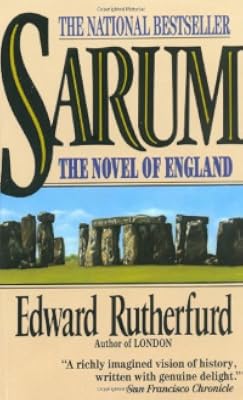
Sarum
by Edward Rutherfurd
On This Page
Description
In Sarum, Edward Rutherfurd weaves a compelling saga of five English families whose fates become intertwined over the course of centuries. While each family has its own distinct characteristics, the successive generations reflect the changing character of Britain. We become drawn not only into the fortunes of the individual family members, but also the larger destinies of each family line. Meticulously researched and epic in scope, Sarum covers the entire sweep of English civilization: from show more the early hunters and farmers, the creation of Stonehenge, the dawn of Christianity, and the Black Death; through the Reformation, the wars in America, the Industrial Age, and the Victorian social reforms; up through the World War II invasion of Normandy and the modern-day concerns of a once-preeminent empire. show lessTags
Recommendations









Member Recommendations
Member Reviews
I wanted to love this book because I love the area it is written about, and the historical events and archaeological sites it is supposed to tell about. However, I can't bring myself to read anymore and waste any more of my life on this book. The writing is abysmal. It's as if someone wanted to write a nonfiction book but figured it wouldn't sell, then threw in some characters (names, really, not characters) and the occasional line of dialogue between chunks of master's thesis and sold the mishmash as a sweeping historical saga. The result is just dreadful, sometimes to the point of being funny. I read about half a page that had particularly annoyed me aloud to my husband and he laughed so hard he nearly cried. I am not sure what book show more everyone else is reading, but I must have gotten hold of the wrong copy because the one I have would not have made it out of a high school English class without a lot of red marks and a failing grade. I wish the author had just published his nonfiction book. I probably would have loved that. show less
Rutherfurd follows James Michener's template, selecting a locale and then telling a sequence of fictional stories that take place there over centuries to highlight key moments in its timeline. The fictional bits are airy and light and not at all the point, serving as window dressing to tell history in a more engaging manner than dry facts. They do perhaps convey a sense of what it was like to live there at those various times, although it can sometimes feel like there's more drama than realism. You might be misled into thinking everyone in all ages lived about as comfortably as we do today, minus an occasional famine or raid. It's the frame he hangs this all upon that really matters, and he is working with an area rich in history. This show more particularly shone in the latter half: from the Black Death through the Spanish Armada, the Commonwealth, Trafalgar, D-Day ...
It is a difficult book to review as a whole when it reads like a sequence of related stories. Some were too melodramatic for my taste (far too many sexually eager underage girls, too much stupid forgetfulness, too many poor life choices) while other parts were more affecting (confronting one's age and powerlessness, rags-to-riches journeys, moral decisions). I don't rate the fictional elements as Rutherfurd's strong point. He is much better at presenting the history and smoothly incorporating research into his tales, the 'medicine' beneath the thick layer of sugar. I always start a Rutherfurd novel with a great deal of enthusiasm and then get more and more bogged down, wondering if some non-fiction coverage may have been the easier route after all. Skimming is an option.
The element I do appreciate from the fictional layer is its portrayal of historical events as current ones. This takes them out of the history textbook and reframes them, with focus given to swirling opinions for and against each new development while the future is still unknown. There are several incidents like this that put the reader into the past as if it were present. These are the novel's (as they are the general style's) highlights. show less
It is a difficult book to review as a whole when it reads like a sequence of related stories. Some were too melodramatic for my taste (far too many sexually eager underage girls, too much stupid forgetfulness, too many poor life choices) while other parts were more affecting (confronting one's age and powerlessness, rags-to-riches journeys, moral decisions). I don't rate the fictional elements as Rutherfurd's strong point. He is much better at presenting the history and smoothly incorporating research into his tales, the 'medicine' beneath the thick layer of sugar. I always start a Rutherfurd novel with a great deal of enthusiasm and then get more and more bogged down, wondering if some non-fiction coverage may have been the easier route after all. Skimming is an option.
The element I do appreciate from the fictional layer is its portrayal of historical events as current ones. This takes them out of the history textbook and reframes them, with focus given to swirling opinions for and against each new development while the future is still unknown. There are several incidents like this that put the reader into the past as if it were present. These are the novel's (as they are the general style's) highlights. show less
Like James Michener, Edward Rutherfurd chooses a place and build his novels around it. Sarum explores 10,000 years of human history on the Salisbury plain of England. Although quite dense (like a fruitcake) Rutherfurd's writing is also quite compelling. One of his devices is to introduce an object -- in this case a small stone carving of a prehistoric woman -- that literally resurfaces every couple of centuries. He also does this with his human characters; physical human features show up generation after generation. At times I was irritated by this, partly because Rutherfurd "tags" his characters with specific descriptions: "stout", "rat-like face", etc. But even more irritating was the passing down of character traits; if you descended show more from a certain family that lived in Roman times, by God, you're a petty thief in 1985! Minor annoyances aside, I truly enjoyed the in-depth sense of a place that Rutherfurd conveys. show less
I greatly enjoyed Sarum. All 1033 pages of it.
Sarum is the first Edward Rutherford book I tackled, although his New York book has stared at me with longing on a shelf for years. Starting at the end of the last Ice Age, Sarum follows the generational paths of five families through time to the modern day. The book hits all the strong beats: the building of Stonehenge, the Roman Invasion of Britain and their colonization, the Dark Ages, Saxon Britain, the Norman Invasion, the War of the Roses, the High Middle Ages and the Black Death, the coming of Protestantism and Queen Elizabeth II, the English Civil War, the conquest of India and the American Revolution, Trafalgar and Waterloo, the Great Wars of the 20th Century. Sarum left me with a show more great sense of breadth and time and gave me an appreciation for age and the passing of time. Everything starts and everything ends -- cultures, religions, industry and business, technology, reigns great and small. That which felt eternal at the time it happened passed and soon became someone else's archeology.
The highlights of the book are the grisly Stonehenge chapter (nearly a novella in itself), the building of the Salisbury Cathedral and the horrible chapter on the Black Death, followed by the Revolution and the Cavaliers in the Civil War. Of the five families, two are the main focus of the book: the horrible decedents of Tep, the river man who has always been there since before the Ice Age ended, and the Shockleys, decedents of a Saxon Thane whose fortunes rise and fall with England's. For 1500 years those two families have back and forths, constantly crossing paths until finally joining in the 20th century. The other families (Caius Porteus's decedents, the family of Nooma the Mason, and the Godefrei's) play second fiddle -- save in the Cathedral chapter -- to the others.
Sometimes the chapters felt a little too short and that generation ended too soon but, generally, I read this book with Wikipedia and my (nonfiction) history of England open to flesh out some of the details where the book glossed over. Overall, I enjoyed the rich detail Rutherford supplies in with the every day lives of his inhabitants of Sarum to give grounding in the time period. No politics get injected in the background of historical period detail -- it is told, straight, to help couch the feelings and motivations of the characters.
I recommend this book to anyone who wants to read some meaty historical fiction or to get an entertaining grounding in the history of Britain. Although some of the archeology in the early part of the book is a little wobbly now (book came out in 1987), the rest is solid and was backed by my reference books.
Five stars. show less
Sarum is the first Edward Rutherford book I tackled, although his New York book has stared at me with longing on a shelf for years. Starting at the end of the last Ice Age, Sarum follows the generational paths of five families through time to the modern day. The book hits all the strong beats: the building of Stonehenge, the Roman Invasion of Britain and their colonization, the Dark Ages, Saxon Britain, the Norman Invasion, the War of the Roses, the High Middle Ages and the Black Death, the coming of Protestantism and Queen Elizabeth II, the English Civil War, the conquest of India and the American Revolution, Trafalgar and Waterloo, the Great Wars of the 20th Century. Sarum left me with a show more great sense of breadth and time and gave me an appreciation for age and the passing of time. Everything starts and everything ends -- cultures, religions, industry and business, technology, reigns great and small. That which felt eternal at the time it happened passed and soon became someone else's archeology.
The highlights of the book are the grisly Stonehenge chapter (nearly a novella in itself), the building of the Salisbury Cathedral and the horrible chapter on the Black Death, followed by the Revolution and the Cavaliers in the Civil War. Of the five families, two are the main focus of the book: the horrible decedents of Tep, the river man who has always been there since before the Ice Age ended, and the Shockleys, decedents of a Saxon Thane whose fortunes rise and fall with England's. For 1500 years those two families have back and forths, constantly crossing paths until finally joining in the 20th century. The other families (Caius Porteus's decedents, the family of Nooma the Mason, and the Godefrei's) play second fiddle -- save in the Cathedral chapter -- to the others.
Sometimes the chapters felt a little too short and that generation ended too soon but, generally, I read this book with Wikipedia and my (nonfiction) history of England open to flesh out some of the details where the book glossed over. Overall, I enjoyed the rich detail Rutherford supplies in with the every day lives of his inhabitants of Sarum to give grounding in the time period. No politics get injected in the background of historical period detail -- it is told, straight, to help couch the feelings and motivations of the characters.
I recommend this book to anyone who wants to read some meaty historical fiction or to get an entertaining grounding in the history of Britain. Although some of the archeology in the early part of the book is a little wobbly now (book came out in 1987), the rest is solid and was backed by my reference books.
Five stars. show less
The book grew on me. I was pulled in from the start by this monster 897 page book, and quickly knew I'd finish the journey. But then, like many Americans, even though, as far as I know, I don't have a drop of English blood, that country fascinates me, because of how its culture and history formed the basis for American society, and because of the wonderful legacy of literature in our common language. So a story that follows the history of Sarum (the area around Salisbury Cathedral and Stonehenge) naturally would hold a strong appeal.
I didn't expect however, to love the novel as much as I did in the end. The style isn't anything special, even clunky at times, I don't agree with all of Rutherford's takes on history, I wasn't strongly show more taken with the characters centered upon in several of the chapters, and I think the prehistoric period that forms the first few chapters aren't his strongest. But I think the effect is cumulative, especially since the novel is obviously so well researched and thought out. Everything from the way people affected the natural environment, what and how they worshiped, their day to day life, their shifting attitudes is so wonderfully depicted, and in that way you get a painless and impressive lesson on English history. The book follows five lineages down the ages from the waning of the Ice Age 9,500 years ago when Britain broke off from the continent to become an island down to the present day.
My major problem with the book is how stereotyped are the five families. If there's a member of the Mason lineage around, well then they have heavy heads, are rather simple and are skilled craftsman. If a Porter, well, then we have a punctilious, pompous prig. Shockleys are usually decent as the day is long and shrewd merchants and their women tend to have a strong warrior spirit. Godfreys, descended from Norman knights, are chivalrous but bad with money. And Wilsons with their long fingers and toes? Dear God, don't turn your back to any of them! Whenever one steps onto the scene, you can practically hear the ominous music. When Cristina in "The Founding" is depicted as treacherous and sly, I knew she'd either be related to the Wilsons or marry into that family. And lo and behold...
There are 19 sections to the book, each of which are more like connected novellas than chapters making up a unified novel. Partly as a result of this, few characters get fleshed out and this is a novel more broad than deep. This is historical fiction, almost more dramatized history than stories with history as a backdrop. But I loved how through these families Rutherford could lead me through the sweep of history in a very human way.
There were some lovely grace notes within though, and some chapters and scenes stand out. There's the story of the Roman Caius Porteus (particularly his affair with the Jewish slave Naomi) in "Sorviodunum" that takes in the Roman invasion in 42 AD and the building of Bath. Another favorite is "The Two Rivers" where the punctiliousness of Caius' descendant Port is used to both poignant and comic effect and we get a Anglo-Saxon woman warrior in Aelgifu, of the Shockley lineage, worthy of Tolkien's Eówyn. My favorite chapter of all might be "The Founding" about the building of Salisbury Cathedral where the motif of the Seven Deadly Sins is skillfully woven into the story of stone carver Osmund Mason. In "New World" set in the reign of Bloody Mary there's a powerful moment between the Puritan Abigail Mason and former prostitute, Nellie Godfrey. The chapter "The Unrest" fascinated me in its picture of civil war pitting brother against brother and the dangerous time of the Burnings with the portrait of the historical "Witchfinder General" Matthew Hopkins.
In "The Calm" a chapter depicting the Georgian era, Adam Shockley, a British captain, returns to Sarum from the American Revolutionary War changed. His conversation with a young Revolutionary War soldier, John Hillier, proved life-changing and he later returns to settle in Pennsylvania. In a later chapter, "The Encampment" his descendant comes to Sarum with the American army to fight the Nazis, and his conversation with a British girl he's in love with reveals a wide divide between them. Both conversations stuck in my mind as an illustration of the different mindsets of the Old and New Worlds.
I had to smile at the note which Rutherford ends the novel. He refuses to leave on a note of triumphalism but more with a gentle head-shaking moment about the perverse persistence of chaotic human nature.
Reading other reviews, I can see criticisms this is a "dead white male" history. I think this an unfair criticism. The whole conceit and premise of the novel is to focus on five families in the English midlands over the centuries. You just don't have much of a presence other than white, particularly in that area of England (this isn't London after all) until after World War Two and only the short closing chapter focuses on the post-war, post-colonial era so naturally the focus remains on the already established families. As for it being malecentric. Well, sorry, women's roles were circumscribed for most of history--and actually I think there are several strong and positive female characters in Sarum--it's their stories by and large I found most memorable. As for the "dead" in dead white male--well, this is a novel focusing on history centuries deep. Duh! What do you expect? Nor do I think it's fair to say this novel doesn't depict the plight of the poor and lower classes. It's a major theme throughout. About the only socio-political criticism of the book I think would be valid is its depiction of gay characters. There are none--except for a pedophile monk. But then this was written in the mid-1980s--so maybe ironically that's just an inadvertent illustration of a recent historical blind-spot given gay issues gained more prominence and sympathy after AIDS made its mark.
Rutherford wrote a novel along these lines for New York City, my own city. And after reading Sarum I'm certainly eager to read it! show less
I didn't expect however, to love the novel as much as I did in the end. The style isn't anything special, even clunky at times, I don't agree with all of Rutherford's takes on history, I wasn't strongly show more taken with the characters centered upon in several of the chapters, and I think the prehistoric period that forms the first few chapters aren't his strongest. But I think the effect is cumulative, especially since the novel is obviously so well researched and thought out. Everything from the way people affected the natural environment, what and how they worshiped, their day to day life, their shifting attitudes is so wonderfully depicted, and in that way you get a painless and impressive lesson on English history. The book follows five lineages down the ages from the waning of the Ice Age 9,500 years ago when Britain broke off from the continent to become an island down to the present day.
My major problem with the book is how stereotyped are the five families. If there's a member of the Mason lineage around, well then they have heavy heads, are rather simple and are skilled craftsman. If a Porter, well, then we have a punctilious, pompous prig. Shockleys are usually decent as the day is long and shrewd merchants and their women tend to have a strong warrior spirit. Godfreys, descended from Norman knights, are chivalrous but bad with money. And Wilsons with their long fingers and toes? Dear God, don't turn your back to any of them! Whenever one steps onto the scene, you can practically hear the ominous music. When Cristina in "The Founding" is depicted as treacherous and sly, I knew she'd either be related to the Wilsons or marry into that family. And lo and behold...
There are 19 sections to the book, each of which are more like connected novellas than chapters making up a unified novel. Partly as a result of this, few characters get fleshed out and this is a novel more broad than deep. This is historical fiction, almost more dramatized history than stories with history as a backdrop. But I loved how through these families Rutherford could lead me through the sweep of history in a very human way.
There were some lovely grace notes within though, and some chapters and scenes stand out. There's the story of the Roman Caius Porteus (particularly his affair with the Jewish slave Naomi) in "Sorviodunum" that takes in the Roman invasion in 42 AD and the building of Bath. Another favorite is "The Two Rivers" where the punctiliousness of Caius' descendant Port is used to both poignant and comic effect and we get a Anglo-Saxon woman warrior in Aelgifu, of the Shockley lineage, worthy of Tolkien's Eówyn. My favorite chapter of all might be "The Founding" about the building of Salisbury Cathedral where the motif of the Seven Deadly Sins is skillfully woven into the story of stone carver Osmund Mason. In "New World" set in the reign of Bloody Mary there's a powerful moment between the Puritan Abigail Mason and former prostitute, Nellie Godfrey. The chapter "The Unrest" fascinated me in its picture of civil war pitting brother against brother and the dangerous time of the Burnings with the portrait of the historical "Witchfinder General" Matthew Hopkins.
In "The Calm" a chapter depicting the Georgian era, Adam Shockley, a British captain, returns to Sarum from the American Revolutionary War changed. His conversation with a young Revolutionary War soldier, John Hillier, proved life-changing and he later returns to settle in Pennsylvania. In a later chapter, "The Encampment" his descendant comes to Sarum with the American army to fight the Nazis, and his conversation with a British girl he's in love with reveals a wide divide between them. Both conversations stuck in my mind as an illustration of the different mindsets of the Old and New Worlds.
I had to smile at the note which Rutherford ends the novel. He refuses to leave on a note of triumphalism but more with a gentle head-shaking moment about the perverse persistence of chaotic human nature.
Reading other reviews, I can see criticisms this is a "dead white male" history. I think this an unfair criticism. The whole conceit and premise of the novel is to focus on five families in the English midlands over the centuries. You just don't have much of a presence other than white, particularly in that area of England (this isn't London after all) until after World War Two and only the short closing chapter focuses on the post-war, post-colonial era so naturally the focus remains on the already established families. As for it being malecentric. Well, sorry, women's roles were circumscribed for most of history--and actually I think there are several strong and positive female characters in Sarum--it's their stories by and large I found most memorable. As for the "dead" in dead white male--well, this is a novel focusing on history centuries deep. Duh! What do you expect? Nor do I think it's fair to say this novel doesn't depict the plight of the poor and lower classes. It's a major theme throughout. About the only socio-political criticism of the book I think would be valid is its depiction of gay characters. There are none--except for a pedophile monk. But then this was written in the mid-1980s--so maybe ironically that's just an inadvertent illustration of a recent historical blind-spot given gay issues gained more prominence and sympathy after AIDS made its mark.
Rutherford wrote a novel along these lines for New York City, my own city. And after reading Sarum I'm certainly eager to read it! show less
This rating is a 3.5 in comparison with Rutherfurd's other books. I thought three chapters' worth of prehistoric peoples was too much, and the last few chapters felt a bit rushed in consequence. And while I thought the information dumps worked better in the narration than in the mouths of the characters, the intercutting of single lines of dialogue between chunks of explanatory narration felt bumpy. (I should just admit right now that I will never be entirely happy with how the information dumping is handled in this sort of book and just learn to live with it.)
My favourite parts were probably the ones involving the cathedral being built, and whenever later chapters dealt with the restoration of or threats to said cathedral. I also show more enjoyed the smugglers, the (English) Civil War bits, and the Romans. Another interesting experiment was the chapter about the plague that features a beginning section narrated from the third person limited viewpoint of a rat, and then a flea, as the plague enters England. It made me itchy and a little nauseated just reading it!
If you like doorstopper history books, this will probably serve your needs well. show less
My favourite parts were probably the ones involving the cathedral being built, and whenever later chapters dealt with the restoration of or threats to said cathedral. I also show more enjoyed the smugglers, the (English) Civil War bits, and the Romans. Another interesting experiment was the chapter about the plague that features a beginning section narrated from the third person limited viewpoint of a rat, and then a flea, as the plague enters England. It made me itchy and a little nauseated just reading it!
If you like doorstopper history books, this will probably serve your needs well. show less
A few days ago, here in early 2024, I recalled reading and enjoying an epic novel that followed a few English families, from prehistory through modern time. Its title and most of its contents escaped me, but this morning's research brought back the almost-thousand-page novel, Sarum.
The idea of following history through a set of stories about family lines, is both sort of kludgy, and at the same time brilliant. I'm willing to agree that a line of the Browns (I don't remember any names from the book) kept their family name and family worldview through centuries. If they were nice people or nasty ones in the bronze age, they were the same in the 1900s. That's the cover Rutherfurd uses to make his novel work. And it did work for me. What show more I know about English history is probably largely influenced by this big, fat, paperback book. show less
The idea of following history through a set of stories about family lines, is both sort of kludgy, and at the same time brilliant. I'm willing to agree that a line of the Browns (I don't remember any names from the book) kept their family name and family worldview through centuries. If they were nice people or nasty ones in the bronze age, they were the same in the 1900s. That's the cover Rutherfurd uses to make his novel work. And it did work for me. What show more I know about English history is probably largely influenced by this big, fat, paperback book. show less
Members
- Recently Added By
Lists

Best Historical Fiction
620 works; 261 members

Historical Fiction
889 works; 91 members
Favourite Books
1,820 works; 316 members

Best Contemporary Literary Fiction (Around the Last 30 Years)
400 works; 124 members

Best of British Literature
226 works; 41 members

Favorite Long Books
330 works; 42 members

20th Century Literature
1,161 works; 55 members
1980s
356 works; 23 members

Novels Published in 1987
81 works; 19 members

Best family sagas
244 works; 34 members

Authors from England
147 works; 4 members

To Read
8 works; 2 members

All Things Great Britain
67 works; 1 member

Retrospective of Historical Fiction
48 works; 7 members

Time-Sweep Novels
28 works; 3 members

History in the long view
55 works; 3 members
Books We Couldn't Put Down
443 works; 197 members
Author Information

35+ Works 24,744 Members
Edward Rutherford is a pseudonym for Francis Edward Wintle. A writer of historical novels, he has also found success with multigenerational epics. His first book Sarum: The Novel of England was published in 1987. It was followed in 1991 with Russka: The Novel of Russia. He has also published two novels which cover the story of Ireland from the show more time just before Saint Patrick to the twentieth century: Dublin: Foundation (The Princes of Ireland) and Ireland: Awakening (The Rebels of Ireland). His books have been translated into twenty languages. Wintle was born in 1948, in Wiltshire, England. He attended Cambridge University and graduated with honors in English. His title's Paris and Sarum: The Novel of England made The New York Times Best Seller List. (Bowker Author Biography) show less
Awards and Honors
Distinctions
Work Relationships
Common Knowledge
- Canonical title
- Sarum
- Original title
- Sarum
- Alternate titles
- Sarum: The Novel of England
- Original publication date
- 1987-05-07
- People/Characters
- Hwll; Akun; Krona; Magri; Caius Porteus; Maeve (show all 31); Tostigus; Petrus Porteus; Constantius Porteus; Placidia Porteus; Vespasian; Peter Shockley; Osmund the Mason; Edith; Aelfwald; Aelfgifu; Agnes Mason; Eustace Godfrey; Michael Shockley; Lizzie Curtis; William Wilson; Robert Forest; Edward Shockley; Katherine Moody Shockley; Thomas Forest; Nellie Godfrey; Agnes Shockley; Jane Shockley; Joseph Porters; Lt. Adam Shockley; Patricia Shockley
- Important places
- England, UK; Wiltshire, England, UK; Salisbury, Wiltshire, England, UK; Salisbury Cathedral, Salisbury, Wiltshire, England, UK; Stonehenge, Wiltshire, England, UK
- Important events
- plagues (Bubonic Plague); Wars of the Roses; Viking Invasions; English Civil War; Napoleonic Wars; Crimean War (show all 8); World War II; Roman Invasion/Occupation of Britain
- Dedication
- This book is dedicated to those who built
and to those who are now trying to save
Salisbury Spire - First words
- First, before the beginning of Sarum, came a time when the world was a colder and darker place.
- Last words
- (Click to show. Warning: May contain spoilers.)But if he thought about the matter at all, he supposed that here, at the place where the five rivers meet, life would go on, as it had always done before.
Classifications
Statistics
- Members
- 4,439
- Popularity
- 3,366
- Reviews
- 85
- Rating
- (3.96)
- Languages
- 9 — Czech, Danish, Dutch, English, French, German, Italian, Spanish, Swedish
- Media
- Paper, Audiobook, Ebook
- ISBNs
- 53
- UPCs
- 1
- ASINs
- 28