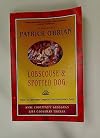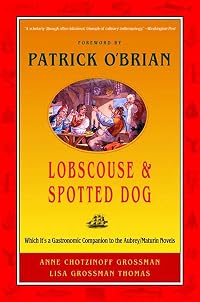
Lobscouse and Spotted Dog
by Anne Chotzinoff Grossman, Lisa Grossman Thomas
On This Page
Description
This work celebrates the joys of the Aubrey/Maturin series of novels in this cookery book full of the food and drink that complements Jack and Stephen's travels.Tags
Recommendations
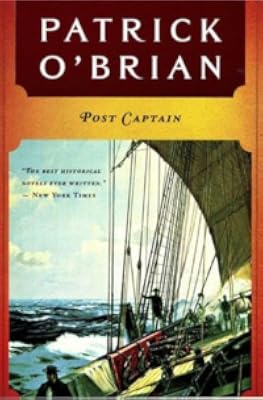
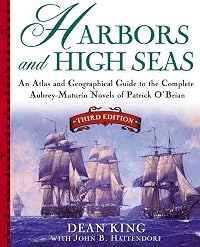














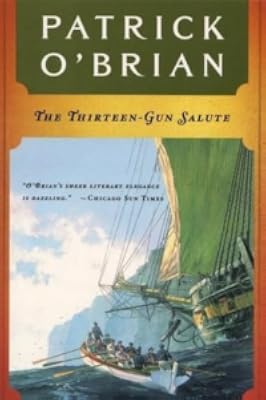
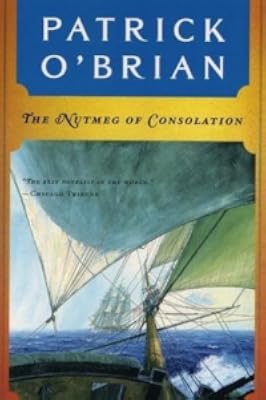
Member Reviews
Summary: A cookbook featuring recipes mentioned in the Aubrey/Maturin novels by Patrick O'Brian, amply sprinkled with the relevant quotes from the books, quotes from period cookbooks, and tips and vignettes from the authors' attempts to recreate early 19th century ingredients and techniques.
Review: Am I ever going to actually make any of the recipes in here? Probably not. I don't really have the time, space, or equipment to regularly spit-roast entire lambs, or to build raised pies from scratch, or to boil puddings for three hours (although after hearing the praises of suet puddings sung for almost 250 pages, I am extremely curious). Did I enjoy reading about them, even though I'm probably never going to cook them? Absolutely. This book show more was interesting from a historical perspective, an excellent companion to understanding the books, and even quite funny in parts.
Recommendation: Worth browsing for anyone who likes the Aubrey/Maturin series and who also likes food. show less
Review: Am I ever going to actually make any of the recipes in here? Probably not. I don't really have the time, space, or equipment to regularly spit-roast entire lambs, or to build raised pies from scratch, or to boil puddings for three hours (although after hearing the praises of suet puddings sung for almost 250 pages, I am extremely curious). Did I enjoy reading about them, even though I'm probably never going to cook them? Absolutely. This book show more was interesting from a historical perspective, an excellent companion to understanding the books, and even quite funny in parts.
Recommendation: Worth browsing for anyone who likes the Aubrey/Maturin series and who also likes food. show less
Grossman and Thomas set out to make every single food, beverage, or potion mentioned in O'Brien's Aubrey/Maturin novels, from the obvious (Spotted Dick) to the distasteful (roasted rats!) to the utterly unappetizing (boiled bird shit Stephen drank while marooned on an island). As the authors live in the US two centuries later, much has changed in the food world. They take us on their culinary journey as they puzzle out raised pies, with pie walls a half-inch thick, construct a roasting aparatus, and boil innumeral puddings. Studded throughout are the choicest bits of O'Brien's prose, showcasing both his incredible knowledge of history and his wonderful sense of humor.
I loved this book. I nearly laughed out loud when they described show more their attempt to make the breadfruit pap that was Jack's prison fare.
I loved this book. I nearly laughed out loud when they described show more their attempt to make the breadfruit pap that was Jack's prison fare.
"Having plenty of breadfruit, we made this, as in duty bound; the results were so unpleasant that we haven't the heart to describe them in much detail...If you dig it up in a day or two you will find it, as Captain Cook said, 'soft and disagreeably sweet.' Wait a few more days for the second fermentation--when you dig it up it will still be soft and disagreeable, but no longer sweet. Captain Cook says this mess will keep 10-12 months, during which time it can be rolled into balls, baked, and eaten 'either hot or cold, and hath a sour and disagreeable taste.'Their commitment to authenticity was incredible, from determining just when pear pies stopped being dyed down to puzzling out exactly how the rats would have been cooked on that fateful evening after they were stolen from Stephen's science experiment. This book would possibly be more enjoyable to a meat-eater (I found myself skimming many of the actual recipes, because one set of animals stuffed with another set of animals starts looking all the same to me after a while), but I think any fan of the Aubrey/Maturin books would enjoy this. show less
We did not have the patience to wait the full 10 months; but we can certainly vouch for the taste.
Makes an awful lot of pap.'"
In the preface, the authors claim that “this book is perforce a work of historical fiction”, which tempered MY excitement about it just as the authors’ excitement “was slightly tempered... by the realization that a great proportion of the recipes published between 1750 and 1810 were lifted verbatim from Hannah Glasse’s 1747 classic, The Art of Cookery Plain and Easy”. However, this appears to have been fairly normal practice in days of yore. Indeed, Glasse had appropriated recipes from previous authors. My excitement rebounded after I realized that the fiction part of this book revolved around O’Brian’s fiction and not the meticulously researched recipes and information re same.
The authors deserve kudos for not straying show more as far afield in their selection of recipes as the authors of many such works do. Although they have not solely adhered to dishes mentioned in O’Brian’s books, their selections are more than reasonable. Although I prefer books that present original recipes with the redacted ones, this duo at least describes some of the original ingredients and their evolution. Kudos to the authors for using such ingredients as lard, suet, and cochineal (there is also a note re this)!
I do wish that at least the main source appeared for each recipe. Although I am in a position to compare the recipes to those of Hannah Glasse, other readers may not wish to devote the time and effort to doing so.
The references to cookbook authors when juxtaposed with names of characters would probably confuse the average reader. It would have been better to explicitly state that a person was such an author or to link to an endnote, and, indeed, the authors have usually done so. The presence of some of the recipes is a bit jarring. See, for example, the lacquered duck. Also, some of the herb combinations strike me as being modern. show less
The authors deserve kudos for not straying show more as far afield in their selection of recipes as the authors of many such works do. Although they have not solely adhered to dishes mentioned in O’Brian’s books, their selections are more than reasonable. Although I prefer books that present original recipes with the redacted ones, this duo at least describes some of the original ingredients and their evolution. Kudos to the authors for using such ingredients as lard, suet, and cochineal (there is also a note re this)!
I do wish that at least the main source appeared for each recipe. Although I am in a position to compare the recipes to those of Hannah Glasse, other readers may not wish to devote the time and effort to doing so.
The references to cookbook authors when juxtaposed with names of characters would probably confuse the average reader. It would have been better to explicitly state that a person was such an author or to link to an endnote, and, indeed, the authors have usually done so. The presence of some of the recipes is a bit jarring. See, for example, the lacquered duck. Also, some of the herb combinations strike me as being modern. show less
This is a most entertaining book.
Proposed, by the mother and daughter compilers, as a “Gastronomic Companion” to the Master and Commander, Jack Aubrey series of novels by author Patrick O’Brien. It is, in essence, a collection of researched recipes, with appropriate quotes and extracts from the books, of the meals served aboard the Royal Navy ships in the 18th century.
At first I was intrigued by some of the names… Lobscouse, Spotty dog, Drowned Baby, Solomongundy – but as I read on it dawned on me that, nomenclature apart, I had eaten, even cooked and served many of these same dishes in my own Navy days.
Some of the dishes were still typical in my childhood – Kedgeree, the “Scouse” of the title, Trifles and my favorite show more pudding Spotted Dick or Dog (both meaning dough) – and survived into my own household to this day.
An enjoyable read and fascinating recipes and experiments … particularly the braising, with Brown Onion Gravy, of the rats! show less
Proposed, by the mother and daughter compilers, as a “Gastronomic Companion” to the Master and Commander, Jack Aubrey series of novels by author Patrick O’Brien. It is, in essence, a collection of researched recipes, with appropriate quotes and extracts from the books, of the meals served aboard the Royal Navy ships in the 18th century.
At first I was intrigued by some of the names… Lobscouse, Spotty dog, Drowned Baby, Solomongundy – but as I read on it dawned on me that, nomenclature apart, I had eaten, even cooked and served many of these same dishes in my own Navy days.
Some of the dishes were still typical in my childhood – Kedgeree, the “Scouse” of the title, Trifles and my favorite show more pudding Spotted Dick or Dog (both meaning dough) – and survived into my own household to this day.
An enjoyable read and fascinating recipes and experiments … particularly the braising, with Brown Onion Gravy, of the rats! show less
I am so happy I bought this book, if only because it answered the question "What the hell is 'balmagowrie'?"
My friends and I did a naval dinner based on a recipes from this book. In fact, it was a bit of a smashing sucess and extremely enjoyable. Highly recommended, in the pratical sense.
Recipes for food mentioned in Patrick O'Brian's novels. Lots of fun (see Ship's Biscuit for a creative way to beat the dough) and information on late 18th - early 19th century cooking. Detailed instructions for making raised pies, boiled puddings and spit-roasted meat.
Members
- Recently Added By
Lists

My Library
11 works; 1 member

Top Five Books of 2022
736 works; 272 members
Author Information
2 Works 412 Members
Anne Chotzinoff Grossman is a writer & musician. Mother of Lisa Grossman Thomas, she lives on Long Island, New York. (Bowker Author Biography)
1 Work 411 Members
Some Editions
Common Knowledge
- Canonical title
- Lobscouse and Spotted Dog
- Original publication date
- 1997
- People/Characters
- Jack Aubrey; Stephen Maturin
Classifications
Statistics
- Members
- 411
- Popularity
- 75,611
- Reviews
- 9
- Rating
- (4.13)
- Languages
- English
- Media
- Paper
- ISBNs
- 2
- ASINs
- 5