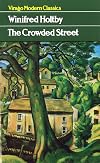
The Crowded Street
by Winifred Holtby
On This Page
Description
This is the story of Muriel Hammond, at twenty living within the suffocating confines of Edwardian middle-class society in Marshington, a Yorkshire village. A career is forbidden to her. Pretty, but not pretty enough, she fails to achieve the one thing required of her - to find a suitable husband. Then comes the First World War, a watershed which tragically revolutionises the lives of her generation. But for Muriel it offers work, friendship, freedom, and one last chance to find a special show more kind of happiness... show lessTags
Recommendations





















Member Reviews
The Crowded Street is the story of a Muriel Hammond, a young girl—and then woman—who seems destined right from the start of the novel to be a spinster. At the age of eleven, she commits a major social faux pas—and her career in a marriage market that considers a woman a spinster by the age of 25 seems to go downhill from there. Although this is a social commentary about the plight of young unmarried (and married) women in early 20th century England, this is also a novel about one young woman’s coming of age as she struggles with her own sense of value in the world.
The novel has a very strong message, but it’s very subtly worked into the plot of the book. Right from the beginning, it’s impressed upon these young women that show more they must make themselves attractive to the opposite sex, and to wait for a husband to come along. Everywhere around Muriel, young women of her age are rushing to get married, often not caring to whom. Holtby’s message about the (sometimes desperate) rush to get married sees its extremes in the case of Muriel’s sister Connie, who at first tries to make a life for herself but ends up getting pregnant and forced into a marriage she doesn’t want.
Muriel is a very shy young woman, insecure in many ways, and I think she tries to hide that under a façade. She’s always using excuses for not marrying or going off on her own, namely that her mother needs her—when it’s very clear to everyone that her mother is just fine on her own. So it’s interesting for the reader to see what happens to Muriel—will she have the courage to forge off on her own, or will she be tied to her mother forever? This is a lesser-known classic, but one well worth bringing back into print. I’m now on the lookout for more of her books; Anderby Wold and South Riding have been reprinted by Virago. show less
The novel has a very strong message, but it’s very subtly worked into the plot of the book. Right from the beginning, it’s impressed upon these young women that show more they must make themselves attractive to the opposite sex, and to wait for a husband to come along. Everywhere around Muriel, young women of her age are rushing to get married, often not caring to whom. Holtby’s message about the (sometimes desperate) rush to get married sees its extremes in the case of Muriel’s sister Connie, who at first tries to make a life for herself but ends up getting pregnant and forced into a marriage she doesn’t want.
Muriel is a very shy young woman, insecure in many ways, and I think she tries to hide that under a façade. She’s always using excuses for not marrying or going off on her own, namely that her mother needs her—when it’s very clear to everyone that her mother is just fine on her own. So it’s interesting for the reader to see what happens to Muriel—will she have the courage to forge off on her own, or will she be tied to her mother forever? This is a lesser-known classic, but one well worth bringing back into print. I’m now on the lookout for more of her books; Anderby Wold and South Riding have been reprinted by Virago. show less
Winifred Holtby was such an advanced, groundbreaking voice for women in the 1930s. In The Crowded Street, her second novel and one of her most successful, Holtby gives us Muriel Hammond: smart but shy, unable to attract male attention and overly concerned about "doing the right thing" in the eyes of her parents. Early on, Muriel's academic ambitions are thwarted by the headmistress at school:
Then, with a kindliness that Muriel found consoling even though it sounded the death knell to her hopes, Mrs. Hancock explained how there were some things that it was not suitable for girls to learn. Astronomy, the science of the stars, was a very instructive pursuit for astronomers, and professors (these latter being evidently a race apart), but it show more was not one of those things necessary for a girl to learn. 'How will it help you, dear, when you, in your future life, have, as I hope, a house to look after?' (p. 29)
On leaving school, Muriel returns home out of some sense of obligation to her mother, who invests considerable time and effort in finding her a suitable match. Muriel has feelings for Godfrey Neale, a local landowner, but he seems to always be just beyond her reach. Muriel's younger sister Connie, tired of the stifling home environment, strikes out on her own to work on a farm but her independent life is far from trouble-free. As Muriel reaches her mid-twenties, popular opinion has it she will never marry. She fears becoming like her spinster Aunt Beatrice, who paints a bleak picture:
'But even more for your own sake, dear. You will marry, I am sure. Marriage is the -- the crown and joy of woman's life -- what we were born for -- to have a husband and children, and a little home of your own. Of course there are some of us to whom the Lord has not pleased to give this. I'm sure I'm not complaining. There may be many compensations, and of course He knows best. But -- it's all right while you're young, Muriel, and there's always a chance -- and when my dear mother was alive and I had someone to look after I am sure no girl could have been happier. It's when you grow older and the people who needed you are dead. And you haven't a home nor anyone who really wants you -- and you hate to stay too long in a house in case somebody else should want to come -- and of course it's quite right. Somebody had to look after Mother. Everybody can't marry.' (p. 223)
Most stories from the early 20th century would tackle this problem Jane Austen style, with the perfect man appearing on the scene to rescue the young woman and offer her a life of security, if not happiness. But Holtby has other ideas, ultimately giving Muriel the strength to forge her own path, one that is not exactly what her mother had in mind but is thankfully vastly different from Aunt Beatrice's experience. Between The Crowded Street and her masterpiece, South Riding, Holtby showed early twentieth century women a new path, with new options, and paved the way for social change. show less
Then, with a kindliness that Muriel found consoling even though it sounded the death knell to her hopes, Mrs. Hancock explained how there were some things that it was not suitable for girls to learn. Astronomy, the science of the stars, was a very instructive pursuit for astronomers, and professors (these latter being evidently a race apart), but it show more was not one of those things necessary for a girl to learn. 'How will it help you, dear, when you, in your future life, have, as I hope, a house to look after?' (p. 29)
On leaving school, Muriel returns home out of some sense of obligation to her mother, who invests considerable time and effort in finding her a suitable match. Muriel has feelings for Godfrey Neale, a local landowner, but he seems to always be just beyond her reach. Muriel's younger sister Connie, tired of the stifling home environment, strikes out on her own to work on a farm but her independent life is far from trouble-free. As Muriel reaches her mid-twenties, popular opinion has it she will never marry. She fears becoming like her spinster Aunt Beatrice, who paints a bleak picture:
'But even more for your own sake, dear. You will marry, I am sure. Marriage is the -- the crown and joy of woman's life -- what we were born for -- to have a husband and children, and a little home of your own. Of course there are some of us to whom the Lord has not pleased to give this. I'm sure I'm not complaining. There may be many compensations, and of course He knows best. But -- it's all right while you're young, Muriel, and there's always a chance -- and when my dear mother was alive and I had someone to look after I am sure no girl could have been happier. It's when you grow older and the people who needed you are dead. And you haven't a home nor anyone who really wants you -- and you hate to stay too long in a house in case somebody else should want to come -- and of course it's quite right. Somebody had to look after Mother. Everybody can't marry.' (p. 223)
Most stories from the early 20th century would tackle this problem Jane Austen style, with the perfect man appearing on the scene to rescue the young woman and offer her a life of security, if not happiness. But Holtby has other ideas, ultimately giving Muriel the strength to forge her own path, one that is not exactly what her mother had in mind but is thankfully vastly different from Aunt Beatrice's experience. Between The Crowded Street and her masterpiece, South Riding, Holtby showed early twentieth century women a new path, with new options, and paved the way for social change. show less
I'd listened to the BBC radio adaptation of The Crowded Street a few years ago and thought it a really good story about the plight of girls who have been brought up thinking there isn't any life worth living without marriage. I read it then as an interesting piece of women's history in fiction form - it was vivid and beautifully written but not something that resonated with my personal life.
I've just finished reading the book now that I find myself in a situation very similar to that of Muriel, the main character, as I'm about to end the most fulfilling relationship I've had to pursue a career.
The end of the novel is particularly poignant as Muriel realizes that happiness, not marriage, should be her goal in life 'I can't be a good show more wife until I've learnt to be a person, and perhaps in the end I'll never be a wife at all. But it doesn't matter. The thing that matters is to take your life into your own hands and live it, following the highest vision as you see it.' I hope I too will 'have the courage to face the happiness I might have known' and follow my vision as I see it, for better or worse.
This book is really dear to me, I'm very grateful I was able to finish it at this moment of my life. In a way, I like to think that The Crowded Street closes a chapter of my life and that South Riding picks up right after. That I had Muriel's realization that one must follows one's dreams only to become Sarah, fulfilling her vision of education as a headmistress. Only time will tell. show less
I've just finished reading the book now that I find myself in a situation very similar to that of Muriel, the main character, as I'm about to end the most fulfilling relationship I've had to pursue a career.
The end of the novel is particularly poignant as Muriel realizes that happiness, not marriage, should be her goal in life 'I can't be a good show more wife until I've learnt to be a person, and perhaps in the end I'll never be a wife at all. But it doesn't matter. The thing that matters is to take your life into your own hands and live it, following the highest vision as you see it.' I hope I too will 'have the courage to face the happiness I might have known' and follow my vision as I see it, for better or worse.
This book is really dear to me, I'm very grateful I was able to finish it at this moment of my life. In a way, I like to think that The Crowded Street closes a chapter of my life and that South Riding picks up right after. That I had Muriel's realization that one must follows one's dreams only to become Sarah, fulfilling her vision of education as a headmistress. Only time will tell. show less
Another odd but interesting book, this time the painstaking account of a life in which almost nothing happens, identity is passivity, resistance to convention is futile and unimaginable, and everything is inutterably dreary and worthless...until nearly the final chapter (of the book - not necessarily of the life!). Details to follow.
I really enjoyed this book. In many ways it is a familiar story- the pain of a young unmarried woman, growing up in a society where for women marriage is all. However I found Muriel's story particularly moving.
The social life of a Yorkshire village at the turn of the 20th century, is perfectly drawn with all the usual little snobberies and anxiety to keep up standards. Holtby does not mock however. She understands how and why this is all so important to Mrs Hammond (Muriel's mother) and her cronies.
Life in Marshington goes on without change until "the War came right in the middle of the tennis tournament"! Marshington is not greatly affected but the changes which do occur are very believable.
Muriel, by the end of the War feels she show more hasn't changed enough. When we originally meet Muriel, she is hapless and naive. We feel for her as she loses opportunities to more confident friends. After leaving school, Muriel rejects a friend's advice to leave Marshington and do something with her life. Staying results in life becoming so bleak that she is jealous when a friend's husband dies...
"I would give all that I possess to share her tears if I could have her memories. I am hungry for her pain".
Muriel has been brought up to believe that love and marriage is all. Local landowner Godfrey Neale acts as love interest in the book for Muriel. Unfortunately he is also love interest for every other girl in the village!
Eventually it is Muriel's friendship with independent Delia (apparently a character loosely based on Vera Brittain) which shows Muriel what she really wants from life.
I found the portrayal of Muriel very poignant and believable. Apparently Holtby said there was a part of her in Muriel and I think there was a part of me which identified with her too! There were other strong characters, though their stories served mostly to further our understanding of Muriel.
The part of the book which lets it down a little, is a section where Muriel's sister ends up living in a Cold Comfort Farm type scenario resulting in some over-blown melodrama! This didn't quite fit in with the quiet sensitivity and perceptiveness of the rest of the book! However, overall I loved this book show less
The social life of a Yorkshire village at the turn of the 20th century, is perfectly drawn with all the usual little snobberies and anxiety to keep up standards. Holtby does not mock however. She understands how and why this is all so important to Mrs Hammond (Muriel's mother) and her cronies.
Life in Marshington goes on without change until "the War came right in the middle of the tennis tournament"! Marshington is not greatly affected but the changes which do occur are very believable.
Muriel, by the end of the War feels she show more hasn't changed enough. When we originally meet Muriel, she is hapless and naive. We feel for her as she loses opportunities to more confident friends. After leaving school, Muriel rejects a friend's advice to leave Marshington and do something with her life. Staying results in life becoming so bleak that she is jealous when a friend's husband dies...
"I would give all that I possess to share her tears if I could have her memories. I am hungry for her pain".
Muriel has been brought up to believe that love and marriage is all. Local landowner Godfrey Neale acts as love interest in the book for Muriel. Unfortunately he is also love interest for every other girl in the village!
Eventually it is Muriel's friendship with independent Delia (apparently a character loosely based on Vera Brittain) which shows Muriel what she really wants from life.
I found the portrayal of Muriel very poignant and believable. Apparently Holtby said there was a part of her in Muriel and I think there was a part of me which identified with her too! There were other strong characters, though their stories served mostly to further our understanding of Muriel.
The part of the book which lets it down a little, is a section where Muriel's sister ends up living in a Cold Comfort Farm type scenario resulting in some over-blown melodrama! This didn't quite fit in with the quiet sensitivity and perceptiveness of the rest of the book! However, overall I loved this book show less
I really enjoyed this book about Muriel who grows up in a Yorkshire town in the early 20th century thinking that doing your duty is the most important thing a young woman can do and that involves getting married, but she is constantly feeling that she's failing at that. It takes ten years, the Great War and its changes to attitudes to women's abilities, a tragedy involving her sister and a friend needing help before she can see a way out to become a person in her own right.
Muriel Hammond is the odd one out; neither handsome, clever, nor rich, it would appear; the girl brought up to be the wife that nobody wants. The Crowded Street is mostly both sad and frustrating, as Muriel fails to escape and really fails to do anything very much other than to be a severe disappointment to her mother. Hope comes in the end with female solidarity and empowerment - thankfully, as otherwise the stultifying air of bourgeoise disappointment would be utterly unreadable. An awful warning, but not without an open window at the end..
Members
- Recently Added By
Lists

Favourite Virago Modern Classics
183 works; 38 members

...read all, pay nowt (Books set in Yorkshire)
86 works; 13 members

In and About the 1920s
181 works; 31 members

Books Read in 2017
4,249 works; 130 members
Books referenced in A Very Great Profession: The Woman's Novel 1914-39
199 works; 6 members

Persephone
148 works; 3 members
Author Information

24+ Works 2,398 Members
Some Editions
Series
Belongs to Publisher Series
Persephone (76)
Common Knowledge
- Canonical title
- The Crowded Street
- Original title
- The Crowded Street
- Original publication date
- 1924
- People/Characters
- Muriel Hammond; Connie Hamond; Delia Vaughan; Godfrey Neale
- Important places
- Marshington, Yorkshire, England, UK; London, England, UK; Yorkshire, England, UK
- Dedication
- To
Jean Finlay McWilliam
An unworthy return
for the delight
of her letters - First words
- The Crowded Street is dedicated to Winifred Holtby's friend, Jean McWilliam. (Introduction)
From the crowded doorway to the piano at the other end of the room the surface of the floor stretched, golden, empty, alluring. (Prologue)
On the evening of 23rd June, 1852, Old Dick Hammond, then known as young Dick, locked the door of the little oilshop, dropped the key in his pocket, and turned westward up Middle Street in Marshington. - Quotations
- "They promise us all sorts of things, happiness, success, adventure and we listen. We think that we are moving on towards some strange, rich carnival and we follow. Then suddenly we find ourselves alone in a dull crowded stre... (show all)et with no caring and our lives un-needed and all the fine thigs that we meant to do are discarded like toys that a child has laid aside."
- Last words
- (Click to show. Warning: May contain spoilers.)She was to explore this further in her next published novel, The Land of Green Ginger. (Introduction)
(Click to show. Warning: May contain spoilers.)For, in her unhappiness, this was the most poignant anguish, that by some mysterious cruelty of events Muriel had never found the Party. (Prologue)
(Click to show. Warning: May contain spoilers.)Far away, on the high terrace, fluttered the rose-pink dress of Phyllis Marshall Gurney.
Classifications
Statistics
- Members
- 280
- Popularity
- 115,615
- Reviews
- 10
- Rating
- (4.03)
- Languages
- English, Spanish
- Media
- Paper, Audiobook, Ebook
- ISBNs
- 8
- ASINs
- 7