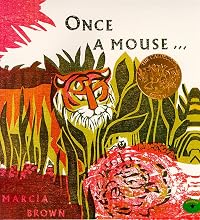
Once a Mouse...
by Marcia Brown
On This Page
Description
As it changes from mouse, to cat, to dog, to tiger, a hermit's pet also becomes increasingly vain.Tags
Recommendations




Member Reviews
Taken from the classic Indian collection of fables, the Hitopadesha, Once a Mouse... follows the story of an old hermit, who, seeing a tiny mouse continuously in danger from the other animals, seeks to protect him by changing him into progressively larger animals. Transformed first into a cat, then a dog, and finally into a tiger, the mouse becomes proud - resentful of the hermit's reminder of his humble beginnings - until finally the hermit must take back his gift.
Awarded the Caldecott Medal in 1962, Brown's book is illustrated with bold woodcut art, in brown, red and yellow tones, making for a visually engaging picture-book. Billed as a fable that depicts a "tiger's fall from grace," teaching the necessity of humility, I couldn't help show more reading it as a reflection of man's arrogance, which I strongly suspect was not the original intention. Maybe the error here is not the tiger's, but the hermit's: for seeking to change nature, and fit it to his own ideas of morality. In any case, I think young readers will probably just enjoy the story, rather than seeking to analyze its message. Definitely worth a look, for those readers with an interest in folklore, and fables. show less
Awarded the Caldecott Medal in 1962, Brown's book is illustrated with bold woodcut art, in brown, red and yellow tones, making for a visually engaging picture-book. Billed as a fable that depicts a "tiger's fall from grace," teaching the necessity of humility, I couldn't help show more reading it as a reflection of man's arrogance, which I strongly suspect was not the original intention. Maybe the error here is not the tiger's, but the hermit's: for seeking to change nature, and fit it to his own ideas of morality. In any case, I think young readers will probably just enjoy the story, rather than seeking to analyze its message. Definitely worth a look, for those readers with an interest in folklore, and fables. show less
I loved this story! The "run-on" sentences reminded me of the style behind "Where the Wild Things are", as a sentence was never at an end on the expected page. Instead, the text continued onto the next page, making it a quick read (I felt I couldn't stop reading until I had finished the sentence, keeping me turning page after page until the end). For example if you read, "was prowling in the forest, and leaped on the dog. Fortunately, the hermit was nearby, and..." (end of page) would you be able to put the book down? Personally, I wanted to know what happened to the poor dog in danger.
The illustrations were large and full of structured shapes. There was a repeating theme of colors consisting of, green, brown, red, and white. This show more prevented the intricate designs from feeling overwhelming and it gave the story a uniform feel. A particular image took up the entire page and showed the hermit man changing the shape-shifting tiger back into a little mouse (the animal he started the world as). This portrays the message perfectly, as it's important to remember where you came from and keep a sense of humbleness. No matter how successful and well-known you may become, stay true to your morals. show less
The illustrations were large and full of structured shapes. There was a repeating theme of colors consisting of, green, brown, red, and white. This show more prevented the intricate designs from feeling overwhelming and it gave the story a uniform feel. A particular image took up the entire page and showed the hermit man changing the shape-shifting tiger back into a little mouse (the animal he started the world as). This portrays the message perfectly, as it's important to remember where you came from and keep a sense of humbleness. No matter how successful and well-known you may become, stay true to your morals. show less
A terrific little fable. Supposedly it's about big and little, but it's clearly also about hubris & humility/ gratitude. The vocabulary is rich, so, despite the fact that it's short, and the main idea is straightforward, it's probably not best for the youngest children.
The art is perfectly apt. Hard to believe the artist is the same one who did Cinderella just a few years earlier - she clearly has the talent to adapt her style to fit the story. I wasn't fond of her work there, but I do love this.
One thing another reviewer mentions is the disappointment of the hermit, that the mouse didn't appreciate the gifted transformations. I didn't pick up on that myself, but she's given us something to think about there.... It's kind of like when show more we as parents want our children to grow up big and strong, or we as teachers want our students to learn and grow - and maybe they don't quite meet our expectations, or maybe we realize, too late, that we were *too* supportive and they didn't have a chance to develop enough independence to develop their own strength.
(Edited last paragraph for clarity.) show less
The art is perfectly apt. Hard to believe the artist is the same one who did Cinderella just a few years earlier - she clearly has the talent to adapt her style to fit the story. I wasn't fond of her work there, but I do love this.
One thing another reviewer mentions is the disappointment of the hermit, that the mouse didn't appreciate the gifted transformations. I didn't pick up on that myself, but she's given us something to think about there.... It's kind of like when show more we as parents want our children to grow up big and strong, or we as teachers want our students to learn and grow - and maybe they don't quite meet our expectations, or maybe we realize, too late, that we were *too* supportive and they didn't have a chance to develop enough independence to develop their own strength.
(Edited last paragraph for clarity.) show less
I really enjoyed this book. After reading this book I can confidently say that it is now one of my favorite children’s books. The was just so intricately put together and contained so much deeper meaning, that I was honestly so surprised that it was a children’s book. For young children, this book would be a fascinating tale of a small mouse that is eventually transformed into a mighty tiger through magic. For older children, this book would contain so many philosophical ideas. Firstly, I love how the book starts and ends with the same phrase: “a hermit sat thinking about big and little.” This gets the reader thinking about this concept right from the start and helps the reader to construct an initial idea about this phrase. show more Then, story takes us on a journey with a little mouse that is continuously changed into a bigger animal. And the bigger it gets, the more changes it encounters: fear, greed, pride, humiliation, and ungratefulness. Through the mouse’s story, we are even able to see some parallels to society today! The mouse, who was once humble and frightened of the bigger animals, develops traits that lead to him forgetting his roots as a small animal and even denies the fact that his experience as one even occurred. It is so interesting to see how you can get children to start thinking about issues like these so early on and through a story that seems so innocent at first. The story really contained a lot of material that could be used for teaching morals and humility. Finally, the aspect of the book that really gave this story appeal, was the beautiful illustrations. These pictures were actually illustrations done with wood cuts, which give the book a more aesthetic feel that highlights the folklore origins this story contains. Not only were the illustrations exquisite, but the pictures added so much to the story that you would have to see them in person to understand. They added so much more content to the story than the words were describing. For example, the author does not explicitly explain the changes in personality that the mouse is undergoing until it is a tiger. However, through the pictures we can infer that the bigger the mouse gets, from a cat to a dog, the more arrogant and conceited it becomes. This is done in such a way that by seeing what is happening in the pictures, the reader can almost experience the story in a whole different way than they could from just reading the words. In conclusion, I was extremely satisfied with this book and was not surprised to find that it was a Caldecott Medal winner. show less
This is a retelling of a traditional Indian fable. A hermit with magical powers tries to help a tiny mouse. But as the mouse is transformed into ever larger animals, he loses his timidity and his sense of gratitude for having been rescued.
It’s an interesting fable, and I think the story has appeal for children (and their parents), much as Aesop’s fables do. However, I am not a great fan of Brown’s illustrations in this case.
Her woodcuts are a different technique from the beautiful illustrations in Cinderella. I was intrigued by the style, but I found the color palette she uses here to be drab and dark.
It’s an interesting fable, and I think the story has appeal for children (and their parents), much as Aesop’s fables do. However, I am not a great fan of Brown’s illustrations in this case.
Her woodcuts are a different technique from the beautiful illustrations in Cinderella. I was intrigued by the style, but I found the color palette she uses here to be drab and dark.
When a hermit saves a little mouse from the claws of a hungry crow, he begins a vicious cycle, constantly rescuing the mouse and changing him into a bigger animal to escape each predator that comes along. He becomes a cat and is chased by a dog. He becomes a dog and is chased by a tiger. He becomes a tiger, and all of a sudden, has no more predators! He becomes cocky and proud, and the tiger forgets all the nice things that the hermit has done for him. He is ungrateful and plots to kill the hermit. But the hermit reads his mind and changes him back into a mouse, to remind him to be humble.
An intriguing corollary to the classic Lion and the Mouse fable; here the animal that receives favors is ungrateful and receives its comeuppance. Woodcut illustrations that are surprisingly engaging given their muted 60s color scheme.
Members
- Recently Added By
Lists

Caldecott Medal Books
91 works; 15 members

Honey For a Child's Heart
1,152 works; 25 members

Romalda Spalding's Writing Road To Reading
213 works; 3 members

A Child's Book Tour of India
71 works; 3 members

Beautiful Feet Books
304 works; 7 members

The Story of the World: History for the Classical Child: Activity Book One
291 works; 3 members

The Story of the World: History for the Classical Child: Activity Book Two
415 works; 2 members

Written and Illustrated By
805 works; 1 member
Author Information

23+ Works 8,864 Members
Awards and Honors
Common Knowledge
- Original publication date
- 1961
- Dedication
- To Hilda
- First words
- One day a hermit sat thinking about big and little.
- Last words
- (Click to show. Warning: May contain spoilers.)And the hermit sat thinking about big -- and little...
Classifications
- Genres
- Children's Books, Picture Books
- DDC/MDS
- 398.2452 — Society, government, & culture Customs, etiquette & folklore Folklore & Folktales Folk literature Fables, Magical Creatures Animals Real animals
- LCC
- PZ8.2 .H5 .O — Language and Literature Fiction and juvenile belles lettres Fiction and juvenile belles lettres Juvenile belles lettres
- BISAC
Statistics
- Members
- 1,571
- Popularity
- 14,526
- Reviews
- 90
- Rating
- (3.62)
- Languages
- English, French
- Media
- Paper
- ISBNs
- 18
- ASINs
- 11