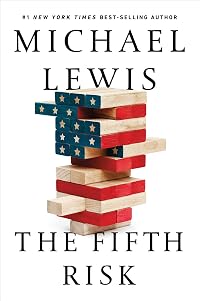
The Fifth Risk
by Michael Lewis
On This Page
Description
"The election happened," remembers Elizabeth Sherwood-Randall, then deputy secretary of the Department of Energy. "And then there was radio silence." Across all departments, similar stories were playing out: Trump appointees were few and far between; those that did show up were shockingly uninformed about the functions of their new workplace. Some even threw away the briefing books that had been prepared for them. Michael Lewis takes us into the engine rooms of a government under attack by show more its own leaders. At Agriculture, the funding of vital programs like food stamps and school lunches is being slashed. The Commerce Department may not have enough staff to conduct the 2020 Census properly. Over at Energy, where international nuclear risk is managed, it's not clear there will be enough inspectors to track and locate black market uranium before terrorists do. Willful ignorance plays a role in these looming disasters. If your ambition is to maximize short-term gain without regard to the long-term cost, you are better off not knowing the cost. If you want to preserve your personal immunity to the hard problems, it's better never to really understand those problems. But if there are dangerous fools in this book, there are also heroes -- unsung, of course. They are the linchpins of the system: those public servants whose knowledge, dedication, and proactivity keep the machinery running. Michael Lewis finds them, and he asks them what keeps them up at night. show lessTags
Recommendations














Member Recommendations
M_Clark Although this book stops in 2008, the techniques it describes that conservatives use to wreck US government agencies helps explain the techniques being used by the Trump administration as well.
20
Member Reviews
If nothing else scares you about the current administration, reading this book WILL do the job. I have read several "current" books about what is happening to the government but Michael Lewis does a terrific job of presenting absolutely frightening material in a fascinatingly readable form. It is a book that can be read quickly but what it does to your thinking means that actions need to be taken by all of us, soon, to stop the destruction of so many essential parts of the government that we, as the general public, just have not nearly understood enough about or appreciated.
If you think that Trump as president is just an unfortunate episode in US history without any serious long term consequences, then you need to read this book. Michael Lewis does an excellent job describing the transition that is supposed to happen when a new president takes office and the poor excuse of what actually did happen when Trump was inaugurated. But this book is not just a rant against Trump, but also a testimony to all the complexities of the US government and the importance of keeping it working with competent administrators. Entertaining and very scary.
It was an interesting experience to read this book, published in 2018 in reaction to the first Trump Presidency, in 2025. It is essentially a bit of well-written propaganda (or an emotional sop) to the Trump Derangement Syndrome that gripped half of America. Lewis, who can write well, but not honestly, cleaves to the party line that Trump, and the populism which brought him to power, could be fatal to America. It is the book equivalent of "but seriously, we can't let this guy get the nuclear codes". You have to triangulate an objective meaning from it, because it is so deeply partisan, but doing so is an interesting exercise.
As a younger man I thought the deep state was an aspect of the intelligence community. I realise now that it is show more the entire civil service. The new, post-Clinton managerialists believe government has become so complicated that it doesn't need politics anymore, but competence. Politics is in fact a danger. The book's sub-title is "Undoing Democracy", which does not appear on its UK cover, but ironically that is the argument the impliedly advances. Technocrats and academics should be given free reign to pursue their intelligent, righteous, worthy passions - because in Lewis' book, America's civil service is staffed entirely by martyrs of genius - and people in MAGA hats are obviously just trying to spoil that out of spite and stupidity. Lewis is entirely unwilling to see the other side of the coin: that whilst living standards of its citizens decline, the federal budget is increasingly out of control, and contains many expenditures that are so wild as to defy belief. As a non-American, I have been victim to this expenditure: I do not appreciate US funding of international transexual advocacy, for example, and I would rather the children in my country were not castrated by ideologues. And so on.
Lewis clings to the favoured logic of the centrists and much of the left: the logic of the emergency. Everything is about saving human life. Everything is potentially fatal. That's why you can't get politics involved. That's why rednecks shouldn't be allowed to vote. This argument is inherently political, of course, but revealing that conceit would expose the nakedness of Lewis' position, and those like him. Because the logic of emergency dictates that at the same time you effectively disenfranchise that swathe of the electorate which votes the wrong way, you should also grant the government greater powers. In fact, you need those powers for the disenfranchisement. This is not explicitly stated in Lewis' book, but his observations will lead us there.
The Fifth Risk is essentially a book advocating for the necessity and importance of the deep state, and arguing that democracy is a risk to that deep state. That's all there is to it. Benjamin Franklin was right: you cannot trade freedom for security, but that is the path we are on, and Lewis is clapping away at the thought.
His strongest points lie in his reasonable distrust of corporatism and technocracy. To the extent the deep state is dismantled, there will be terrible human beings at the helm of immoral corporations seeking to profit - and seeking profit only - from the ruins. That is an entirely justifiable concern. It is that potential profit which underpins their endorsement of MAGA, of course. However, Lewis' wariness of these corporations does not extend to those on his side. Goldman Sachs, for example, is fine.
The serious issue here is metaphysical, because if Lewis' centrist managerial non-politics is validated by the fact it saves lives, the real political question is deeper still. What is the life we are saving actually for? What do we believe in, and who are we as a people? That is not something reflected in the mainstream political spectrum of any country in the West. We are not allowed to believe, unless it is belief in Israel and the guilt of our own native population. And who are we? We are cattle, and we should do as we are told, for our own good, because the world is more complicated and dangerous than we could understand.
This book, read carefully, is a sign that one of the biggest risks to the West has already manifested. show less
As a younger man I thought the deep state was an aspect of the intelligence community. I realise now that it is show more the entire civil service. The new, post-Clinton managerialists believe government has become so complicated that it doesn't need politics anymore, but competence. Politics is in fact a danger. The book's sub-title is "Undoing Democracy", which does not appear on its UK cover, but ironically that is the argument the impliedly advances. Technocrats and academics should be given free reign to pursue their intelligent, righteous, worthy passions - because in Lewis' book, America's civil service is staffed entirely by martyrs of genius - and people in MAGA hats are obviously just trying to spoil that out of spite and stupidity. Lewis is entirely unwilling to see the other side of the coin: that whilst living standards of its citizens decline, the federal budget is increasingly out of control, and contains many expenditures that are so wild as to defy belief. As a non-American, I have been victim to this expenditure: I do not appreciate US funding of international transexual advocacy, for example, and I would rather the children in my country were not castrated by ideologues. And so on.
Lewis clings to the favoured logic of the centrists and much of the left: the logic of the emergency. Everything is about saving human life. Everything is potentially fatal. That's why you can't get politics involved. That's why rednecks shouldn't be allowed to vote. This argument is inherently political, of course, but revealing that conceit would expose the nakedness of Lewis' position, and those like him. Because the logic of emergency dictates that at the same time you effectively disenfranchise that swathe of the electorate which votes the wrong way, you should also grant the government greater powers. In fact, you need those powers for the disenfranchisement. This is not explicitly stated in Lewis' book, but his observations will lead us there.
The Fifth Risk is essentially a book advocating for the necessity and importance of the deep state, and arguing that democracy is a risk to that deep state. That's all there is to it. Benjamin Franklin was right: you cannot trade freedom for security, but that is the path we are on, and Lewis is clapping away at the thought.
His strongest points lie in his reasonable distrust of corporatism and technocracy. To the extent the deep state is dismantled, there will be terrible human beings at the helm of immoral corporations seeking to profit - and seeking profit only - from the ruins. That is an entirely justifiable concern. It is that potential profit which underpins their endorsement of MAGA, of course. However, Lewis' wariness of these corporations does not extend to those on his side. Goldman Sachs, for example, is fine.
The serious issue here is metaphysical, because if Lewis' centrist managerial non-politics is validated by the fact it saves lives, the real political question is deeper still. What is the life we are saving actually for? What do we believe in, and who are we as a people? That is not something reflected in the mainstream political spectrum of any country in the West. We are not allowed to believe, unless it is belief in Israel and the guilt of our own native population. And who are we? We are cattle, and we should do as we are told, for our own good, because the world is more complicated and dangerous than we could understand.
This book, read carefully, is a sign that one of the biggest risks to the West has already manifested. show less
Although really it should be called "The Fifth Risk: Undoing Government" because Lewis' main point - illustrated by many very scary examples - is that federal government, that favourite whipping post of the right, is in the process of being dismantled by people who don't even know what it does. The problem that Lewis highlights is that government departments - he focuses on Commerce (which has very little to do with Business), Agriculture (which is not just the department that deals with farming) and Energy (think cleaning up nuclear waste rather than regulating oil) - do such a a wide range of both vital and tremendously useful stuff that it is almost impossible for career veterans to understand them properly, let alone political show more appointees
Sounds like these behemoths could do with some simplification and reorganisation then? There's certainly an argument for it. But to reorganise requires understanding, care, thought and intelligence. None of which Trump appointees have.
Have you wondered why Federal Government's response to COVID-19 has been, at best, laggardly and at worst criminally negligent? The answers are all here. As Lewis presents it, ignorance is not just an unfortunate side effect of the Trump regime but a deliberate policy. If you don't understand an issue, you don't have to deal with it. If you aren't even aware of an issue you can brush it aside. Ignorance is easier; ignorance is bliss. Experts are troublemakers - much easier to get rid of them and replace them with fawning lackeys. The COVID response is disaster enough, but you are left being glad that at least there hasn't been a nuclear accident to deal with; because, for the first time in history, the US probably wouldn't be able to
So whilst Trump appointees such as Rick Perry, Barry Myers and Wilbur Ross may entertainingly come across as, in turn, incompetent, corrupt and hopelessly out of his depth, that isn't really the point. The point is that you have to at least understand what government does when you are supposed to be running it. You have to do the work. As we all know, Donald Trump isn't interested in work and is pulling this edifice down without even knowing it
Scary stuff indeed. Minus half a star because it feels like a combination of 1 long and 2 mid length magazine pieces. So structurally its far from perfect. But the content is devastating show less
Sounds like these behemoths could do with some simplification and reorganisation then? There's certainly an argument for it. But to reorganise requires understanding, care, thought and intelligence. None of which Trump appointees have.
Have you wondered why Federal Government's response to COVID-19 has been, at best, laggardly and at worst criminally negligent? The answers are all here. As Lewis presents it, ignorance is not just an unfortunate side effect of the Trump regime but a deliberate policy. If you don't understand an issue, you don't have to deal with it. If you aren't even aware of an issue you can brush it aside. Ignorance is easier; ignorance is bliss. Experts are troublemakers - much easier to get rid of them and replace them with fawning lackeys. The COVID response is disaster enough, but you are left being glad that at least there hasn't been a nuclear accident to deal with; because, for the first time in history, the US probably wouldn't be able to
So whilst Trump appointees such as Rick Perry, Barry Myers and Wilbur Ross may entertainingly come across as, in turn, incompetent, corrupt and hopelessly out of his depth, that isn't really the point. The point is that you have to at least understand what government does when you are supposed to be running it. You have to do the work. As we all know, Donald Trump isn't interested in work and is pulling this edifice down without even knowing it
Scary stuff indeed. Minus half a star because it feels like a combination of 1 long and 2 mid length magazine pieces. So structurally its far from perfect. But the content is devastating show less
The transition teams for the newly elected Presidents Bush and Obama showed up at the Departments of Energy, Commerce and Agriculture the day after those candidates became President-elect. The day after the 2016 Presidential Election officials of those departments were prepared to meet the Trump transition team, but nobody showed up. This was the first sign of the indifference and incompetence of our current administration. Michael Lewis does a fine job of showing how important our federal agencies are and how much of what they do is not known to the general public. Now we see that the very people chosen to head those agencies by the President also don't know and don't care. The 5th risk title came from a question the author asked show more Energy dept. officials. The first risk was a lost or stolen nuclear device and the next ones were out of control nukes in North Korea or Iran but the fifth risk was simple bad management. That is the one we have. Managers who don't know what they are doing and don't care. Read this book. It will scare you. show less
Entertaining and well written, like all of Lewis's books. Particularly interesting are the discussions of the DOE and NOAA. Parts of it seem a little dated, in 2019. My main criticisms are that Lewis omits the broader context, comparing Trump to Obama but not to previous Presidents, especially Republicans. By 2019 it has become clear that the Trump administration isn't an exception; rather in corruption and willful ignorance it has achieved the ne plus ultra of Republican governance philosophy. Lewis is also insufficiently critical of the government programs he studies; obviously not on climate change but sometimes there really are two sides to an issue. There are a few extended digressions, but I'll take a Michael Lewis digression any day.
It’s what you fail to imagine that kills you... It is what you never learned that might have saved you. This is the warning and the tag line of Michael Lewis' new book, The Fifth Risk. Lewis does a masterful job of outlining just what some of the departments of the federal government (Energy, Agriculture,and Commerce) do and how dedicated the individuals are who devout their extensive knowledge and passion to the operation of these agencies. This highlights the warning of the book by detailing how the new administration showed no interest in the baton passing of the government transition program. Various interviews of accomplished officials revealed how tenuous some of the risks are to our future: nuclear accidents, electrical grid show more sabotage , and the threats of North Korea and Iran seem logical but the new risk has to do with the fallout if the work of the government is not continued. Lewis contends that the new administration prefers ignorance. "If you want to preserve your personal immunity to the hard problems, it’s better never to really understand those problems,” he writes. “There is an upside to ignorance, and a downside to knowledge. Knowledge makes life messier.” Recommended reading show less
Members
- Recently Added By
Lists

Top Five Books of 2018
802 works; 265 members

Dim Sum Lunch Reading
43 works; 2 members

Books Read in 2019
4,052 works; 110 members

Huxley's Reading Log 2020
24 works; 1 member

2024-2025 Ezra Klein Guest Recommendations
213 works; 6 members
Author Information

33+ Works 35,690 Members
Michael Lewis was born in New Orleans, Louisiana on October 15, 1960. He received a BA in art history from Princeton University in 1982 and a Masters in economics from the London School of Economics in 1985. He is a non-fiction author/journalist of mostly financial themes. His books include Liar's Poker, Moneyball: The Art of Winning an Unfair show more Game, The Blind Side: Evolution of a Game, The Money Culture, Boomerang, Flash Boys: A Wall Street Revolt, The Big Short: Inside the Doomsday Machine and The Undoing Project: A Friendship That Changed Our Minds. (Bowker Author Biography) show less
Some Editions
Awards and Honors
Awards
Common Knowledge
- Canonical title
- The Fifth Risk
- Original title
- The Fifth Risk
- Original publication date
- 2018-10-02
- People/Characters
- Max Stier (Partnership for Public Service, [org]); Ernest Moniz (Secretary of the DOE [bio]); Elizabeth Sherwood-Randall (Deputy Secretary of the DOE [bio]); Kevin Knobluch (DOE Chief of Staff, Chief Risk officer); John MacWilliams (DOE, Chief Risk Officer); Arun Majumdar (DOE, Advanced Research Projects Agency--Energy [bio]) (show all 18); Ali Zaidi (Federal government budget specialist); DJ Patil (1st Chief Data Scientist, Dept. of Commerce [bio]); Kathryn Sullivan (Commerce Under secretary for NOAA [bio]); Catherine Wotecki (USDA chief scientist [bio]); Lillian Salerno (USDA, Rural Development); Kevin Concannon (USDA, Food, Nutrition and Consumer Services); David Friedberg (Climate Corporation); Donald Trump (45th POTUS [bio]); Chris Christie (54th governor of New Jersey, Trump advisor [bio]); Barry Myers (CEO, AccuWeather [bio]); Thomas Pyle (Trump advisor, Institute for Energy Research [org. article]); Rick Perry (Secretary of Energy [bio])
- Important events
- Presidency of Donald Trump
- Epigraph
- Donald J. Trump
@realDonaldTrump
Real organized process taking place as I decide on Cabinet and many other positions. I am the only one who knows who the finalists are!
9:55 pm – 15 Nov 2016
__________... (show all)_______________
25,572 retweets 112,055 likes - First words
- Chris Christie noticed a piece in the New York Times -- that's how it all started. (Prologue)
- Quotations
- The relationship between the people and their government troubled her (Kathy Sullivan, head of NOAA). The government was the mission of an entire society: why was the society undermining it? "I'm routinely appalled by how p... (show all)rofoundly ignorant even highly educated people are when it comes to the structure and function of our government," she said. "The sense of identity as Citizen has been replaced by Consumer. The idea that government should serve the citizens like a waiter or concierge, rather than in a 'collective good' sense."
There is another way to think of John MacWilliams' fifth risk: the risk a society runs when it falls into the habit of responding to long-term risks with short-term solutions. […] “Program Management” is the existential... (show all) risk that you never really even imagine as a risk. (Chapter I: “Tail Risk,” p. 75 (Norton, 2018))
Thousands of people inside the Federal government had spent the better part of a year drawing a vivid picture of it for the benefit of the new administration. The United States government might be the most complicated on the... (show all) face of the earth. Its two million federal employees take orders from four thousand political appointees. Dysfunction is baked into the structure of the thing: the subordinates know their bosses will be replaced every four to eight years. And that the direction of their enterprises might change overnight – with an election, or a war, or some other political event. (Chapter I: “Tail Risk,” p. 37 (Norton, 2018))
The 2020 national census will be a massive undertaking for which there is not a moment to lose, and yet there's no Trump appointee in place to run it. “The actual government has not really taken over,” said Max Stier. ... (show all)“It's kindergarten soccer. Everyone is on the ball. No one is at their positions. But I doubt Trump sees the reality. Everywhere he goes, everything is going to be hunky-dory and nice. No-one gives him the bad news.” (Chapter I: “Tail Risk,” p. 46 (Norton, 2018))
The third department [Rick] Perry wanted to get rid of, he later recalled, was the Department of Energy. In his confirmation hearings to run the department, Perry confessed that when he called for its elimination, he hadn't ... (show all)actually known what the Department of Energy did – and he now regretted saying that it didn't do anything worth doing. (Chapter I: “Tail Risk,” p. 47 (Norton, 2018))
With the nuclear scientist who understood the DOE better than anyone on earth [Rick] Perry has spent minutes, not hours. “He has no personal interest in understanding what we do and effecting change,” a DOE staffer told ... (show all)me in June 2017. “He's never been briefed on a program – not a single one, which to me is shocking.” (Chapter I: “Tail Risk,” p. 46 (Norton, 2018))
Since [Rick] Perry was confirmed, his role has been ceremonial and bizarre. He pops up in distant lands and tweets in praise of this or that DOE program while his masters in the White House create this budgets to eliminate t... (show all)hose very programs. His sporadic communications have in them something of the shell-shocked grandmother trying to preside over a pleasant family Thanksgiving dinner while pretending that her blind-drunk husband isn't standing naked on the dining-room table waving the carving knife over his head. (Chapter I: “Tail Risk,” p. 46 (Norton, 2018))
Meanwhile, inside the DOE building, people claiming to be from the Trump administration appeared willy-nilly, unannounced, and unintroduced to the career people […] “Yes, you can notice the difference,” says one young c... (show all)areer civil servant, in response to the obvious question. “There's a lack of professionalism. They're not very polite. Maybe they've never worked in a office or government setting. It's not hostility so much as a real sense of concern with sharing information with the career employees. Because of the lack of communication, nothing is being done. All policy questions remain unanswered.” (Chapter I: “Tail Risk,” p. 46-47 (Norton, 2018))
By early summer, I had spoken with twenty or so of the people who ran the department [DOE], along with a handful of career people. All of them understood their agency as a powerful tool for dealing with the most alarming ri... (show all)sks facing humanity. All thought the tool was being badly handled and at risk of being busted. They'd grown used to the outside world not particularly knowing or caring what they did – unless they screwed up. (Chapter I: “Tail Risk,” p. 62 (Norton, 2018))
What we know about them we know mainly from whistle-blowers who worked inside the [Hanford] nuclear facility – and who have been ostracized by their community for threatening the industry in a one-industry town. (“Resist... (show all)ance to understanding a risk grows with proximity,” writes Kate Brown.) (Chapter I: “Tail Risk,” p. 74 (Norton, 2018))
There is another way to think of John MacWilliams' fifth risk: the risk a society runs when it falls into the habit of responding to long-term risks with short-term solutions. […] “Program Management” is the existential... (show all) risk that you never really even imagine as a risk. (Chapter I: “Tail Risk,” p. 75 (Norton, 2018))
A small portion of its massive annual budget ($164 billion in 2016) was actually spent on farmers, but it financed and managed all these programs in rural America – including the free school lunch for kids living near the p... (show all)overty line. “I'm sitting there looking at this,” said Ali. “The USDA had subsidized the apartment my family lived in. The hospital we used. The fire department. The town's water. The electricity. It had paid for the food I had eaten.” (Chapter II: “People Risk,” p. 88 (Norton, 2018)) - Last words
- (Click to show. Warning: May contain spoilers.)Last It's what you fail to imagine that kills you.
- Publisher's editor
- Sterling Lawrence
- Blurbers
- Wolfe, Tom; Gapper, John; Paul, Pamela; Smith, Kyle; Lanchester, John; Williams, John (show all 7); Gofen, Charlie
- Canonical DDC/MDS
- 320.973090512
- Canonical LCC
- E912.L48
Classifications
Statistics
- Members
- 1,820
- Popularity
- 11,977
- Reviews
- 85
- Rating
- (3.95)
- Languages
- 5 — English, German, Italian, Spanish, Portuguese (Portugal)
- Media
- Paper, Audiobook, Ebook
- ISBNs
- 21
- ASINs
- 9