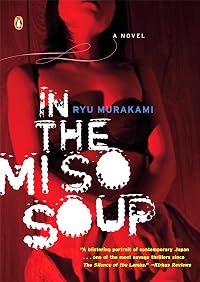
In the Miso Soup
by Ryū Murakami
On This Page
Description
It is just before New Year's. Frank, an overweight American tourist, has hired Kenji to take him on a guided tour of Tokyo's sleazy nightlife on three successive evenings. But Frank's behavior is so strange that Kenji begins to entertain a horrible suspicion: that his new client is in fact the serial killer currently terrorizing the city. It isn't until the second night, however, in a scene that will shock you and make you laugh and make you hate yourself for laughing, that Kenji learns show more exactly how much he has to fear and how irrevocably his encounter with this great white whale of an American will change his life. Kenji's intimate knowledge of Tokyo's sex industry, his thoughtful observations and wisecracks about the emptiness and hypocrisy of contemporary Japan, and his insights into the shockingly widespread phenomena of "compensated dating" and selling it among Japanese schoolgirls, give us plenty to think about on every page. Kenji is our likable, if far from innocent, guide to the inferno of violence and evil into which he unwillingly descends - and from which only Jun, his sixteen-year-old, can possibly save him. show lessTags
Recommendations





Member Recommendations
Member Reviews
I like weird books. And apparently when it comes to Japanese fiction, I like violent books. (I'm not really sure why I keep reading Japanese fiction where people are killed. Maybe that's just a lot of the Japanese fiction that gets translated into English?)
I'm not really sure if I can explain this book. show more Basically, a Japanese tour guide is hired to show an American around the seedy side of Tokyo's nightlife. The American ends up being a serial killer.
But even before the real violence sets in, it's just such a weird book. There's something about the writing style I supposed - it really sucked me in even though I'm pretty sure I had a shocked-to-horrified expression on my face while reading 90% of this book.
On a larger scale, it touches on the issues of loneliness, the disconnect of younger generations (compared to post-WW2 folks; this isn't a teenagers-are-the-bane-of-our-society type book), cultural differences, who's to blame for society's issues... It's not exactly the most flattering towards Americans, but then it isn't exactly a glowing review of the Japanese either. Murakami is critical of everyone, apparently.
Basically people who love horror movies are people with boring lives. They want to be stimulated, and they need to reassure themselves, because when a really scary movie is over, you’re reassured to see that you’re still alive and the world still exists as it did before.Earlier this year, I read Popular Hits of the Showa Era and it was weird and oddly entrancing, so I decided to read something else by Murakami. I picked this book.
I'm not really sure if I can explain this book. show more Basically, a Japanese tour guide is hired to show an American around the seedy side of Tokyo's nightlife. The American ends up being a serial killer.
“He’s checking out a Print Club booth.”It's a horrifically violent book. Do not read while eating. Most of it isn't gory, but there is one (long) scene that... You know, I have a strong stomach but I'm glad I didn't hit that part while I was eating lunch. For some reason, it was particularly gruesome.
“A what?”
“You know, that machine that takes photos of you and then prints them out on cute little stickers. I don’t think he knows how it works. He’s watching a group of girls posing for a picture.”
“I think you’re probably all right, then, Kenji. I can’t imagine a murderer making Print Club photos of himself.”
I’m not sure why, but that seemed to make sense.
Frank sighed as though bored and cut off his other ear as well. It fell to the floor soundlessly, like a slice of fishcake or something, and lay there among the loose strands of hair and cigarette ashes.And that doesn't even get into the really icky parts. (Let's not discuss a man's face begin set on fire.) One disadvantage of particularly evocative writing style, I suppose?
But even before the real violence sets in, it's just such a weird book. There's something about the writing style I supposed - it really sucked me in even though I'm pretty sure I had a shocked-to-horrified expression on my face while reading 90% of this book.
On a larger scale, it touches on the issues of loneliness, the disconnect of younger generations (compared to post-WW2 folks; this isn't a teenagers-are-the-bane-of-our-society type book), cultural differences, who's to blame for society's issues... It's not exactly the most flattering towards Americans, but then it isn't exactly a glowing review of the Japanese either. Murakami is critical of everyone, apparently.
What’s good about Americans, if I can generalize a little, is that they have a kind of openhearted innocence. And what’s not so good is that they can’t imagine any world outside the States, or any value system different from their own. The Japanese have a similar defect, but Americans are even worse about trying to force others to do whatever they themselves believe to be right.So yeah, this all probably really says nothing concrete about this book, but it's just weird. Did I like it? Yes, in a horrifying sort of way. The underlying issues were really interesting to think on and the actual plot was engaging in a rubbernecking-at-a-horrible-car-accident kind of way. I can't say I'd recommend it to anyone because if someone actually read it, they might think I had massive mental problems, but yeah, really fascinating read. I'm definitely going to have to read more Ryu Murakami books. Once I recover from this one. show less
This is one of the most shocking books I have ever read. At first it seems like an average tale of an American man looking for an authentic Japanese experience, guided by a local. In the middle of the book, Murakami describes the horrific actions of the American protagonist. It makes for very uncomfortable reading, but I couldn't look away. Although the description is graphic, it has to exist within the novel in order to throw the first third and the last third into relief. Without it, the rest of the book is a nothing. Very cleverly done.
Yowza! What can I say about this book? What should I say? Kenji is a tour guide for foreigners visiting Tokyo, but not your ordinary tour guide; he's a sex industry tour guide specializing in providing excursions into the many different type of sex clubs and shops in the sleazy part of town. His American client, Frank, seems a bit off... let me reword that... His American client, Frank, is seriously fried, screwed up beyond repair! You can hear his brain sizzling like the neon lights in the city. The tour guide slowly becomes the tourist as Frank teaches him a thing or two or five about life.
Written in the first person, Kenji convincingly describes the city and the sleaze. And you really start to feel Kenji's uneasiness and confusion show more planted and nurtured tenderly by Frank. Ryu Murakami amazingly passes that uneasy feeling to you, the reader, and before you know it things happen, things that will shock you, things that will be hard to erase from your memory. You soon feel that you're a witness to a horrible crime and there's not one damn thing you can do about it.
Last year I read Zombie by Joyce Carol Oates, a book about a serial killer from the serial killer's point of view. Let me just say that reading In the Miso Soup is more unsettling and more distressing. Just know what you're getting into before you read this book.
As for the title... it's a metaphor and only explained on the last page. I can tell you though it will not take away from your pleasure of slurping up a hot bowl of the soup. But if you're in Tokyo, in the Kabuki-cho district, you might want to think twice about going into omiai pub, or matchmaking pub. Lessons learned there may be impossible to forget, especially if you see a big American sitting in the corner.
With this book I have now read all of Ryu Murakami's English translated books. Whew... I need a break.
'When you're a kid, getting lost isn't just an event or a situation, it's like a career move. You get this thrill of anxiety and fear and a feeling that you've done something that can never be undone. My sense of myself, of my body, would become very shaky, and I'd feel like I was going to melt into the gray fog all around me. A lot of times I'd start screaming. But adults never pay any attention to a a little kid alone on the street just screaming - crying, maybe, but not screaming On this day I was mostly just afraid but still really excited. And then Mama appeared. All of a sudden she pulled up beside me in the car and said: 'Goodness, it's my little boy!' I started bawling, not because I was happy or relieved to see her but because I was scared. I felt like Mama had merged with the Unknown and must therefore be a completely different person. I thought I somehow had to find a way back to the world I knew, and when Mama went to take me in her arms I shook her off and tried to run away. I wasn't supposed to meet up with Mama here, I was only supposed to see her back in the real world, and so this woman couldn't be my real Mama even though she looked just liker her. So when she grabbed me again I bit her on the wrist, so hard that my jaw went numb. I didn't think I had any choice, I didn't know what else to do. Mama was yelling her head off. I guess I bit right through the skin where there was an artery or something, because blood started gushing out into my mouth, lots of it, and I was biting so hard I couldn't breathe, so I gulped it all down, like a baby nursing at its mother's breast, just sucking up the blood. I felt like I had to, like if I didn't drink it all up I'd suffocate. Have you ever swallowed somebody else's blood, Kenji?' show less
Written in the first person, Kenji convincingly describes the city and the sleaze. And you really start to feel Kenji's uneasiness and confusion show more planted and nurtured tenderly by Frank. Ryu Murakami amazingly passes that uneasy feeling to you, the reader, and before you know it things happen, things that will shock you, things that will be hard to erase from your memory. You soon feel that you're a witness to a horrible crime and there's not one damn thing you can do about it.
Last year I read Zombie by Joyce Carol Oates, a book about a serial killer from the serial killer's point of view. Let me just say that reading In the Miso Soup is more unsettling and more distressing. Just know what you're getting into before you read this book.
As for the title... it's a metaphor and only explained on the last page. I can tell you though it will not take away from your pleasure of slurping up a hot bowl of the soup. But if you're in Tokyo, in the Kabuki-cho district, you might want to think twice about going into omiai pub, or matchmaking pub. Lessons learned there may be impossible to forget, especially if you see a big American sitting in the corner.
With this book I have now read all of Ryu Murakami's English translated books. Whew... I need a break.
'When you're a kid, getting lost isn't just an event or a situation, it's like a career move. You get this thrill of anxiety and fear and a feeling that you've done something that can never be undone. My sense of myself, of my body, would become very shaky, and I'd feel like I was going to melt into the gray fog all around me. A lot of times I'd start screaming. But adults never pay any attention to a a little kid alone on the street just screaming - crying, maybe, but not screaming On this day I was mostly just afraid but still really excited. And then Mama appeared. All of a sudden she pulled up beside me in the car and said: 'Goodness, it's my little boy!' I started bawling, not because I was happy or relieved to see her but because I was scared. I felt like Mama had merged with the Unknown and must therefore be a completely different person. I thought I somehow had to find a way back to the world I knew, and when Mama went to take me in her arms I shook her off and tried to run away. I wasn't supposed to meet up with Mama here, I was only supposed to see her back in the real world, and so this woman couldn't be my real Mama even though she looked just liker her. So when she grabbed me again I bit her on the wrist, so hard that my jaw went numb. I didn't think I had any choice, I didn't know what else to do. Mama was yelling her head off. I guess I bit right through the skin where there was an artery or something, because blood started gushing out into my mouth, lots of it, and I was biting so hard I couldn't breathe, so I gulped it all down, like a baby nursing at its mother's breast, just sucking up the blood. I felt like I had to, like if I didn't drink it all up I'd suffocate. Have you ever swallowed somebody else's blood, Kenji?' show less
Well, that escalated quickly.
Kenji is a young man who makes his living giving tours of Tokyo's red light districts to foreigners. Over the New Year weekend, a time when the Japanese are focused on quiet family celebrations and many clubs are closed, Kenji is hired by Frank, an American businessman. He needs the money, but Kenji finds Frank off-putting and the things Frank says put him on edge. He tries telling his girlfriend about Frank, but what does he have beyond vague suspicions and a distrust of someone who isn't Japanese?
The novel begins so subtly. Kenji works illegally in an area that exists outside the mainstream, so is it any wonder that the kind of man who would hire a personal guide to the legal and less-than-legal parts of show more Japan's sex industry seems unsavory? And Kenji's suspicions are so vague that it seemed this novel was going to explore Japanese xenophobia, especially given that many of the sex workers are not Japanese. And then Kenji meets Frank for their second night of sex tourism and, well, every single thing I had thought for the first third of the novel was turned on its head and things begin to happen.
This is noir with a hard edge and plenty of undercurrent. show less
Kenji is a young man who makes his living giving tours of Tokyo's red light districts to foreigners. Over the New Year weekend, a time when the Japanese are focused on quiet family celebrations and many clubs are closed, Kenji is hired by Frank, an American businessman. He needs the money, but Kenji finds Frank off-putting and the things Frank says put him on edge. He tries telling his girlfriend about Frank, but what does he have beyond vague suspicions and a distrust of someone who isn't Japanese?
The novel begins so subtly. Kenji works illegally in an area that exists outside the mainstream, so is it any wonder that the kind of man who would hire a personal guide to the legal and less-than-legal parts of show more Japan's sex industry seems unsavory? And Kenji's suspicions are so vague that it seemed this novel was going to explore Japanese xenophobia, especially given that many of the sex workers are not Japanese. And then Kenji meets Frank for their second night of sex tourism and, well, every single thing I had thought for the first third of the novel was turned on its head and things begin to happen.
This is noir with a hard edge and plenty of undercurrent. show less
It's taken me several days to sort out what I want to say about In the Miso Soup. From the description, tags, and cover, I was half expecting graphic splatterpunk, but was instead treated to a suspenseful, philosophical, and sometimes poignant novel...that happened to have a moderately long scene of graphic violence in the middle.
This was a tense, chilling, and creepy book with one section of explosive, very explicit violence. (Definitely not a book for the faint of heart.) Most of the action takes place in a red light district of Tokyo so there is also a lot of discussion of the sex trade, peep shows, etc....
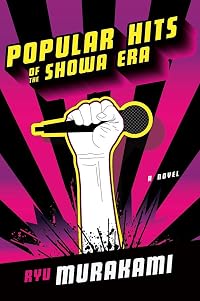
I read a different Ryū Murakami book, Popular Hits of the Showa Era, earlier this year. While Popular Hits also included explosive violence, it also had funny moments and a level of outrageousness that gave it... not a levity exactly, but maybe a wink and a nod of acknowledgement that you were participating in a farce just by reading it. In the Miso Soup is more serious and philosophical, making it all the scarier and a much more soul-chilling book. show more There's quite a bit of commentary on society, materialism, loneliness, and more.
I don't always draw clear pictures in my head of characters (they're usually a vague person shape) but I had very clear pictures of both Kenji and Frank. In fact, I realized this morning that Frank (in my head) looks very much like Philip Seymour Hoffman.
Recommended if you like dark and disturbing books. I'd also recommend reading it in one sitting (which I wasn't able to do due to life circumstances) as I think it keeps you immersed in the tension better. "Liked" is not the right word for this book and I am not sure what word I am groping for; the book is excellent at building tension and is succinctly and skillfully written. show less
I read a different Ryū Murakami book, Popular Hits of the Showa Era, earlier this year. While Popular Hits also included explosive violence, it also had funny moments and a level of outrageousness that gave it... not a levity exactly, but maybe a wink and a nod of acknowledgement that you were participating in a farce just by reading it. In the Miso Soup is more serious and philosophical, making it all the scarier and a much more soul-chilling book. show more There's quite a bit of commentary on society, materialism, loneliness, and more.
I don't always draw clear pictures in my head of characters (they're usually a vague person shape) but I had very clear pictures of both Kenji and Frank. In fact, I realized this morning that Frank (in my head) looks very much like Philip Seymour Hoffman.
Recommended if you like dark and disturbing books. I'd also recommend reading it in one sitting (which I wasn't able to do due to life circumstances) as I think it keeps you immersed in the tension better. "Liked" is not the right word for this book and I am not sure what word I am groping for; the book is excellent at building tension and is succinctly and skillfully written. show less
There is something fascinating about Ryu Murakami’s writing. He is so excessively morbid that it works. I see very few Japanese influences in his novels. Sure he critiques the society around him, but he partakes of very few of the subjects and issues you find in the pages of Soseki and Tanizaki. His language is tight and his material pointed social commentary.
The way he paints the inner demon in us all is vivid and grotesque and not easily forgotten.
If an author were judged by the morals of his characters Ryu would be considered a very sinister man indeed. I get the sense he has a singular purpose in his writing, that with all of his books he is trying to strain our suspension of disbelief as we encounter the monstrosities within our show more world. Less so than Popular Hits of the Showa Era he takes us on a roller coaster ride. Ryu Murakami reads best at night. He talks about the things you don’t bring into polite conversation. And the characters he uses, even between novels, don’t seem to care about your hang-ups. He’s a bold writer, a Japanese Ballard. Some of his plots play out like movies, especially the one-upmanship of Popular Hits of the Showa Era, but what you get is such detail that you can’t look away, such horror that you can’t stop reading – the type of scenario that Stephen King cooks up and can never quite pull off. show less
The way he paints the inner demon in us all is vivid and grotesque and not easily forgotten.
If an author were judged by the morals of his characters Ryu would be considered a very sinister man indeed. I get the sense he has a singular purpose in his writing, that with all of his books he is trying to strain our suspension of disbelief as we encounter the monstrosities within our show more world. Less so than Popular Hits of the Showa Era he takes us on a roller coaster ride. Ryu Murakami reads best at night. He talks about the things you don’t bring into polite conversation. And the characters he uses, even between novels, don’t seem to care about your hang-ups. He’s a bold writer, a Japanese Ballard. Some of his plots play out like movies, especially the one-upmanship of Popular Hits of the Showa Era, but what you get is such detail that you can’t look away, such horror that you can’t stop reading – the type of scenario that Stephen King cooks up and can never quite pull off. show less
Members
- Recently Added By
Lists

Japanese Literature
230 works; 40 members

Best of World Literature
437 works; 52 members

Books That Will Keep You on the Edge of Your Seat
73 works; 20 members

75 Books Challenge Halloween Read "Official" Selections
71 works; 7 members

Best Japanese Fiction
41 works; 10 members

Noirvember: The Best Noir
113 works; 56 members

Books Read in 2014
2,344 works; 89 members

Stories set on Island Country of Japan
18 works; 3 members

75 Books Challenge 2015 Halloween Read long list
45 works; 4 members

Diverse Horror
262 works; 6 members

Books Read in 2015
3,299 works; 126 members

Books for Birute
39 works; 1 member

el
1,139 works; 1 member
Talk Discussions
Past Discussions
In the Miso Soup by Ryū Murakami in Author Theme Reads (August 2012)
Author Information

95+ Works 7,326 Members
Some Editions
Awards and Honors
Common Knowledge
- Canonical title
- In the Miso Soup
- Original title
- イン ザ・ミソスープ; In za misosūpu
- Original publication date
- 1997 (original Japanese) (original Japanese); 2003 (English: McCarthy) (English: McCarthy)
- People/Characters
- Kenji; Frank; Jun; Lady #3; Lady #4; Lady #5 (show all 18); Madoka; Maki; Noriko; Reika; Rie; Satoshi; Akiko Takahashi; Yokoyama-san; Yuko; The Latin American woman; The manager; The waiter
- Important places
- Kabukichō, Tokyo, Japan; Tokyo, Japan
- First words
- My name is Kenji.
- Last words
- (Click to show. Warning: May contain spoilers.)"The feather of a swan," I said.
- Original language
- Japanese
Classifications
- Genres
- Fiction and Literature, Horror, General Fiction
- DDC/MDS
- 895.635 — Literature & rhetoric Literatures of other languages Literatures of East and Southeast Asia Japanese Japanese fiction 1945–2000
- LCC
- PL856 .U696 .I513 — Language and Literature Languages and literatures of Eastern Asia, Africa, Oceania Languages of Eastern Asia, Africa, Oceania Japanese language and literature Japanese literature Individual authors and works
- BISAC
Statistics
- Members
- 2,089
- Popularity
- 9,922
- Reviews
- 71
- Rating
- (3.44)
- Languages
- 16 — Czech, Danish, Dutch, English, Estonian, French, German, Hungarian, Italian, Japanese, Korean, Norwegian (Bokmål), Portuguese, Romanian, Russian, Spanish
- Media
- Paper, Ebook
- ISBNs
- 28
- ASINs
- 8