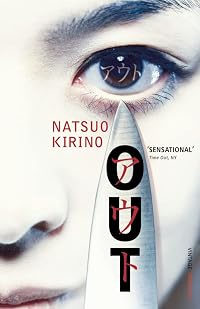
Out
by Natsuo Kirino
On This Page
Description
Winner of Japan's Grand Prix for Crime Fiction * Edgar Award Finalist * Nothing in Japanese literature prepares us for the stark, tension-filled, plot-driven realism of Natsuo Kirino's award-winning literary mystery Out. This mesmerizing novel tells the story of a brutal murder in the staid Tokyo suburbs, as a young mother who works the night shift making boxed lunches strangles her abusive husband and then seeks the help of her coworkers to dispose of the body and cover up her crime. The show more coolly intelligent Masako emerges as the plot's ringleader, but quickly discovers that this killing is merely the beginning, as it leads to a terrifying foray into the violent underbelly of Japanese society. At once a masterpiece of literary suspense and pitch-black comedy of gender warfare, Out is also a moving evocation of the pressures and prejudices that drive women to extreme deeds, and the friendships that bolster them in the aftermath. show lessTags
Recommendations








Member Recommendations
Member Reviews
About the first 60% of this book was the most incredible crime story I have ever read. Brilliant characterization where the characters leap and skip and kill off the pages.
Masako, Kuniko, Yoshie and Yayoi form a relationship working part-time at night in a food factory. All these women have troubles in their personal lives, and most of them because they're women in a violent and misogynistic society. Violence and abuse against women, mistreatment and inequality in the workplace, objectification and a very strange obsession for youth that verges (and is very blatant at points) on the pedophilic and where women are deemed unattractive and disposable past the age of thirty and of course treated even worse when deemed unattractive, and the show more strain of doing all the labour and care in domestic settings. Pressure weighs on these women; something happens and something snaps and a murder is committed and covered up, and someone becomes falsely accused and seeks revenge. I won't divulge more on the plot because a good part of this story moves along with what is revealed. This was really good storytelling, that is, until it wasn't.
The truth is there was so much going on at the same time, and I expected the story to give in and fold into itself the way collapsed stars do too. When all the material has been used up and it all just folds and it is done. Which is what happened somewhere past the halfway mark, and credit to the writer they kept it going longer than I thought it would. Too many coincidences that couldn't be ignored even though they made for exciting parts, too many holes that couldn't be filled, and things just got progressively worse the more the story advanced, culminating in a bathetic (and personally, unconvincing) ending.
Yet I still think this is a good book in the end, and that it does a great job exploring the many subjects it does: misogyny, xenophobia, the predatory financial systems that are meant to leach off all they can on individuals, violence and what it does to the person it is inflicted on and the person that does the inflicting, as well as that function of literature which is to touch and prick on what is taboo. Despite the disappointment of how certain parts and characters are handled (the last third of this book really didn't read like it was written by the person who had done the previous portion), and the ending which was meant to be shocking and a way to keep up with all the unexpected scandalous points happening throughout the book and provide a climax but instead ended up feeling trite and insipid, this was good. But just like a collapsed star that releases fragments of itself into space and is reduced to something that doesn't resemble its more powerful and luminescent former form, I ended up longing and mourning for the earlier brilliant part of this book. show less
Masako, Kuniko, Yoshie and Yayoi form a relationship working part-time at night in a food factory. All these women have troubles in their personal lives, and most of them because they're women in a violent and misogynistic society. Violence and abuse against women, mistreatment and inequality in the workplace, objectification and a very strange obsession for youth that verges (and is very blatant at points) on the pedophilic and where women are deemed unattractive and disposable past the age of thirty and of course treated even worse when deemed unattractive, and the show more strain of doing all the labour and care in domestic settings. Pressure weighs on these women; something happens and something snaps and a murder is committed and covered up, and someone becomes falsely accused and seeks revenge. I won't divulge more on the plot because a good part of this story moves along with what is revealed. This was really good storytelling, that is, until it wasn't.
The truth is there was so much going on at the same time, and I expected the story to give in and fold into itself the way collapsed stars do too. When all the material has been used up and it all just folds and it is done. Which is what happened somewhere past the halfway mark, and credit to the writer they kept it going longer than I thought it would. Too many coincidences that couldn't be ignored even though they made for exciting parts, too many holes that couldn't be filled, and things just got progressively worse the more the story advanced, culminating in a bathetic (and personally, unconvincing) ending.
Yet I still think this is a good book in the end, and that it does a great job exploring the many subjects it does: misogyny, xenophobia, the predatory financial systems that are meant to leach off all they can on individuals, violence and what it does to the person it is inflicted on and the person that does the inflicting, as well as that function of literature which is to touch and prick on what is taboo. Despite the disappointment of how certain parts and characters are handled (the last third of this book really didn't read like it was written by the person who had done the previous portion), and the ending which was meant to be shocking and a way to keep up with all the unexpected scandalous points happening throughout the book and provide a climax but instead ended up feeling trite and insipid, this was good. But just like a collapsed star that releases fragments of itself into space and is reduced to something that doesn't resemble its more powerful and luminescent former form, I ended up longing and mourning for the earlier brilliant part of this book. show less
When Yayoi Yamamoto kills her abusive husband, her coworkers somewhat grudgingly help her dispose of the body. But can they avoid the attentions of the police, loan sharks, yakuza, and somebody rather scarier than all the others?
It sounds like the plot of a black comedy, but the very graphic descriptions of rape, necrophilia, and dismemberment soon put paid to that idea. There were definitely times I had to put it aside and get some snacks or a drink before I could continue. But having said that, if you've got the stomach for it, it's a great, tense thriller which leaves you alternatively appalled by and rooting for the main character, Masako Katori.
It sounds like the plot of a black comedy, but the very graphic descriptions of rape, necrophilia, and dismemberment soon put paid to that idea. There were definitely times I had to put it aside and get some snacks or a drink before I could continue. But having said that, if you've got the stomach for it, it's a great, tense thriller which leaves you alternatively appalled by and rooting for the main character, Masako Katori.
Interesting little read, I appreciate that the cast is kept to a minimum and the author put a lot of effort into making each of the character feel deep and unique.
While the main thing that pushes story forward - the murder and its consequences - it was the least interesting part to me. I liked how it described Japanese society at the time, with all their frustrations, unfulfilled dreams and everyday boredom.
While of course there's also place for yakuza and the likes, but they are kept to a minimum during the best parts of the story.
I've just put the book down, so maybe I'm overreacting, but I think that once Kirino explored enough of the main cast of 4 women, she rushed to the end, making the book seem to me like a typical crime show more thriller. I didn't like it. The strange sentimentality at the very end is pretty weird to me, but I guess that's due to cultural differences (like with Millenium Actress by Satoshi Kon - I couldn't enjoy this movie by finding main character motivation and feelings completely unrelatable and strange... there's something similar there).
I very much enjoyed this book and it made me feel like I experienced living in Tokio for a little while - in boots of a few low income, no perspectives households. It felt real. Too bad the author felt the need to "spice the book up" while it didn't need it.
Still, 75% of it was just pure meat - I would love to read some novels that keep their focus on societal commentary alone with some drama that doesn't need to add any additional "excitement" show less
While the main thing that pushes story forward - the murder and its consequences - it was the least interesting part to me. I liked how it described Japanese society at the time, with all their frustrations, unfulfilled dreams and everyday boredom.
While of course there's also place for yakuza and the likes, but they are kept to a minimum during the best parts of the story.
I've just put the book down, so maybe I'm overreacting, but I think that once Kirino explored enough of the main cast of 4 women, she rushed to the end, making the book seem to me like a typical crime show more thriller. I didn't like it. The strange sentimentality at the very end is pretty weird to me, but I guess that's due to cultural differences (like with Millenium Actress by Satoshi Kon - I couldn't enjoy this movie by finding main character motivation and feelings completely unrelatable and strange... there's something similar there).
I very much enjoyed this book and it made me feel like I experienced living in Tokio for a little while - in boots of a few low income, no perspectives households. It felt real. Too bad the author felt the need to "spice the book up" while it didn't need it.
Still, 75% of it was just pure meat - I would love to read some novels that keep their focus on societal commentary alone with some drama that doesn't need to add any additional "excitement" show less
There are many wonderful things to say about this book.
Many thoughts on its, perhaps, problematic aspects and the graphic depiction of rape.
Many of those have been said by other people, reviewers, interviewers, Kirino herself, analyzing and explaining the archetypes the characters represent, and whether or not, the ending is simply gratuitous or also serves as a metaphor.
None have talked about the subtle, yet extremely prevalent, constant fatphobia, on Kirino's part.
Kuniko, the fat character, is a somewhat lesser villain, and thus does despicable things and is hated by most, which makes sense.
Her body however, is described by everyone's POV as burdensome, ugly, huge, hideous, etc. By everyone, literally not one person in this book show more doesn't think her fatness is as ugly as her manipulation and extortion.
This ties into the fact that the character herself is an analogy for consumerism and excess and it's easy enough to fall into the trap of rationalizing this prejudiced writing as "well it's to drive the point further that this is a character that goes to extremes, does not have boundaries, is uncontrollable etc..."
Notice how this kind of reasoning resembles all the excuses people give when they want to feel righteous about fatshaming another person. This argument is constructed in the same prejudiced way we talk when we oppress fat people .
Consider that Kuniko is the only one of the four women who has a marginalized body, and the only of the characters that has her body be a metaphor for something else, something vile, bad, reprehensible. Something to be judged about. Something that defines her character and her worth as a person and as a woman.
Using fat bodies as a metaphor is fatphobic and prejudiced.
Using bodies as a metaphor in general is waaaaay too problematic.
Honestly this was the hardest part to read, her humiliation, the way her "lesson" at the end is written to make the reader feel like some "justice" is done. It all read disgusting to me, by far more than the ero-guro/rape scenes did.
And sure, if one wants to talk about the book there are, again, many points to be brought up about various issues, but everyone has already done that and I have read their opinions and thoughts about everything else BUT this fact. Because fat-shaming is so ingrained into everything we hardly take notice of it. Because we make excuses about metaphors and the author's intent, when the answer is very clear, and very simple. This is some fatphobic shit.
I wish I'd read someone else also mention this. show less
Many thoughts on its, perhaps, problematic aspects and the graphic depiction of rape.
Many of those have been said by other people, reviewers, interviewers, Kirino herself, analyzing and explaining the archetypes the characters represent, and whether or not, the ending is simply gratuitous or also serves as a metaphor.
None have talked about the subtle, yet extremely prevalent, constant fatphobia, on Kirino's part.
Kuniko, the fat character, is a somewhat lesser villain, and thus does despicable things and is hated by most, which makes sense.
Her body however, is described by everyone's POV as burdensome, ugly, huge, hideous, etc. By everyone, literally not one person in this book show more doesn't think her fatness is as ugly as her manipulation and extortion.
This ties into the fact that the character herself is an analogy for consumerism and excess and it's easy enough to fall into the trap of rationalizing this prejudiced writing as "well it's to drive the point further that this is a character that goes to extremes, does not have boundaries, is uncontrollable etc..."
Notice how this kind of reasoning resembles all the excuses people give when they want to feel righteous about fatshaming another person. This argument is constructed in the same prejudiced way we talk when we oppress fat people .
Consider that Kuniko is the only one of the four women who has a marginalized body, and the only of the characters that has her body be a metaphor for something else, something vile, bad, reprehensible. Something to be judged about. Something that defines her character and her worth as a person and as a woman.
Using fat bodies as a metaphor is fatphobic and prejudiced.
Using bodies as a metaphor in general is waaaaay too problematic.
Honestly this was the hardest part to read, her humiliation, the way her "lesson" at the end is written to make the reader feel like some "justice" is done. It all read disgusting to me, by far more than the ero-guro/rape scenes did.
And sure, if one wants to talk about the book there are, again, many points to be brought up about various issues, but everyone has already done that and I have read their opinions and thoughts about everything else BUT this fact. Because fat-shaming is so ingrained into everything we hardly take notice of it. Because we make excuses about metaphors and the author's intent, when the answer is very clear, and very simple. This is some fatphobic shit.
I wish I'd read someone else also mention this. show less
I wasn't sure why this book is titled "Out" until a reviewer here enlightened me. The four women in the plot are all seeking a way out of their circumstances. Willingly or unwillingly, only by participating in such gruesome acts as murder or disposal of bodies, do they have a plausible way out of their loneliness or poverty. What they ended up doing is out of the world but their loneliness and feelings of being trapped must speak to us all.
I'd very much recommend this book to fans of Koushun Takami's Battle Royale. Although the stories are very different, there's a similarity of style, and a similar theme of the exploration of the possibility of underlying violence in the psyche of the average citizen of Japan.
In 'Out' we are introduced to a group of Japanese women who are part-time night workers at a factory. They're all poor and each is dealing with a collection of personal and family problems. But when one, in an unprecedented revolt, strikes back against her abusive husband and strangles him to death, they are all brought into a plot to cover up the crime. For a while, it seems like they have been successful - the murder is pinned on a local casino owner and pimp. But show more when the casino owner is released for lack of evidence, his career ruined by the media revelation that he was formerly a gang member who brutally raped and murdered a woman - he is out for revenge. The women are in more trouble than when they were in fear of the law.
Excellent characterization and character interaction, and a tensely drawn plot. Good crime novel. show less
In 'Out' we are introduced to a group of Japanese women who are part-time night workers at a factory. They're all poor and each is dealing with a collection of personal and family problems. But when one, in an unprecedented revolt, strikes back against her abusive husband and strangles him to death, they are all brought into a plot to cover up the crime. For a while, it seems like they have been successful - the murder is pinned on a local casino owner and pimp. But show more when the casino owner is released for lack of evidence, his career ruined by the media revelation that he was formerly a gang member who brutally raped and murdered a woman - he is out for revenge. The women are in more trouble than when they were in fear of the law.
Excellent characterization and character interaction, and a tensely drawn plot. Good crime novel. show less
Easily the best thing I've read this summer (so far). The writing and characterizations are crisp and clean, like the boxed lunch assembly line the women work on. Despite its length and numerous characters, the novel's pacing never sags, nor do any of the characters ever feel ill-served by the time spent with them. The plot twists about nicely (albeit a bit predictably), but you're always left wanting to keep turning the page to see what happens next.
Kirino's social commentary about women in a modern Japanese society nicely underscores the novel's more violent and "masculine" aspects, and gives what would otherwise be just another crime/revenge novel a solid and welcomed twist.
Kirino's social commentary about women in a modern Japanese society nicely underscores the novel's more violent and "masculine" aspects, and gives what would otherwise be just another crime/revenge novel a solid and welcomed twist.
Members
- Recently Added By
Lists

Best Noir Fiction
160 works; 14 members

Diverse Horror
262 works; 6 members

Female Protagonist
1,056 works; 57 members

50 Tough Books for Extreme Readers
71 works; 39 members

Literature by People of Color
81 works; 9 members

Most Disturbing Books
124 works; 27 members

Books Read in 2016
4,666 works; 199 members

Asia
178 works; 7 members

Books Read in 2007
326 works; 8 members

100 Best Thrillers of All Time
100 works; 6 members

Books Read in 2021
5,361 works; 114 members

The 100 Best Crime Novels and Thrillers since 1945
100 works; 6 members

Favorite Books in Translation
320 works; 133 members

Books We Couldn't Put Down
443 works; 197 members
Author Information

50+ Works 6,914 Members
Some Editions
Awards and Honors
Awards
Distinctions
Series
Belongs to Publisher Series
Common Knowledge
- Canonical title
- Out
- Original title
- OUT
- Original publication date
- 1997 (original Japanese) (original Japanese); 2005 (English: Snyder) (English: Snyder)
- People/Characters
- Masako Katori; Yayoi Yamamoto; Yoshie Azuma; Kuniko Jonouchi; Mitsuyoshi Satake; Reika Cho (club manager) (show all 32); Anna (Taiwanese club waitress); Tetsuya Jonouchi (Kuniko's husband); Miki Azuma (Yoshie's younger daughter); Kunimatsu (casino manager); Kenji Yamamoto (Yayoi's husband); Yoshie's mother-in-law; Nobuki Katori (Masako's son); Yoshiki Katori (Masako's husband); Roberto Kazuo Miyamori (Brazilian factory worker); Komada (health inspector); Hirosawa (factory boss); Yokihiso Yamamoto (Yayoi's older son); Milk (Yayoi's cat); Takashi Yamamoto (Yayoi's younger son); Inspector Ingushi; Akira Yamada (Jumonji, debt collector); Kazue (Yoshie's older daughter); Issey (Kazue's son); Soga (gang member); Kinusgasa (detective); Imai (detective); Chin (club floor manager); Yanagi (new club employee); Jewel (Anna's dog); Nakayama (factory foreman); Yoko Morisaki (Yayoi's neighbor)
- Important places
- Tokyo, Japan; Playground; Mika; Japan
- Related movies
- Out (2002 | IMDb)
- Epigraph
- "The way to despair is to refuse
to have any kind of experience...."
—Flannery O'Connor - First words
- There's never been a novel like Out - nor is there likely to be another - because it has the feel of a book worked out at great length in the author's mind and soul. It is the lurid labyrinth that is Tokyo today, adroi... (show all)tly observed and pondered over the lifetime of a mature and acutely thoughtful artist. Natsuo Kirino seems to have sifted through the entire hard-boiled literary canon and the everything-that-can-go-wrong-will-go-wrong subset of film noir to come up with the story. -Introduction, James Ellroy
She got to the parking lot earlier than usual. The thick, damp July darkness engulfed her as she stepped out of the car. Perhaps it was the heat and humidity, but the night seemed especially black and heavy. -Chapter 1, Night... (show all) Shift - Last words
- (Click to show. Warning: May contain spoilers.)The elevator moaned like the wind as it came to meet her.
- Blurbers*
- Hayder, Mo; Wolferen, Karel van
- Original language
- Japanese
*Some information comes from Common Knowledge in other languages. Click "Edit" for more information.
Classifications
- Genres
- Fiction and Literature, Mystery, Horror
- DDC/MDS
- 813 — Literature & rhetoric American literature in English American fiction in English
- LCC
- PL855 .I566 .O8713 — Language and Literature Languages and literatures of Eastern Asia, Africa, Oceania Languages of Eastern Asia, Africa, Oceania Japanese language and literature Japanese literature Individual authors and works
- BISAC
Statistics
- Members
- 3,857
- Popularity
- 4,110
- Reviews
- 143
- Rating
- (3.89)
- Languages
- 19 — Czech, Danish, Dutch, English, Estonian, French, German, Hungarian, Italian, Japanese, Korean, Norwegian (Bokmål), Polish, Portuguese, Russian, Slovenian, Spanish, Swedish, Thai
- Media
- Paper, Audiobook, Ebook
- ISBNs
- 53
- ASINs
- 13