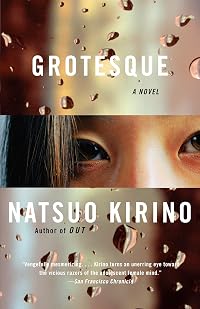
Grotesque
by Natsuo Kirino
On This Page
Description
Fiction. Literature. Mystery. Thriller. HTML:Life at the prestigious Q High School for Girls in Tokyo exists on a precise social axis: a world of insiders and outsiders, of haves and have-nots. Beautiful Yuriko and her unpopular, unnamed sister exist in different spheres; the hopelessly awkward Kazue Sato floats around among them, trying to fit in.Years later, Yuriko and Kazue are dead — both have become prostitutes and both have been brutally murdered. Natsuo Kirino, celebrated author of show more Out, seamlessly weaves together the stories of these women's struggles within the conventions and restrictions of Japanese society. At once a psychological investigation of the pressures facing Japanese women and a classic work of noir fiction, Grotesque is a brilliantly twisted novel of ambition, desire, beauty, cruelty, and identity by one of our most electrifying writers. show lessTags
Recommendations





Member Recommendations
Member Reviews
Grotesque is less a crime novel than an autopsy of hierarchy.
Like Out and Real World, Natsuo Kirino examines women navigating systems that were never designed for them. But here, the structure is colder, more fragmented, and more psychologically confrontational. Truth is unstable. Every narrator edits. Every account contradicts. By the end, justice feels irrelevant. What matters is who controls the story.
The novel begins with the murder of Yuriko, a woman whose extraordinary beauty defined her life from birth. Her sister—the unnamed narrator—assembles testimony, journals, and statements, supposedly to clarify what happened. Yet as the narrative unfolds, it becomes clear that clarification is not the goal. Control is.
Yuriko show more understands beauty as currency. She never romanticizes it; she trades on it. Kazue believes effort will overcome structural barriers, until she slowly begins to question that belief. Zhang reinvents himself through narrative inflation. The narrator, meanwhile, constructs superiority as insulation. Each character responds differently to the same male-defined hierarchy, but none escape it.
What makes Grotesque so unsettling is that awareness changes nothing. Yuriko knows her capital has a half-life. Kazue begins to suspect that hard work will not deliver dignity. The narrator recognizes systemic bias. Yet insight does not produce liberation. It produces bitterness, calculation, or resignation.
The ending is a deliberate shock. The narrator—who spent the entire novel dissecting and condemning the lives of her sister and Kazue—steps into the same world she judged. Her decision to become a sex worker does not read as empowerment or redemption. It reads as obsession completing its arc. The final question—whether her client might be Zhang—collapses the narrative into recursion. The system is not dismantled; it is reenacted.
Kirino refuses catharsis. There is no moral clarity, no triumphant exposure of truth. Instead, Grotesque suggests that hierarchy operates like weather: some people have insulation, some do not, and knowing the rules does not grant the power to change them.
Its ambition is immense, its structure intellectually rigorous, and its thematic coherence remarkable. The slight emotional distance is intentional—it mirrors the narrator’s coldness—but it prevents the novel from landing with the same visceral impact as Out.
Still, it is a mind-bending, deeply uncomfortable work. Not a story about solving a murder, but about how women are valued, ranked, and remembered—and what happens when those rankings are internalized so completely that even rebellion becomes repetition. show less
Like Out and Real World, Natsuo Kirino examines women navigating systems that were never designed for them. But here, the structure is colder, more fragmented, and more psychologically confrontational. Truth is unstable. Every narrator edits. Every account contradicts. By the end, justice feels irrelevant. What matters is who controls the story.
The novel begins with the murder of Yuriko, a woman whose extraordinary beauty defined her life from birth. Her sister—the unnamed narrator—assembles testimony, journals, and statements, supposedly to clarify what happened. Yet as the narrative unfolds, it becomes clear that clarification is not the goal. Control is.
Yuriko show more understands beauty as currency. She never romanticizes it; she trades on it. Kazue believes effort will overcome structural barriers, until she slowly begins to question that belief. Zhang reinvents himself through narrative inflation. The narrator, meanwhile, constructs superiority as insulation. Each character responds differently to the same male-defined hierarchy, but none escape it.
What makes Grotesque so unsettling is that awareness changes nothing. Yuriko knows her capital has a half-life. Kazue begins to suspect that hard work will not deliver dignity. The narrator recognizes systemic bias. Yet insight does not produce liberation. It produces bitterness, calculation, or resignation.
The ending is a deliberate shock. The narrator—who spent the entire novel dissecting and condemning the lives of her sister and Kazue—steps into the same world she judged. Her decision to become a sex worker does not read as empowerment or redemption. It reads as obsession completing its arc. The final question—whether her client might be Zhang—collapses the narrative into recursion. The system is not dismantled; it is reenacted.
Kirino refuses catharsis. There is no moral clarity, no triumphant exposure of truth. Instead, Grotesque suggests that hierarchy operates like weather: some people have insulation, some do not, and knowing the rules does not grant the power to change them.
Its ambition is immense, its structure intellectually rigorous, and its thematic coherence remarkable. The slight emotional distance is intentional—it mirrors the narrator’s coldness—but it prevents the novel from landing with the same visceral impact as Out.
Still, it is a mind-bending, deeply uncomfortable work. Not a story about solving a murder, but about how women are valued, ranked, and remembered—and what happens when those rankings are internalized so completely that even rebellion becomes repetition. show less
Another multi-POV novel. The first narrator has a very homey style that was very readable despite it not being all that compelling. Reading this I didn’t so much want to find out who killed the two women as much as I wanted to understand more about them and how they could have fallen so far. All were products of a very prestigious school and presumably had almost every advantage. But the ultra-competitive Japanese culture somehow warped them early and created gaping holes in their personalities. Those holes were mostly in the self-esteem area. They were crushed by the need to win, to be the best, to be first. To come in second was a terrible fate. Granted no one wanted to come in last, but if you didn’t practically kill yourself to show more avoid it, something was wrong with you. Seems like a very grinding existence to me, even more competitive than here in the US.
At first I liked the initial story-teller, then she too became a grotesque. Later in the novel when she meets an old classmate, the woman tells her that her face now fairly gushes malevolence. As the novel progressed, that became more and more apparent. Alone, bitter and twisted she uses her hatred for everyone around her as her sole emotional nourishment. Her hatred for her sister is something you can almost see. She finds something distasteful or hateful in everyone she meets. No one has a redeeming quality in her eyes. Might the people she speaks about be better than she allows? Possibly, but not actually. No one in this novel is likeable, but all are pitiable. All have been ground down to their basest level.
Then we get Yuriko’s diary; the monstrously beautiful sister-turned-whore. She is a vile creature in her own way. So beautiful that people are immediately silenced upon seeing her, she believes this to be the only thing of worth about her or about anyone, really. She sees herself as a creature built solely for sex which she doesn’t particularly like. She likes men. Has to have them constantly to validate that she is worthwhile. She dismisses her sister as a jealous shrew, which she is, but only later realizes that she herself is a grotesque too. She has no illusions to what she is though and is convinced that she will die early and at the hands of one of her johns.
Kazue Sato is the 3rd to tell her story. Brought up to believe that anything was within reach, she fails to see how much of an outsider she really is. In the microcosm of the Q School for Young Ladies, she is clearly on the outside and will never be on the cheerleading team no matter how hard she tries. The older sister despises her for her lack of insight and pretends to be her friend only so she can set her up for more humiliation. Even after Kazue recognizes this, she so desperately needs contact that she takes this pretend friend as a real one. As an adult, she’s no less pathetic, telling everyone within earshot that she went to the Q School for Young Ladies and was a blah-blah important person at this most prestigious company. She even gave her card to her johns to prove she was a better person than just a whore.
The whole thing was just sad and distasteful. As it was meant to be I’m sure. The very title, Grotesque, shows what the author herself thinks of her creations. show less
At first I liked the initial story-teller, then she too became a grotesque. Later in the novel when she meets an old classmate, the woman tells her that her face now fairly gushes malevolence. As the novel progressed, that became more and more apparent. Alone, bitter and twisted she uses her hatred for everyone around her as her sole emotional nourishment. Her hatred for her sister is something you can almost see. She finds something distasteful or hateful in everyone she meets. No one has a redeeming quality in her eyes. Might the people she speaks about be better than she allows? Possibly, but not actually. No one in this novel is likeable, but all are pitiable. All have been ground down to their basest level.
Then we get Yuriko’s diary; the monstrously beautiful sister-turned-whore. She is a vile creature in her own way. So beautiful that people are immediately silenced upon seeing her, she believes this to be the only thing of worth about her or about anyone, really. She sees herself as a creature built solely for sex which she doesn’t particularly like. She likes men. Has to have them constantly to validate that she is worthwhile. She dismisses her sister as a jealous shrew, which she is, but only later realizes that she herself is a grotesque too. She has no illusions to what she is though and is convinced that she will die early and at the hands of one of her johns.
Kazue Sato is the 3rd to tell her story. Brought up to believe that anything was within reach, she fails to see how much of an outsider she really is. In the microcosm of the Q School for Young Ladies, she is clearly on the outside and will never be on the cheerleading team no matter how hard she tries. The older sister despises her for her lack of insight and pretends to be her friend only so she can set her up for more humiliation. Even after Kazue recognizes this, she so desperately needs contact that she takes this pretend friend as a real one. As an adult, she’s no less pathetic, telling everyone within earshot that she went to the Q School for Young Ladies and was a blah-blah important person at this most prestigious company. She even gave her card to her johns to prove she was a better person than just a whore.
The whole thing was just sad and distasteful. As it was meant to be I’m sure. The very title, Grotesque, shows what the author herself thinks of her creations. show less
Alla voce grottesco, il dizionario recita "stranamente bizzarro e inconsueto, tale da risultare ridicolo", e bizzarri, inconsueti, ridicoli nella loro tragedia sono i personaggi di questo libro, così presi da se stessi e compressi nella società classista giapponese da perdere qualsiasi senso comune e qualsiasi contatto con la realtà.
Ognuno di loro presenta una propria confessione, sia come io narrante, sia sotto forma di lettere e diari, e ovunque si sente il tanfo della menzogna.
L'unico modo che trovano per sentirsi vivi è vendere se stessi, perché, incapaci di valutarsi, ritengono che solo il prezzo che gli altri sono disposti a pagare per acquistarli sia il loro effettivo valore.
Un libro notevole, che non raggiunge la perfezione show more solo perché la prima parte, coi suoi continui accenni ad avvenimenti che verranno spiegati più avanti, tende a essere un po' noiosa. show less
Ognuno di loro presenta una propria confessione, sia come io narrante, sia sotto forma di lettere e diari, e ovunque si sente il tanfo della menzogna.
L'unico modo che trovano per sentirsi vivi è vendere se stessi, perché, incapaci di valutarsi, ritengono che solo il prezzo che gli altri sono disposti a pagare per acquistarli sia il loro effettivo valore.
Un libro notevole, che non raggiunge la perfezione show more solo perché la prima parte, coi suoi continui accenni ad avvenimenti che verranno spiegati più avanti, tende a essere un po' noiosa. show less
I'm disappointed.
I'm disappointed because as I wanted to pull a blurb off the internet, I ended up reading the Wikipedia article on this book and found out that this book was censored so despite the very long 700 pages, it turns out I didn't end up reading the actual book. Turns out that the US version was censored and as the French version is translated from the English version, they ended up doing the same thing. I'm quite annoyed actually.
What is this book about? It's not an easy-going plot, I'll tell you that.
Our narrator, is the child of a Swiss White man and Japanese woman, and has always felt inferior to her younger sister, Yuriko, who was so beautiful that everyone was swayed by her beauty. The book is about our narrator show more telling the history of her life and Yuriko's, so that we can try to understand why Yuriko, who turned into a prostitute at a young age, and the narrator's childhood friend Kazue, who also turned into a prostitute but later in life despite her position in a prestigious company, ended up murdered just a few months apart by the same suspect, a Chinese illegal immigrant named Zhang.
Everyone is terrible in this book and it just gets worse and worse and I have to be honest it was a tiring read. And I wondered what Kirino was trying to say with this book. I wondered what the point of it all was, and how Kirino could be inspired to write such a novel. But when I got to the end I finally understood. It was a book about women, and how, no matter what path they take, willingly or not, successful or not, full of family or not, they will always be considerd inferior to men in society. And their value will always be assigned by men as it can so easily be taken away by men. And so the question is, as women, do we try to seek that validation or do we feed into it and take advantage of it. Either way, as women, even if we feel like we conquered man's world, it comes to the realization that we will always be the weaker sex.
So it's a grueling book, with no happy end, but Kirino's message comes through finally quite powerfully.
Do I wish it was shorter than 700 pages? Very much yes. It could have been just fine at 400. But reading Kirino's message led me into a lot of introspection about society and I think that makes it all worth it.
Now for the censorship which involves the end of the book so I'll put it under spoiler tags.
According to Wikipedia, "Publisher Knopf censored the American translation, removing a section involving underage male prostitution, as it was considered too taboo for U. S. audiences. In the original Yurio (Yuriko's blind son whom she abandoned, and later on is taken in by our narrator) becomes a prostitute in order to earn money. The narrator wants to join him but due to her age, she has no customers. For this reason, she becomes Yurio's pimp instead. However, eventually their relationship turns sour. At the end, she decides to take up the offer from a customer who is curious about her being a 40-year old virgin. The English version skips Yurio's incursion with prostitution and the narrator's involvement with his activities. There is a mention of her accepting the offer of her first client, but it is left up to interpretation if this really happens or is a figment of the narrator's imagination."
Cutting out so much from this character's story is really unfortunate as I had noticed myself in the translation that his inclusion in the story didn't feel fleshed out as much especially considering how much time Kirino spent telling the rest of the story. While I can't say how much this additional plot would have contributed to the overall message and character development of our narrator, I can say that I feel cheated. At this day and age, let the reader decide what we want to read and stop censoring books! show less
I'm disappointed because as I wanted to pull a blurb off the internet, I ended up reading the Wikipedia article on this book and found out that this book was censored so despite the very long 700 pages, it turns out I didn't end up reading the actual book. Turns out that the US version was censored and as the French version is translated from the English version, they ended up doing the same thing. I'm quite annoyed actually.
What is this book about? It's not an easy-going plot, I'll tell you that.
Our narrator, is the child of a Swiss White man and Japanese woman, and has always felt inferior to her younger sister, Yuriko, who was so beautiful that everyone was swayed by her beauty. The book is about our narrator show more telling the history of her life and Yuriko's, so that we can try to understand why Yuriko, who turned into a prostitute at a young age, and the narrator's childhood friend Kazue, who also turned into a prostitute but later in life despite her position in a prestigious company, ended up murdered just a few months apart by the same suspect, a Chinese illegal immigrant named Zhang.
Everyone is terrible in this book and it just gets worse and worse and I have to be honest it was a tiring read. And I wondered what Kirino was trying to say with this book. I wondered what the point of it all was, and how Kirino could be inspired to write such a novel. But when I got to the end I finally understood. It was a book about women, and how, no matter what path they take, willingly or not, successful or not, full of family or not, they will always be considerd inferior to men in society. And their value will always be assigned by men as it can so easily be taken away by men. And so the question is, as women, do we try to seek that validation or do we feed into it and take advantage of it. Either way, as women, even if we feel like we conquered man's world, it comes to the realization that we will always be the weaker sex.
So it's a grueling book, with no happy end, but Kirino's message comes through finally quite powerfully.
Do I wish it was shorter than 700 pages? Very much yes. It could have been just fine at 400. But reading Kirino's message led me into a lot of introspection about society and I think that makes it all worth it.
Now for the censorship which involves the end of the book so I'll put it under spoiler tags.
Cutting out so much from this character's story is really unfortunate as I had noticed myself in the translation that his inclusion in the story didn't feel fleshed out as much especially considering how much time Kirino spent telling the rest of the story. While I can't say how much this additional plot would have contributed to the overall message and character development of our narrator, I can say that I feel cheated. At this day and age, let the reader decide what we want to read and stop censoring books! show less
The book is well written, but that may be one of the few good things I have to say about Grotesque. This novel would seem to be a critique of Japanese culture - particularly the subordinate state of women in Japan; it would also seem to be about self-loathing; it could also be about the harmful consequences of cross-cultural interaction. The book could work on any of these levels, but ultimately it fails.
The story is about three principal characters and a handful of supporting characters. The three principals - the extremely beautiful Yuriko, the attractive but ultimately plain Kazue, and the narrator (Mitsuru), Yuriko's older, plain, dumpy sister - seem to be intended to illustrate how Japan's rigidly stratified, highly competitive, show more and ultimately overwhelmingly sexist society destroys women, and does so from the inside - by making women loathe themselves.
The problem with the book, and why it ultimately fails, is that the book is, from beginning to end, fatalistic to a depressing extent. You cannot read one page of this book without feeling depressed. The characters are filled with hatred for others, loathing for themselves, and the pursuit of self-destruction.
By the end, one is so overwhelmed by the oppressive negativity of the book that I had to start wondering about the psychological state of the author, Ms. Kirino, herself. Would it be possible to indulge oneself in such a bottomless pit of hatred and disgust unless one was, oneself, of a "grotesque" nature? Is this a case of Ms. Kirino glancing in a mirror?
This is a disturbing book, and all the more so because it is a compelling book. The reader wants to read on, even though each page is an indulgence in hate. By the time you finish this book you will hate yourself for having bothered to read it; you will reflect on the misery and tragedy of the lives depicted in it, and the fact that there is not one positive note to be taken away from the whole lot.
The book clearly lives up to its title. show less
The story is about three principal characters and a handful of supporting characters. The three principals - the extremely beautiful Yuriko, the attractive but ultimately plain Kazue, and the narrator (Mitsuru), Yuriko's older, plain, dumpy sister - seem to be intended to illustrate how Japan's rigidly stratified, highly competitive, show more and ultimately overwhelmingly sexist society destroys women, and does so from the inside - by making women loathe themselves.
The problem with the book, and why it ultimately fails, is that the book is, from beginning to end, fatalistic to a depressing extent. You cannot read one page of this book without feeling depressed. The characters are filled with hatred for others, loathing for themselves, and the pursuit of self-destruction.
By the end, one is so overwhelmed by the oppressive negativity of the book that I had to start wondering about the psychological state of the author, Ms. Kirino, herself. Would it be possible to indulge oneself in such a bottomless pit of hatred and disgust unless one was, oneself, of a "grotesque" nature? Is this a case of Ms. Kirino glancing in a mirror?
This is a disturbing book, and all the more so because it is a compelling book. The reader wants to read on, even though each page is an indulgence in hate. By the time you finish this book you will hate yourself for having bothered to read it; you will reflect on the misery and tragedy of the lives depicted in it, and the fact that there is not one positive note to be taken away from the whole lot.
The book clearly lives up to its title. show less
I’ve been meaning to read more Japanese fiction, but nothing quite prepared me for Natsuo Kirino’s twisted tale of female bitterness. It has made a great impact. Brutal and crude, it’s told in a detached manner that verges on the soulless. It’s also a sobering story of three young women fighting for empowerment and recognition in a world where the only accepted currency is beauty. The tale is grotesque; the setting is bleak; there isn’t a single sympathetic character in the whole damn book and yet, despite all of this, Kirino manages to create something completely gripping.
For the rest of the review please see my blog:
https://theidlewoman.net/2016/11/06/grotesque-natsuo-kirino/
For the rest of the review please see my blog:
https://theidlewoman.net/2016/11/06/grotesque-natsuo-kirino/
Bleak. An unrelentingly brutal analysis of the human condition. This might be unmistakably Japanese, but the characters, their motivations, their self delusionment, their flaws and dependencies, are recognizable in any modern society. Bleak. And brilliant. Not the easiest book to read, but impossible to ignore.
Members
- Recently Added By
Lists

Japanese Literature
230 works; 40 members

Best Noir Fiction
160 works; 14 members

Best Books With Sisters
130 works; 30 members

Recommended Horror and Dark Fiction by Women
81 works; 13 members
Author Information

50+ Works 6,925 Members
Some Editions
Awards and Honors
Awards
Distinctions
Notable Lists
Common Knowledge
- Canonical title
- Grotesque
- Original title
- グロテスク; Gurotesuku; Grotesque
- Original publication date
- 2003 (original Japanese) (original Japanese); 2007 (English: Copeland) (English: Copeland)
- People/Characters
- Yuriko; Kazue Sato; Mitsuru; Mark Johnson; Masami Johnson; Takashi Kijima (show all 7); Zhang
- Important places
- Tokyo, Japan; Switzerland
- First words
- Whenever I meet a man, I catch myself wondering what our child would look like if we were to make a baby. It's practically second nature to me now. Whether he's handsome or ugly, old or young, a picture of our child flashes a... (show all)cross my mind. -Chapter One, A Chart of Phantom Children
- Quotations
- All of them had the ability to interact with others: friends, lovers, someone to whom they could open their hearts, someone with whom they could share conversation, someone they longed to see once work was done. They had peop... (show all)le outside the workplace who made them feel happy.
- Last words
- (Click to show. Warning: May contain spoilers.)I strained my eyes to see.
- Blurbers
- Gaitskill, Mary
- Original language
- Japanese
- Canonical DDC/MDS
- 895.635
- Canonical LCC
- PL855.I566 G8713
Classifications
- Genres
- Fiction and Literature, Mystery, Horror, General Fiction
- DDC/MDS
- 895.635 — Literature & rhetoric Literatures of other languages Literatures of East and Southeast Asia Japanese Japanese fiction 1945–2000
- LCC
- PL855 .I566 .G8713 — Language and Literature Languages and literatures of Eastern Asia, Africa, Oceania Languages of Eastern Asia, Africa, Oceania Japanese language and literature Japanese literature Individual authors and works
- BISAC
Statistics
- Members
- 1,458
- Popularity
- 16,119
- Reviews
- 43
- Rating
- (3.48)
- Languages
- 10 — Dutch, English, French, German, Italian, Japanese, Portuguese, Russian, Spanish, Turkish
- Media
- Paper, Ebook
- ISBNs
- 26
- ASINs
- 4