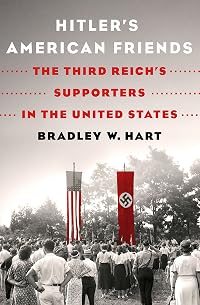
Hitler's American Friends: The Third Reich's Supporters in the United States
by Bradley W. Hart
On This Page
Description
"A book examining the strange terrain of Nazi sympathizers, nonintervention campaigners and other voices in America who advocated on behalf of Nazi Germany in the years before World War II. Americans who remember World War II reminisce about how it brought the country together. The less popular truth behind this warm nostalgia: until the attack on Pearl Harbor, America was deeply, dangerously divided. Bradley W. Hart's Hitler's American Friends exposes the homegrown antagonists who sought to show more protect and promote Hitler, leave Europeans (and especially European Jews) to fend for themselves, and elevate the Nazi regime. Some of these friends were Americans of German heritage who joined the Bund, whose leadership dreamed of installing a stateside Führer. Some were as bizarre and hair-raising as the Silver Shirt Legion, run by an eccentric who claimed that Hitler fulfilled a religious prophesy. Some were Midwestern Catholics like Father Charles Coughlin, an early right-wing radio star who broadcast anti-Semitic tirades. They were even members of Congress who used their franking privilege--sending mail at cost to American taxpayers--to distribute German propaganda. And celebrity pilot Charles Lindbergh ended up speaking for them all at the America First Committee. We try to tell ourselves it couldn't happen here, but Americans are not immune to the lure of fascism. Hitler's American Friends is a powerful look at how the forces of evil manipulate ordinary people, how we stepped back from the ledge, and the disturbing ease with which we could return to it."-- show lessTags
Recommendations














Member Reviews
Rating: 4* of five
The Publisher Says: A book examining the strange terrain of Nazi sympathizers, nonintervention campaigners and other voices in America who advocated on behalf of Nazi Germany in the years before World War II.
Americans who remember World War II reminisce about how it brought the country together. The less popular truth behind this warm nostalgia: until the attack on Pearl Harbor, America was deeply, dangerously divided.
Bradley W. Hart's Hitler's American Friends exposes the homegrown antagonists who sought to protect and promote Hitler, leave Europeans (and especially European Jews) to fend for themselves, and elevate the Nazi regime.
Some of these friends were Americans of German heritage who joined the Bund, whose show more leadership dreamed of installing a stateside Führer. Some were as bizarre and hair-raising as the Silver Shirt Legion, run by an eccentric who claimed that Hitler fulfilled a religious prophesy. Some were Midwestern Catholics like Father Charles Coughlin, an early right-wing radio star who broadcast anti-Semitic tirades. They were even members of Congress who used their franking privilege—sending mail at cost to American taxpayers—to distribute German propaganda. And celebrity pilot Charles Lindbergh ended up speaking for them all at the America First Committee.
We try to tell ourselves it couldn't happen here, but Americans are not immune to the lure of fascism. Hitler's American Friends is a powerful look at how the forces of evil manipulate ordinary people, how we stepped back from the ledge, and the disturbing ease with which we could return to it.
I RECEIVED A DRC FROM THE PUBLISHER VIA NETGALLEY. THANK YOU.
My Review: It's always been a failing of the left-wing political folk to see the Apocalypse in each and every thunderation from the Christo-Fascist Right as the ongoing battle for the USA's soul continues. There are now, there were in the 1950s, there were in the 1930s and 1940s, traitorous scum whose personal vision of a Perfect World contains only people like them, who are willing to do anything legal or not to enforce their will on the eternal majority who don't want that. In an article in The Nation, the author of the think piece I've linked to comments most saliently on the Red Scare years' school-textbook battles, book burnings, and other such performative outrage with this pithy remark:
The fact is that our country's been under some form of internal attack from fascist and/or authoritarian right-wing rabble since Day One. So has every other political structure. Let's not forget the fate of Periclean Athens. It's the eternal project of greedy, selfish control freaks to get everything they can into their own hands and to control what they can't possess.
Author Hart made a well-researched and -written alarm call against calm, resigned acceptance of the culture coup attempted during the 45th president's term in this book. He uses the well-documented and clearly overcome existence, activities, and failures of Nazi sympathizers in the US. It is an effective technique; it uses as its organizing principle a simple structure: Each chapter is dedicated to a single organization active in promoting German/Nazi interests in the US, and gives some crucial details about how and why this choice was made. It also characterizes and puts into timely context the people who made up the institution in question. This avoids a common trap in histories of zeitgeists or social movements, the dreaded alphabet soup of initialism and too-similar or too-often-repeated names. That admittedly more synthetic approach can weave a tapestry of details. It more often than that causes severe MEGO disease.
The most disturbing take-away of this entire loudly rung tocsin is that these forces of anti-democratic rage failed because they lacked a credible, powerful leader. Today's versions, it is very frightening to realize, do not suffer from that lack. It isn't that Author Hart is unaware of this, it's that he seemed to feel he shouldn't make as much of the echoes I heard in each chapter of current events as I would've preferred. There is something to be said for taking off the gloves and hitting the enemy within hard. It's something "they" do a lot of (see my review of The Obama Hate Machine) and with a lot less factual basis than Author Hart presents.
Why this book only gets four stars from me is the quite startling number of uncorrected typos that made it from the DRC I read into the library copy I checked out. Scandalous! And, in the end, there were moments that I found myself not quite satisfied with the case the author made for some person or organization's motivation for opposing the US entry into WWII. Mixed motives are more common than pure ones on every gradation of the ideological spectrum, as (for example) morally based pacifism is present among right-wingers, too.
Perhaps the most telling thing that I noticed go underremarked was the utter ineffectuality of Hoover's FBI in going after right-wing terrorism. Red Scare propaganda against our nominal allies the Soviets was rife. How telling that is...British intelligence informed the US government better about domestic threats than Hoover's FBI.
I was still angered and unsettled and unnerved by this read. I am recommending it to all and sundry who think the Right's victory in the 2022 midterm elections is somehow inevitable. We who do not wish to have our country scourged by the hypocrites and religious nuts of this book's modern counterparts should heed Author Hart's dictum: "{U}nfortunately, the merchants of hate always seem to have someone to listen to them." Let's plug the holes in our national awareness. It can only help the side dedicated to the rights and duties of citizens against the Right's attacks on them. show less
The Publisher Says: A book examining the strange terrain of Nazi sympathizers, nonintervention campaigners and other voices in America who advocated on behalf of Nazi Germany in the years before World War II.
Americans who remember World War II reminisce about how it brought the country together. The less popular truth behind this warm nostalgia: until the attack on Pearl Harbor, America was deeply, dangerously divided.
Bradley W. Hart's Hitler's American Friends exposes the homegrown antagonists who sought to protect and promote Hitler, leave Europeans (and especially European Jews) to fend for themselves, and elevate the Nazi regime.
Some of these friends were Americans of German heritage who joined the Bund, whose show more leadership dreamed of installing a stateside Führer. Some were as bizarre and hair-raising as the Silver Shirt Legion, run by an eccentric who claimed that Hitler fulfilled a religious prophesy. Some were Midwestern Catholics like Father Charles Coughlin, an early right-wing radio star who broadcast anti-Semitic tirades. They were even members of Congress who used their franking privilege—sending mail at cost to American taxpayers—to distribute German propaganda. And celebrity pilot Charles Lindbergh ended up speaking for them all at the America First Committee.
We try to tell ourselves it couldn't happen here, but Americans are not immune to the lure of fascism. Hitler's American Friends is a powerful look at how the forces of evil manipulate ordinary people, how we stepped back from the ledge, and the disturbing ease with which we could return to it.
I RECEIVED A DRC FROM THE PUBLISHER VIA NETGALLEY. THANK YOU.
My Review: It's always been a failing of the left-wing political folk to see the Apocalypse in each and every thunderation from the Christo-Fascist Right as the ongoing battle for the USA's soul continues. There are now, there were in the 1950s, there were in the 1930s and 1940s, traitorous scum whose personal vision of a Perfect World contains only people like them, who are willing to do anything legal or not to enforce their will on the eternal majority who don't want that. In an article in The Nation, the author of the think piece I've linked to comments most saliently on the Red Scare years' school-textbook battles, book burnings, and other such performative outrage with this pithy remark:
Most Americans don’t think that proponents of critical race theory are secretly spreading “Marxism” in the schools, either, or that woke corporations are somehow supporting the same evil project. The people who make such claims are a small minority, just as they were in the 1950s.
The fact is that our country's been under some form of internal attack from fascist and/or authoritarian right-wing rabble since Day One. So has every other political structure. Let's not forget the fate of Periclean Athens. It's the eternal project of greedy, selfish control freaks to get everything they can into their own hands and to control what they can't possess.
Author Hart made a well-researched and -written alarm call against calm, resigned acceptance of the culture coup attempted during the 45th president's term in this book. He uses the well-documented and clearly overcome existence, activities, and failures of Nazi sympathizers in the US. It is an effective technique; it uses as its organizing principle a simple structure: Each chapter is dedicated to a single organization active in promoting German/Nazi interests in the US, and gives some crucial details about how and why this choice was made. It also characterizes and puts into timely context the people who made up the institution in question. This avoids a common trap in histories of zeitgeists or social movements, the dreaded alphabet soup of initialism and too-similar or too-often-repeated names. That admittedly more synthetic approach can weave a tapestry of details. It more often than that causes severe MEGO disease.
The most disturbing take-away of this entire loudly rung tocsin is that these forces of anti-democratic rage failed because they lacked a credible, powerful leader. Today's versions, it is very frightening to realize, do not suffer from that lack. It isn't that Author Hart is unaware of this, it's that he seemed to feel he shouldn't make as much of the echoes I heard in each chapter of current events as I would've preferred. There is something to be said for taking off the gloves and hitting the enemy within hard. It's something "they" do a lot of (see my review of The Obama Hate Machine) and with a lot less factual basis than Author Hart presents.
Why this book only gets four stars from me is the quite startling number of uncorrected typos that made it from the DRC I read into the library copy I checked out. Scandalous! And, in the end, there were moments that I found myself not quite satisfied with the case the author made for some person or organization's motivation for opposing the US entry into WWII. Mixed motives are more common than pure ones on every gradation of the ideological spectrum, as (for example) morally based pacifism is present among right-wingers, too.
Perhaps the most telling thing that I noticed go underremarked was the utter ineffectuality of Hoover's FBI in going after right-wing terrorism. Red Scare propaganda against our nominal allies the Soviets was rife. How telling that is...British intelligence informed the US government better about domestic threats than Hoover's FBI.
I was still angered and unsettled and unnerved by this read. I am recommending it to all and sundry who think the Right's victory in the 2022 midterm elections is somehow inevitable. We who do not wish to have our country scourged by the hypocrites and religious nuts of this book's modern counterparts should heed Author Hart's dictum: "{U}nfortunately, the merchants of hate always seem to have someone to listen to them." Let's plug the holes in our national awareness. It can only help the side dedicated to the rights and duties of citizens against the Right's attacks on them. show less
Very entertaining and revealing book identifying some of the Third Reich's supporters in the United States, or "Hitler's Friends." Named a lot of individuals and businesses that were a surprise to me. The book is broken into eight categories: The Bund, Silver Legion and the Chief, Religious Right, Senators, Businessmen, Students, America First, and Spies. Interesting how happenstance and luck often prevented these groups from having more influence, and how deciding not to pursue some leads probably resulted in danger or harm to Americans or the war effort. The breakdown into the eight chapters made it easy to follow the events and the afterword summed up everything nicely.
Hart, Bradley W. Hitler’s American Friends: The Third Reich’s Supporters in the United States. Thomas Dunne, 2018.
In Hitler’s American Friends, media historian Bradley W. Hart takes a close look at early attempts to generate a fascist movement in the United States to rival those in Germany and Italy. Before WWII, there was no shortage of would-be American Fuhrers. Several were delusional nut cases. Consider, for example, William Pelley, a silent-era screenwriter, who thought Jesus was telling him he was the man to save the country. He became convinced that the Bureau of Indian Affairs had been taken over by Jewish Bolsheviks, making Native Americans his natural allies. For a while, he called himself “Chief Pelley of the Tribe of show more Silver.” But there were other, more serious contenders. Detroit priest Father Coughlin had a radio audience of millions, which he used to spout antisemitic rants that echoed Hitler’s propaganda. He backed the creation of a militia that would spearhead a government takeover. When they were caught robbing an armory, he denied all knowledge. Detroit was a natural home for a right-wing movement because Henry Ford was drawn to the fascist cause and had strong business ties in Germany. Another celebrity, Charles Lindberg was a spokesman for the isolationist America First movement, a group that was cheered on by Nazi propagandists. Had Lindberg been the Republican candidate in 1940, German intelligence had funds secreted to support him. More disturbing was George Sylvester Viereck, a U.S. citizen, who worked for the German government recruiting U. S. legislators to disseminate speeches authored by Viereck and other German intelligence agents. In one scheme he arranged for dozens of legislators to use their franking privileges to send the propaganda directly to their constituents. Note: Hart’s book gets a strong blurb from Rachel Maddow, whose new Rachel Maddow Ultra podcast, tells Viereck’s story. Hart does not make obvious comparisons to present-day right-wing movements, but his readers are no doubt tempted to make them. 4 stars. show less
In Hitler’s American Friends, media historian Bradley W. Hart takes a close look at early attempts to generate a fascist movement in the United States to rival those in Germany and Italy. Before WWII, there was no shortage of would-be American Fuhrers. Several were delusional nut cases. Consider, for example, William Pelley, a silent-era screenwriter, who thought Jesus was telling him he was the man to save the country. He became convinced that the Bureau of Indian Affairs had been taken over by Jewish Bolsheviks, making Native Americans his natural allies. For a while, he called himself “Chief Pelley of the Tribe of show more Silver.” But there were other, more serious contenders. Detroit priest Father Coughlin had a radio audience of millions, which he used to spout antisemitic rants that echoed Hitler’s propaganda. He backed the creation of a militia that would spearhead a government takeover. When they were caught robbing an armory, he denied all knowledge. Detroit was a natural home for a right-wing movement because Henry Ford was drawn to the fascist cause and had strong business ties in Germany. Another celebrity, Charles Lindberg was a spokesman for the isolationist America First movement, a group that was cheered on by Nazi propagandists. Had Lindberg been the Republican candidate in 1940, German intelligence had funds secreted to support him. More disturbing was George Sylvester Viereck, a U.S. citizen, who worked for the German government recruiting U. S. legislators to disseminate speeches authored by Viereck and other German intelligence agents. In one scheme he arranged for dozens of legislators to use their franking privileges to send the propaganda directly to their constituents. Note: Hart’s book gets a strong blurb from Rachel Maddow, whose new Rachel Maddow Ultra podcast, tells Viereck’s story. Hart does not make obvious comparisons to present-day right-wing movements, but his readers are no doubt tempted to make them. 4 stars. show less
This book was sent to me by St. Martin’s Press via NetGalley. Thank you.
Professor Hart has written an excellent, concise account of Americans who supported, and in some cases, actually conspired with Nazi Germany prior to World War II. The first two of eight chapters deal with the German Bund and the Silver League, organizations who had thousands of members. Though these organizations were very vocal, Hart reveals that, for all their noise, they were the least effective in helping Germany achieve its goal of keeping America out of the European War.
The German Bund never really could unite its membership. Some chapters were no more than social organizations which celebrated German culture and others were extreme supporters of show more Hitler’s ideals. These members dressed in distinctive uniforms emulating the SA and sent their children to Nazi-inspired summer camps, some actually in Germany. But because of the flawed leadership, the Bund and the League never really presented a serious threat in their own right and their antics only irritated Nazi Germany whose purpose was to keep America neutral, not alienate its citizenry with obvious pro-Nazi displays.
The Religious Right with its access to the popular medium of radio was quite another matter. Millions of Americans listened to Catholic priest Father Charles Coughlin spew his anti-Semitic beliefs every week. His loyal listeners believed that he was one of them and he played on their fears about how it was Jewish businessmen, in cahoots with President Roosevelt, who controlled the economy in the country and kept the hard-working average citizen from getting ahead.
Hart examines the government officials like Senator Burton K. Wheeler from Montana who pushed the isolationist policies and the universities which still encouraged academic relationships, like foreign exchange studies, even when the atrocities in Germany were common knowledge.
I found the most disturbing chapter to be the analysis of complicit US businesses. The bottom line for the companies was profit so Ford and GM kept their German factories open using forced labor to produce trucks and tanks for the Reich. They collected their profits at the war’s end and only years later compensated the forced laborers. Coca-Cola invented Fanta for the German market because the original syrup could not get through British navy blockade. Montgomery Ward, Sears, Quaker Oats, and other companies did not give up their German ties until after Dec 7, 1941.
Finally, there was the most dangerous organization America First. The chief spokesperson for praising Hitler’s Germany and preaching isolation, if not active support, was Charles Lindbergh. America First had 800,000 active members (as compared to the German Bund at 5,000) and there was a possibility that it could push a presidential candidate in Lindbergh who would give Roosevelt a real challenge.
Why is this study so relevant now? According to Professor Hart, quoting from a letter written by Lord Lothian the British Ambassador, this was Germany’s Plan, “…Cast doubt on the integrity of newspapers and newpapermen who favor the Allied cause… Start attacks along religious and racial lines. Keep the people of the United States fighting among themselves, and play to the keep-out-of-war sentiments of the people by painting the horrors of war." (p. 7)
Finally, the author states why ultimately Germany failed in its attempt to keep the United States isolationist. “For whatever their flaws then and now, America’s political parties and leaders rose to the challenge presented by this moment in history. In many cases, politicians made the difficult decision to act on principle and patriotism rather than out of political expediency and the pursuit of victory at any price. The far right never could find its American fuher…The American political system survived a series of major existential threats at a moment when the fate of the free world hung in the balance. In the face of such courageous stands by America’s leaders, Hitler’s friends never stood much of a chance.” (p. 236) show less
Professor Hart has written an excellent, concise account of Americans who supported, and in some cases, actually conspired with Nazi Germany prior to World War II. The first two of eight chapters deal with the German Bund and the Silver League, organizations who had thousands of members. Though these organizations were very vocal, Hart reveals that, for all their noise, they were the least effective in helping Germany achieve its goal of keeping America out of the European War.
The German Bund never really could unite its membership. Some chapters were no more than social organizations which celebrated German culture and others were extreme supporters of show more Hitler’s ideals. These members dressed in distinctive uniforms emulating the SA and sent their children to Nazi-inspired summer camps, some actually in Germany. But because of the flawed leadership, the Bund and the League never really presented a serious threat in their own right and their antics only irritated Nazi Germany whose purpose was to keep America neutral, not alienate its citizenry with obvious pro-Nazi displays.
The Religious Right with its access to the popular medium of radio was quite another matter. Millions of Americans listened to Catholic priest Father Charles Coughlin spew his anti-Semitic beliefs every week. His loyal listeners believed that he was one of them and he played on their fears about how it was Jewish businessmen, in cahoots with President Roosevelt, who controlled the economy in the country and kept the hard-working average citizen from getting ahead.
Hart examines the government officials like Senator Burton K. Wheeler from Montana who pushed the isolationist policies and the universities which still encouraged academic relationships, like foreign exchange studies, even when the atrocities in Germany were common knowledge.
I found the most disturbing chapter to be the analysis of complicit US businesses. The bottom line for the companies was profit so Ford and GM kept their German factories open using forced labor to produce trucks and tanks for the Reich. They collected their profits at the war’s end and only years later compensated the forced laborers. Coca-Cola invented Fanta for the German market because the original syrup could not get through British navy blockade. Montgomery Ward, Sears, Quaker Oats, and other companies did not give up their German ties until after Dec 7, 1941.
Finally, there was the most dangerous organization America First. The chief spokesperson for praising Hitler’s Germany and preaching isolation, if not active support, was Charles Lindbergh. America First had 800,000 active members (as compared to the German Bund at 5,000) and there was a possibility that it could push a presidential candidate in Lindbergh who would give Roosevelt a real challenge.
Why is this study so relevant now? According to Professor Hart, quoting from a letter written by Lord Lothian the British Ambassador, this was Germany’s Plan, “…Cast doubt on the integrity of newspapers and newpapermen who favor the Allied cause… Start attacks along religious and racial lines. Keep the people of the United States fighting among themselves, and play to the keep-out-of-war sentiments of the people by painting the horrors of war." (p. 7)
Finally, the author states why ultimately Germany failed in its attempt to keep the United States isolationist. “For whatever their flaws then and now, America’s political parties and leaders rose to the challenge presented by this moment in history. In many cases, politicians made the difficult decision to act on principle and patriotism rather than out of political expediency and the pursuit of victory at any price. The far right never could find its American fuher…The American political system survived a series of major existential threats at a moment when the fate of the free world hung in the balance. In the face of such courageous stands by America’s leaders, Hitler’s friends never stood much of a chance.” (p. 236) show less
This is an excellent overview of the many US supporters of Hilter prior to the US entry into WW II. Although much of the book covers familiar ground covered by other authors, it seems to be more comprehensive than other books. The discussion of Father Coughlin was particularly useful.
Particularly valuable is the section detailing what happened to each of the main figures after the war. Very little follow-up was done on these people and the author asks what would have happened if Joseph McCarthy would have identified former Nazi sympathizers in the same way he identified former communists.
The structure of the book, dividing the discussion into areas like businessmen, religion, and politicians, is very effective. My main criticism is show more that it is sometimes difficult to keep timelines straight. show less
Particularly valuable is the section detailing what happened to each of the main figures after the war. Very little follow-up was done on these people and the author asks what would have happened if Joseph McCarthy would have identified former Nazi sympathizers in the same way he identified former communists.
The structure of the book, dividing the discussion into areas like businessmen, religion, and politicians, is very effective. My main criticism is show more that it is sometimes difficult to keep timelines straight. show less
Being an account of America's right wing fringe during the runup to its entry into World War II, incorporating a coda which traces its afterlife, as far as is possible, given that many actors tried and succeeded in fading into history's woodwork after the war. Many of the individuals and organizations are familiar; others, especially in the chapters on business and espionage, are less so. The book reflects solid research and is interesting to read. The author was well-served by neither factchecking nor copy editing; e.g., there were four American radio networks in 1940, not three, and it is difficult to accept that any significant part of the Lend Lease Act's aid went to France late in 1940, as the nation's government had ceased to show more exist in any recognizable form and typos, though not extremely prevalent, are more than one would like to expect from a major house. . show less
Fascinating read about those who sympathized with Hitler before and during WWII. I knew of some of them (Lindberg, Ford Motors), but was surprised by others (Coca-Cola, GM). This is extremely well-researched and I highly recommend to any WWII or history buffs.
Members
- Recently Added By
Lists

History: War & Terrorism
64 works; 1 member
Author Information

3 Works 205 Members
Bradley W. Hart is Assistant Professor at California State University, Fresno, USA. His previous works include a co-edited volume entitled The Foundations of the British Conservative Party: Essays on Conservatism from Lord Salisbury to David Cameron (2013).
Awards and Honors
Common Knowledge
- Original publication date
- 2018
- People/Characters
- Ernest Lundeen; Henry Ford; Charles Lindbergh; O. John Rogge; William Dudley Pelley; George Sylvester Viereck (show all 7); Charles Coughlin
Classifications
- Genres
- History, Nonfiction, Politics and Government, General Nonfiction
- DDC/MDS
- 320.53 — Society, government, & culture Political science Types of Government Political ideologies Radicalism, collectivism, fascism
- LCC
- E806 .H35 — History of the United States United States Twentieth century Franklin Delano Roosevelt's administrations,
- BISAC
Statistics
- Members
- 193
- Popularity
- 170,029
- Reviews
- 8
- Rating
- (3.87)
- Languages
- English
- Media
- Paper, Audiobook, Ebook
- ISBNs
- 5
- ASINs
- 2