
On This Page
Description
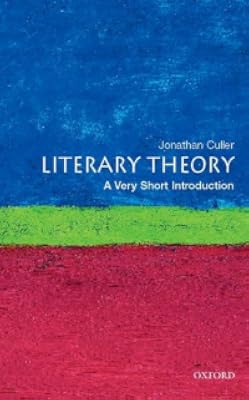
Culler offers insights into theories about the nature of language and meaning, looks at whether literature is a form of self-expression or a method of appeal to an audience, and outlines the ideas behind deconstruction and semiotics.Tags
Recommendations





Member Recommendations
TeaWren I recommend '50 Literature Ideas' first as it provides a clear, concise overview of 50 common literary terms. This way, when 'Literary Theory' uses those words to describe other words/ideas you'll know what it's on about. I wish I'd done that.
20
Member Reviews
I loved that Culler organized the work thematically rather than by critical schools. Given that many of the best theorists overlap in many fields--is Judith Butler a psychoanalyst or feminist? is Althusser a structuralist or Marxist? and what is Foucault?--I think Culler's approach best represents how theory actually works. After all, poststructuralism, Marxism, and psychoanalysis tend to do much the same thing in a theoretical context: they all call 'the natural' (of language, of the state and economics, of the personality) into question and thereby transform the self into subject. That denaturalization is the key difference from what came before, not the differences between, say, a politically informed and a merely linguistic show more poststructuralism.
Moreover, even though it originally appeared about 10 years ago, its refusal to split theory into various schools preserved it from obsolescence. The pure Lacanian died out in 1999 or so, and now the best critics draw on everything.
Highly recommended. This is probably the one I'll assign. show less
Moreover, even though it originally appeared about 10 years ago, its refusal to split theory into various schools preserved it from obsolescence. The pure Lacanian died out in 1999 or so, and now the best critics draw on everything.
Highly recommended. This is probably the one I'll assign. show less
Although Culler's 'very short' (in fact, perfectly sufficient) introduction to literary theory is certainly about literary theory, it also covers much greater ground - 'Theory' itself and its derivatives, cultural studies, feminist theory, gender studies and anti-colonialist theory.
This is because the Academy was drawn deeply into this territory in the latter quarter of the last century. The contemporary study of literature cannot be seriously understood without understanding the incursions into it of these external elements.
As someone who is deeply resistant to the cultural imperialism of Theory and its transformation of thought into ideology, I found Culler's guide to be fair-minded and reasonable, outlining the state of literary show more theory at the end of the last century without taking any particular partisan position.
As a result I can (whatever one's views on what has happened to Western culture) recommend the book as a decent guide to the facts of what has happened. Indeed, it is quite an achievement to cover so much ground so clearly with only very few obscurities in a discipline filled with the latter.
To his credit, he does see the wood for the trees. Although it is more than it promises in its title, he does not neglect the discussion of literature qua literature and he is careful to present more traditional views of writing and text alongside the more fashionable ones.
As a result, for once in my reviews, I do not feel I have to 'critique a critique' but can simply let the text lie as a useful guide - whatever private despair I may feel at the ideologisation of culture by an excess of over-wrought junior academics and their politicised confreres. show less
This is because the Academy was drawn deeply into this territory in the latter quarter of the last century. The contemporary study of literature cannot be seriously understood without understanding the incursions into it of these external elements.
As someone who is deeply resistant to the cultural imperialism of Theory and its transformation of thought into ideology, I found Culler's guide to be fair-minded and reasonable, outlining the state of literary show more theory at the end of the last century without taking any particular partisan position.
As a result I can (whatever one's views on what has happened to Western culture) recommend the book as a decent guide to the facts of what has happened. Indeed, it is quite an achievement to cover so much ground so clearly with only very few obscurities in a discipline filled with the latter.
To his credit, he does see the wood for the trees. Although it is more than it promises in its title, he does not neglect the discussion of literature qua literature and he is careful to present more traditional views of writing and text alongside the more fashionable ones.
As a result, for once in my reviews, I do not feel I have to 'critique a critique' but can simply let the text lie as a useful guide - whatever private despair I may feel at the ideologisation of culture by an excess of over-wrought junior academics and their politicised confreres. show less
This is a fantastic li'l Lit Theory book. It is short, but rather than superficially skimming the surface of as many theoretical schools as possible, Culler takes a more interesting (and page appropriate) approach by encountering those different schools through an exploration of lit theory's practical concerns. You get chapters like "What is Theory?" and "Language, Meaning, and Interpretation," and as a result of his method, you actually do end up coming across some of the main lines of thinking that these theoretical schools identify with, only you do it with an organic understanding of critical theory's overall nature and purpose.
I highly recommend this book to anyone who reads and/or has even a slight interest in literary or cultural show more studies. Jonathan Culler does more in 120 pages than most others do in 500. show less
I highly recommend this book to anyone who reads and/or has even a slight interest in literary or cultural show more studies. Jonathan Culler does more in 120 pages than most others do in 500. show less
This is a fantastic li'l Lit Theory book. It is short, but rather than superficially skimming the surface of as many theoretical schools as possible, Culler takes a more interesting (and page appropriate) approach by encountering those different schools through an exploration of lit theory's practical concerns. You get chapters like "What is Theory?" and "Language, Meaning, and Interpretation," and as a result of his method, you actually do end up coming across some of the main lines of thinking that these theoretical schools identify with, only you do it with an organic understanding of critical theory's overall nature and purpose.
I highly recommend this book to anyone who reads and/or has even a slight interest in literary or cultural show more studies. Jonathan Culler does more in 120 pages than most others do in 500. show less
I highly recommend this book to anyone who reads and/or has even a slight interest in literary or cultural show more studies. Jonathan Culler does more in 120 pages than most others do in 500. show less
This book is actually part of a series from the Oxford University Press dedicated to introducing things... well, very shortly. Culler concentrates not on the different schools of theory (though he does go over them briefly in an appendix), but more the whys and hows. Despite his best efforts, I, an English graduate student, still feel somewhat baffled by the whole thing, but it's a very readable book, and I at least have a somewhat better inkling of all this malarkey than I did before.
This was very dry reading but at least I now know what I would be in for when approaching anything labeled or described as Literary Theory. So if you're in the least bit interested in literary theory but don't know where to start, this is probably the best place. At least when you're finished you'll definitely know if you want to proceed any further with the subject.
Very useful idea for a reference book, great choice of subject matter, nice compact size. Horrible writing style. There were sentences so convoluted in here I reread them thrice over just to make sure I wasn't imagining things or going blind.
Members
- Recently Added By
Author Information

21+ Works 3,852 Members
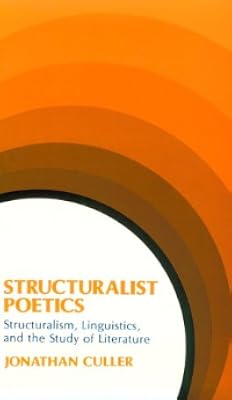
Professor of English and Comparative Literature at Cornell University, Culler has played an important role in the dissemination of structuralist and poststructuralist theory in the U.S. academy. His Structuralist Poetics (1975) was one of the first books to survey the new continental theory, and it included a bibliography with all the English show more translations of that work then available. As the title suggests, Culler's book concentrates on structuralist literary analysis, explicating in particular what various continental critics had to say about the "deep structures" or codes governing literary production as a mode of discourse with an apparent radical diversity of texts and "surface structures." He also covers some of the background to structuralist literary theory. Interestingly, Culler also develops in this book a theory of reading that is not quite structuralist, although it does make use of a structuralist vocabulary and some structuralist ideas. The Pursuit of Signs (1981) is, the second in his trilogy of introductions to this theory. It offers explanations of poststructuralist theory, which is as much a response to as a development of structuralist theory, whose premises it frequently rejects. Just one year later, Culler published a supplement to this volume, On Deconstruction (1982), devoted not only to the work of Derrida but also to the work of American deconstructionists, who were sometimes elaborating deconstruction in more obviously political directions; for example, by generating feminist deconstructive analyses. Culler has continued to interpret Continental theory and theorists for U.S. audiences in his more recent publications. A prolific author, he has also published books about nineteenth-century French literature and culture, the field in which he did his graduate work, and books or essays on a range of other topics which he addresses from the perspective of poststructuralist theory, including puns, tourism, and trash. (Bowker Author Biography) show less
Some Editions
Series

Belongs to Publisher Series
Work Relationships
Has as a teacher's guide
Common Knowledge
- Canonical title
- Literary Theory: A Very Short Introduction
- Original publication date
- 1997
- People/Characters
- Jacques Derrida; Michel Foucault; Robert Frost
- First words
- In literary and cultural studies these days there is a lot of talk about theory - not theory of literature, mind you; just plain 'theory'.
Chapter 1
What is theory?
In literary and cultural studies these days, there has for some time been a lot of talk about theory — not theory of literature, mind you; just plain 'theory'. (2nd ed.)
Preface
Many introductions to literary theory describe a series of 'schools' of criticism. - Last words
- (Click to show. Warning: May contain spoilers.)I began by saying that theory was endless - an unbounded corpus of challenging and fascinating writings - but not just more writings: it is also an ongoing project of thinking which does not end when a very short introduction ends.
(Click to show. Warning: May contain spoilers.)I began by saying that theory was endless — an unbounded corpus of challenging and fascinating writings, to which the 21st century continues to add — but not just more writings: it is also an ongoing project of thinking which does not end when a Very Short Introduction ends. (2nd ed.) - Blurbers
- Kermode, Frank; Miller, J. Hillis; Waugh, Patricia
- Original language
- English
- Canonical DDC/MDS
- 801.95
Classifications
- Genres
- Literature Studies and Criticism, Nonfiction, Philosophy
- DDC/MDS
- 801.95 — Literature & rhetoric Literature, rhetoric & criticism Philosophy and theory Nature and character Literary theory and criticism
- LCC
- PN81 .C857 — Language and Literature Literature (General) Literature (General) Criticism
- BISAC
Statistics
- Members
- 1,981
- Popularity
- 10,613
- Reviews
- 25
- Rating
- (3.57)
- Languages
- 11 — Czech, English, French, German, Greek, Italian, Latvian, Polish, Spanish, Turkish, Portuguese (Portugal)
- Media
- Paper, Audiobook, Ebook
- ISBNs
- 34
- ASINs
- 10