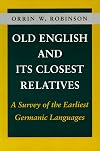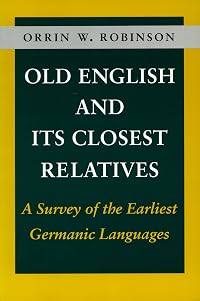
Old English and Its Closest Relatives
by Orrin W. Robinson
On This Page
Description
This accessible introductory reference source surveys the linguistic and cultural background of the earliest known Germanic languages and examines their similarities and differences. The Languages covered include:Gothic Old Norse Old SaxonOld English Old Low Franconian Old High German Written in a lively style, each chapter opens with a brief cultural history of the people who used the language, followed by selected authentic and translated texts and an examination of particular areas show more including grammar, pronunciation, lexis, dialect variation and borrowing, textual transmission, analogy and drift.-- show lessTags
Recommendations












Member Reviews
This is a great basic overview of the various older Germanic languages from a comparative linguistic viewpoint. Its only weakness, I feel, is that its title, with its particular reference to Old English, implies that that language will hold a privileged position — which may or may not be desirable to you, depending on your interests. By singling out Old English from all the other languages in the title, I assumed the author would frequently make comparisons between a given Germanic language and Old English when at all possible. That, however, was not the case and Old English was really just given the same treatment as any of the other languages, both in length and depth of its description, and it was not at all a focal point when show more examples of shared or unique features were noted throughout the book. The subtitle, "A Survey of the Earliest Germanic Languages," is a much more fitting description.
Of course, there are times when certain non-English comparisons were most appropriate — for example, his frequent recourse to Gothic or Old Norse is to be expected given their antiquity or positions as the only East and North Germanic languages in the book, respectively — but there were many instances where I felt the author ignored pointing out interesting connections between a given language and Old English, instead choosing to make that connection with, say, Old High German or Old Saxon instead.
As my rating demonstrates, however, this hardly detracted from my opinion of the book. It was interesting, informative, engaging and well-written. I'm very interested in comparative and historical linguistics in general, though, so the author not following through with what I felt was an implication that Old English would be the main metric of comparison was not a problem for me. However, if you're a student of English and not particularly interested in Germanic linguistics generally, and are looking for a book focused on Old English and how its cousins are similar to it, this book may be overkill for your needs. Put another way, imagine that this book was actually titled "A Survey of the Earliest Germanic Languages," without any special reference to English. If you'd still be interested in such a book, then you should check this one out. show less
Of course, there are times when certain non-English comparisons were most appropriate — for example, his frequent recourse to Gothic or Old Norse is to be expected given their antiquity or positions as the only East and North Germanic languages in the book, respectively — but there were many instances where I felt the author ignored pointing out interesting connections between a given language and Old English, instead choosing to make that connection with, say, Old High German or Old Saxon instead.
As my rating demonstrates, however, this hardly detracted from my opinion of the book. It was interesting, informative, engaging and well-written. I'm very interested in comparative and historical linguistics in general, though, so the author not following through with what I felt was an implication that Old English would be the main metric of comparison was not a problem for me. However, if you're a student of English and not particularly interested in Germanic linguistics generally, and are looking for a book focused on Old English and how its cousins are similar to it, this book may be overkill for your needs. Put another way, imagine that this book was actually titled "A Survey of the Earliest Germanic Languages," without any special reference to English. If you'd still be interested in such a book, then you should check this one out. show less
This is a handy hook for anyone interested in comparative linguistics or in the deeper roots of the English language. Robinson's coverage goes beyond formal grammar and vocabulary to cover the varying natures of the Germanic family's literatures and surviving early documents.
Ratings
Members
- Recently Added By
Lists

Great Books About Language
73 works; 45 members

Books Read in 2017
4,249 works; 130 members
Author Information

4+ Works 326 Members
Common Knowledge
- Canonical title
- Old English and Its Closest Relatives
- Original publication date
- 1992
- First words
- PREFACE
A number of years ago, I began teaching a class at Stanford entitled "Introduction to the Germanic Languages."
On the face of it, the educated speaker would have little reason to think of English and German as variant forms of the same language. - Publisher's editor
- Psoinos, Paul
Classifications
- Genres
- Nonfiction, History
- DDC/MDS
- 430.09 — Language German & related languages German and related languages modified standard subdivisions of Germanic languages History, geographic treatment, biography of Germanic languages
- LCC
- PE124 .R63 — Language and Literature English language English Anglo-Saxon. Old English
- BISAC
Statistics
- Members
- 324
- Popularity
- 98,132
- Reviews
- 2
- Rating
- (4.27)
- Languages
- English
- Media
- Paper, Ebook
- ISBNs
- 5
- ASINs
- 3