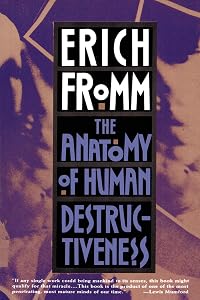
The Anatomy of Human Destructiveness
by Erich Fromm
On This Page
Description
Erich Fromm's groundbreaking examination of aggression and human natureThroughout history, humans have shown an incredible talent for destruction as well as creation. Aggression has driven us to great heights and brutal lows. In The Anatomy of Human Destructiveness, renowned social psychologist Erich Fromm discusses the differences between forms of aggression typical for animals and two very specific forms of destructiveness that can only be found in human beings: sadism and necrophilic show more destructiveness. His case studies span zoo animals, necrophiliacs, and the psychobiographies of notorious figures such as Adolf Hitler and Joseph Stalin. Through his broad scholarship, Fromm offers a comprehensive exploration of the human impulse for violence.This ebook features an illustrated biography of Erich Fromm including rare images and never-before-seen documents from the author's estate. show lessTags
Recommendations









































Member Recommendations

Member Reviews
Fromm immediately endeared himself to me with this epigraph: "When I look at history I am a pessimist... but when I look at prehistory I am an optimist." (Incidentally, this was taken out of context. The writer, JC Smuts, actually only likes prehistory because he believes it shows how far we've come. Quite contrary to the point Fromm is making.)
The first and shortest part of the book is dedicated to a discussion of psychological theory (Instinctivism vs. Behaviorism), and, not being a psychologist, I honestly have forgotten how exactly Fromm comes down on these issues. In the second part, my favorite, Fromm discusses human psychology and society in an evolutionary context. Here, he is trying to systematically debunk the notion that show more human aggression, most clearly demonstrated in Nazi Germany, is biologically innate or culturally inevitable. Toward the end of this part, in an "analysis of thirty primitive tribes," Fromm classifies each as one of three types: "Life-Affirmative Societies," "Nondestructive-Aggressive Societies," and "Destructive Societies."
In the third part, occupying over half the pages, Fromm identifies two main character traits that lead to "malignant aggression": sadism (the Destructive Character, demonstrated by the cases of Joseph Stalin and Heinrich Himmler) and necrophilia (the Necrophilous Character). The latter is broadened far beyond the usual sexual connotation and seems to be Fromm's most significant innovation. The final chapter is an analysis of "Adolf Hitler, A Clinical Case of Necrophilia."
The underlying theme, which I find most significant, is that Nazi Germany is not so much an historical aberration as an extreme case, and the only solution to this malignant aggression is to change the social conditions which precipitate the development of the character types which cause it. show less
The first and shortest part of the book is dedicated to a discussion of psychological theory (Instinctivism vs. Behaviorism), and, not being a psychologist, I honestly have forgotten how exactly Fromm comes down on these issues. In the second part, my favorite, Fromm discusses human psychology and society in an evolutionary context. Here, he is trying to systematically debunk the notion that show more human aggression, most clearly demonstrated in Nazi Germany, is biologically innate or culturally inevitable. Toward the end of this part, in an "analysis of thirty primitive tribes," Fromm classifies each as one of three types: "Life-Affirmative Societies," "Nondestructive-Aggressive Societies," and "Destructive Societies."
In the third part, occupying over half the pages, Fromm identifies two main character traits that lead to "malignant aggression": sadism (the Destructive Character, demonstrated by the cases of Joseph Stalin and Heinrich Himmler) and necrophilia (the Necrophilous Character). The latter is broadened far beyond the usual sexual connotation and seems to be Fromm's most significant innovation. The final chapter is an analysis of "Adolf Hitler, A Clinical Case of Necrophilia."
The underlying theme, which I find most significant, is that Nazi Germany is not so much an historical aberration as an extreme case, and the only solution to this malignant aggression is to change the social conditions which precipitate the development of the character types which cause it. show less
I got this book for 3.5 $ one day as I was walking on the street, and a guy was selling those on the sidewalk. The book called out after me, the title was very attractive, but I never thought it would be such an amazing read! That was back in 2010, I believe. I used this book as a reference for many papers that I wrote, it made me love psychology even more. I shall reread it again this year.
150 FRO 4
Az agresszivitás, a pusztításhajlam, a rombolás vágya ősidőktől fogva sajátja az emberi természetnek - legalábbis így tartja a közhiedelem. Korunk egyik legjelentősebb pszichológusa, e világsikert aratott, számos nyelvre lefordított tudományos alapmű szerzője azonban vitába száll ezzel az önfelmentő vélekedéssel, és elképesztő ismeretanyag felhasználásával, elmés és lenyűgözően logikus érveléssel bizonyítja, hogy a fenti tulajdonságok a modern idők „vívmányai”, a mai ember kevéssé rokonszenves személyiségjegyei.Ahogyan nem ismerünk szadista állatokat sem, a korai ember agresszivitása is csak a védekezést, a túlélést szolgálta, nem volt öncélú, a gyökerei a biológiai show more adottságokig nyúltak vissza, és nem az elme, a tudattalan sötétjéből eredeztettek. show less
Jan 24, 2022Hungarian
Ratings
Members
- Recently Added By
Lists

Books Read in 2009
464 works; 11 members

Nonfreudian/Nonjungian/Nonlacanian/NonD&G Psychological Analysis
36 works; 2 members
Author Information

183+ Works 18,536 Members
Psychologist and philosopher Erich Fromm was born in Frankfurt, Germany on March 23, 1900. He received a Ph.D in sociology from the University of Heidelberg in 1922 and finished his psychoanalytical training at the Psychoanalytical Institute in Berlin in 1930. He started his own clinical practice and joined the Frankfurt Institute for Social show more Research. In 1934, he moved to New York and became a professor at Columbia University. In 1950, he moved to Mexico City and became a professor at the Universidad Nacional Autónoma de Mexico, where he created a psychoanalytic section at the medical school. He retired from there in 1965 and moved to Muralto, Switzerland in 1974. Throughout his life, Fromm maintained a clinical practice and wrote books. His writings were notable for both their social and political commentary and their philosophical and psychological underpinnings. He became known for linking human personality types with socioeconomic and political structures. His most popular book, The Art of Loving, was first published in 1956 and became an international bestseller. He died on March 18, 1980. (Bowker Author Biography) show less
Some Editions
Awards and Honors
Awards
Distinctions
Series
Belongs to Publisher Series
rororo sachbuch (7052)
Work Relationships
Common Knowledge
- Canonical title*
- Anatomía de la destructividad humana
- Original title
- The Anatomy of Human Destructiveness
- Original publication date
- 1973
- First words
- Preface:
This study is the first volume of a comprehensive work on psychoanalytic theory. I s tarted with the study of aggression and destructiveness because, aside from being one of the fundamental theoretical problems<... (show all)br>in psychoanalysis, the wave of destructiveness engulfing the world makes it also one of the most practically relevant ones.
Introduction: Instincts and Human Passions
The increase in violence and destructiveness on a national and world scale has turned the attention of professionals and the general public alike to the theoretical inquiry... (show all) into the nature and causes of
aggression. Such a concern is not surprising; what is surprising is the fact that this preoccupation is so recent, especially since an investigator of the towering stature of Freud, revising his earlier theory centered
around the sexual drive, had already in the 1920s formulated a new theory in which the passion to destroy ("death instinct") was considered equal in strength to the passion to love ("life instinct," "sexuality"). The public, however, continued to think of Freudianism chiefly in terms of presenting the libido as man's central passion, checked only by the instinct for self-preservation. - Last words
- (Click to show. Warning: May contain spoilers.)Thus Freud the scientist became to some extent the prisoner of Freud the leader of the movement; or to put it differently, Freud the teacher became the prisoner of his faithful, but uncreative disciples.
- Original language
- English
- Canonical DDC/MDS
- 155.232
- Canonical LCC
- BF575.A3
*Some information comes from Common Knowledge in other languages. Click "Edit" for more information.
Classifications
- Genres
- Nonfiction, Anthropology, Sociology, General Nonfiction, Philosophy, History
- DDC/MDS
- 155.232 — Philosophy & psychology Psychology Differential and developmental psychology Individual Psychology Traits Particular Traits
- LCC
- BF575 .A3 — Philosophy, Psychology and Religion Psychology Psychology Affection. Feeling. Emotion
- BISAC
Statistics
- Members
- 943
- Popularity
- 28,345
- Reviews
- 5
- Rating
- (4.11)
- Languages
- 17 — Catalan, Czech, Dutch, English, Finnish, French, German, Hungarian, Italian, Lithuanian, Polish, Portuguese, Russian, Serbian, Spanish, Swedish, Turkish
- Media
- Paper, Ebook
- ISBNs
- 38
- ASINs
- 22