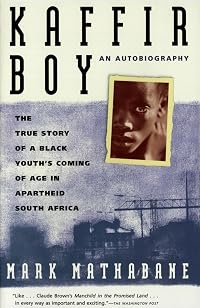
Kaffir Boy: The True Story of a Black Youth's Coming of Age in Apartheid South Africa
by Mark Mathabane
On This Page
Description
The classic story of life in apartheid South Africa Mark Mathabane was weaned on devastating poverty and schooled in the cruel streets of South Africa's most desperate ghetto, where bloody gang wars and midnight police raids were his rites of passage. Like every other child born in the hopelessness of apartheid, he learned to measure his life in days, not years. Yet Mark Mathabane, armed only with the courage of his family and a hard-won education, raised himself up from the squalor and show more humiliation to win a scholarship to an American university. This extraordinary memoir of life under apartheid is a triumph of the human spirit over hatred and unspeakable degradation, for Mark Mathabane did what no physically and psychologically battered "Kaffir" from the rat-infested alleys of Alexandra was supposed to do-he escaped to tell about it. show lessTags
Recommendations




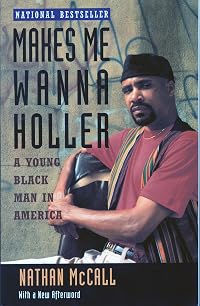
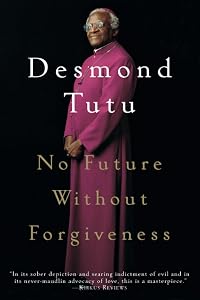
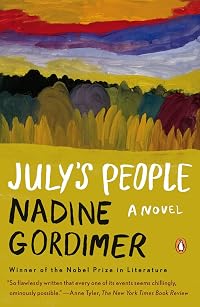

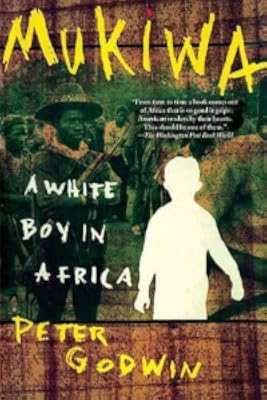


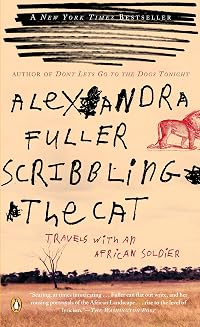
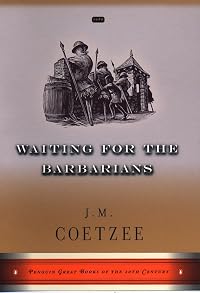
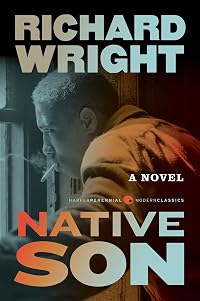
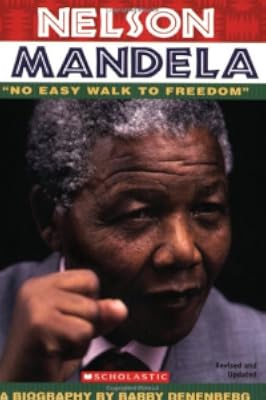
Member Recommendations
Member Reviews
Set in South Africa during the dark days of apartheid, Kaffir Boy is the story of Mark Mathabane's life. He lives with his family in a ghetto in Johannesburg, not only in abject poverty, but also in constant fear of police raids. The police roust the black population frequently to verify their "passes," the documents that allow them permission to live and work. Unfortunately, the passes are rarely in order because keeping them clear often requires bribes and also because the rules are completely nonsensical - you need a pass to live in the city, but you first need a nearby job to allow the document that permits you to live there. And you need the pass to get a job, although if you're unemployed, you're not allowed to be issued a pass. show more Sound ridiculous? It is. It would be merely farcical if the raids didn't involve terrifying children and tossing the meager contents of homes, and if the penalties didn't include being shipped off to tribal reserves or being imprisoned.
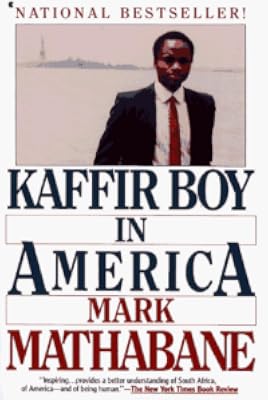
I remember apartheid being an issue in the media when I was in high school in the '80s, but I admit I didn't know about the incredible inhumanity of it. As practiced, it sounded like it was possibly more dehumanizing than slavery, and I honestly didn't think such a thing could exist. Mark was subject to "Bantu education," which was the non-compulsory system to prepare black children for their lives of subservience. Faced with few opportunities, he worked as hard as he could at school and also fell into playing tennis, which opened doors to him that he might never have known existed. A meeting with Stan Smith, an American Wimbledon champion and seemingly all-around great guy, led to Mathabane eventually getting a scholarship to go to college in the US, which is where the book ends. He later wrote another memoir, Kaffir Boy in America, which picks up where this one left off. I am curious about it because before leaving South Africa, Mathabane clearly views America as a sort of interracial utopia - which is definitely was not in 1979 (and still isn't today).
I listened to the audio version of the book, which was narrated by Mathabane himself. His speaking voice is beautiful and melodic, and I doubt that anyone else could have done justice to the words in various tribal languages, protest anthems, childhood songs, and snippets in Afrikaans. Some of the events were very difficult to listen to, and I had to take a couple of breaks from it just to regain my equilibrium. But nonetheless, I would recommend it to anyone interested in learning more about what daily life was like under apartheid. show less
I remember apartheid being an issue in the media when I was in high school in the '80s, but I admit I didn't know about the incredible inhumanity of it. As practiced, it sounded like it was possibly more dehumanizing than slavery, and I honestly didn't think such a thing could exist. Mark was subject to "Bantu education," which was the non-compulsory system to prepare black children for their lives of subservience. Faced with few opportunities, he worked as hard as he could at school and also fell into playing tennis, which opened doors to him that he might never have known existed. A meeting with Stan Smith, an American Wimbledon champion and seemingly all-around great guy, led to Mathabane eventually getting a scholarship to go to college in the US, which is where the book ends. He later wrote another memoir, Kaffir Boy in America, which picks up where this one left off. I am curious about it because before leaving South Africa, Mathabane clearly views America as a sort of interracial utopia - which is definitely was not in 1979 (and still isn't today).
I listened to the audio version of the book, which was narrated by Mathabane himself. His speaking voice is beautiful and melodic, and I doubt that anyone else could have done justice to the words in various tribal languages, protest anthems, childhood songs, and snippets in Afrikaans. Some of the events were very difficult to listen to, and I had to take a couple of breaks from it just to regain my equilibrium. But nonetheless, I would recommend it to anyone interested in learning more about what daily life was like under apartheid. show less
KAFFIR BOY (a library sale find) has been sitting on my bookshelf for several years, and now I've finally read it. It was a major bestseller in 1986 when it was first published, mainly for its graphic content, I suspect. Because author Mathabane was unflinching in his depiction of the squalid ghetto where he grew up, the eldest of several children in apartheid South Africa where whites ruled with an iron fist to keep the native blacks "in their place." "Kaffir" is the South African equivalent of the n-word, and I was indeed often reminded of the works of Richard Wright, Dick Gregory and James Baldwin, all of whom I read back in my college days. While I absolutely admire Mathabane for what he endured, and how he persevered in his studies show more (in ill-equipped, substandard schools) and managed to "escape" to the United States on a tennis scholarship, I often felt buried in redundant descriptions of the horrors and indignities of apartheid, and felt some scrupulous editing could have made this an even better book. Googling Mathabane, I found he is now a US citizen and has written a few more books, but for now I'm kinda on the fence as to whether I'll read them. But I am glad I read this one - a real eye-opener on the apartheid system, something that played a prominent part in a favorite Graham Greene novel, THE HUMAN FACTOR. This was a good book though, if a little too long, and I will recommend it highly, especially to anyone curious about the apartheid era.
- Tim Bazzett, author of the memoir, BOOKLOVER show less
- Tim Bazzett, author of the memoir, BOOKLOVER show less
The term "kaffir" is a derogatory term in South Africa, and its use in the title is somewhat shocking but perhaps, appropriately so. The book tells the story of Johannes (Mark) and his family, his childhood in South Africa and then his success in the the world of tennis. It tells of the sacrifices and struggles of his mother and her belief that education was so very important to the future of her children. Heartwarming but so sad.
A powerful and thought provoking look at life in a South African shanty town. Emotionally, the 1st 50 pages of the book were difficult to get through, but I do consider it a must-read for anyway wanting to understand the Apartheid era in South Africa.
Kaffir Boy by Mark Mathabane is an amazing autobiography that tells of Mark Mathabane's childhood thru adult hood and the many things he had to go thru during the time of apartheid in South Africa. I really enjoyed this book more than any autobiography I have read. The setting is set in the mid-1960's and goes thru the years til 1990's when Mark moves to America. This book was really inspiring to me for the simple fact that Mark achieved something so extrordinary that no one else could in South Africa of that time. Anyone who loves real life stories with a happy ending is going to enjoy this book.
A very inspiring success story from a man with the odds stacked against him from birth. I have had the pleasure of hearing Mr. Mathabane speak on television and was impressed by the clarity of his message. He delivers his words crisply and precisely, and there is no doubt about his convictions. It is apparent that he speaks from experience. And he writes as well as he speaks.
This is a novel about Mark Mathabane, and what it was like for him growing up in the Apartheid that was South Africa. This novel provides a look into something no one in my classroom will have seen before, and it brings up issues of wealth, race, and racial history, all of which have certain places in classroom discussion. Because Mathabane succeeded in his pursuits as a tennis player, it is also an story that can provide inspiration to its readers. Because of the rare perspective of Apartheid it provides, as well as the charged issues it deals with, Kaffir Boy is a novel that I would love to incorporate into my own classroom.
Members
- Recently Added By
Lists

Best Autobiographies and Memoirs
370 works; 67 members

Africa
109 works; 8 members

Banned Books Week 2014
268 works; 63 members
School Made Us Read It
380 works; 197 members

B-B to Get
131 works; 1 member
Author Information

11+ Works 1,973 Members
Mark Mathabane is the author of Kaffir Boy in America, Love in Black and White, and African Women: Three Generations.
Some Editions
Awards and Honors
Awards
Series
Belongs to Publisher Series
dtv (10913)
Work Relationships
Is abridged in
Has as a student's study guide
Common Knowledge
- Canonical title
- Kaffir Boy: The True Story of a Black Youth's Coming of Age in Apartheid South Africa
- Original title
- Kaffern Boy
- Original publication date
- 1986
- Epigraph
- I, as a Christian, have always felt that there is one thing above all about "apartheid" or "seperate development" that is unforgivable. It seems utterly indifferent to the suffering of individual persons, who lose their land... (show all), their homes, their jobs, in pursuit of what surely is the most terrible dream in the world. -Albert Luthuli, 1960 Nobel Peace Prize winner
"Rise like Lions after slumber In unvanquishable number- Shake your chains to earth like dew Which in sleep had fallen on you- Ye are many - they are few." -Percy Bysshe Shelley, The Mask of Anarchy
The limits of tyrants are prescriberd by the endurance of those whom they oppress. -Frederick Douglas
Give me the liberty to know, to utter, and to argue freely according to conscience, above all liberties. -John Milton - Dedication
- This book is dedicated to those handful of white South Africans who helped me grow as a human being and a tennis player, and with who, I share the hope of someday seeing a South Africa free of aparthied; and to Stan and Marjo... (show all)ry Smith, who believed in me and gave me a new lease on life by providing me with the opportunity to realize my dream. A very special dedication goes to my family and to millions of my black brothers and sisters who still remain slaves in the prison house of apartheid. To them, for teaching me to fight and to be a survivor, I chant, "Amandla! Awethu! (Power is ours!)"; let us not rest until we are free to live in dignity in the land of our birth.
- First words
- Warning: This road passes through proclaimed Bantu locations, any person who enters the locations without a permit renders himself liable for prosecution for contravening the Bantu (Urban areas) consolidation act of 1945, a... (show all)nd the location regulation act of the city of Johannesburg.
- Last words
- (Click to show. Warning: May contain spoilers.)I followed destiny.
Classifications
Statistics
- Members
- 1,441
- Popularity
- 16,426
- Reviews
- 15
- Rating
- (4.02)
- Languages
- 5 — Dutch, English, German, Norwegian, Swedish
- Media
- Paper, Audiobook, Ebook
- ISBNs
- 29
- UPCs
- 1
- ASINs
- 10