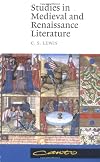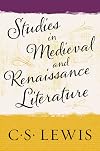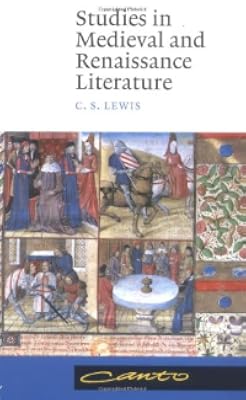
Studies in Medieval and Renaissance Literature
by C. S. Lewis
On This Page
Description
This entertaining and learned volume contains book reviews, lectures, and hard to find articles from the late C. S. Lewis, whose constant aim was to show the twentieth-century reader how to read and understand old books and manuscripts. Highlighting works by Spenser, Dante, Malory, Tasso, and Milton, Lewis provides a refreshing update to medieval and Renaissance criticism, and equips modern readers to understand these works in a new way.Tags
Recommendations









Member Reviews
These studies have been taken from lecture notes or books begun and abandoned by Lewis and were probably never meant for publication. They have been collected and edited by Walter Hooper and were published as a book of essays in 1966 three years after Lewis's death.
The essays are certainly more than just scrapings from the bottom of a barrel, they are mostly well written, stand up well enough on their own and provide plenty of thoughtful material. The first three provide an excellent introduction on how to approach a medieval text and how to view the medieval world. The next three will be of interest for those reading, or familiar with Dante's Divine Comedy and the final bunch covers Edmund Spenser and his Faerie Queene. There are also show more short essays on Malory's Morte d'Arthur and Tasso.
I found some gems in the first three essays on medieval text and was hooked on reading the very first paragraph of the first essay: De Audiendis Poetis (How to study Poetry):
"There are more ways than one of reading old books. A choice between two of them is well expressed by Mr Spiers when he denounces as 'discouraging' that before the modern reader can properly appreciate a medieval poem he must first have somehow put himself back into the age when it was composed. For thus he will be seeking not 'what the poem means', but 'what it once meant' and will become concerned less with reading and responding to a poem than with reading outside it
That anything that takes us outside the poem and leaves us there is regrettable, I fully agree. But we may have to go outside it in order that we may come inside it again, better equipped."
In the essay Genesis of a Medieval Book Lewis discusses authorship and points to the differences of the medieval approach to our own today. Lewis says Medieval writers were engaged in a sort of 'touching up' exercise; why invent new stories when there were plenty of excellent old stories available. He was concerned with presenting the story to a medieval audience and if this involved embellishment or emasculation then so be it. He was not concerned with accuracy or in many instances with the modern idea of authorship. Lewis's essay on Imagination and Thought in the Middle Ages attempts to present to us a medieval persons view of the world. In the excellent The Discarded Image he explains this at some length but here the shorter version is no less effective.
In Morte d'Arthur Lewis is concerned with exploring Malory's view of the world especially his ideas on nobility which is a key theme in the work. The essays on Dante's The Divine Comedy follows some close reading of the text and will be of interest to those people reading or familiar with the poem. The essays on Spenser are a 'mixed bag' There are good essays on Tasso's influence, the life of Spenser and how to approach The Faerie Queene, however essays on Neo-Platonism and the role of Genius in Spenser's allegory are dense and scholarly.
Not an essential book and it would be only of limited interest to the casual reader. However with my interest in medieval literature and Edmund Spenser there was more than enough to keep me interested show less
The essays are certainly more than just scrapings from the bottom of a barrel, they are mostly well written, stand up well enough on their own and provide plenty of thoughtful material. The first three provide an excellent introduction on how to approach a medieval text and how to view the medieval world. The next three will be of interest for those reading, or familiar with Dante's Divine Comedy and the final bunch covers Edmund Spenser and his Faerie Queene. There are also show more short essays on Malory's Morte d'Arthur and Tasso.
I found some gems in the first three essays on medieval text and was hooked on reading the very first paragraph of the first essay: De Audiendis Poetis (How to study Poetry):
"There are more ways than one of reading old books. A choice between two of them is well expressed by Mr Spiers when he denounces as 'discouraging' that before the modern reader can properly appreciate a medieval poem he must first have somehow put himself back into the age when it was composed. For thus he will be seeking not 'what the poem means', but 'what it once meant' and will become concerned less with reading and responding to a poem than with reading outside it
That anything that takes us outside the poem and leaves us there is regrettable, I fully agree. But we may have to go outside it in order that we may come inside it again, better equipped."
In the essay Genesis of a Medieval Book Lewis discusses authorship and points to the differences of the medieval approach to our own today. Lewis says Medieval writers were engaged in a sort of 'touching up' exercise; why invent new stories when there were plenty of excellent old stories available. He was concerned with presenting the story to a medieval audience and if this involved embellishment or emasculation then so be it. He was not concerned with accuracy or in many instances with the modern idea of authorship. Lewis's essay on Imagination and Thought in the Middle Ages attempts to present to us a medieval persons view of the world. In the excellent The Discarded Image he explains this at some length but here the shorter version is no less effective.
In Morte d'Arthur Lewis is concerned with exploring Malory's view of the world especially his ideas on nobility which is a key theme in the work. The essays on Dante's The Divine Comedy follows some close reading of the text and will be of interest to those people reading or familiar with the poem. The essays on Spenser are a 'mixed bag' There are good essays on Tasso's influence, the life of Spenser and how to approach The Faerie Queene, however essays on Neo-Platonism and the role of Genius in Spenser's allegory are dense and scholarly.
Not an essential book and it would be only of limited interest to the casual reader. However with my interest in medieval literature and Edmund Spenser there was more than enough to keep me interested show less
Ratings
Members
- Recently Added By
Author Information

528+ Works 522,829 Members
C. S. (Clive Staples) Lewis, "Jack" to his intimates, was born on November 29, 1898 in Belfast, Ireland. His mother died when he was 10 years old and his lawyer father allowed Lewis and his brother Warren extensive freedom. The pair were extremely close and they took full advantage of this freedom, learning on their own and frequently enjoying show more games of make-believe. These early activities led to Lewis's lifelong attraction to fantasy and mythology, often reflected in his writing. He enjoyed writing about, and reading, literature of the past, publishing such works as the award-winning The Allegory of Love (1936), about the period of history known as the Middle Ages. Although at one time Lewis considered himself an atheist, he soon became fascinated with religion. He is probably best known for his books for young adults, such as his Chronicles of Narnia series. This fantasy series, as well as such works as The Screwtape Letters (a collection of letters written by the devil), is typical of the author's interest in mixing religion and mythology, evident in both his fictional works and nonfiction articles. Lewis served with the Somerset Light Infantry in World War I; for nearly 30 years he served as Fellow and tutor of Magdalen College at Oxford University. Later, he became Professor of Medieval and Renaissance English at Cambridge University. C.S. Lewis married late in life, in 1957, and his wife, writer Joy Davidman, died of cancer in 1960. He remained at Cambridge until his death on November 22, 1963. (Bowker Author Biography) show less
All Editions
Series
Belongs to Publisher Series
Common Knowledge
- Canonical title
- Studies in Medieval and Renaissance Literature
- Original title
- Studies in Medieval and Renaissance literature
- Original publication date
- 1966 (collection) (collection)
- Original language*
- Englisch
*Some information comes from Common Knowledge in other languages. Click "Edit" for more information.
Classifications
- Genres
- Literature Studies and Criticism, Nonfiction, Fiction and Literature, Religion & Spirituality
- DDC/MDS
- 809.02 — Literature & rhetoric Literature, rhetoric & criticism History, description, critical appraisal of more than two literatures By Period 6th-15th centuries, 500-1499
- LCC
- PN681 .L4 — Language and Literature Literature (General) Literature (General) Literary history By period Medieval (to 1500)
- BISAC
Statistics
- Members
- 400
- Popularity
- 77,542
- Reviews
- 1
- Rating
- (4.17)
- Languages
- Chinese, English
- Media
- Paper, Ebook
- ISBNs
- 6
- ASINs
- 4