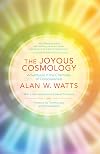
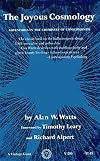
The Joyous Cosmology: Adventures in the Chemistry of Consciousness
by Alan W. Watts
On This Page
Description
A classic account of the psychedelic experience The Joyous Cosmology is Alan Watts's exploration of the insight that the consciousness-changing drugs LSD, mescaline, and psilocybin can facilitate "when accompanied with sustained philosophical reflection by a person who is in search, not of kicks, but of understanding." More than an artifact, it is both a riveting memoir of Watts's personal experiments and a profound meditation on our perennial questions about the nature of existence and the show more existence of the sacred. show lessTags
Recommendations


















Member Reviews
It was a quick read. Due to the material's age, I did not find anything that I haven't already come across elsewhere. The disdain for prohibition and the knowledge that it simply does not work plainly put as it was, to me, was a point of interest. Politicians (at least in this country) are so far behind this currently that a book from the late 1960s is still somewhat relevant. Of course, most of those mummies were around then too: I should call them all ghouls from now on. Do I recommend this one? Not really, you could probably find something more up-to-date along the same lines.
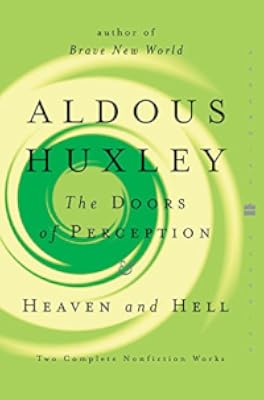
The other reviews pretty much said what I think. This was the last of Watts' books I had on my list to read, and I was understandably excited given the subject matter treated by one of my favorite thinkers. He uses his incredible ability of expressing complex ideas very simply in order to describe various "hallucinogenic" experiences he has had: the things he has seen, the thoughts that have occurred, etc. It sometimes reads pretty dry, when he uses very esoteric words to create a sort of poetry of sound instead of actually trying to convey a point. But in other places he raises such good observations and describes the altered thought process so clearly that the rest of the book more than makes up for it. It's an important Watts book show more for any fan of his to have in their collection, esp. given the collaboration with Alpert/Dass and Leary. It's also an excellent and natural companion piece for Huxley's The Doors of Perception/Heaven & Hell. show less
Ratings
Members
- Recently Added By
Lists

Nonordinary States of Consciousness
184 works; 7 members
Author Information

224+ Works 17,197 Members
Alan Watts (1915-1973) was a renowned lecturer and the author of nearly thirty books, including The Way of Zen and The Book. Born in Chislehurst, England, he moved to the United States in 1938 and began Zen training in New York. He received a master's degree in theology from Seabury-Western Theological Seminary and served as an Episcopal priest show more before leaving the ministry in 1950 to move to California, where he joined the faculty of the American Academy of Asian Studies (now the California Institute of Integral Studies). show less
Common Knowledge
- Original title
- The Joyous Cosmology
- Original publication date
- 1962
- Dedication
- To the people of Druid Heights
- First words
- [Prologue] Slowly it becomes clear that one of the greatest of all suberstitions is the separation of the mind from the body.
[Main] To begin with, this world has a different kind of time. It is the time of biological rythm, not the of the clock and all that goes with the clock. - Quotations
- But for this reason the scientist understands better than anyone else just how inseperable things are. The more he tries to cut out external influences upon an experimental siutation, the more he discovers new ones, hitherto ... (show all)unsuspected. The more carefully he describes, say, the motion of a given particle, the more he finds himself describing also the space in which it moves.
Such aids to perception are medicines, not diets, and as the use of a medicine should lead on to a more healthful mode of living, so the experiences which I have described suggest measures we might take to maintain a sounder ... (show all)form of sanity.
No one is more dangerously insane than one who is sane all the time: he is like a steel bridge without flexibility, and the order of his life is rigid and brittle. - Last words
- (Click to show. Warning: May contain spoilers.)[Main] Its warmth and radiance—“tongues of flame infolded”—are an efflorescence of love so endearing that I feel I have seen the heart of all hearts.
(Click to show. Warning: May contain spoilers.)[Epilogue] For the clear direction of their thought is toward the revelation of a unified cosmology, no longer sundered by the ancient irreconcilables of mind and matter, substance and attribute, thing and event, agent and agt, stuff and energy. And if this should come to be a universe in which man is neither thought nor felt to be a lonely subject confronted by alien and threatening objects, we shall have a cosmology not only unified but also joyous. - Original language
- English
Classifications
Statistics
- Members
- 351
- Popularity
- 89,691
- Reviews
- 2
- Rating
- (4.06)
- Languages
- Czech, English, French, German
- Media
- Paper, Ebook
- ISBNs
- 7
- ASINs
- 7