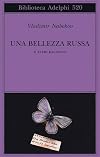
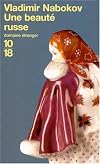
A Russian Beauty and Other Stories
by Vladimir Nabokov
On This Page
Description
Translations of thirteen stories reflect the author's personal and social interests between 1924 and 1940.Tags
Recommendations














Member Reviews
I enjoyed this varied collection quite a bit. I rated eleven of the thirteen individual stories as 7s or 8s (out of 10). And aside from the strengths of the stories separately, I was also fascinated by the window offered by many of them into the world of Russian expatriates in Berlin after the First World War. The prose was a pleasure to read, although you might want to have a dictionary close to hand when you tackle this book.
The stories offer quite a bit of variety, with simple stories that connect at an emotional level and others that are more complicated and in some cases ambiguous. Often it seems that short stories make little or no effort to build character, but Nobokov gives us intriguing and compelling people even in some of show more the shortest of these tales.
My favorites were "An Affair of Honor," "A Visit to the Museum," and "Lips to Lips." show less
The stories offer quite a bit of variety, with simple stories that connect at an emotional level and others that are more complicated and in some cases ambiguous. Often it seems that short stories make little or no effort to build character, but Nobokov gives us intriguing and compelling people even in some of show more the shortest of these tales.
My favorites were "An Affair of Honor," "A Visit to the Museum," and "Lips to Lips." show less
What can one say about Nabokov's collection of stories, written originally in Russian, during the 1930s? I've never really liked Nabokov (except for the novel Ada, which I found enthralling), but I'm completely fascinated by him, his works, and his disdain for the average reader. I must say that, unlike some of his novels, I didn't feel him constantly poking me in the back as I read and whispering, "did you get that? did you get that? I thought not," with a superior smirk on his face. Although I did smell him looking over my shoulder when reading the short introductions he included before each of the stories.
Many of the stories have for milieu the faded, sad world of Russian emigres in Berlin. He captures the atmosphere of people who show more are living their lives between expectation and resignation: a magical and awkward kind of limbo. In the stories "Ultima Thule" and "Solus Rex", both of which were chapters from an unfinished and destroyed novel, Nabokov's way with language and storytelling draws you along and it is a wonderful ride. It makes one wish he had finished that novel.
Contains: Foreword; A Russian Beauty; The Leonardo; Torpid Smoke; Breaking the News; Lips to Lips; The Visit to the Museum; An Affair of Honor; Terra Incognita; A Dashing Fellow; Ultima Thule; Solus Rex; The Potato Elf; The Circle show less
Many of the stories have for milieu the faded, sad world of Russian emigres in Berlin. He captures the atmosphere of people who show more are living their lives between expectation and resignation: a magical and awkward kind of limbo. In the stories "Ultima Thule" and "Solus Rex", both of which were chapters from an unfinished and destroyed novel, Nabokov's way with language and storytelling draws you along and it is a wonderful ride. It makes one wish he had finished that novel.
Contains: Foreword; A Russian Beauty; The Leonardo; Torpid Smoke; Breaking the News; Lips to Lips; The Visit to the Museum; An Affair of Honor; Terra Incognita; A Dashing Fellow; Ultima Thule; Solus Rex; The Potato Elf; The Circle show less
This collection of short stories is the first writing by Nabakov that I have ever read, and I liked it. Thirteen stories, originally written in Russian and published in the émigré press, some of which were translated and published in various English periodicals, now gathered together. Well, not exactly now, as my copy was published in 1973, and I believe I obtained in the early '90's. Nonetheless, this is a delightful collection of stories. Many are set in Berlin in the 1920's-'30's, where Nabakov's family first settled after fleeing the Russian Revolution. To borrow from the language of music, there is writing here in major and minor keys, with interesting lines of melody and harmony, varying pitch and intriguing tempo. The stories show more are 90 years old, republished in English over 40 years ago, and yet still carrying a fresh and captivating aroma. I've never read Nabakov before, but these stories whet my palate to sample him again someday. show less
A somewhat variable collection of stories written during Nabokov's emigre years, published in Russian language publications like Posledniya Novosti, and then re-published in English in such magazines as The New Yorker and Playboy in the '60's & '70's. The weakest of these tales, "Torpid Smoke" & "Terra Icognita", survive as modernistic experiments with little of intrinsic interest. Others are richly comic ("Lips to Lips", "An Affair of Honor") and/or polgnant, in a grotesque sort of way ("The Potato Elf", "Breaking the News"). Of special interest are the first two chapters of an abandoned novel that clearly pave the way to such masterpieces as Pale Fire -- "Ultima Thule" and "Solus Rex". Of course, a dictionary is required, as is a show more nocuous sense of humor, in order to enjoy many of Nabokov's sentiments or such sentence fragments such as: "goodness knows into what furuncles the mamillae of merit may turn under scrutiny!" show less
Nabokov can do no wrong.
Ratings
Members
- Recently Added By
Author Information

458+ Works 95,792 Members
Vladimir Vladimirovich Nobokov was born April 22, 1899 in St. Petersburg, Russia to a wealthy family. He attended Trinity College, Cambridge. When he left Russia, he moved to Paris and eventually to the United States in 1940. He taught at Wellesley College and Cornell University. Nobokov is revered as one of the great American novelists of the show more 20th Century. Before he moved to the United States, he wrote under the pseudonym Vladimir Serin. Among those titles, were Mashenka, his first novel and Invitation to a Beheading. The first book he wrote in English was The Real Life of Sebastian Knight. He is best know for his work Lolita which was made into a movie in 1962. In addition to novels, he also wrote poetry and short stories. He was a finalist for the National Book Award for Fiction seven times, but never won it. Nabokov died July 2, 1977. show less
All Editions
Common Knowledge
- Epigraph
- To Véra
- First words
- Olga, of whom we are about to speak, was born in the year 1900, in a wealthy, carefree family of nobles.
- Original language
- Russian
Classifications
- Genres
- General Fiction, Fiction and Literature
- DDC/MDS
- 891.7 — Literature & rhetoric Literatures of other languages East Indo-European and Celtic literatures Russian and East Slavic languages
- LCC
- PZ3 .N121 — Language and Literature Fiction and juvenile belles lettres Fiction and juvenile belles lettres Fiction in English
Statistics
- Members
- 275
- Popularity
- 116,753
- Reviews
- 5
- Rating
- (4.00)
- Languages
- 6 — English, French, German, Italian, Japanese, Spanish
- Media
- Paper, Ebook
- ISBNs
- 20
- ASINs
- 2