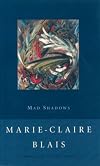
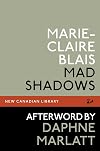
Mad Shadows
by Marie-Claire Blais
On This Page
Description
A harrowing pathology of the soul, Mad Shadows centres on a family group: Patrice, the beautiful and narcissistic son; his ugly and malicious sister, Isabelle-Marie; and Louise, their vain and uncomprehending mother. These characters inhabit an amoral universe where beauty reflects no truth and love is an empty delusion. Each character is ultimately annihilated by their own obsessions.Tags
Recommendations

























Member Reviews
I read this slim, disturbing novella in one sitting during the middle of the night, partly because I could not tear myself away from the drama and partly because it was so twisted that I needed it to be over. This is a warped, dark fairy tale exploring themes related to family, love, beauty, and ugliness. It is mostly about mean people who do treacherous things to one another. It’s seriously impressive how much violence and hatred Blais packed into this short novella. It kind of kicks ass in the same way a Babes in Toyland song does: a short but concentrated burst of fury, distortion, and aggressive female rage. Maybe Blais is Quebec’s answer to Flannery O’Connor (minus the grace at the end). Even though this novella is almost 60 show more years old, it’s well worth checking out if you are looking for a bold, dynamic, and twisted example of how powerful the form can be. show less
This was Canadian author Marie-Claire Blais’s first book. It was published in 1959 and translated from the French by Daphne Marlatt in 1960. Blais was a winner of the French language Governor General’s award in 1996 for Soifs.
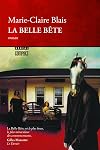
Apparently this was made into a film last year with its French title, La Belle Bête. I wish they would have kept this title, The Beautiful Beast, for the English version of the book rather than using Mad Shadows. The Beautiful Beast is much more fitting.
"She thought of the approaching marriage of this pair of dolls, a male doll and a female doll. She would have to live in the midst of this depravity-the artificial depravity of faces in the movies. How sad, she thought, they have no souls."
This is a story of a show more very dysfunctional family. Louise is a beautiful, but aging mother who is trying her best to hold on to her beauty. Aside from the usual ways, she also does this by nearly worshipping her son Patrice, who is beautiful but retarded. She sees her own beauty in him and thus is blind to his mental condition. In contrast to her extreme over-affection for her son is her disdain for her daughter Isabelle-Marie. She is not loved by her mother simply because she is not beautiful. This sets up a series of events that is catastrophic for the family.
To be frank, I read this book because it was short (130 pages), and I could use it for the Canadian Challenge. While not ‘enjoyable’ because of the subject matter, it was thought-provoking, and I’m very glad I did read it. I would recommend it to anyone, not just those participating in the Canadian Challenge. show less
Apparently this was made into a film last year with its French title, La Belle Bête. I wish they would have kept this title, The Beautiful Beast, for the English version of the book rather than using Mad Shadows. The Beautiful Beast is much more fitting.
"She thought of the approaching marriage of this pair of dolls, a male doll and a female doll. She would have to live in the midst of this depravity-the artificial depravity of faces in the movies. How sad, she thought, they have no souls."
This is a story of a show more very dysfunctional family. Louise is a beautiful, but aging mother who is trying her best to hold on to her beauty. Aside from the usual ways, she also does this by nearly worshipping her son Patrice, who is beautiful but retarded. She sees her own beauty in him and thus is blind to his mental condition. In contrast to her extreme over-affection for her son is her disdain for her daughter Isabelle-Marie. She is not loved by her mother simply because she is not beautiful. This sets up a series of events that is catastrophic for the family.
To be frank, I read this book because it was short (130 pages), and I could use it for the Canadian Challenge. While not ‘enjoyable’ because of the subject matter, it was thought-provoking, and I’m very glad I did read it. I would recommend it to anyone, not just those participating in the Canadian Challenge. show less
This was a novel that was read by Mott The Hoople’s Svengali, Guy Stevens, and became one of their album titles as well.
It’s a strange tale of an unhappy family but appellee entitled mad, dark, and in the shadows. There is the beautiful but idiot son, the long-suffering daughter who is ugly, the narcissistic mother and they do not live happily ever after. The afterword claims that somehow this is in the context of Roman Catholic Quebec but for the life of me I don’t see any Catholic references in it at all. If anything it reminds me of E.L. Doctorow’s Sweet Land stories short, depressing, and sad.
It’s a strange tale of an unhappy family but appellee entitled mad, dark, and in the shadows. There is the beautiful but idiot son, the long-suffering daughter who is ugly, the narcissistic mother and they do not live happily ever after. The afterword claims that somehow this is in the context of Roman Catholic Quebec but for the life of me I don’t see any Catholic references in it at all. If anything it reminds me of E.L. Doctorow’s Sweet Land stories short, depressing, and sad.
[Mad Shadows] is the fifth novel but the first published novel of Marie-Claire Blais, Quebec’s Margaret Atwood. It is the story is about the dysfunctional relationship between a mother with her daughter and her son. While Blais’ [A Season in the Life of Emmanuel] is undoubtedly more famous, [Mad Shadows] made her a star in certain literary circles, especially American. I was originally excited to read this book; the hope of something short, dynamic, and by a famous but obscure to me author seemed enticing.
My Summation: this isn’t a very good novel or novella or even a good short story. The plot of [Mad Shadows] was so contrived, the narration was so artificial, the dialogue was phoney, I literally put this book down somewhere in show more Part One when the summer started and read twelve or twenty other books instead. Nietzsche was some magnificent ball of hashish compared to Blais.
The novel is literally bare of anything that does not advance the thesis. What is the thesis? The thesis is textbook psychology as applied to rural Quebec; though one would not know it was Quebec since there are no frames of reference that some wrongly take as filler. The use of such derivative dramatic themes and clichés of mother-daughter detachment, a slow death via cancer, narcissism, and suicide before a speeding train—which might tug at the heart-strings of some—are so unimaginative that I would’ve expected this from a high school student or an Ontario high school teacher.
Sometimes readers are generous, and justly so, to translated works. Much of the original flavour, sentiment, and sometimes even the meaning can be lost in translation. Readers, however, can be disappointed or even insulted with repetition after repetition of virtually the same words and lines, when others would have sufficed; I think I counted three uses of “lust” and/or “lustily” in a sitting. However, while I have no doubt that Merloyd Lawrence did an adequate job, I find no reason to be charitable with [Mad Shadows].
I’m pretty sure that any translator in the biz can do a faithful translation of this novel. English and French, and their antecedents, have been translated into the other since at least the Norman Invasion of 1066; the road is well worn and has been known commonly since ages past, Milord! Heck, I know French—no one born in Ontario doesn’t know a bit of French—and last night I tried to reverse translate the novel back into French to see what I might have missed. I didn’t miss much; it seems, in either language.
>>>> Two Thumbs Down show less
My Summation: this isn’t a very good novel or novella or even a good short story. The plot of [Mad Shadows] was so contrived, the narration was so artificial, the dialogue was phoney, I literally put this book down somewhere in show more Part One when the summer started and read twelve or twenty other books instead. Nietzsche was some magnificent ball of hashish compared to Blais.
The novel is literally bare of anything that does not advance the thesis. What is the thesis? The thesis is textbook psychology as applied to rural Quebec; though one would not know it was Quebec since there are no frames of reference that some wrongly take as filler. The use of such derivative dramatic themes and clichés of mother-daughter detachment, a slow death via cancer, narcissism, and suicide before a speeding train—which might tug at the heart-strings of some—are so unimaginative that I would’ve expected this from a high school student or an Ontario high school teacher.
Sometimes readers are generous, and justly so, to translated works. Much of the original flavour, sentiment, and sometimes even the meaning can be lost in translation. Readers, however, can be disappointed or even insulted with repetition after repetition of virtually the same words and lines, when others would have sufficed; I think I counted three uses of “lust” and/or “lustily” in a sitting. However, while I have no doubt that Merloyd Lawrence did an adequate job, I find no reason to be charitable with [Mad Shadows].
I’m pretty sure that any translator in the biz can do a faithful translation of this novel. English and French, and their antecedents, have been translated into the other since at least the Norman Invasion of 1066; the road is well worn and has been known commonly since ages past, Milord! Heck, I know French—no one born in Ontario doesn’t know a bit of French—and last night I tried to reverse translate the novel back into French to see what I might have missed. I didn’t miss much; it seems, in either language.
>>>> Two Thumbs Down show less
Ratings
Members
- Recently Added By
Lists

New Canadian Library
191 works; 7 members
Author Information

54+ Works 1,007 Members
Marie Claire Blais, 1939 - French-Canadian writer Marie Claire Blais was born in 1939. Her first published novel, "La Belle Bete" (1959; Mad Shadows, 1960), was received with mixed reviews. It tells the story of a family in her native Quebec Province that is shut off from other people and love. Blais has also written plays and poetry and used show more poetic techniques in the novella "Le Jour est Noir" (1962; The Day is Dark, 1967). Her best known novel, "Une Saison dans la Vie d'Emmanuel" (1965; A Season in the Life of Emmanuel, 1966), won France's Prix Medicis and tells the bleak story of people trapped in their worn degraded, poverty-stricken worlds. (Bowker Author Biography) show less
Awards and Honors
Awards
Series
Belongs to Publisher Series
New Canadian Library (78)
Common Knowledge
- Original title
- La Belle Bête
- Original publication date
- 1959
- Related movies
- La belle Bête (2006 | IMDb)
- Disambiguation notice
- Original title: La Belle Bête (English: Mad Shadows)
Classifications
Statistics
- Members
- 167
- Popularity
- 196,154
- Reviews
- 4
- Rating
- (3.54)
- Languages
- English, French
- Media
- Paper, Ebook
- ISBNs
- 6
- ASINs
- 5