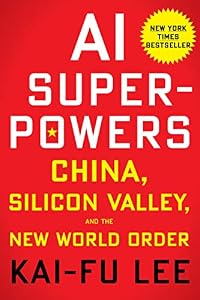
AI Superpowers: China, Silicon Valley, and the New World Order
by Kai-Fu Lee
On This Page
Description
In this thought-provoking book, Lee argues powerfully that because of the unprecedented developments in AI, dramatic changes will be happening much sooner than many of us expected. Indeed, as the US-Sino AI competition begins to heat up, Lee urges the US and China to both accept and to embrace the great responsibilities that come with significant technological power. Most experts already say that AI will have a devastating impact on blue-collar jobs. But Lee predicts that Chinese and show more American AI will have a strong impact on white-collar jobs as well. Is universal basic income the solution? In Lee's opinion, probably not. But he provides a clear description of which jobs will be affected and how soon, which jobs can be enhanced with AI, and most importantly, how we can provide solutions to some of the most profound changes in the future of human history. show lessTags
Recommendations











Member Recommendations
Member Reviews
I fail to see why this book gets such high ratings. Yes, it's written in a very readable way. Despite the author's experience in A.I., he never makes it too technical. There are not enough graphic charts, but the ones that are there are very useful.
Unfortunately, all of this is of course not enough to write a positive review. Why not? Well, for starters, there's almost no mention of India. I'm a aware that this book is meant to be a comparison between the two tech giants, but India is up & coming, and I believe that it will surpass China very soon. And now, the worst part: this has got to be the most repetitive book I've ever read. I'll give you an example: In chapter 5, The Four Waves of AI, Lee mentions the Chinese company Iflytek a show more whopping eight times, and this is only on the first two pages!
I still don't understand how I made it through... show less
Unfortunately, all of this is of course not enough to write a positive review. Why not? Well, for starters, there's almost no mention of India. I'm a aware that this book is meant to be a comparison between the two tech giants, but India is up & coming, and I believe that it will surpass China very soon. And now, the worst part: this has got to be the most repetitive book I've ever read. I'll give you an example: In chapter 5, The Four Waves of AI, Lee mentions the Chinese company Iflytek a show more whopping eight times, and this is only on the first two pages!
I still don't understand how I made it through... show less
An exceptionally well-crafted, insightful, and captivating exploration of the history and current landscape of artificial intelligence. Kai-Fu Lee masterfully delves into the intricacies of entrepreneurship in China, drawing from his personal experiences to provide an unparalleled perspective. With clarity and depth, the author elucidates the fundamental concepts of AI and deep learning, demystifying their operations and elucidating their vast potential as well as the associated risks.
The latter part of the book delves into the potential perils entailed by the profound automation that AI can usher in. Lee presents a compelling array of strategies to preempt and potentially address these challenges, ranging from innovative retraining show more initiatives to workload reduction measures. Notably, he delves into the intriguing notion of utilizing a Universal Basic Income (UBI) as a tool to mitigate the societal impact of increased automation.
What sets Lee's narrative apart is his unique perspective, shaped by his triumphant battle against cancer. This perspective lends a profound dimension to his insights on AI's implications and its trajectory, in contrast to the often mechanistic and productivity-centric views prevalent in the field. He introduces a visionary model rooted in symbiosis, envisioning a future where AI takes on automation tasks while humans focus on endeavors necessitating empathy, affection, and human connection.
Within this envisioned human-AI symbiosis, Lee introduces the concept of a social stipend, strategically fostering a framework where individuals are incentivized to contribute through volunteering and personal growth. This transformative proposal encapsulates the evolution of societal dynamics that AI can catalyze, fundamentally redefining the traditional contours of work and human interaction.
In summation, Kai-Fu Lee's opus is extraordinary, deftly weaving together history, technology, and human sentiment. Through his unique vantage point, he imparts a compelling narrative that challenges convention and inspires contemplation, illuminating a future where AI and humanity coalesce in harmonious coexistence. show less
Lee has written a readable and informative book that provides the reader with an understanding of the past, present, and future development of artificial intelligence. He describes in detail the work being done in AI in the United States and China—the global leaders in artificial intelligence. He identifies the promises and perils of AI infiltrating all aspects of our lives. It is easy to read the first two-thirds of the book as a wake-up call for America to pay attention to the Chinese juggernaut that threatens American economic and technological supremacy. But then Lee makes an unexpected pivot. He shares his personal confrontation with cancer and how it changed his value system. In the last third of the book, Lee outlines how the show more disruption being caused by AI can be a catalyst for transforming human society. The current trajectory threatens a future with dramatic increases in unemployment and economic inequality, which heighten the likelihood of violent social upheaval. Lee envisions a future where AI technology and human compassion are integrated to create societies characterized by love. This is a book to be read by anyone interested in getting a glimpse of the possible futures that await humanity and who wants to make informed choices about the direction we should take. show less
I think that this is an okay book in terms of giving the reader an overview of Artificial Intelligence(AI). It shows its growth and the potential disruption that may occur in the future. The main focus is on the domination of AI by the United States and China. Lee has been involved with AI for 30 years and has worked in both the US and China in a variety of positions in the technology world. He really gets into the differences between Silicon Valley and China in terms of how they develop products. He shows that our dominating position in technology can be eroded if China takes the lead in AI. I do think he seems to cheer lead too much for China and their governments support for AI development. He presupposes that this regime will always show more be there to support things. I do think that the things he points out in terms of the possibility of great societal disruption are insightful. I just felt that the book could have been summed up in a long article. It does make you realize that unless AI is properly managed the potential for future problems could be large. I think Yuval Hurari "Human Deux" deals with the future of technology is a better way. show less
Wider in scope than the title suggests
I enjoyed reading this book because of the high level view it provides of several important tends in tech in the last decade and likely the next one: the growing significance of the Chinese tech ecosystem and of machine learning based applications.
The background section explaining the rise of and competition between Chinese tech companies for the Chinese market is probably good enough reason to get the book, because the stories in it challenge many unstated assumptions in the West about the nature of Chinese tech companies today. ( Eg. That they are copycats which map neatly to an American prototype, or that they are almost like government sponsored monopolies, or even that American companies' show more failure to dominate that market are mostly due to government action ).
I found his take on which industries are more susceptible to automation in the coming decades based on data categories, and his appraisal of the strengths and weaknesses of the American and Chinese tech ecosystems thought provoking. For example, that Chinese companies will have or already have the data edge in industries that mix digital and physical world operations, due to vertical integration and amount of users,
And that America has the edge in top talent. This later factor would only come into play in the case of a true breakthrough (eg in the amount of labelled data needed), so it is unpredictable. In other industries he sees them as more evenly matched.
There's more in it than those two topics. Later sections make the case that the effects on employment may be more relevant to the world at large than the rivalry angle in the title.
I liked the organization of the book and the clarity of the writing, though it comes at the cost of some repetition. In terms of things that seem missing: more digging into the constraints different ecosystems operate under, eg privacy and labor laws and their enforcement, surveillance, as well as trade secrets. He mentions there is a privacy law in China as well, but there's no digging into details comparing them or what it means in practice. show less
I enjoyed reading this book because of the high level view it provides of several important tends in tech in the last decade and likely the next one: the growing significance of the Chinese tech ecosystem and of machine learning based applications.
The background section explaining the rise of and competition between Chinese tech companies for the Chinese market is probably good enough reason to get the book, because the stories in it challenge many unstated assumptions in the West about the nature of Chinese tech companies today. ( Eg. That they are copycats which map neatly to an American prototype, or that they are almost like government sponsored monopolies, or even that American companies' show more failure to dominate that market are mostly due to government action ).
I found his take on which industries are more susceptible to automation in the coming decades based on data categories, and his appraisal of the strengths and weaknesses of the American and Chinese tech ecosystems thought provoking. For example, that Chinese companies will have or already have the data edge in industries that mix digital and physical world operations, due to vertical integration and amount of users,
And that America has the edge in top talent. This later factor would only come into play in the case of a true breakthrough (eg in the amount of labelled data needed), so it is unpredictable. In other industries he sees them as more evenly matched.
There's more in it than those two topics. Later sections make the case that the effects on employment may be more relevant to the world at large than the rivalry angle in the title.
I liked the organization of the book and the clarity of the writing, though it comes at the cost of some repetition. In terms of things that seem missing: more digging into the constraints different ecosystems operate under, eg privacy and labor laws and their enforcement, surveillance, as well as trade secrets. He mentions there is a privacy law in China as well, but there's no digging into details comparing them or what it means in practice. show less
Classical case of bad China business writing:
* Reduce world to a binary contrast between ‘Caricature USA’ vs ‘Caricature China’;
* Ignore the political context and the CCP’s behaviour and aims entirely;
* Fall for the ‘Amazing China’ propaganda trap, engage in baseless speculation based on anecdotes and pilots and PR stunts.
Questionable economics, non-existent labour theory.
Alright introduction to debate on impact of AI.
* Reduce world to a binary contrast between ‘Caricature USA’ vs ‘Caricature China’;
* Ignore the political context and the CCP’s behaviour and aims entirely;
* Fall for the ‘Amazing China’ propaganda trap, engage in baseless speculation based on anecdotes and pilots and PR stunts.
Questionable economics, non-existent labour theory.
Alright introduction to debate on impact of AI.
Probably the 4th book I've read on AI. He starts by correctly identifying the superpower competition between China and the US, and identifies aspects in which China is on the path to superiority. He is gloomy about what it means for the labor force in the future, but then devolves into a maudlin memoir of his own brush with death and how that has shaped his views of humanity and tries to tie it to the issue at hand.
Members
- Recently Added By
Lists

Mind Expanding Books by hackerkid
581 works; 8 members

The China Project Book List
100 works; 2 members
Author Information
14 Works 858 Members
Kai-Fu Lee was born on December 3, 1961 in Taipei, Taiwan. He earned a B.S. degree in computer science from Columbia University and a Ph.D in computer science from Carnegie Mellon University. In 1988, he completed his doctoral dissertation on Sphinx, the first large-vocabulary, speaker-independent, continuous speech recognition system. Lee has show more written two books on speech recognition and more than 60 papers in computer science. His doctoral dissertation was published in 1988 as a Kluwer monograph, Automatic Speech Recognition: The Development of the Sphinx Recognition System. Together with Alex Waibel, another Carnegie Mellon researcher, Lee edited Readings in Speech Recognition. (Bowker Author Biography) show less
Some Editions
Awards and Honors
Awards
Notable Lists
Common Knowledge
- Canonical title*
- I.A. La plus grande mutation de l'histoire
- Original title
- AI Superpowers. China, Silicon Valley, and the New World order
- Original publication date
- 2018-09-25 (1e édition originale anglaise ∙ Houghton Mifflin Harcourt) (1e édition originale anglaise ∙ Houghton Mifflin Harcourt); 2019-09-04 (1e traduction et édition française, Essai, Les Arènes) (1e traduction et édition française, Essai, Les Arènes)
- Original language*
- Anglais (Etats-Unis) (Etats-Unis)
*Some information comes from Common Knowledge in other languages. Click "Edit" for more information.
Classifications
- Genres
- Technology, Economics, Nonfiction, General Nonfiction, Business, Science & Nature
- DDC/MDS
- 338.4 — Society, government, & culture Economics Production Secondary industries and services
- LCC
- HC79 .I55 .L435 — Social sciences Economic history and conditions Economic history and conditions Special topics
- BISAC
Statistics
- Members
- 512
- Popularity
- 58,374
- Reviews
- 16
- Rating
- (3.66)
- Languages
- 5 — English, French, German, Portuguese, Spanish
- Media
- Paper, Audiobook, Ebook
- ISBNs
- 15
- ASINs
- 4