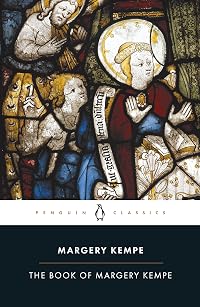
The Book of Margery Kempe
by Margery Kempe
On This Page
Description
The Book of Margery Kempe is the extraordinary account of a medieval wife, mother and mystic from Norfolk. Having married in c. 1393, given birth to 14 children, and pursued unsuccessful ventures in brewing and milling, Kempe made a vow of chastity and embarked on a life of prayer, penance and pilgrimage. Known as the earliest autobiography in the English language, it contains intimate portraits of people and places, and a remarkable eye for detail, as it traces the transformation of a show more 'sinful wretch' to a holy pilgrim. show lessTags
Recommendations







Member Recommendations
Member Reviews
I don't get why people are giving Margery poor reviews. She's fantastic. She's a rare peek into a voice we don't hear often from Medieval Times - an illiterate, lower-middle-class woman.
It all started when Margery had her first child (the first of many). She experienced what we might call post-partum psychosis, but which they called "full of devils". After eight months tormented by insanity, a vision of Jesus brought her back to herself. Thereafter, Margery was able to converse with holy figures - Jesus, Mary, and even God himself, and often became so overwhelmed with her experiences that she fell on the ground, wept, screamed and cried.
Margery switches between lofty religious concerns to petty grievances at the drop of a hat - show more complaining about how her fellow pilgrims bullied her and stole her pillow, or acquaintances constantly trying to ditch her.
Even though I might not have tolerated her long as a companion, I can't help but admire her special brand of feisty derangement from this safe distance of 800 years. She travelled widely, visiting the Holy Land and Rome as a woman travelling alone (attaching herself to unwary pilgrimage groups or unlucky beggars). She was arrested more than once, and if you believe her, defended herself well.
I especially liked her response upon being told that women weren't to preach, essentially. "I'm not preaching, I'm just talking."
Her husband was a long-suffering fellow, who Margery said sometimes went away when the embarrassment came to much, but always returned in the end. She bullied him into taking a vow of celibacy with her, revealing to the bizarre sex-negativity of the of the Medieval Christian world - in which even consensual sex with one's lawfully-married spouse was considered unclean - and he eventually accepted under the threat of Jesus' wrath.
Margery still complains of the local gossips spreading awful rumours that she was having sex with her husband, and so she was forced to live apart from him to prove her nay-sayers wrong. This backfires when, nearing the end of his life, her husband has a dangerous accident, and the same gossips allegedly accuse her of being responsible for his injury since she wasn't home looking after him like a good wife.
She also claimed to have the gift of prophesy. One of her sons, married and living on the continent, considered visiting her, but was frightened of the dangerous journey. She consulted her visions, and assured him that he would arrive home in perfect health. So he and his wife came, only for him to fall ill and die shortly after arriving.
Margery, of course, reasons that her prophesy was correct, since technically he got home before dying. And anyway, going home to God is the ultimate and best sort of a homecoming.
Inexplicably, she later fell out with her daughter in law.
Margery is fantastic, unique, wacky, probably suffers from mental illness, feisty, insufferable, petty and an all-round character. I don't see how anyone can read her and not laugh, cringe, and at times sympathise at her antics. show less
It all started when Margery had her first child (the first of many). She experienced what we might call post-partum psychosis, but which they called "full of devils". After eight months tormented by insanity, a vision of Jesus brought her back to herself. Thereafter, Margery was able to converse with holy figures - Jesus, Mary, and even God himself, and often became so overwhelmed with her experiences that she fell on the ground, wept, screamed and cried.
Margery switches between lofty religious concerns to petty grievances at the drop of a hat - show more complaining about how her fellow pilgrims bullied her and stole her pillow, or acquaintances constantly trying to ditch her.
Even though I might not have tolerated her long as a companion, I can't help but admire her special brand of feisty derangement from this safe distance of 800 years. She travelled widely, visiting the Holy Land and Rome as a woman travelling alone (attaching herself to unwary pilgrimage groups or unlucky beggars). She was arrested more than once, and if you believe her, defended herself well.
I especially liked her response upon being told that women weren't to preach, essentially. "I'm not preaching, I'm just talking."
Her husband was a long-suffering fellow, who Margery said sometimes went away when the embarrassment came to much, but always returned in the end. She bullied him into taking a vow of celibacy with her, revealing to the bizarre sex-negativity of the of the Medieval Christian world - in which even consensual sex with one's lawfully-married spouse was considered unclean - and he eventually accepted under the threat of Jesus' wrath.
Margery still complains of the local gossips spreading awful rumours that she was having sex with her husband, and so she was forced to live apart from him to prove her nay-sayers wrong. This backfires when, nearing the end of his life, her husband has a dangerous accident, and the same gossips allegedly accuse her of being responsible for his injury since she wasn't home looking after him like a good wife.
She also claimed to have the gift of prophesy. One of her sons, married and living on the continent, considered visiting her, but was frightened of the dangerous journey. She consulted her visions, and assured him that he would arrive home in perfect health. So he and his wife came, only for him to fall ill and die shortly after arriving.
Margery, of course, reasons that her prophesy was correct, since technically he got home before dying. And anyway, going home to God is the ultimate and best sort of a homecoming.
Inexplicably, she later fell out with her daughter in law.
Margery is fantastic, unique, wacky, probably suffers from mental illness, feisty, insufferable, petty and an all-round character. I don't see how anyone can read her and not laugh, cringe, and at times sympathise at her antics. show less
From the medieval history reading program. This is called “the first English autobiography”, which is somewhat stretching the term. Margery Kempe was a 14th century middle class Englishwoman from Lynn who had an extreme bout of postpartum depression after her first child and suddenly began having fits of uncontrollable sobbing every time she went to church, and then every time she had religious thoughts – which was often. She had conversations with Jesus, Mary, Mary Magdalene, St. Bridget, St. Katherine, St. John the Evangelist, and pretty much the entire calendar of saints. This went on her entire life, from around 1390 or so to sometime in the 1400s (she’s known to have been born in 1373 and lived at least until she was 65). show more
She must have been insufferable. Her book relates the trials and tribulations she underwent because her contemporaries didn’t like her crying. She went on pilgrimage to Jerusalem, Rome, Compostella, and Aachen – crying the whole way. Groups of pilgrims would pick her up out of sympathy, tolerate her for a while, and then abandon her in the middle of nowhere after they couldn’t take the sobbing any more. (She was always reassured by whatever saint she was in touch with at the time that her companions were merely hypocritically abashed by her holiness). She’s certainly annoying to the reader, as she makes practically no mention of politics, or description of her travels, or even the names of her family (she took a vow of chastity, but had 14 children; her husband was importunate).
An interesting question to me is how she survived. From what little she reveals, she was middle class (itself sort of a rarity in medieval England); she always managed to find enough money to go on pilgrimages (I don’t know how much it would cost to get from England to Jerusalem in the 14th century, but I imagine it wasn’t within the reach of the lower class). In many cases she depended on the charity of others, who must have been happy to feed her just because she couldn’t cry and eat at the same time. Another interesting observation is no one ever suggested she was mad – although madness was certainly known at the time. Instead she was repeatedly accused of being a heretic – a Lollard. (For those of you who have mislaid your copy of Peterson’s Guide to Medieval Heresy, Lollards were followers of John Wycliffe, who held that humans could understand God by reading the Bible, and didn’t need the intervention of priests. Wycliffe produced the first English translation of the Bible). Kempe was questioned several times by various authorities, including the Archbishop of Canterbury; her views were always pronounced orthodox, although it was often suggested that she go home and act like a normal woman (i.e., weaving or spinning or cooking) rather than crying all the time. She certainly makes no favorable reference to Lollardry in her book, although her direct conversations with Jesus and the saints may have been taken as bypassing priestly intervention.
Very frustrating, much as Margery must have been. show less
She must have been insufferable. Her book relates the trials and tribulations she underwent because her contemporaries didn’t like her crying. She went on pilgrimage to Jerusalem, Rome, Compostella, and Aachen – crying the whole way. Groups of pilgrims would pick her up out of sympathy, tolerate her for a while, and then abandon her in the middle of nowhere after they couldn’t take the sobbing any more. (She was always reassured by whatever saint she was in touch with at the time that her companions were merely hypocritically abashed by her holiness). She’s certainly annoying to the reader, as she makes practically no mention of politics, or description of her travels, or even the names of her family (she took a vow of chastity, but had 14 children; her husband was importunate).
An interesting question to me is how she survived. From what little she reveals, she was middle class (itself sort of a rarity in medieval England); she always managed to find enough money to go on pilgrimages (I don’t know how much it would cost to get from England to Jerusalem in the 14th century, but I imagine it wasn’t within the reach of the lower class). In many cases she depended on the charity of others, who must have been happy to feed her just because she couldn’t cry and eat at the same time. Another interesting observation is no one ever suggested she was mad – although madness was certainly known at the time. Instead she was repeatedly accused of being a heretic – a Lollard. (For those of you who have mislaid your copy of Peterson’s Guide to Medieval Heresy, Lollards were followers of John Wycliffe, who held that humans could understand God by reading the Bible, and didn’t need the intervention of priests. Wycliffe produced the first English translation of the Bible). Kempe was questioned several times by various authorities, including the Archbishop of Canterbury; her views were always pronounced orthodox, although it was often suggested that she go home and act like a normal woman (i.e., weaving or spinning or cooking) rather than crying all the time. She certainly makes no favorable reference to Lollardry in her book, although her direct conversations with Jesus and the saints may have been taken as bypassing priestly intervention.
Very frustrating, much as Margery must have been. show less
Margery Kempe is a fascinating personality, both for her unpretentious mysticism and for the psychological anxiety that her intense spirituality caused her. In her book, she is candid about her struggles with clerical hypocrisy, with sexuality, and with the negative reactions of others to the outward expressions of her visions (she seems to have spent an inordinate amount of time weeping and loudly crying out, manifestations of her grief at the sufferings of Christ's Passion). But for all the turmoil in her psyche, she evinces no skepticism about her mystical beliefs, relating as fact many of her conversations with God.
The text is repetitive and lacking in detail, even given its antiquity. However, Margery Kempe's guilelessness creates show more a vivid, revealing self-portrait. The Penguin edition I read was sparse in annotation. The Norton Critical Edition, which I haven't seen, might provide a better contextual framework for the book. show less
The text is repetitive and lacking in detail, even given its antiquity. However, Margery Kempe's guilelessness creates show more a vivid, revealing self-portrait. The Penguin edition I read was sparse in annotation. The Norton Critical Edition, which I haven't seen, might provide a better contextual framework for the book. show less
I felt obliged to try reading this first autobiographical work in the English language, and fortunately it was not as bad as I'd feared. Margery reveals almost nothing about her times (14th century England) but there's entertainment to be had in others' reactions to her incessant weeping, which I can well understand, and yet - since I didn't have to listen to her? - I found her sympathetic. She takes too many daring chances, subjects herself to too much humiliation for me to suspect her of being insincere in her faith.
If her story struck me as funny in places (especially when I forgot how roughshod a society she lived in that could easily make good on its death threats), it isn't out of disrespect for her devotion. I'm made skeptical show more by the voice of God that sounds almost nothing like him in the Bible, something she doesn't try to do in the brief second part written years later. Her insisting that she bore every trial like a meek saint is a stark contrast with the book itself, which amounts to a written defense and is sometimes even threatening to her persecutors.
Perhaps Margery suffered under a mental illness and this rationalized it for her, maybe it was at least partly an act, or perhaps she really was more blessed than most. It's an intriguing artifact, whichever your view. show less
If her story struck me as funny in places (especially when I forgot how roughshod a society she lived in that could easily make good on its death threats), it isn't out of disrespect for her devotion. I'm made skeptical show more by the voice of God that sounds almost nothing like him in the Bible, something she doesn't try to do in the brief second part written years later. Her insisting that she bore every trial like a meek saint is a stark contrast with the book itself, which amounts to a written defense and is sometimes even threatening to her persecutors.
Perhaps Margery suffered under a mental illness and this rationalized it for her, maybe it was at least partly an act, or perhaps she really was more blessed than most. It's an intriguing artifact, whichever your view. show less
I was inspired to read this after thoroughly enjoying The Book of the Maidservant, by Rebecca Barnhouse. It was hard to believe that the maidservant's mistress, Margery Kempe, was so ridiculous, but I see after reading her first-person account, that Margery Kempe was indeed a ridiculous woman. This is believed to be the first English autobiography, written during the 15th century, lost for many years, then found in the early 1900's. Margery Kempe would be an excellent tragic heroine of her own soap opera, with some people adoring her and others reviling her. She talks to Jesus, and he asks her thoughts on a variety of topics. She speaks of many things, from sex to the reputation of holy men to the brewing of beer, and she ultimately show more undertakes a pilgrimage to the Holy Land. And she weeps. And weeps. And weeps. You have to give the woman credit - she certainly had an extremely high opinion of herself and her religious beliefs. And she had in incredibly tolerant husband (she made him take a vow of chastity after having had 14 children with him), but perhaps this was partly due to her inherited wealth. Though I couldn't finish the book (she was just too much for me), it was still pretty amazing to get a glimpse into the life of this illiterate, powerful, pious, and slightly mad woman. show less
It's probably a bit unfair to give this only two stars as it is very much of its era and closely follows the form of 'Saints Lives' type books . It isn't meant to be a tightly plotted literary masterpiece, it does not even unfold chronologically. Though I sometimes enjoyed the (unintentional) wry humour of some of it, on the whole I felt a bit manipulated by Margery. I would most definitely come down on the 'madness' side of any argument, but have a sneaking suspicion that may be exactly what Margery would have wanted in order to feed her martyr complex.
On the whole, though, I am glad that I read it and it contains some interesting details about everyday medieval life and some not so everyday aspects, such as travel to foreign show more countries. It took a lot of sifting in order to glean those bits, though. show less
On the whole, though, I am glad that I read it and it contains some interesting details about everyday medieval life and some not so everyday aspects, such as travel to foreign show more countries. It took a lot of sifting in order to glean those bits, though. show less
Enjoyable not as the wisdom of a mystic (Margery had complex psychological reasons for her strange behaviour, undoubtedly), but for its homely glimpses of medieval life. And Margery even gets to meet a true mystic, Mother Julian of Norwich, who treats Margery with characteristic gentleness and wisdom.
Members
- Recently Added By
Lists

100 Books to Read in a Lifetime (That Are Older Than 200 Years)
415 works; 174 members

Favourite Medieval Books
49 works; 17 members

The Well-Educated Mind Reading Challenge
75 works; 7 members

Europe
205 works; 6 members

Folio Society
831 works; 49 members

Books You Read For University
184 works; 3 members

In Our Time books
4,934 works; 2 members

el
1,139 works; 1 member

Reading LIst
648 works; 1 member

The Well-Educated Mind, Susan Wise Bauer, 2016
179 works; 3 members
Literature Before the 17th Century
20 works; 5 members

College Reads (Lit Edition)
75 works; 5 members

Well-Educated Mind
150 works; 3 members
501 Must-Read Books
529 works; 72 members

Literary Works Read in College
316 works; 15 members

Books Read in 2007
326 works; 8 members

Cloistered Women
5 works; 1 member
Author Information
6+ Works 2,128 Members
The daughter of a respected merchant and public official, Margery Kempe was born in about 1373 in Norfolk, England. When Kempe was in her 20s, she began having visions in which she talked to Jesus, Mary, and some saints. In 1414, Kempe and her husband, a local official named John Kempe whom she married in 1393, embarked on a series of pilgrimages show more to the Holy Land and throughout Europe. At about the age of 60, Kempe dictated her spiritual autobiography to two scribes. The earliest autobiography written in English, The Book of Margery Kempe discusses every aspect of Kempe's life, including her marriage, religious conversion, and many pilgrimages. Margery Kempe is believed to have died sometime around 1440. (Bowker Author Biography) show less
Some Editions
Awards and Honors
Notable Lists
Series
Belongs to Publisher Series
Work Relationships
Is contained in
Is abridged in
Common Knowledge
- Canonical title
- The Book of Margery Kempe
- Original publication date
- 1438
- People/Characters
- Margery Kempe
- Important places
- Bishop's Lynn, Norfolk, England, UK [now King's Lynn, Norfolk, England, UK]; Norfolk, England, UK; Norwich, Norfolk, England, UK; Rome, Italy; Jerusalem
- First words
- Here begins a short study which offers sinful wretches great reassurance, consolation and comfort, and an understanding of the sublime and inexpressible mercy of our sovereign saviour Christ Jesus.
- Quotations
- A little later, I thought I saw our Lady walking towards her home ... Once our Lady was home and resting on her bed it occurred to me to make her a nice hot drink, but when I took it to her she told me to throw it away.
This tumult of inner experience came directly from God. Sometimes it came in the form of visions and sensory hallucinations and sometimes as intimations directly received into her soul.... Her visions ... are clothed in words... (show all) so intense and fine as to represent language almost transfigured.... Margery was grappling to express in words an experience so sublime as to go beyond any human language.
I frequently heard a bird singing sweetly in my ear, along with other sounds and melodies that went beyond my powers of description.
No one should be surprised if the place-names aren't written correctly. I was more concerned with meditating than studying place-names. As for my scribe, please excuse him, too, as he'd never seen them.
Once I was with the monks at the church in Canterbury, and they bitterly despised and condemned me because I was weeping so much. I wept for nearly the whole day, morning and afternoon alike, both for the monks and priests an... (show all)d for those in the secular life. I wept so much that my husband went away, as if he didn't know me. - Last words
- (Click to show. Warning: May contain spoilers.)Amen.
Classifications
- Genres
- Religion & Spirituality, Nonfiction, Biography & Memoir, History
- DDC/MDS
- 248.220924 — Religion Christian practice & observance Christian experience, practice, life Religious experience Mystical Christianity
- LCC
- PR2007 .K4 — Language and Literature English English Literature Anglo-Norman period. Early English. Middle English
- BISAC
Statistics
- Members
- 1,610
- Popularity
- 14,158
- Reviews
- 16
- Rating
- (3.60)
- Languages
- English, English (Middle), French, Italian
- Media
- Paper, Audiobook, Ebook
- ISBNs
- 24
- ASINs
- 37
