On This Page
Description
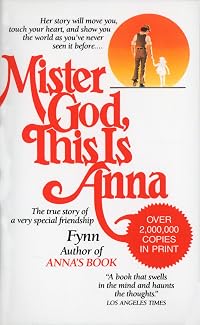
Anna was four years old when Fynn, then only 16 himself, found her wandering round London's Docklands one foggy night in the 1930s. Badly neglected and abandoned by her parents, he took her home to be cared for by his own family. The impact of this extraordinary child on Fynn, his friends and the people in their neighbourhood was to be immense. Nobody who met Anna could remain the same: this intelligent, lively, precocious chatterbox had an outlook on life which completely undercut adult show more pretensions and illusions. Anna's influence continues today. Anyone dipping into her thought-processes falls under the spell of her luminous innocence, wisdom and intimate relationship with 'Mister God'. show lessTags
Recommendations






















Member Recommendations

Member Reviews
My life changed when I read this book. My life will continue to change because I read this book. I could never read this book enough times to be immune to all of the layers of meaning, the challenges to self-satisfied certainty and invitations to experience wonder that this little book brings to the reader. If you've ever known an extraordinary child, if you've ever believed in an extraordinary God, if you've ever thought that maybe there is more to this life than staying off the grass, take the time to spend some time with Anna.
I’ve been wanting to read this story for years, but never got around to it. When I realized it fit a reading challenge I was doing recently, I decided it was high time to pick it up. This is a short story, but it is FULL of vivacious, joy-filled, lived-to-the-hilt life. It was beautiful to experience, and when I finished the book, it felt like the end came too soon—but that, too, is life. Anna is the kind of person you never forget, and I can understand why Fynn felt like it was high time to put her story to paper. The world is richer for having had Anna in it—even if her story isn’t so well-known anymore.
I didn’t agree with all the conclusions Anna came to, as the book went on, but overall, her thoughts, observations, and show more approach to philosophy were intriguing and well-described. Reading this book is like taking a step back in time. It’s beautiful, poetic, gripping, well done, and memorable.
I’ll finish this review with one of my favorite quotes. It made me laugh out loud, and my family had to listen to me read it out. It doesn’t have anything directly to do with Anna, but I loved the general concept:
“Mum, being the daughter of an Irish farmer, was given to making stews. A large black iron pot and an equally large black iron kettle were the two most used utensils in the kitchen. Often the only way one could distinguish the stew from the brew was that tea always came in large cups and stew was put on plates. Here the difference ended, for the brew often had as much solid matter in it as did the stew.” show less
I didn’t agree with all the conclusions Anna came to, as the book went on, but overall, her thoughts, observations, and show more approach to philosophy were intriguing and well-described. Reading this book is like taking a step back in time. It’s beautiful, poetic, gripping, well done, and memorable.
I’ll finish this review with one of my favorite quotes. It made me laugh out loud, and my family had to listen to me read it out. It doesn’t have anything directly to do with Anna, but I loved the general concept:
“Mum, being the daughter of an Irish farmer, was given to making stews. A large black iron pot and an equally large black iron kettle were the two most used utensils in the kitchen. Often the only way one could distinguish the stew from the brew was that tea always came in large cups and stew was put on plates. Here the difference ended, for the brew often had as much solid matter in it as did the stew.” show less
This is a book about God, and maths. Fynn, the author, is a teenage boy who meets a four year old runaway girl, and takes her home. She lives with him until she dies in a terrible accident a few years later, before she is eight . She is a strange, insightful, curious child, and the book is Fynn's story about their time together.
I was surprised how much I cared if the story was true or not. It felt important to my interpretation of the book whether there had been a real person who had lived this strange life and been so cruelly bereaved, or whether the book was made up out of saccharine whole cloth and Anna was just an invention to tug at our heartstrings. From what little internet research I can do, the author really did grow up in the show more East End, and did claim the story was true. Should it matter if it is Deep Truths anyway?
It is definitely a book that feels from very long ago. Taking home a runaway child as though they were a kitten, with no-one else particularly intervening or caring! Wandering the streets of the East End in the middle of the night with the other drifters... It leaves you with a feeling we tidy up the world and make it better and safer, but take away some of the spaces for great goodness as we remove the risk of great evil. Then again, maybe a home thatlets a 7 year old fall on a spiked fence when going after a kitten isn't the sort of home we should place vulnerable kids in! show less
I was surprised how much I cared if the story was true or not. It felt important to my interpretation of the book whether there had been a real person who had lived this strange life and been so cruelly bereaved, or whether the book was made up out of saccharine whole cloth and Anna was just an invention to tug at our heartstrings. From what little internet research I can do, the author really did grow up in the show more East End, and did claim the story was true. Should it matter if it is Deep Truths anyway?
It is definitely a book that feels from very long ago. Taking home a runaway child as though they were a kitten, with no-one else particularly intervening or caring! Wandering the streets of the East End in the middle of the night with the other drifters... It leaves you with a feeling we tidy up the world and make it better and safer, but take away some of the spaces for great goodness as we remove the risk of great evil. Then again, maybe a home that
I'm a fervent atheist, raised agnostic, and yet I loved this fable when I was a child and still appreciate it now. Anna's Mister God is not Christian, is not a patriarch or even a person, but is an expression of Anna's spirit. And she's an amazing little girl. She might not be real, but the author is, and his story is interesting & relevant. http://www.finchden.com/sgh/index.htm
This little book reminds of [b:The Little Prince|157993|The Little Prince|Antoine de Saint-Exupéry|https://d.gr-assets.com/books/1367545443s/157993.jpg|2180358], [b:Sir Gibbie|541924|Sir Gibbie|George MacDonald|https://d.gr-assets.com/books/1175644467s/541924.jpg|19040699], and even [b:The Secret Garden|2998|The Secret Garden|Frances Hodgson show more Burnett|https://d.gr-assets.com/books/1327873635s/2998.jpg|3186437]. In many ways it's better than any of them because Anna's philosophy is so creative, so radical - and works well, I'm confident, for those readers conflicted between science and religion. It's also a lovely story about a friendship between a compassionate and sharp young man and a funny and adorable little girl. show less
This little book reminds of [b:The Little Prince|157993|The Little Prince|Antoine de Saint-Exupéry|https://d.gr-assets.com/books/1367545443s/157993.jpg|2180358], [b:Sir Gibbie|541924|Sir Gibbie|George MacDonald|https://d.gr-assets.com/books/1175644467s/541924.jpg|19040699], and even [b:The Secret Garden|2998|The Secret Garden|Frances Hodgson show more Burnett|https://d.gr-assets.com/books/1327873635s/2998.jpg|3186437]. In many ways it's better than any of them because Anna's philosophy is so creative, so radical - and works well, I'm confident, for those readers conflicted between science and religion. It's also a lovely story about a friendship between a compassionate and sharp young man and a funny and adorable little girl. show less
Fynn findet die fünjährige Anna die vor ihren Eltern geflüchtet ist, weil diese sie misshandelt haben. Sie spricht mit Mister Gott. In die Kirche geht sie nicht, hat sie nicht nötig denn "ich weiss, dass ich Mister Gott lieb hab und Leute und Katzen und Hunde und Spinnen und Blumen und Bäume ... und überhaupt lles; ich ganz allein mit meiner ganzen Figur." Drei Jahre lang bringt sie Sonnenschein in Fynns Leben.
This is, by far, the most boring book I have read this year, and that's including the one book I DNFed.
So much of rambling and philosophy. I could barely stop myself yawning after every few paras. It was the sheer determination of not having another DNF so soon this year that made me complete this work.
Young Fynn (who says he's 19 years old in the book but later editions place him at 16 due to a time inconsistency with the war; the first seed of doubt was planted in my mind at this point in the book.) meets little Anna outside a shop. She seems to have run away from her place after being abused by her parents and is determined not to return. So Fynn takes her to his home. The book details out Anna's precocious intellect, her curiosity show more about "Mister God", and her tragic end and its aftermath on Fynn. (Not a spoiler. Her untimely death is revealed on the very first page of the book.)
The book starts off very well. The way Fynn and Anne meet, the way they chat for three hours eating hot dogs before Fynn takes her home to his mother, those initial days at his house, the way he changed his work habits for her... All very captivating. Until that point, the writing seems easy-going, realistic and quick. Later though, the focus is entirely on the Anna's observations about her "Mister God" and the conversations she has with Fynn about her interpretation of the divine and Fynn's queries about the same. There's just a little info about her interactions with others in the family or friends circle.
The relationship between Fynn and Anne is very fluid. As he himself says, "I saw myself variously as father, brother, uncle, friend." I admired their immediate connection with each other and Fynn's clear devotion for the little girl. But instead of focusing on this beautiful, short-lived relationship, Fynn decides to focus mainly on Anne's thoughts about God, and the hundred thousand questions raised in his mind by her constant musings. This is what brings the book down. The conversations between the two get very repetitive and dragged. I think I should have been much more of a religious idealist or much more of a philosopher to truly appreciate this book. Sadly, I am neither.
I don't know why I was getting the feeling that this account is partly fictionalised. Children can be precocious but this book does seem to be a stretch. So many of the conversations seem impossible for a 5-7 year old. The pessimistic part of me just doesn't let me trust this narrative to be entirely based in reality.
My copy had some illustrations too and they were more scary than cute. show less
So much of rambling and philosophy. I could barely stop myself yawning after every few paras. It was the sheer determination of not having another DNF so soon this year that made me complete this work.
Young Fynn (who says he's 19 years old in the book but later editions place him at 16 due to a time inconsistency with the war; the first seed of doubt was planted in my mind at this point in the book.) meets little Anna outside a shop. She seems to have run away from her place after being abused by her parents and is determined not to return. So Fynn takes her to his home. The book details out Anna's precocious intellect, her curiosity show more about "Mister God", and her tragic end and its aftermath on Fynn. (Not a spoiler. Her untimely death is revealed on the very first page of the book.)
The book starts off very well. The way Fynn and Anne meet, the way they chat for three hours eating hot dogs before Fynn takes her home to his mother, those initial days at his house, the way he changed his work habits for her... All very captivating. Until that point, the writing seems easy-going, realistic and quick. Later though, the focus is entirely on the Anna's observations about her "Mister God" and the conversations she has with Fynn about her interpretation of the divine and Fynn's queries about the same. There's just a little info about her interactions with others in the family or friends circle.
The relationship between Fynn and Anne is very fluid. As he himself says, "I saw myself variously as father, brother, uncle, friend." I admired their immediate connection with each other and Fynn's clear devotion for the little girl. But instead of focusing on this beautiful, short-lived relationship, Fynn decides to focus mainly on Anne's thoughts about God, and the hundred thousand questions raised in his mind by her constant musings. This is what brings the book down. The conversations between the two get very repetitive and dragged. I think I should have been much more of a religious idealist or much more of a philosopher to truly appreciate this book. Sadly, I am neither.
I don't know why I was getting the feeling that this account is partly fictionalised. Children can be precocious but this book does seem to be a stretch. So many of the conversations seem impossible for a 5-7 year old. The pessimistic part of me just doesn't let me trust this narrative to be entirely based in reality.
My copy had some illustrations too and they were more scary than cute. show less
I read this in Junior High, to this day it is one of the few books to ever make me cry, which is probably why I've never reread it, but I still have the copy I owned way back when and I haven't needed to reread it, it has stuck with me all this time.
I find it interesting that none of my memories of this book focus on it's use of God as a them, character or even guiding principle in the story. I have no memory at all of that aspect of this book. Which to me actually makes it a stronger book as it means it holds on it's own without relying on knowledge of it's religious elements to draw you to it or involve you in it.
I find it interesting that none of my memories of this book focus on it's use of God as a them, character or even guiding principle in the story. I have no memory at all of that aspect of this book. Which to me actually makes it a stronger book as it means it holds on it's own without relying on knowledge of it's religious elements to draw you to it or involve you in it.
Members
- Recently Added By
Lists

You Couldn't Pay Me to Read That (Take 2)
203 works; 82 members

Ten Books That Have Stayed With Me
160 works; 30 members

1970s
657 works; 23 members
Author Information

Some Editions
Series

Belongs to Publisher Series
Work Relationships
Is contained in
Common Knowledge
- Canonical title*
- Hallo, Mister Gott, hier spricht Anna
- Original title
- Mister God, This is Anna
- Alternate titles*
- Hallo Mister Gott, hier spricht Anna
- Original publication date
- 1974
- People/Characters
- Anna; Fynn; Mister God
- Important places
- London, England, UK
- First words
- "The diffrense from a person and an angel is easy.
- Last words
- (Click to show. Warning: May contain spoilers.)I felt sure that somewhere Anna and Mister God were laughing.
(Click to show. Warning: May contain spoilers.)I shall be dead. - Blurbers
- Holmes, Marjorie
- Original language
- English
- Disambiguation notice
- This is the single novel of "Mister God, This is Anna". Please do NOT combine with the combination/omnibus books.
*Some information comes from Common Knowledge in other languages. Click "Edit" for more information.
Classifications
Statistics
- Members
- 1,752
- Popularity
- 12,569
- Reviews
- 37
- Rating
- (4.05)
- Languages
- 9 — Danish, Dutch, English, Finnish, German, Norwegian, Portuguese, Spanish, Swedish
- Media
- Paper, Audiobook, Ebook
- ISBNs
- 54
- ASINs
- 37