The Natural History of Religion
by David Hume
On This Page
Description
Hume begins with the observation that there is much variety in people's taste (or the aesthetic judgments people make). However, Hume argues that there is a common mechanism in human nature that gives rise to, and often even provides justification for, such judgments. He takes this aesthetic sense to be quite similar to the moral sense for which he argues in his Book 3 of A Treatise of Human Nature (1739-1740) and in An Enquiry Concerning the Principles of Morals (1751). Furthermore, he show more argues that this still leaves room for the ability to refine one's aesthetic palate. (Fieser, 2006, 2) Hume took as his premise that the great diversity and disagreement regarding matters of taste had two basic sources - sentiment, which was to some degree naturally varying, and critical facility, which could be cultivated. Each person is a combination of these of two sources, and Hume endeavors to delineate the admirable qualities of a critic, that they might augment their natural sense of beauty into a reliable faculty of judgment. There are a variety of qualities of the good critic that he describes, each of which contributes to an ultimately reliable and just ability to judge. show lessTags
Recommendations














Member Reviews
Hume's Natural History of Religion is an early foray into comparative religious studies. As a professed partisan of "genuine Theism and Religion" (21), Hume shows his own implicit theological orientation to be an unsurprising Enlightenment Deism. The "natural history" element of his account emphasizes what he understood to be the chronological priority of polytheism to (mono-) theism, and the general rooting of religious behavior and identity in relatively base fears and appetites.
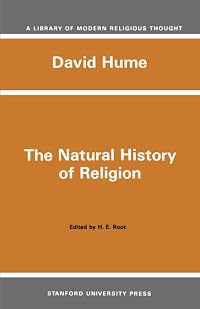
As editor H.E. Root notes, Hume's primary historical data are rather incomplete and under-interpreted from the perspective of more recent studies of the same questions. His overall polemical fabric, is, however, nicely woven. While giving greater theological show more credit to the theists (evidently the Abrahamic religions), he also notes that their loftier virtues are reflected in more significant vices than pagan polytheists ever exhibited. The second major arc of the text is a series of comparisons between polytheism and theism on the counts of "Persecution and Toleration," "courage or abasement," "reason or absurdity," and "Doubt or Conviction." In this sequence of short chapters, the illustrations grow more and more amusing, climaxing with a series of jokes about the Eucharist in the question of "Doubt or Conviction" (55-7).
After the sets of comparisons, Hume moves on to a pox on both houses section, in which he castigates religions generally on grounds of "impious conceptions of the divine nature" and "bad influence on morality." These are the most contentious chapters, and likely the ones that especially earned the alarm and reprobation of his contemporaries. But they are soundly argued.
In his "Editor's Introduction," Root understands the final gesture of Hume's text to be one proposing that philosophy be a "substitute for religion" (20). But Root had already observed that Hume "did not believe that religion was a 'primary' constituent of human nature" (14) and thus it was in no need of a substitute if philosophers or others were to turn away from it. Root also neglects the intellectual history of the centuries leading up to Hume, in which theology and philosophy were often construed as mutually antagonistic efforts. An empiricist such as Hume could not help but be a partisan of philosophy in this contest, and such partisanship was perhaps the motive guiding this entire text. show less
As editor H.E. Root notes, Hume's primary historical data are rather incomplete and under-interpreted from the perspective of more recent studies of the same questions. His overall polemical fabric, is, however, nicely woven. While giving greater theological show more credit to the theists (evidently the Abrahamic religions), he also notes that their loftier virtues are reflected in more significant vices than pagan polytheists ever exhibited. The second major arc of the text is a series of comparisons between polytheism and theism on the counts of "Persecution and Toleration," "courage or abasement," "reason or absurdity," and "Doubt or Conviction." In this sequence of short chapters, the illustrations grow more and more amusing, climaxing with a series of jokes about the Eucharist in the question of "Doubt or Conviction" (55-7).
After the sets of comparisons, Hume moves on to a pox on both houses section, in which he castigates religions generally on grounds of "impious conceptions of the divine nature" and "bad influence on morality." These are the most contentious chapters, and likely the ones that especially earned the alarm and reprobation of his contemporaries. But they are soundly argued.
In his "Editor's Introduction," Root understands the final gesture of Hume's text to be one proposing that philosophy be a "substitute for religion" (20). But Root had already observed that Hume "did not believe that religion was a 'primary' constituent of human nature" (14) and thus it was in no need of a substitute if philosophers or others were to turn away from it. Root also neglects the intellectual history of the centuries leading up to Hume, in which theology and philosophy were often construed as mutually antagonistic efforts. An empiricist such as Hume could not help but be a partisan of philosophy in this contest, and such partisanship was perhaps the motive guiding this entire text. show less
What are the origins of religion? The question has been working up more than one philosopher over the past centuries! Hume, tentatively, attempted to answer it too... How did he fare?
For him, to understand the origins of religion one must first of all understand how the most primitives among them -to him: polytheisms- were born and later developed, since monotheisms are its descendants. What he noticed, is that from births to marriages, deaths, wars, fortunes, poverty, suffering, happiness, diseases, health, and wealth and lack, not only our mortal, human lives, are being shaped by all sorts of highs and lows, but, pagan divinities are all, some ways or others, connected to such life circumstances... To worship the gods, then, to try show more and gain their favours, is for Hume but a crude mean to try and control the uncontrollable. Religion, in other words, is born out of our emotions, poorly stirred by ignorance and our fears of the unknown.
He, actually, extrapolates, by showing that the logical outcome of the competition between all these gods and divinities, all these cults and rituals, could only lead to the establishment of One and Only, more powerful, more omnipotent, more helpful. What that a good thing? Not at all! One God, one cult, one dogma, one and only 'Truth', could only have but deplorable consequences for morality and mankind as a whole, with never ending religious wars and conflicts to religious fanaticisms and dogmatisms being evidence of such negative outcome...
Well?
Well, Hume was wrong about primitive religions: animism and totemism predated polytheism. He can also be annoying, relentlessly portraying religions as something akin to being immoral, as if morality was solely dependent upon a belief (or not) in God (having said that, he was writing in 18th century Europe -such view, then, can be forgiven, or so I guess...). Yet...
Yet, for those (like me) who don't believe in 'divine revelations', let alone in the supernatural, I found that his views still stands remarkably well and are still remarkably relevant. Isn't indeed all about emotions, explaining the unknown, trying to control the uncontrollable, and bringing comfort amidst uncertainties? Maybe. Or maybe not. Again: the question has been working up countless thinkers across the centuries, and I personally doubt that a clear cut explanation will ever be offered! Meanwhile, though, here's a very short essay, but worth reading. show less
For him, to understand the origins of religion one must first of all understand how the most primitives among them -to him: polytheisms- were born and later developed, since monotheisms are its descendants. What he noticed, is that from births to marriages, deaths, wars, fortunes, poverty, suffering, happiness, diseases, health, and wealth and lack, not only our mortal, human lives, are being shaped by all sorts of highs and lows, but, pagan divinities are all, some ways or others, connected to such life circumstances... To worship the gods, then, to try show more and gain their favours, is for Hume but a crude mean to try and control the uncontrollable. Religion, in other words, is born out of our emotions, poorly stirred by ignorance and our fears of the unknown.
He, actually, extrapolates, by showing that the logical outcome of the competition between all these gods and divinities, all these cults and rituals, could only lead to the establishment of One and Only, more powerful, more omnipotent, more helpful. What that a good thing? Not at all! One God, one cult, one dogma, one and only 'Truth', could only have but deplorable consequences for morality and mankind as a whole, with never ending religious wars and conflicts to religious fanaticisms and dogmatisms being evidence of such negative outcome...
Well?
Well, Hume was wrong about primitive religions: animism and totemism predated polytheism. He can also be annoying, relentlessly portraying religions as something akin to being immoral, as if morality was solely dependent upon a belief (or not) in God (having said that, he was writing in 18th century Europe -such view, then, can be forgiven, or so I guess...). Yet...
Yet, for those (like me) who don't believe in 'divine revelations', let alone in the supernatural, I found that his views still stands remarkably well and are still remarkably relevant. Isn't indeed all about emotions, explaining the unknown, trying to control the uncontrollable, and bringing comfort amidst uncertainties? Maybe. Or maybe not. Again: the question has been working up countless thinkers across the centuries, and I personally doubt that a clear cut explanation will ever be offered! Meanwhile, though, here's a very short essay, but worth reading. show less
David Hume was een scherpzinnig criticus van de neiging tot religieus fanatisme en dogmatisme die zijns inziens vooral uit het westerse monotheïsme voortvloeit. Dat blijkt onder meer uit zijn Natural History of Religion. Hierin betoogt Hume dat religie niet zozeer ontspringt aan een cognitieve overtuiging betreffende het bestaan van een almachtige God, maar veeleer aan de passies van angst en hoop en de neiging tot antropomorfe projectie. Uitgaande van deze gedachte verdedigt hij dat het westerse monotheïsme volgens een natuurlijk-causaal proces is ontstaan uit het meer primitieve polytheïsme. Het essay, dat is geschreven in een kleurrijke en polemische stijl, laat zich niet enkel lezen als een studie over het ontstaan van het show more monotheïsme, maar ook als een kritische bezinning op de verhouding van de religie tot de moraliteit, de passies en de menselijke sociabiliteit. In dit boek is tevens een vertaling opgenomen van Humes essay 'Of Superstition and Enthousiasm'. Dit vlot leesbare opstel geeft een goed beeld van Humes meer praktische en morele kritiek op de religie. 'Dit geschrift (The Natural History of Religion) toont Hume in zijn volle grootheid als schrijver' (F.L. van Holthoon in zijn boek Hume - Leven en werk) Mede t.g.v. Hume's 300ste geboortedag op 26 april 2011. David Hume (1711-1776) Schots filosoof, essayist, historicus en diplomaat, is een van de belangrijkste denkers van de achttiende eeuw. Hij geldt als de voornaamste criticus vóór Kant van de klassieke metafysica show less
Nov 26, 2018Dutch
Ratings
Members
- Recently Added By
Lists

Atheism, humanism, freethought, &c. — Best nonfiction books in favour of
167 works; 14 members
Author Information

414+ Works 17,869 Members
David Hume was born in Edinburgh to a minor Scottish noble family, raised at the estate of Ninewells, and attended the University of Edinburgh for two years until he was 15. Although his family wished him to study law, he found himself unsuited to this. He studied at home, tried business briefly, and after receiving a small inheritance traveled to show more France, settling at La Fleche, where Descartes had gone to school. There he completed his first and major philosophical work, A Treatise of Human Nature (1739--40), published in three volumes. Hume claimed on the title page that he was introducing the experimental method of reasoning into moral subjects, and further that he was offering a new way of seeing the limits of human knowledge. Although his work was largely ignored, Hume gained from it a reputation as a philosophical skeptic and an opponent of traditional religion. (In later years he was called "the great infidel.") This reputation led to his being rejected for professorships at both Edinburgh and Glasgow. To earn his living he served variously as the secretary to General St. Clair, as the attendant to the mad Marquis of Annandale, and as the keeper of the Advocates Library in Edinburgh. While holding these positions, he wrote and published a new version of his philosophy, the two Enquiries, and many essays on social, political, moral, and literary subjects. He also began his six-volume History of England from the Roman Invasion to the Glorious Revolution (1754--62), the work that made him most famous in his lifetime. Hume retired from public life and settled in Edinburgh, where he was the leading figure in Scottish letters and a good friend to many of the leading intellectuals of the time, including Adam Smith and Benjamin Franklin. During this period, he completed the Dialogues Concerning Natural Religion, which he had been working on for more than 25 years. Hume first worked on the Dialogues in the middle of his career, but put them aside as too provocative. In his last years he finished them and they were published posthumously in 1779. They are probably his best literary effort and have been the basis for continuous discussion and debate among philosophers of religion. Toward the end of Hume's life, his philosophical work began to be taken seriously, and the skeptical problems he had raised were tackled by philosophers in Scotland, France, and finally Germany, where Kant claimed that Hume had awakened him from his dogmatic slumbers. Hume was one of the most influential philosophers of modern times, both as a positive force on skeptical and empirical thinkers and as a philosopher to be refuted by others. Interpreters are still arguing about whether he should be seen as a complete skeptic, a partial skeptic, a precursor of logical positivism, or even a secret believer. (Bowker Author Biography) show less
Series
Belongs to Publisher Series
Work Relationships
Is contained in
Common Knowledge
- Original publication date
- 1957
Classifications
- Genres
- Nonfiction, Philosophy, Religion & Spirituality, General Nonfiction, History
- DDC/MDS
- 210 — Religion Philosophy & theory of religion Philosophy and theory of religion
- LCC
- BL51 — Philosophy, Psychology and Religion Religions. Mythology. Rationalism Religions. Mythology. Rationalism Philosophy of religion. Psychology of religion. Religion
- BISAC
Statistics
- Members
- 198
- Popularity
- 165,446
- Reviews
- 3
- Rating
- (4.04)
- Languages
- Dutch, English, Italian, Portuguese
- Media
- Paper, Ebook
- ISBNs
- 22
- ASINs
- 7