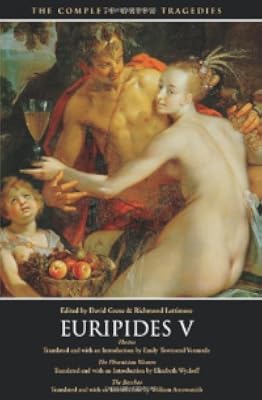
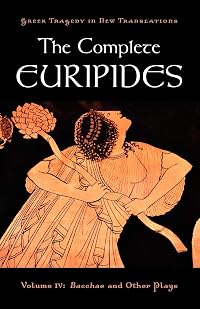
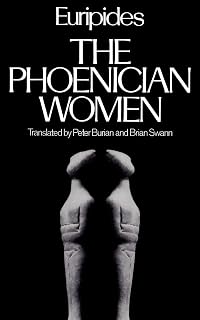
Electra, The Phoenician Women, The Bacchae
by Euripides
On This Page
Description
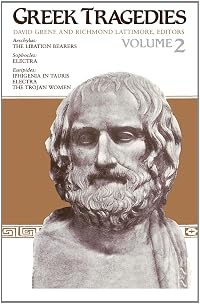
In nine paperback volumes, the Grene and Lattimore editions offer the most comprehensive selection of the Greek tragedies available in English. Over the years these authoritative, critically acclaimed editions have been the preferred choice of over three million readers for personal libraries and individual study as well as for classroom use.Tags
Recommendations













Member Recommendations
Member Reviews
After reading the introduction to this series, I expected something much more fractured than what I encountered on the page; however, I found Euripides' style in this work to be very coherent. After reading Aeschylus, I noticed the aesthetic jump that Euripides had taken via the psychological subtext inherent in his characters. Whereas reading Aeschylus felt flat (although I enjoyed "Agamemnon"); there was too much exposition in Aeschylus; too much that did not expedite the forward motion of his plays. Whereas with Euripides, one is transported directly into the action that is happening in the present moment of the play, by means of the narrative, as well as the dialogue. Also noteworthy is Euripides' technique of having the characters show more exchange one-liners in dialogue. Although I immediately connected to all of the dramas in this edition, "The Bacchae" is a standout. It's a dark, crazy, absurd and even funny play; the highlight being the "Celebrity Death Match" between Pentheus and Dionysus. As grim as scenario of "The Bacchae" is, it often reads like a comedy (the scene with Pentheus "in drag" after having been hypnotized by Dionysus is hysterical). Euripides was ahead of his time, avant-garde; therefore of the great and / or known Greek playwrights, he was the one who garnered the fewest prizes. I'm looking forward to reading "Hippolytus" in Euripides I of this series. show less
William Arrowsmith's rendering of The Bacchae is like a punch to the gut. No other version I know has its visceral impact.
Electra is one of my favorite Greek tragedies. I suppose that's only because she's one of the few young women who gets to star in her own show. Eh.
Ok, I just read The Bacchae, and it's definitely the most messed-up thing I've had to read for school in awhile. So um, check it out if you're up for craziness.
'The Bacchae' is fantastic
Ratings
Members
- Recently Added By
Lists

Kilobook
19 works; 1 member
Author Information

1,345+ Works 34,171 Members
Euripides was born in Attica, Greece probably in 480 B.C. He was the youngest of the three principal fifth-century tragic poets. In his youth he cultivated gymnastic pursuits and studied philosophy and rhetoric. Soon after he received recognition for a play that he had written, Euripides left Athens for the court of Archelaus, king of Macedonia. show more Fragments of about fifty-five plays survive. Among his best-known plays are Alcestis, Medea and Philoctetes, Electra, Iphigenia in Tauris, The Trojan Women, and Iphigenia in Aulis Iphigenia. He died in Athens in 406 B.C. (Bowker Author Biography) show less
Some Editions
Series
Belongs to Publisher Series
The Complete Greek Tragedies-Chicago 1960 (Set v. 7, Euripides v. 5)
Work Relationships
Is contained in
Common Knowledge
- Canonical title
- Electra, The Phoenician Women, The Bacchae
- Original publication date
- 408-413 BCE
- Important places
- Argos, Greece
- First words
- A high bare slope of the Argive hills commanding a view of the road to Argo, stage left, and the southern passes toward Sparta, right.
- Last words
- (Click to show. Warning: May contain spoilers.)So ends the play.
Classifications
Statistics
- Members
- 1,348
- Popularity
- 17,766
- Reviews
- 6
- Rating
- (3.95)
- Languages
- English
- Media
- Paper, Ebook
- ISBNs
- 5
- ASINs
- 9