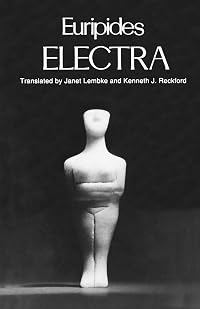
Electra
by Euripides
On This Page
Description
From the dramatist Aristotle called "the most tragic of poets, " a retelling of the classical myth of a family torn apart by vengeance. One of the most well-known tragedies by Euripides, Electra brings to life the story of siblings driven to matricide to avenge their father's death. With a unique empathy for the plight of his female characters, Euripides places Electra's passion and sorrow at the center of the play, gracing her with a complexity that distinguishes the tragedian from show more contemporaries Sophocles and Aeschylus, who also wrote versions of the myth, and making Euripides's Electra as relevant and riveting for the modern reader as when it was first produced in the fifth century BC. show lessTags
Recommendations













Member Reviews
This was a bit of a letdown after the dazzling Medea; Euripides was clearly less spirited here. Formally, the play is perfectly constructed and certainly contains some beautiful passages, but sometimes also monologues that are far too long. Striking is the much more positive image painted here of Clytemnestra, Electra's mother, who killed her own husband, Agamemnon. With the older tragedians Aeschyles and Sophocles, she is practically evil personified; here, Euripides has her bear witness to remarkable self-insight and dignity: “I am not proud of what I have done, my child, what I have wrought, I now bitterly regret. My unbridled rage at my husband has driven me too far.”
Electra, in her blind hatred, does stand out somewhat in show more comparison: she cherishes her martyrdom, wallows in her bitterness, and is more neurotic than heroic in nature. As most experts point out: just as in his other plays, Euripides' characters usually justify their actions based on their own motives and do not hide behind gods who have manipulated them. This play is somewhat of an exception to that: at the end, Apollo is nevertheless identified as the main culprit for the drama that unfolds.
As far as the gods are concerned, Euripides is certainly balancing on the edge here. In several passages, the value of divine oracles is explicitly called into question, Apollo is lashed out as the instigator of all misery, and at the end, it is suggested that man determines his own destiny. So, what’s it, Euripides? In short, there are some flaws in this play that make me consider it one of Euripides' weaker works.
In the margin, a note about the translation: I read two very different Dutch translations, and in one, there is the beautiful, meaningful phrase “mother whom we loved, when we hated you,” a statement by Electra after the murder she committed with her brother on their mother Clytemnestra; but in the other translation, that is omitted entirely. It demonstrates yet again that the textual transmission of these tragedies is very dubious on certain points.
Disclaimer: I'm reading and reviewing all classic ancient Greek plays, more or less in chronological order. But I'm not giving a rating. How could I, given their age? I'll make an exception only when a play is exceptional and still strikes an emotional and/or intellectual chord. show less
Electra, in her blind hatred, does stand out somewhat in show more comparison: she cherishes her martyrdom, wallows in her bitterness, and is more neurotic than heroic in nature. As most experts point out: just as in his other plays, Euripides' characters usually justify their actions based on their own motives and do not hide behind gods who have manipulated them. This play is somewhat of an exception to that: at the end, Apollo is nevertheless identified as the main culprit for the drama that unfolds.
As far as the gods are concerned, Euripides is certainly balancing on the edge here. In several passages, the value of divine oracles is explicitly called into question, Apollo is lashed out as the instigator of all misery, and at the end, it is suggested that man determines his own destiny. So, what’s it, Euripides? In short, there are some flaws in this play that make me consider it one of Euripides' weaker works.
In the margin, a note about the translation: I read two very different Dutch translations, and in one, there is the beautiful, meaningful phrase “mother whom we loved, when we hated you,” a statement by Electra after the murder she committed with her brother on their mother Clytemnestra; but in the other translation, that is omitted entirely. It demonstrates yet again that the textual transmission of these tragedies is very dubious on certain points.
Disclaimer: I'm reading and reviewing all classic ancient Greek plays, more or less in chronological order. But I'm not giving a rating. How could I, given their age? I'll make an exception only when a play is exceptional and still strikes an emotional and/or intellectual chord. show less
My review of this book disappeared so I am reposting it!
The three great Greek tragedians, Aeschylus, Sophocles, and Euripides, dramatized Electra and Orestes' quest for revenge for their father's murder by their mother, Clytemnestra, and her lover, Aegtheis. While Aeschylus and Sophocles see this dual revenge killing as troubling yet ultimately justified, Euripides questions if matricide is warranted. He contrasts Electra's certainty with Orestes' ambiguity. Consequently, I found it the most interesting of the three plays.
This version of Euripides' Electra is part of a series that pairs a poet with a classical scholar. The exquisite translation, with fine-tuned writing, flowed throughout, making the play a joy to read.
I read all three show more versions back to back as part of a course on Greek tragedy. I enjoyed the sequential reading and recommend the play to anyone interested in Theater, the Classical World, or both. show less
The three great Greek tragedians, Aeschylus, Sophocles, and Euripides, dramatized Electra and Orestes' quest for revenge for their father's murder by their mother, Clytemnestra, and her lover, Aegtheis. While Aeschylus and Sophocles see this dual revenge killing as troubling yet ultimately justified, Euripides questions if matricide is warranted. He contrasts Electra's certainty with Orestes' ambiguity. Consequently, I found it the most interesting of the three plays.
This version of Euripides' Electra is part of a series that pairs a poet with a classical scholar. The exquisite translation, with fine-tuned writing, flowed throughout, making the play a joy to read.
I read all three show more versions back to back as part of a course on Greek tragedy. I enjoyed the sequential reading and recommend the play to anyone interested in Theater, the Classical World, or both. show less
Tragedija u šest činova o surovoj osveti brata i sestre, Oresta i Elektre koji ubijaju svoju majku i njenog ljubavnika Klitemanestru i Egista, zbog ubistva njihovog oca Agamemnona nakon povratka iz Trojanskog rata. Mesto radnje je seosko imanje i seoska koliba vlasništvo nekog prostog seljaka za koga je Elektra prisilno udata kako ne bi izrodila plemeniti porod koji bi mogao tražiti osvetu.
Šesti čin je prilično surov (scena ubistva majke). Elektri i Orestu osveta ne donosi ništa dobro jer se njih dvoje tek što su se našli moraju ponovo rastati, Elektra će se udati za Orestovog prijatelja ali će je večito izjedati kajanje, dok Orest beži pomućenog uma progonjen od Furija.
Euripid je bio jedan od prvih realista, što su mu show more njegovi savremenici preacivali zbog otklona od ustaljenog tradicionalnog prikaza u dotadašnjim tragedijama. Bio je poznat po tome što je čoveka prikazivao onakvim kakvim jeste, a ne kakav bi trebalo da bude. show less
Šesti čin je prilično surov (scena ubistva majke). Elektri i Orestu osveta ne donosi ništa dobro jer se njih dvoje tek što su se našli moraju ponovo rastati, Elektra će se udati za Orestovog prijatelja ali će je večito izjedati kajanje, dok Orest beži pomućenog uma progonjen od Furija.
Euripid je bio jedan od prvih realista, što su mu show more njegovi savremenici preacivali zbog otklona od ustaljenog tradicionalnog prikaza u dotadašnjim tragedijama. Bio je poznat po tome što je čoveka prikazivao onakvim kakvim jeste, a ne kakav bi trebalo da bude. show less
I didn't enjoy Electra. It's partly that I truly don't like the character Electra herself, but that wouldn't matter so much if it weren't for the way that the play itself was constructed.
Why in the world did Orestes hide who he was in the first place? It has no point, not advancing the plot one whit for him to conceal his identity until the old tutor guessed it from a scar. And then after it was guessed, it was all tra-la, tra-la, of course you're Orestes, celebrations abound, let's continue. Why didn't he just come up to Electra and (once they were in the privacy of her house) tell her that he was his brother? It's a fake plot device made solely for the fabrication of 'tension,' and I don't like it.
There was one part that I did really show more enjoy, though: the chorus singing of the golden fleece. I have no idea what it had to do with the story, except that shearing hair seems to be a theme in this story. There's Orestes with his shorn lock on the tomb of Agamemnon, and Electra with her hair cropped off (although she claims it's snarled as well, which I would not have caught had it not been for the footnote). There's the short story of the golden fleece, incomplete and pretty much irrelevant as far as I can surmise, but lovely nonetheless. There are one or two other instances of hair being mentioned, enough for me to believe that it had a theme of some kind. Of what theme that might be, however, I have no idea.
Orestes' speech of praise for the peasant seems contrived simply for the use of lecturing the Greek citizens on how to value a man. Besides which, if the peasant were that worth and important, he would have had a name. Maybe. I mean, Euripides was one of those really original playwrights, who usually called a king "King" and a queen "Queen" and such.
All in all, no go. A few really lovely parts, but nothing worth bringing home to mother. Who is, incidentally, the murderer of your father. And who holds more awesome in one fingernail than Electra holds in her whole body. No, Orestes' and Electra's bodies combined. May they be smited by the furies and never whine again. show less
Why in the world did Orestes hide who he was in the first place? It has no point, not advancing the plot one whit for him to conceal his identity until the old tutor guessed it from a scar. And then after it was guessed, it was all tra-la, tra-la, of course you're Orestes, celebrations abound, let's continue. Why didn't he just come up to Electra and (once they were in the privacy of her house) tell her that he was his brother? It's a fake plot device made solely for the fabrication of 'tension,' and I don't like it.
There was one part that I did really show more enjoy, though: the chorus singing of the golden fleece. I have no idea what it had to do with the story, except that shearing hair seems to be a theme in this story. There's Orestes with his shorn lock on the tomb of Agamemnon, and Electra with her hair cropped off (although she claims it's snarled as well, which I would not have caught had it not been for the footnote). There's the short story of the golden fleece, incomplete and pretty much irrelevant as far as I can surmise, but lovely nonetheless. There are one or two other instances of hair being mentioned, enough for me to believe that it had a theme of some kind. Of what theme that might be, however, I have no idea.
Orestes' speech of praise for the peasant seems contrived simply for the use of lecturing the Greek citizens on how to value a man. Besides which, if the peasant were that worth and important, he would have had a name. Maybe. I mean, Euripides was one of those really original playwrights, who usually called a king "King" and a queen "Queen" and such.
All in all, no go. A few really lovely parts, but nothing worth bringing home to mother. Who is, incidentally, the murderer of your father. And who holds more awesome in one fingernail than Electra holds in her whole body. No, Orestes' and Electra's bodies combined. May they be smited by the furies and never whine again. show less
Rated: B-The New Lifetime Reading Plan: Number 7e
Just part of my ongoing self education.
882.01 EUR
Apr 26, 2020Italian
Members
- Recently Added By
Lists

Agamemnon's legacy
38 works; 4 members

Truly old classics
63 works; 6 members

Western World's Greatest Books - Project Gutenberg
295 works; 15 members

Favourite Books
1,819 works; 316 members

Favourite Greek Books
97 works; 1 member
100 Books to Read in a Lifetime (That Are Older Than 200 Years)
415 works; 175 members

Greatest Books, allegedly
484 works; 9 members

Books Read in 2022
5,166 works; 114 members

New Lifetime Reading Plan by Fadiman and Major
225 works; 5 members

Recommended Reading : 600 Classics Reviewed, Editors of Salem Press, 2015
634 works; 6 members

Next Plays / 2025
352 works; 1 member

Next Plays to Watch
50 works; 1 member

euripides ranked
23 works; 1 member

Lectuurlijst
63 works; 1 member
Author Information

1,344+ Works 34,145 Members
Euripides was born in Attica, Greece probably in 480 B.C. He was the youngest of the three principal fifth-century tragic poets. In his youth he cultivated gymnastic pursuits and studied philosophy and rhetoric. Soon after he received recognition for a play that he had written, Euripides left Athens for the court of Archelaus, king of Macedonia. show more Fragments of about fifty-five plays survive. Among his best-known plays are Alcestis, Medea and Philoctetes, Electra, Iphigenia in Tauris, The Trojan Women, and Iphigenia in Aulis Iphigenia. He died in Athens in 406 B.C. (Bowker Author Biography) show less
Some Editions
Awards and Honors
Series
Belongs to Publisher Series
Work Relationships
Is contained in
5 Plays: Bacchae / Heracles / Children of Heracles / Phoenician Women / Suppliant Women by Euripides
Great Books of The Western World: Aeschylus, Sophocles, Euripides, Aristophanes by Robert Maynard Hutchins (indirect)
11 Plays: Alcestis / Andromache / Children of Heracles / Electra / Hecuba / Helen / Heracles / Hippolytus / Medea / Suppliant Women / Trojan Women by Euripide
9 Plays: Alcestis / Andromache / Bacchae / Children of Heracles / Electra / Hecuba / Helen / Heracles / Hyppolytus by Euripides
Euripides III: Hecuba, Andromache, The Trojan Women, Ion (The Complete Greek Tragedies) (Vol 5) by Euripides
A Treasury of the Theatre; an Anthology of Great Plays From Aeschylus to Hebbel by Philo M. Jr. Buck
Has the adaptation
Has as a student's study guide
Common Knowledge
- Canonical title*
- Электра
- Original publication date
- 420 BCE
- People/Characters
- Electra; Orestes; Clytemnestra; Castor
- Important places
- Argos, Greece
*Some information comes from Common Knowledge in other languages. Click "Edit" for more information.
Classifications
- Genres
- Fiction and Literature, Poetry
- DDC/MDS
- 882.01 — Literature & rhetoric Classical & modern Greek literatures Classical Greek dramatic poetry and drama standard subdivisions; collections; history, description, critical appraisal; Specific periods Ancient period to ca. 499
- LCC
- PA3975 .E5 .L46 — Language and Literature Greek language and literature. Latin language and literature Greek literature Individual authors Euripedes
- BISAC
Statistics
- Members
- 374
- Popularity
- 83,745
- Reviews
- 7
- Rating
- (3.68)
- Languages
- 11 — Danish, Dutch, English, French, German, Greek (Ancient), Greek, Italian, Multiple languages, Russian, Spanish
- Media
- Paper, Ebook
- ISBNs
- 40
- ASINs
- 17