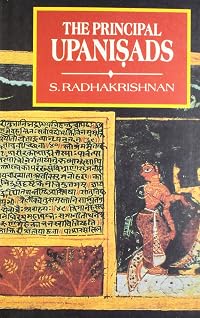
The Principle Upanisads
by S. Radhakrishnan
On This Page
Description
The Upanisads, the basic philosophical texts of Hinduism, represent the height of Vedic philosophy. Many of the older Upanisads can be dated in the eighth and seventh centuries BCE. This newly reissued scholarly work by S. Radhakrishnan, first published in 1953 and long out of print, contains in full the classical Upanisads, those commented on or mentioned by the eighth-century Indian philosopher Shankara. The Sanskrit text, transliterated into Roman script, is followed, verse-by-verse, with show more an English translation. The volume also includes a commentary on the argument, notes on the vocabulary, and a very detailed introduction by Dr. Radhakrishnan. show lessTags
Recommendations

















Member Reviews
This is a very thick book with comprehensive commentary on each verse and a great introduction. I highly recommend reading the introduction before delving into the Upanishads. The sanskrit text is presented in Latin transliteration -- I found this very useful. Once I gathered from the reading what are the basic sanskrit terms for major concepts I could always look at the transliteration if I wanted to clarify the translated text. The translation tries to be as literal as possible without loosing the meaning. I find that good. Another good thing about this translation is that of the translated Upanishads no passages are skipped.
In many other translations the passages that are thought by the translator to be "irrelevant" to the Western show more reader are often skipped. I would rather have the version where I have the option of deciding what is relevant and what is not. show less
In many other translations the passages that are thought by the translator to be "irrelevant" to the Western show more reader are often skipped. I would rather have the version where I have the option of deciding what is relevant and what is not. show less
This is a very thick book with comprehensive commentary on each verse and a great introduction. I highly recommend reading the introduction before delving into the Upanishads. The sanskrit text is presented in Latin transliteration -- I found this very useful. Once I gathered from the reading what are the basic sanskrit terms for major concepts I could always look at the transliteration if I wanted to clarify the translated text. The translation tries to be as literal as possible without loosing the meaning. I find that good. Another good thing about this translation is that of the translated Upanishads no passages are skipped.
In many other translations the passages that are thought by the translator to be "irrelevant" to the Western show more reader are often skipped. I would rather have the version where I have the option of deciding what is relevant and what is not. show less
In many other translations the passages that are thought by the translator to be "irrelevant" to the Western show more reader are often skipped. I would rather have the version where I have the option of deciding what is relevant and what is not. show less
Ratings
Members
- Recently Added By
Lists

Writers In Public Domain 2026
90 works; 1 member

In Our Time books
4,934 works; 2 members
Author Information

74+ Works 1,800 Members
A philosopher and scholar, Sarvepalli Radhakrishnan was also a statesman, even to the extent of serving as India's president from 1962 to 1967. Brought up as a devout Hindu but also educated in Christian missionary schools, Radhakrishnan's philosophy often was comparative, finding lines of convergence and divergence between East and West. Based in show more Vedantic idealism, Radhakrishnan affirmed the necessity of an experience of the absolute as the basis of any truly profound grasp of reality. In this regard, he focused his scholarship on the great classical texts of the Indian tradition: the Upanishads, the Bhagavad Gita, the Brahma Sutra, and the various Vedantic commentaries. However, Radhakrishnan's fundamentally mystical, idealistic dimension did not lead him to renounce the material world. On the contrary, he affirmed action in the world as the expression of the transformative power of the absolute itself. Unlike many traditional Vedantists, Radhakrishnan did not view the material world with all its differentiation as unreal; rather, it is simply not absolute in itself. Spiritual and moral value ultimately derives from something deeper. In this way, he established a metaphysical ground for religious tolerance, an openness he brought to his own activities in the political sphere. (Bowker Author Biography) show less
Awards and Honors
Notable Lists
Common Knowledge
- Canonical title
- The Principle Upanisads
- Original publication date
- 1953
Classifications
- Genres
- Religion & Spirituality, Nonfiction, Philosophy
- DDC/MDS
- 294.59218 — Religion Other religions Buddhism/Hinduism Hinduism Hindu scriptures Sacred Scriptures Vedic literature The Upanishads
- LCC
- BL1120 .A3 .R32 — Philosophy, Psychology and Religion Religions. Mythology. Rationalism Religions. Mythology. Rationalism History and principles of religions Asian. Oriental By religion Sacred books. Sources Vedic texts
- BISAC
Statistics
- Members
- 202
- Popularity
- 162,075
- Reviews
- 2
- Rating
- (4.33)
- Languages
- English
- Media
- Paper
- ISBNs
- 8
- UPCs
- 1
- ASINs
- 3