Complete Works of Tacitus
by Tacitus, Alfred John Cornelius
On This Page
Description
Ancient Roman senator and historian Publius Cornelius Tacitus is known throughout Western history as one of the greatest historical writers of the Silver Age of Latin literature. He lived during the first century AD and was the son of a wealthy aristocratic family. Not much is known about his personal life; however, it is clear that both Tacitus and Pliny the Elder were acquaintances and even possibly childhood friends, though there is no substantial evidence to support this. Tacitus studied show more rhetoric in order to create a career in law and politics. He steadily rose throughout the ranks due to his strong speaking style and oration skills. However, his language skills did not stop with verbal speeches. He was also an accomplished writer who focused on the history of the Roman Empire. He created five works, "The Annals," "The Histories," "The Agricola," "The Germania," and "A Dialogue on Oratory." His works delve deep into the facts as he knew them, rarely ever embellishing history to create a story. He also stayed true to chronological order and laid history out in visible steps. It is also notable that Tacitus knew that his fellow politicians were corrupt; he believed that they gave up their strong voice in order to please a usually corrupt emperor. These five great works are brought together in this collection of "The Complete Works of Tacitus." show lessTags
Recommendations













Member Reviews
This book is a collection of the complete works of Tacitus. I only read one of the essays.
Tacitus' essay Germania provides the views of this ancient Roman historian about the early German tribes. The essay is a form of ethnography describing the customs and styles of the early German tribes. He then describes the individual tribes.
The essay is difficult to read for a modern reader. First, the names of most of the tribes are unfamiliar and the place names are not identifiable. Second, it is questionable how trustworthy his assessments are since he likely did not visit all of the tribes he described.
This reader would have preferred an annotated version that could explain what Tacitus got right and to translate the names and locations show more of the tribes he mentions. The book was, nevertheless interesting to read for the references to some of the better known tribes and his description of their customs. show less
Tacitus' essay Germania provides the views of this ancient Roman historian about the early German tribes. The essay is a form of ethnography describing the customs and styles of the early German tribes. He then describes the individual tribes.
The essay is difficult to read for a modern reader. First, the names of most of the tribes are unfamiliar and the place names are not identifiable. Second, it is questionable how trustworthy his assessments are since he likely did not visit all of the tribes he described.
This reader would have preferred an annotated version that could explain what Tacitus got right and to translate the names and locations show more of the tribes he mentions. The book was, nevertheless interesting to read for the references to some of the better known tribes and his description of their customs. show less
A strong, clear voice of warning about politics and power. Even after the span of centuries, his commentary remains relevant.
Fascinating exploration of the early Empire. The books on Agricola and Germany were quite interesting examinations of pre-Europe Europe.
" ... Tacitus I consider as the first writer in the world without a single exception. his book is a compound of history & morality of which we have no other example." — Thomas Jefferson to Anne Cary Bankhead, 8 Dec. 1800
Of Gordon’s translation, TJ wrote: " . . . the solidity of his [i.e. Tacitus] matter, his brevity, & his fondness for point & antithesis make him difficult. I would advise the use of a translation to be read after the original . . . Murphy’s is preferred by those who cannot read the original, and who do not therefore know the spirit of the author. But those who do find much more of that spirit in Gordon’s. his selection of Tacitus & Sallust for translation seems to have been dictated by the similar causticity of show more his own genius . . . " — Thomas Jefferson to Charles Clay, 1 May 1813. (TJ had sent Clay's son, Cyrus, a copy of Tacitus, which he had bought from Nicolas Gouin Dufief on Jan. 4, 1813 for $8.00.) show less
Of Gordon’s translation, TJ wrote: " . . . the solidity of his [i.e. Tacitus] matter, his brevity, & his fondness for point & antithesis make him difficult. I would advise the use of a translation to be read after the original . . . Murphy’s is preferred by those who cannot read the original, and who do not therefore know the spirit of the author. But those who do find much more of that spirit in Gordon’s. his selection of Tacitus & Sallust for translation seems to have been dictated by the similar causticity of show more his own genius . . . " — Thomas Jefferson to Charles Clay, 1 May 1813. (TJ had sent Clay's son, Cyrus, a copy of Tacitus, which he had bought from Nicolas Gouin Dufief on Jan. 4, 1813 for $8.00.) show less
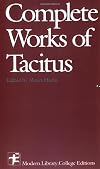
Edition: // Descr: xxv, 773 p. 18.5 cm. // Series: The Modern Library of the World's Best Books Call No. { 878 T11 4 } Translated from the Latin by Alfred John Church and William Jackson Brodribb Edited and with an Introduvction by Moses Hadas Contains Glossary of Place Names. // //
Edition: First Modern Library Edition // Descr: xxv, 773 p. 18.5 cm. // Series: The Modern Library of the World's Best Books Call No. { 878 T11 22 copy #1 } Translated from the Latin by Alfred John Church and William Jackson Brodribb Edited and with an Introduction by Moses Hadas Contains Glossary of Place Names. // //
Edition: // Descr: xxv, 773 p. 18.5 cm. // Series: The Modern Library College Editions Call No. { 878 T11 22 copy #2 } Translated from the Latin by Alfred John Church and William Jackson Brodribb Edited with an Introduction by Moses Hadas Contains Glossary of Place Names. // //
Members
- Recently Added By
Lists

Book Titles Mentioned In Newberry Medal And Honor Books
884 works; 3 members

Books cited in Progress by Samuel McDonald
160 works; 1 member
Author Information

544+ Works 14,189 Members
Tacitus was a Roman senator who survived the terror launched among the Roman aristocracy by the emperor Domitian to rise to prominence and become first suffect consul and later proconsul of Asia. His historical works, which originally covered the first century of the empire from the accession of Tiberius to the assassination of Domitian, are an show more indictment of the emperors and of the senatorial aristocracy under imperial autocracy. They remain the fundamental sources of imperial history in this period. The embarrasing paradox of Tacitus's success under a "bad" emperor appears to have had an effect on his works, whose tone may have struck contemporaries as a defense of his prominence under a despot. Tacitus is thus often thought to have nursed a nostalgia for the Republic and the free nobility of its senatorial order. However, his attitude is less genuinely backward-looking than occupied with the contemporary moral and political problems of aristocratic honor. In The Annals, which survives only in part, he examines palace politics under the Julio-Claudians. The unspoken questions that occupy this examination are those of the possibilities of uncompromised and dignified service under despotism, and the opportunities therein to mitigate its evil. These themes emerge into daylight in The Agricola, his laudatory biography of his father-in-law, the Roman general who conquered Britain. The work portrays Agricola as a straightforward military man who preserved his integrity and the admiration of his contemporaries under the emperor Domitian, even though his greatest achievements went unrewarded. Tacitus was a trained advocate, and fundamental to his outlook is his prosecutorial purpose. He states the case against the emperors and others who attract his unfavorable judgment. This bias can be difficult for the reader to overcome. But Tacitus also played by the rules of advocacy. He appears to bring to light facts unfavorable to his case in order to interpret them according to the necessities of his argument. His lawyerly honesty thereby allows the historian to dissect the facts from their matrix in order to use them in reconstructing a historical account of the first century of the empire which is more balanced, if inevitably less committed, than that of Tacitus. (Bowker Author Biography) show less
1 Work 759 Members
Some Editions
Series
Belongs to Publisher Series
Work Relationships
Contains
Common Knowledge
- Original publication date
- 98
- First words
- Rome at the beginning was ruled by kings.
- Last words
- (Click to show. Warning: May contain spoilers.)They laughed good-humouredly, and we parted.
Classifications
Statistics
- Members
- 759
- Popularity
- 37,069
- Reviews
- 9
- Rating
- (4.16)
- Languages
- 8 — Dutch, English, French, German, Hungarian, Italian, Latin, Spanish
- Media
- Paper, Ebook
- ISBNs
- 17
- ASINs
- 20