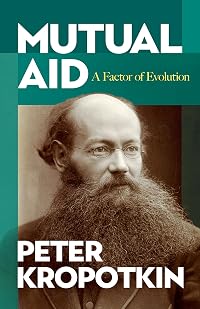
Mutual Aid: A Factor of Evolution
by Peter Kropotkin
On This Page
Description
One hundred years after his death, Peter Kropotkin is still one of the most inspirational figures of the anarchist movement. It is often forgotten that Kropotkin was also a world-renowned geographer whose seminal critique of the hypothesis of competition promoted by Social Darwinism helped revolutionize modern evolutionary theory. An admirer of Darwin, he used his observations of life in Siberia as the basis for his 1902 collection of essays Mutual Aid: A Factor of Evolution. Kropotkin show more demonstrated that mutually beneficial cooperation and reciprocity-in both individuals and as a species-plays a far more important role in the animal kingdom and human societies than does individualized competitive struggle. Kropotkin carefully crafted his theory making the science accessible. His account of nature rejected Rousseau's romantic depictions and ethical socialist ideas that cooperation was motivated by the notion of "universal love." His understanding of the dynamics of social evolution shows us that the power of cooperation-whether it is bison defending themselves against a predator or workers unionizing against their boss. His message is clear: solidarity is strength! Every page of this new edition of Mutual Aid has been beautifully illustrated by one of anarchism's most celebrated current artists, N.O. Bonzo. The reader will also enjoy original artwork by GATS and insightful commentary by David Graeber, Ruth Kinna, Andrej Grubacic, and Allan Antliff. show lessTags
Recommendations










































Member Reviews
This book cannot be underestimated in importance. It was written in response to Social Darwinism (and the horrifying excuse Social Darwinism gave for mass extermination of races), based on Kropotkin's scientific experiences in Siberia concerning cooperation in nonhuman animals, as well as his studies of savages, barbarians, the medieval city, and ourselves. This book concludes that cooperation and mutual aid are the most important factors in the evolution of the species and the ability to survive. Very much at the forefront of cultural battles (namely the attempt to hold off fascism). However, it would be a mistake to write this very much scientific book off for its ideological underpinnings (and equally a mistake to write it off show more ideologically for its scientific biases).
In Natural History Magazine (1997), Stephen Jay Gould emphasizes that Kropotkin’s basic argument is correct, although in comparison to up-to-date evolutionary (and revolutionary!) understandings, it does have a few flaws, one technical and one general:
'If Kropotkin overemphasized mutual aid, most Darwinians in Western Europe had exaggerated competition just as strongly. If Kropotkin drew inappropriate hope for social reform from his concept of nature, other Darwinians had erred just as firmly (and for motives that most of us would now decry) in justifying imperial conquest, racism, and oppression of industrial workers as the harsh outcome of natural selection in the competitive mode.'
'In judging arguments about nature that also have overt social implications: When such claims imbue nature with just those properties that make us feel good or fuel our prejudices, be doubly suspicious. Be especially wary of arguments that find kindness, mutuality, synergism, harmony – the very elements that we strive mightily, and so often unsuccessfully, to put into our own lives – intrinsically in nature.'
('Kropotkin was no crackpot', Stephen Jay Gould)
Humanity must therefore not forget that civilization is his battleground and that we must make civilization ours to make Nature ours.
And this book can give dispossessed folk too much of a scientific bias, too often turning away from the memory of historical/material struggles to the weak argument of a permanent, natural, biological state of freedom, of the glorification of the so-called golden age of primitive man.
A book that shows how science and society do not mutually exclude the other. Absolutely essential reading for understanding our battles of ideology and also for understanding the development of scientific understandings of evolution. Both of those themes continue in extreme importance well into the present.
An under-read, full-blown classic. show less
In Natural History Magazine (1997), Stephen Jay Gould emphasizes that Kropotkin’s basic argument is correct, although in comparison to up-to-date evolutionary (and revolutionary!) understandings, it does have a few flaws, one technical and one general:
'If Kropotkin overemphasized mutual aid, most Darwinians in Western Europe had exaggerated competition just as strongly. If Kropotkin drew inappropriate hope for social reform from his concept of nature, other Darwinians had erred just as firmly (and for motives that most of us would now decry) in justifying imperial conquest, racism, and oppression of industrial workers as the harsh outcome of natural selection in the competitive mode.'
'In judging arguments about nature that also have overt social implications: When such claims imbue nature with just those properties that make us feel good or fuel our prejudices, be doubly suspicious. Be especially wary of arguments that find kindness, mutuality, synergism, harmony – the very elements that we strive mightily, and so often unsuccessfully, to put into our own lives – intrinsically in nature.'
('Kropotkin was no crackpot', Stephen Jay Gould)
Humanity must therefore not forget that civilization is his battleground and that we must make civilization ours to make Nature ours.
And this book can give dispossessed folk too much of a scientific bias, too often turning away from the memory of historical/material struggles to the weak argument of a permanent, natural, biological state of freedom, of the glorification of the so-called golden age of primitive man.
A book that shows how science and society do not mutually exclude the other. Absolutely essential reading for understanding our battles of ideology and also for understanding the development of scientific understandings of evolution. Both of those themes continue in extreme importance well into the present.
An under-read, full-blown classic. show less
Interesting book. Written as a response to the essay “the struggle for existence in human society” by Thomas h. Huxley, who was arguing that competition, particularly in large complex cities demanded state rules people, when scarcity arose could not be counted on to be civilized. Kropotkin takes a counter point and starting with animals and moving through simpler to more complex societies shows that mutual aid has in fact been the more common and beneficial mode. Not totally sure how this relates to anarchy per se, but my research continues.
Written by the Russian 'Anarchist Prince', Mutual Aid is Kropotkin's work on cooperation as opposed to conflict within the natural and human world. The chapters are on mutual aid among animals; among 'savages' and 'barbarians' as Kropotkin calls them; in the medieval city; and amongst ourselves.
The work Kropotkin put into this book is phenomonal, the points he makes are elaborated on and demonstrated adequately, and I think it deserves a wider audience. To anyone who thinks conflict is the foundation of nature, I beg of you, read this book.
The work Kropotkin put into this book is phenomonal, the points he makes are elaborated on and demonstrated adequately, and I think it deserves a wider audience. To anyone who thinks conflict is the foundation of nature, I beg of you, read this book.
Kropotkin argues that mutual aid, co-operation, solidarity with one's neighbors, sociability, have played the leading part in human evolution, not competition. The Darwinian struggle for survival has been with the environment, not with other people. Man is not the warlike being he is thought to be. "At no period of man's life were wars the normal state of existence." He challenges Thomas Hobbes on his view of human nature. Primitive man always preferred peace to war, though migration was sometimes necessary and often led to war. Mutual aid was absolutely essential to the survival of our human ancestors. He gives examples of co-operation among Bushmen, Hottentots, Eskimos, barbarians, etc.
Medieval people had their craft guilds and show more communal building projects. In modern times there are labor unions, political societies, clubs, insurance alliances, communal ownership of grazing lands, etc.
He gives examples from the animal kingdom, from beetles to baboons. Mutual aid is the rule within species. Hyenas hunt in packs and beavers work in common. Animals attack other species, but within species life in societies is the rule. Co-operation is absolutely necessary for survival among small and feeble animals. He challenges some of Darwin's statements about competition within species.
Kropotkin's examples are many and convincing. show less
Medieval people had their craft guilds and show more communal building projects. In modern times there are labor unions, political societies, clubs, insurance alliances, communal ownership of grazing lands, etc.
He gives examples from the animal kingdom, from beetles to baboons. Mutual aid is the rule within species. Hyenas hunt in packs and beavers work in common. Animals attack other species, but within species life in societies is the rule. Co-operation is absolutely necessary for survival among small and feeble animals. He challenges some of Darwin's statements about competition within species.
Kropotkin's examples are many and convincing. show less
Kropotkin's observation that species succeed just as much (or more) by cooperating than by competing was innovative a century ago, and helped buck the trend of a vicious, individualistic interpretation of Darwinism. But his book is now very dated and superseded by more recent findings, his style is tiring (consisting of a very long list of examples of mutual aid), and his argumentation is biased.
I liked Kropotkin as a teenager, but had never read this. Wordy by today’s standards but I enjoyed this survey of social good works among animals and people.
Mutual Aid: A Factor of Evolution is a book by Peter Kropotkin on the subject of mutual aid, written while he was living in exile in England. It was first published by William Heinemann in London in October 1902. The individual chapters had originally been published in 1890-96 as a series of essays in the British monthly literary magazine, Nineteenth Century.
Written partly in response to Social Darwinism and in particular to Thomas H. Huxley's Nineteenth Century essay, "The Struggle for Existence," Kropotkin's book drew on his experiences in scientific expeditions in Siberia to illustrate the phenomenon of cooperation. After examining the evidence of cooperation in nonhuman animals, "savages," "barbarians," in medieval cities, and in show more modern times, he concludes that cooperation and mutual aid are as important in the evolution of the species as competition and mutual strife, if not more so. show less
Written partly in response to Social Darwinism and in particular to Thomas H. Huxley's Nineteenth Century essay, "The Struggle for Existence," Kropotkin's book drew on his experiences in scientific expeditions in Siberia to illustrate the phenomenon of cooperation. After examining the evidence of cooperation in nonhuman animals, "savages," "barbarians," in medieval cities, and in show more modern times, he concludes that cooperation and mutual aid are as important in the evolution of the species as competition and mutual strife, if not more so. show less
Members
- Recently Added By
Lists

Library Wishlist
46 works; 1 member

Patriarchy and white supremacy de-programming
69 works; 1 member

Books cited in Progress by Samuel McDonald
160 works; 1 member

In Our Time books
4,934 works; 2 members
Author Information

178+ Works 5,774 Members
Some Editions
Series
Belongs to Publisher Series
Work Relationships
Common Knowledge
- Canonical title
- Mutual Aid: A Factor of Evolution
- Alternate titles
- Mutual Aid
- Original publication date
- 1902
- People/Characters
- Charles Darwin [Charles Robert: 1809-1882]; W. H. Hudson; Maxim Kovalevsky; John Lubbock; Alfred Russel Wallace
- First words
- PREFACE TO THE 1914 EDITION
When the present war began, involving nearly all Europe in a terrible struggle, and this struggle assumed, in those parts of Belgium and France which were invaded by the Germans, a never yet kno... (show all)wn character of wholesale destruction of life among the non-combatants and pillage of the means of subsistence of the civil population, "struggle for existence" became a favourite explanation with those who tried to find an excuse for these horrors. - Original language
- Russian
Classifications
- Genres
- Nonfiction, Sociology, Anthropology, Science & Nature, Philosophy, General Nonfiction, Politics and Government
- DDC/MDS
- 302.14 — Society, government, & culture Social sciences, sociology & anthropology Mass Communication & Media General topics of social interaction Social participation
- LCC
- HM131 .K92 — Social sciences Sociology (General) Sociology These are obsolete numbers no longer used
- BISAC
Statistics
- Members
- 1,213
- Popularity
- 20,452
- Reviews
- 10
- Rating
- (4.22)
- Languages
- 14 — Catalan, Danish, Dutch, English, Esperanto, French, German, Greek, Italian, Japanese, Russian, Serbian, Spanish, Swedish
- Media
- Paper, Audiobook, Ebook
- ISBNs
- 102
- ASINs
- 34