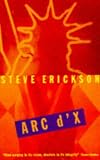
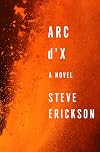
Arc d'X
by Steve Erickson
On This Page
Description
In a desperate effort to liberate herself, a fourteen-year-old slave--mistress to the man who invented America--finds herself flung into a different time and world Steve Erickson's provocative reimagining of American history, Arc d'X begins with the relationship between Thomas Jefferson and Sally Hemings. With "skin . . . too white to be quite black and too black to be quite white," Sally is loved only to the extent that she can be possessed, and finds hope only in the promise that her show more children's lives will be different from her own. The couple's paradox-riven union echoes through the ages and in an alternate epoch where time plays by other rules. In Aeonopolis, a theocratic city at the foot of a volcano, priests seek to have Sally indicted, and in an emptied-out Berlin, the Wall is being rebuilt. Dizzyingly imaginative, Arc d'X is an unrivaled exploration of "the pursuit of happiness." show lessTags
Recommendations




















Member Reviews
Tough to think of a place to start here. I had come to this because I was kind of fascinated by Erickson's short story (which I guess is now a novel?) Zeroville, and this was the only book of his I ever seemed to find (and it had a glowing blurb from William Gibson, which, that's certainly something).
I finished this book and didn't feel that I enjoyed it. This reviewer: http://quarterlyconversation.com/arc-dx-by-steven-erickson-review and I seem to be mostly on the same page - I almost want to email this person and track them down to talk this out further, because the Lynch connection seems even stronger in light of the Twin Peaks material that's come out between then and now (watch the third season and read this book and tell me show more they're not on the same wavelength).
Anyhow, that's me digressing. The point in that review I wanted to get to here is this idea of Erickson "breaking the piano", hammering on these metaphors to the point that you kind of lose any sense of what the characters are doing. Twin Peaks is always interesting to me because you have these very human, down-to-earth stories overlapping and bouncing off of the activities of this weird, higher-dimensional battle that the show never really explains all that well. Here, what you do get of that human element (and I'm not saying it's not there, because it certainly is) is wrapped up in layer upon layer of all this other stuff (which, to be clear, is nowhere near as weird as that other stuff is in Twin Peaks, it's just that it feels impenetrable).
Overall, I came away from this feeling like Erickson's a really great writer, but he's just not for me, and that's fine. show less
I finished this book and didn't feel that I enjoyed it. This reviewer: http://quarterlyconversation.com/arc-dx-by-steven-erickson-review and I seem to be mostly on the same page - I almost want to email this person and track them down to talk this out further, because the Lynch connection seems even stronger in light of the Twin Peaks material that's come out between then and now (watch the third season and read this book and tell me show more they're not on the same wavelength).
Anyhow, that's me digressing. The point in that review I wanted to get to here is this idea of Erickson "breaking the piano", hammering on these metaphors to the point that you kind of lose any sense of what the characters are doing. Twin Peaks is always interesting to me because you have these very human, down-to-earth stories overlapping and bouncing off of the activities of this weird, higher-dimensional battle that the show never really explains all that well. Here, what you do get of that human element (and I'm not saying it's not there, because it certainly is) is wrapped up in layer upon layer of all this other stuff (which, to be clear, is nowhere near as weird as that other stuff is in Twin Peaks, it's just that it feels impenetrable).
Overall, I came away from this feeling like Erickson's a really great writer, but he's just not for me, and that's fine. show less
Great premise and opens like a shotgun blast. I was with him for the first first character shifts, but after a while it seemed like he was doing it just for the hell of it. I couldn't care less ebout Etcher, Georgie or Erickson, and the book sort of meanders past the point with clumsy allusions to History Slavery and Sex. The writing is also quite purple at time. You can only call someone's cunt her 'vacancy' for so long before I have to chuckle. I give it a three for the great writing that is there and the story's originality. It's kind of like one of those albums where the concept is perfect, the guitar is fine, but the songs are weak.
Arc D'x I think is still one of those examples where it is not because something's missing, but show more because there's too-much there, that keeps the book from being a masterpiece. Frankly, the Georgie scenes were so fucking heavy-hand, whispering AMERICA all the time, it brought down the rest of the book. Without these 50 or so pages, the Erickson and Berlin scenes, it would have been a much better book. I mean, the concept is pretty heavy-handed as is, but sometimes Erickson writes like an art-school bumluck, preposterous attempts at figuring his already pretty obvious allegorical idea--history re-written, American as a melange of dark (pun) and light, etc...---that he loses track of the novel's greatest positive: it's narrative thrust.
I'll probably always think of this book like how I view Dark Side of the Moon: A LOT of great things and those three bad songs that drag the album down. Unlike an album, however, I can't skip a tune.
3.5/5. show less
Arc D'x I think is still one of those examples where it is not because something's missing, but show more because there's too-much there, that keeps the book from being a masterpiece. Frankly, the Georgie scenes were so fucking heavy-hand, whispering AMERICA all the time, it brought down the rest of the book. Without these 50 or so pages, the Erickson and Berlin scenes, it would have been a much better book. I mean, the concept is pretty heavy-handed as is, but sometimes Erickson writes like an art-school bumluck, preposterous attempts at figuring his already pretty obvious allegorical idea--history re-written, American as a melange of dark (pun) and light, etc...---that he loses track of the novel's greatest positive: it's narrative thrust.
I'll probably always think of this book like how I view Dark Side of the Moon: A LOT of great things and those three bad songs that drag the album down. Unlike an album, however, I can't skip a tune.
3.5/5. show less
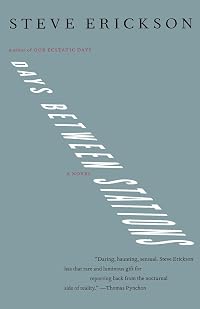
This was a reread. Wasn't really working for me this time around, though, so I put it down. I'd still recommend to anyone who hasn't read Erickson. This or any of his other 3 early novels (Rubicon Beach, Days Between Stations, [b:Tours of the Black Clock|7839|Tours of the Black Clock A Novel|Steve Erickson|http://photo.goodreads.com/books/1165644915s/7839.jpg|4037]). Very much takes you into mesmerizing alternate dream-realities, usually somewhat post-apocalyptic. He has a fine hypnotic writing style. He can get pretty heavy-handed and repetitive with the metaphors, but he's much more accessible than, say, the French surrealists, if you've try to read them.
Absolutely brilliant. Historical novel about Sally Hemings, Thomas Jefferson's mistress & slave, with profound psychological depth (desire, pain, happiness), some timeshift elements, and the play of symbols and U.S. history. So good it transcends any typical slipstream categorizations.
Good writing, cool atmosphere, too much sex, in the middle it seems like it's going nowhere but the end is fabulous how he links all the characters together.
Ratings
Members
- Recently Added By
Lists

Best Science Fiction Novels
816 works; 426 members

Speculative Fiction: Slipstream Literature
166 works; 16 members
Author Information

38+ Works 3,061 Members
Steve Erickson teaches writing at the California Institute of the Arts and is also the film critic for Los Angeles magazine.
Some Editions
Work Relationships
Is abridged in
Common Knowledge
- Canonical title
- Arc d'X
- Original publication date
- 1993
- People/Characters
- Sally Hemings; Thomas Jefferson; Wade; Mallory; Etcher; Mona
- Important places
- Berlin, Germany
- First words
- On an April night almost midpoint in the Eighteent Century, in the county of Orange and the colony of Virginia, Jacob Pollroot tasted his death a moment before swallowing it.
- Last words
- (Click to show. Warning: May contain spoilers.)And she watched take flight, like a black moth from his dead mouth, the name of the woman he loved.
- Blurbers
- Pynchon, Thomas; Gibson, William; Straub, Peter; Robbins, Tom
Classifications
- Genres
- Fiction and Literature, General Fiction, Science Fiction, Historical Fiction
- DDC/MDS
- 813.54 — Literature & rhetoric American literature in English American fiction in English 1900-1999 1945-1999
- LCC
- PS3555 .R47 .A89 — Language and Literature American literature American literature Individual authors 1961-
- BISAC
Statistics
- Members
- 317
- Popularity
- 100,319
- Reviews
- 5
- Rating
- (3.87)
- Languages
- English, Italian, Japanese
- Media
- Paper, Ebook
- ISBNs
- 9
- ASINs
- 3