On This Page
Description
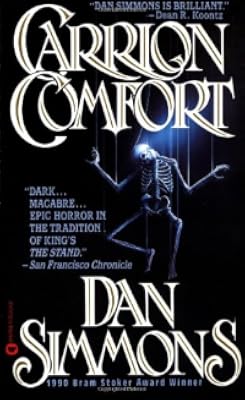
Embraced by giants such as Stephen King and Dean R. Koontz, Dan Simmons's Carrion Comfort was originally published by Warner Books in 1989, and remains a classic of dark fantasy and horror."One of the three greatest horror novels of the 20th century. Simple as that." —Stephen King
THE PAST... Caught behind the lines of Hitler's Final Solution, Saul Laski is one of the multitudes destined to die in the notorious Chelmno extermination camp. Until he rises to meet his fate and finds himself show more face to face with an evil far older, and far greater, than the Nazi's themselves...
THE PRESENT... Compelled by the encounter to survive at all costs, so begins a journey that for Saul will span decades and cross continents, plunging into the darkest corners of 20th century history to reveal a secret society of beings who may often exist behind the world's most horrible and violent events. Killing from a distance, and by darkly manipulative proxy, they are people with the psychic ability to 'use' humans: read their minds, subjugate them to their wills, experience through their senses, feed off their emotions, force them to acts of unspeakable aggression. Each year, three of the most powerful of this hidden order meet to discuss their ongoing campaign of induced bloodshed and deliberate destruction.
But this reunion, something will go terribly wrong. Saul's quest is about to reach its elusive object, drawing hunter and hunted alike into a struggle that will plumb the depths of mankind's attraction to violence, and determine the future of the world itself...
"Epic in scale and scope but intimately disturbing, Carrion Comfort spans the ages to rewrite history and tug at the very fabric of reality. A nightmarish chronicle of predator and prey that will shatter your world view forever. A true classic." —Guillermo del Toro
. Fiction. Horror. show less
Tags
Recommendations







Member Reviews
This sweeping historical fantasy imagines a world in which an infinitesimally small subset of humans has evolved the ability to control others with their minds. Our protagonist, Saul Laski, first encountered this evil while an inmate in a concentration camp. He found himself a literal pawn in a game of chess played with humans piloted around by two of these creatures. As pieces were captured, they were executed.
Having narrowly escaped this harrowing event with his life, Saul devotes himself to two things: survival, and the destruction of the creature that once controlled his mind. Saul's journey will culminate in the discovery of a secret enclave of these mind vampires who meet up annually to play this fatal game. Moreover, the small show more club is in the midst of an internal power struggle that will throw the fate of the world into the balance.
Along the way, Saul will collect allies, a small town sheriff who is investigating a bizarre massacre that is linked to Saul's investigations. The other, the daughter of an innocent bystander who is determined to bring the killer of her father to justice.
In the end, Saul will need every advantage at his disposal if he can hope to defeat the grisly terror from his nightmares.
Alas, I did not find this book particularly riveting. It is really quite long, and I often felt that it didn't need to be. We spend a lot of time getting to know some of the vampires. We spend lots if time in their heads listening to their inner monologues which mainly serve the purpose of convincing the reader that they are evil, which is silly and a waste of time. We also spend lots of time watching them do terrible crimes, or deliver hateful speeches to each other. It got tedious after awhile, and there seemed to be an unpleasant reveling in the evil of it all that seemed in poor taste.
Some of the rape scenes which were rendered in excruciating detail seemed to be exploitative and sensualized in a repulsive way. It seemed to invite the (male) reader to enter into the fantasy of raping women without fear of consequence.
The racist screeds of Melanie are likewise reveled in and presented in a way that give the impression that while she may be evil she might also have a few points?
Likewise, the fat southern preacher has a graphic sex scene with another male vampire and this seemed to be presented as a provocation to make the reader go, "EWW, gross! They're evil AND gay!" The sexuality of these two characters is not explored at any other point in the book, but seemed to be used only in this scene to underscore their truly base nature.
Even if I'm reading into this and the author himself doesn't subscribe to these amoral views, I would at the very least say that he's terrible at writing villains. This is a book composed primarily of villains. I love a good villain, and these are not good villains. The author just seemed to be trying to outdo himself with imagining repugnant qualities to give them. But they have no motives, no drive, no real personality. They are just "bad". They are not complex which makes them boring, which makes most of the book boring because we spend a lot of time with them.
I would not recommend reading this massive tome to anyone. There's much better horror out there. show less
Having narrowly escaped this harrowing event with his life, Saul devotes himself to two things: survival, and the destruction of the creature that once controlled his mind. Saul's journey will culminate in the discovery of a secret enclave of these mind vampires who meet up annually to play this fatal game. Moreover, the small show more club is in the midst of an internal power struggle that will throw the fate of the world into the balance.
Along the way, Saul will collect allies, a small town sheriff who is investigating a bizarre massacre that is linked to Saul's investigations. The other, the daughter of an innocent bystander who is determined to bring the killer of her father to justice.
In the end, Saul will need every advantage at his disposal if he can hope to defeat the grisly terror from his nightmares.
Alas, I did not find this book particularly riveting. It is really quite long, and I often felt that it didn't need to be. We spend a lot of time getting to know some of the vampires. We spend lots if time in their heads listening to their inner monologues which mainly serve the purpose of convincing the reader that they are evil, which is silly and a waste of time. We also spend lots of time watching them do terrible crimes, or deliver hateful speeches to each other. It got tedious after awhile, and there seemed to be an unpleasant reveling in the evil of it all that seemed in poor taste.
Some of the rape scenes which were rendered in excruciating detail seemed to be exploitative and sensualized in a repulsive way. It seemed to invite the (male) reader to enter into the fantasy of raping women without fear of consequence.
The racist screeds of Melanie are likewise reveled in and presented in a way that give the impression that while she may be evil she might also have a few points?
Likewise, the fat southern preacher has a graphic sex scene with another male vampire and this seemed to be presented as a provocation to make the reader go, "EWW, gross! They're evil AND gay!" The sexuality of these two characters is not explored at any other point in the book, but seemed to be used only in this scene to underscore their truly base nature.
Even if I'm reading into this and the author himself doesn't subscribe to these amoral views, I would at the very least say that he's terrible at writing villains. This is a book composed primarily of villains. I love a good villain, and these are not good villains. The author just seemed to be trying to outdo himself with imagining repugnant qualities to give them. But they have no motives, no drive, no real personality. They are just "bad". They are not complex which makes them boring, which makes most of the book boring because we spend a lot of time with them.
I would not recommend reading this massive tome to anyone. There's much better horror out there. show less
The twentieth century Anniversary Edition is the one to get because it has a remarkable 20-page or so introduction that lays bare the publishing history and the intellectual and personal origins of what was to be Simmons' second published novel.
Any aspiring genre writer should read this introduction because of its insights into what it means to be a writer in a recession. It gives interesting clues to the personality of an author whose psychodynamics embrace the hope of education and deep pessimism about the human condition.
This is not as good as 'Song of Kali' though not by much. The fault may lie in its origin. The traumatic process of getting it published seems to have resulted in a stubborn determination to make it 'perfect' rather show more than just 'good enough' for publication.
The result is that it is almost too 'perfect' - a truly innovative vampiric plot line, excellent characterisation and a detail of descriptive execution that is quite staggering sometimes. But that is where the problem lies.
It is 767 pages long. A good editor might have suggested some restraint in the action thriller scenes that go through every detail of a car chase or fire fight. It is like watching a movie except that movies are not novels and novels are not movies. The effect is sometimes a little tiresome.
Maybe 100-150 pages could have been lost and the reader allowed more imagination for themselves. And perhaps a little more 'spelling it out' at other key points because the writer was throwing so much data at us that perhaps the trees obscured the wood for a short while.
But praise is still due if only because he takes up the holocaust meme and does not make it trite and sentimental. It is of its time (1979) when the Holocaust was perhaps rawer than it is now to a student of human evil (for that is what Simmons clearly is).
Today it might be harder to write this story and not have it look hackneyed or ludicrous but his account of Jewish revenge and ultimately unintended consequences - and of moral anbiguity - still rings true, unaffected by what has happened since to the Holocaust meme in popular literature.
Mossad too is not caricatured - though definitely heroes, their heroism is contextualised and Simmons is not afraid to note when Israelis behave as badly as their past oppressors. He writes of Jews without being either patronising or overly stereotypical.
The story itself is of vampires as powerful atavistic genetic sports - few in number but deeply murderous by nature. He plays this out like the chess games that are so central to the world view of his Oberst character.
Of course, the brilliant plotting relies far too much on luck - or is it ineluctable fate - so that it reads too much like a recent Tom Cruise movie to be wholly credible. But credibility is not the point of the book in any case. We are in the realm of existential metaphor.
The mind vampires are just an exaggeration of the human condition. Even Hitler is hinted to be as (in the Bunker) a victim of a vampire rather than being one (as more trite writers would offer us). The vampires are an opportunity to examine our animal roots and find them wanting.
Simmons is also a liberal in the American sense. The story is one of diversity heroes and rebels (this is 1979 so we are talking race and gender though not sexual orientation) countering variants of white supremacism, religious manipulation and monied power yet handled with a light touch.
The political elite is seen as part-creature of the vampires and the facilitation of evil requires the participation of so-called Neutrals who choose to serve evil without question of which the type is the cold introvert Maria Chen who we can see is clearly existentially desperate for love.
In other words, the hold of vampires is partly one of direct mind control of 'victims' but it is equally one of collaboration from those humans without moral compass. Read physical force for mind control and this is the story of the holocaust.
The strange ambiguous love story of Harod and Chen, two psychopaths, is an allegory of life at the borderline where the instinct for survival competes with the last lingerings of some forgotten need for love and wins out. These two have a history that is all-too-human somewhere there.
Each is just on the other side of the border line between human and vampire from the other and makes one wonder whether either could have been saved by a different origin, a childhood that was not abused or unlucky. This is Simmonds trying to find the point where evil begins and ends.
Chen's final sacrifice, whether cold despair or something approaching selfless love, is compared implicitly with Harod's revenge for her sacrifice, yet another act of brutal violence even if it helps our heroes. And perhaps this is the border line between human and vampire - redemption.
There is also violence of social situation (exemplified by a violent black street gang who become allies of the heroes) set against innate genetic evil, animalistic and original (as in original sin).
This is the classic liberal (and socialist) problem that all the progressive education in the world cannot deal with the true sociopath. There is a hint of this awareness in Simmons' introduction where he tells us something of his teaching background which clearly meant a great deal to him.
Tony Harod may interest twenty-first readers in particular - the weakest of the mind vampires, a film producer who can only use his skills on women and uses it for psychopathic sexual gratification. He is also the only mind vampire whose evil may have emerged situationally.
Harod exists to show a continuum from normal psychopathy to the pure evil of the three main evil protagonists who had a Brady-Hindley cohesion of sorts, with an evil televangelist and an evil billionaire as half way houses. Harod even gains brief sympathy at times as a loser out of his depth.
Simmons is intent, it would seem, on seeing evil as a gradient with Harod, who exemplifies the problem that was to launch the #metoo novement, being the link between psychopathic ordinary humanity and the genetic sports whose extreme element is genocidal.
Abusing women, murdering for gain or manipulating for wealth, causing pain or killing for entertainment and pleasure, genocide - these all happen to people in a tale that is actually about the real source of evil, differential power relations amongst morally unequal people.
The gradient continues to the final surviving vampire. The story is always one of brutal competition for power between the players as much as its use against 'us' so that the final insane survivor must ineluctably be the one capable of the most heinous crime from a human point of view.
The ordinary humans suffer, survive or die around this tiny group of creatures in this long metaphor for the nature of power in society. A fine if flawed novel which I can understand Stephen King accepting as a worthy offering within his own tradition of dense narratives about evil. show less
Any aspiring genre writer should read this introduction because of its insights into what it means to be a writer in a recession. It gives interesting clues to the personality of an author whose psychodynamics embrace the hope of education and deep pessimism about the human condition.
This is not as good as 'Song of Kali' though not by much. The fault may lie in its origin. The traumatic process of getting it published seems to have resulted in a stubborn determination to make it 'perfect' rather show more than just 'good enough' for publication.
The result is that it is almost too 'perfect' - a truly innovative vampiric plot line, excellent characterisation and a detail of descriptive execution that is quite staggering sometimes. But that is where the problem lies.
It is 767 pages long. A good editor might have suggested some restraint in the action thriller scenes that go through every detail of a car chase or fire fight. It is like watching a movie except that movies are not novels and novels are not movies. The effect is sometimes a little tiresome.
Maybe 100-150 pages could have been lost and the reader allowed more imagination for themselves. And perhaps a little more 'spelling it out' at other key points because the writer was throwing so much data at us that perhaps the trees obscured the wood for a short while.
But praise is still due if only because he takes up the holocaust meme and does not make it trite and sentimental. It is of its time (1979) when the Holocaust was perhaps rawer than it is now to a student of human evil (for that is what Simmons clearly is).
Today it might be harder to write this story and not have it look hackneyed or ludicrous but his account of Jewish revenge and ultimately unintended consequences - and of moral anbiguity - still rings true, unaffected by what has happened since to the Holocaust meme in popular literature.
Mossad too is not caricatured - though definitely heroes, their heroism is contextualised and Simmons is not afraid to note when Israelis behave as badly as their past oppressors. He writes of Jews without being either patronising or overly stereotypical.
The story itself is of vampires as powerful atavistic genetic sports - few in number but deeply murderous by nature. He plays this out like the chess games that are so central to the world view of his Oberst character.
Of course, the brilliant plotting relies far too much on luck - or is it ineluctable fate - so that it reads too much like a recent Tom Cruise movie to be wholly credible. But credibility is not the point of the book in any case. We are in the realm of existential metaphor.
The mind vampires are just an exaggeration of the human condition. Even Hitler is hinted to be as (in the Bunker) a victim of a vampire rather than being one (as more trite writers would offer us). The vampires are an opportunity to examine our animal roots and find them wanting.
Simmons is also a liberal in the American sense. The story is one of diversity heroes and rebels (this is 1979 so we are talking race and gender though not sexual orientation) countering variants of white supremacism, religious manipulation and monied power yet handled with a light touch.
The political elite is seen as part-creature of the vampires and the facilitation of evil requires the participation of so-called Neutrals who choose to serve evil without question of which the type is the cold introvert Maria Chen who we can see is clearly existentially desperate for love.
In other words, the hold of vampires is partly one of direct mind control of 'victims' but it is equally one of collaboration from those humans without moral compass. Read physical force for mind control and this is the story of the holocaust.
The strange ambiguous love story of Harod and Chen, two psychopaths, is an allegory of life at the borderline where the instinct for survival competes with the last lingerings of some forgotten need for love and wins out. These two have a history that is all-too-human somewhere there.
Each is just on the other side of the border line between human and vampire from the other and makes one wonder whether either could have been saved by a different origin, a childhood that was not abused or unlucky. This is Simmonds trying to find the point where evil begins and ends.
Chen's final sacrifice, whether cold despair or something approaching selfless love, is compared implicitly with Harod's revenge for her sacrifice, yet another act of brutal violence even if it helps our heroes. And perhaps this is the border line between human and vampire - redemption.
There is also violence of social situation (exemplified by a violent black street gang who become allies of the heroes) set against innate genetic evil, animalistic and original (as in original sin).
This is the classic liberal (and socialist) problem that all the progressive education in the world cannot deal with the true sociopath. There is a hint of this awareness in Simmons' introduction where he tells us something of his teaching background which clearly meant a great deal to him.
Tony Harod may interest twenty-first readers in particular - the weakest of the mind vampires, a film producer who can only use his skills on women and uses it for psychopathic sexual gratification. He is also the only mind vampire whose evil may have emerged situationally.
Harod exists to show a continuum from normal psychopathy to the pure evil of the three main evil protagonists who had a Brady-Hindley cohesion of sorts, with an evil televangelist and an evil billionaire as half way houses. Harod even gains brief sympathy at times as a loser out of his depth.
Simmons is intent, it would seem, on seeing evil as a gradient with Harod, who exemplifies the problem that was to launch the #metoo novement, being the link between psychopathic ordinary humanity and the genetic sports whose extreme element is genocidal.
Abusing women, murdering for gain or manipulating for wealth, causing pain or killing for entertainment and pleasure, genocide - these all happen to people in a tale that is actually about the real source of evil, differential power relations amongst morally unequal people.
The gradient continues to the final surviving vampire. The story is always one of brutal competition for power between the players as much as its use against 'us' so that the final insane survivor must ineluctably be the one capable of the most heinous crime from a human point of view.
The ordinary humans suffer, survive or die around this tiny group of creatures in this long metaphor for the nature of power in society. A fine if flawed novel which I can understand Stephen King accepting as a worthy offering within his own tradition of dense narratives about evil. show less
After first reading THE TERROR, then SUMMER OF NIGHT, and now CARRION COMFORT, I can honestly say that I am a huge Dan Simmons fan. The man writes horror like no one else, and that is because he is able to take the genre and expertly mash it up with others, giving us something truly special. THE TERROR has elements of historical fiction and the best of Jack London in it, while SUMMER OF NIGHT taps into Baby Boomer nostalgia as good as anything Stephen King has written, along with being a great coming of age in a small town story. But CARRION COMFORT is nothing like those first two, making it plain that Simmons is a truly versatile writer, and a master of many subjects.
CARRION COMFORT is Simmons’ epic take on vampires, and I do mean show more epic, as my paperback copy clocks in at 767 pages. There are no fanged bloodsuckers to be found anywhere on those pages, instead, Simmons gives us his own take on them, his creatures of the night have no problem walking in the day, and instead of blood, these are vampires who feed on the minds of others, stealing their thoughts, emotions, and personalities, ultimately hollowing them out completely and taking control of their bodies. This is often portrayed in horrifying detail, although there is little real gore. And like true vampires, they are very long lived, becoming cold and cruel, utterly incapable of empathy on any level. They are among the most truly evil villains I have ever encountered in any piece of fiction, and as all of us horror fans know, if the author gets the bad guys right, half his work is done.
As I noted, CARRION COMFORT is a long book and sprawling book, with a large cast of characters, with the action jumping to multiple locations. Though some reviewers have complained about the length, I am one of those readers who crave the deep dive into character and plot, and as there is a lot of action, and many POV’s from interesting characters, for me, the story never seemed to drag. Simmons begins his novel in a Nazi concentration camp in the waning days of World War II, where a protagonist and antagonist is introduced, and then jumping the story ahead to the year 1980, where the main action takes place as a meeting of a secret society of these mind vampires, or Users, takes a bad turn, resulting in some major carnage, and putting an unlikely trio of heroes on a mission of revenge against an enemy a million times more powerful than themselves. Though the good guys get a lot of space, this is one book where we really get to know the villains well. One of the Users, Melanie Fuller, is given the singular honor of having a first person POV, and the result is that the reader is treated like one of the Users themselves, as Melanie calmly explains herself, and the atrocities she inflicts upon the truly innocent, as though she is confiding in her own kind. It is a great technique to draw us into the story. On the other side, no book could have a better hero than Saul Laski, a Jewish survivor of the Nazi horrors who has never given up on finding the User who tormented him in the camps. We also meet a young black woman determined to avenge her father; a good old boy Southern sheriff who is anything but a caricature; a sleazy Hollywood producer who literally uses women; a deputy director of the FBI who is anything but a public servant; a Washington power broker whose real power is a horrific secret, and then there is the Oberst, a sadist with delusions of grandeur, capable of putting his former Nazi cohorts to shame. There is a rich cast of supporting characters, some good, some bad, some just victims in the wrong place at the wrong time, as this book does have a high body count by the end.
CARRION COMFORT was written in the 80’s, and published in 1989, and one can see some of that decades cultural touchstones in the novel, as it as more shoot outs and action scenes, involving semi and automatic weapons, helicopters, fancy sports cars, and explosions than a Schwarzenegger movie. One character is clearly modeled on some of that decade’s more prominent, and shameless, TV televangelists. Simmons does manage to avoid getting bogged down in info dumps or unnecessarily long scenes where back story is inserted; his writing is cramped with detail – he paints a picture well – but for the most part, you always feel like the story is going somewhere.
Of particular interest to aspiring, or even successful writers, is the introduction Simmons included in my edition, where he relates his early struggles as a writer to get CARRION COMFORT completed while still holding down a job as a school teacher, along with the subsequent battle with an editor at a major publishing house, one that ended with him buying back his own book rather than put up with this person’s abuse anymore. It is no doubt some score settling, but it is also an interesting look at the creative process and the machinations of the publishing business.
CARRION COMFORT is a book that should be read by every lover of good horror fiction, yet I think far too few have ever heard of it, which is a shame. It takes an original approach to an old horror trope, and the best thing I can say about is that you never are sure which way the story is going on any given page. We are always wondering what will happen next, and for me, that is the highest praise I can give a book. It is what makes it such a page turner despite its length. And what a movie it would make in the right hands, I would love to see what David Cronenberg could do with it, or even Steven Spielberg. I’m sure it would turn out better than READY PLAYER ONE. May I suggest Richard Dreyfuss as Saul and Jessica Lange as Melanie. show less
CARRION COMFORT is Simmons’ epic take on vampires, and I do mean show more epic, as my paperback copy clocks in at 767 pages. There are no fanged bloodsuckers to be found anywhere on those pages, instead, Simmons gives us his own take on them, his creatures of the night have no problem walking in the day, and instead of blood, these are vampires who feed on the minds of others, stealing their thoughts, emotions, and personalities, ultimately hollowing them out completely and taking control of their bodies. This is often portrayed in horrifying detail, although there is little real gore. And like true vampires, they are very long lived, becoming cold and cruel, utterly incapable of empathy on any level. They are among the most truly evil villains I have ever encountered in any piece of fiction, and as all of us horror fans know, if the author gets the bad guys right, half his work is done.
As I noted, CARRION COMFORT is a long book and sprawling book, with a large cast of characters, with the action jumping to multiple locations. Though some reviewers have complained about the length, I am one of those readers who crave the deep dive into character and plot, and as there is a lot of action, and many POV’s from interesting characters, for me, the story never seemed to drag. Simmons begins his novel in a Nazi concentration camp in the waning days of World War II, where a protagonist and antagonist is introduced, and then jumping the story ahead to the year 1980, where the main action takes place as a meeting of a secret society of these mind vampires, or Users, takes a bad turn, resulting in some major carnage, and putting an unlikely trio of heroes on a mission of revenge against an enemy a million times more powerful than themselves. Though the good guys get a lot of space, this is one book where we really get to know the villains well. One of the Users, Melanie Fuller, is given the singular honor of having a first person POV, and the result is that the reader is treated like one of the Users themselves, as Melanie calmly explains herself, and the atrocities she inflicts upon the truly innocent, as though she is confiding in her own kind. It is a great technique to draw us into the story. On the other side, no book could have a better hero than Saul Laski, a Jewish survivor of the Nazi horrors who has never given up on finding the User who tormented him in the camps. We also meet a young black woman determined to avenge her father; a good old boy Southern sheriff who is anything but a caricature; a sleazy Hollywood producer who literally uses women; a deputy director of the FBI who is anything but a public servant; a Washington power broker whose real power is a horrific secret, and then there is the Oberst, a sadist with delusions of grandeur, capable of putting his former Nazi cohorts to shame. There is a rich cast of supporting characters, some good, some bad, some just victims in the wrong place at the wrong time, as this book does have a high body count by the end.
CARRION COMFORT was written in the 80’s, and published in 1989, and one can see some of that decades cultural touchstones in the novel, as it as more shoot outs and action scenes, involving semi and automatic weapons, helicopters, fancy sports cars, and explosions than a Schwarzenegger movie. One character is clearly modeled on some of that decade’s more prominent, and shameless, TV televangelists. Simmons does manage to avoid getting bogged down in info dumps or unnecessarily long scenes where back story is inserted; his writing is cramped with detail – he paints a picture well – but for the most part, you always feel like the story is going somewhere.
Of particular interest to aspiring, or even successful writers, is the introduction Simmons included in my edition, where he relates his early struggles as a writer to get CARRION COMFORT completed while still holding down a job as a school teacher, along with the subsequent battle with an editor at a major publishing house, one that ended with him buying back his own book rather than put up with this person’s abuse anymore. It is no doubt some score settling, but it is also an interesting look at the creative process and the machinations of the publishing business.
CARRION COMFORT is a book that should be read by every lover of good horror fiction, yet I think far too few have ever heard of it, which is a shame. It takes an original approach to an old horror trope, and the best thing I can say about is that you never are sure which way the story is going on any given page. We are always wondering what will happen next, and for me, that is the highest praise I can give a book. It is what makes it such a page turner despite its length. And what a movie it would make in the right hands, I would love to see what David Cronenberg could do with it, or even Steven Spielberg. I’m sure it would turn out better than READY PLAYER ONE. May I suggest Richard Dreyfuss as Saul and Jessica Lange as Melanie. show less
If everyone could understand the working of a psychopath's mind, we undoubtedly would be closer to insanity ourselves.
Honestly? God damn. I found this book on accident; the local library included it on a table with various horror recommendations, and the cover made it hard to not pick it up. Now, I'm just wondering how I've never heard of it before. But to be fair, neither had my father who happens to be a horror expert (admittedly mostly when it comes to cinema).
I knew just a few pages in that I was going to love it. I did. I also had a hard time putting it down; the urge to make sure the "good" characters made it out okay was incredibly strong, perhaps partly because of how well-written they were. They were alive on the pages, but so show more were the "bad" guys and honestly, the mix of the two was just... amazing. It was thrilling to not only read the story in different perspectives but also feel the change that came with each new prespective. I often feel like that is an aspect of the story telling that a lot of authors fail to truly accomplish; not just create different characters but write them so vividly different as well. Simmons managed to write some of the most frightening, discomforting characters I've encountered; them themselves sometimes more terrifying than the story itself.
But with that said, Simmons also managed to create a group of "heroes" that honestly spoke to me in a way few characters manage to do no matter how much I end up loving them. They were complex and alive and just.... bound to stay with me for quite sometime. So, thank you, Dan. show less
Honestly? God damn. I found this book on accident; the local library included it on a table with various horror recommendations, and the cover made it hard to not pick it up. Now, I'm just wondering how I've never heard of it before. But to be fair, neither had my father who happens to be a horror expert (admittedly mostly when it comes to cinema).
I knew just a few pages in that I was going to love it. I did. I also had a hard time putting it down; the urge to make sure the "good" characters made it out okay was incredibly strong, perhaps partly because of how well-written they were. They were alive on the pages, but so show more were the "bad" guys and honestly, the mix of the two was just... amazing. It was thrilling to not only read the story in different perspectives but also feel the change that came with each new prespective. I often feel like that is an aspect of the story telling that a lot of authors fail to truly accomplish; not just create different characters but write them so vividly different as well. Simmons managed to write some of the most frightening, discomforting characters I've encountered; them themselves sometimes more terrifying than the story itself.
But with that said, Simmons also managed to create a group of "heroes" that honestly spoke to me in a way few characters manage to do no matter how much I end up loving them. They were complex and alive and just.... bound to stay with me for quite sometime. So, thank you, Dan. show less
This was the second novel Dan Simmons wrote, immediately after Song of Kali. It was not his second published novel, however. Read the introduction to this edition to find out why; it makes a good story on its own, except for the really abrupt ending.
Simmons' genre-hopping tendencies start showing up right here - supposedly a horror story, this reads more like his take on a Robert Ludlum thriller - but with psychic, mind-controlling bad guys. It certainly is a page-turner, which is a good thing given its length, though there is a slow patch right at the beginning of the End Game. Taken along with all the rest of Simmons' output it only strengthens my opinion that this author can turn his hand to any genre and produce competent work.
So - show more End Game? - what's that all about? There's a chess theme running throughout the novel, which is divided into three sections, Opening, Middle Game and End Game. It's an inextricable part of the novel but towards the end becomes overt and slows the pace at a time when one would expect the opposite. On the other hand, the device solves some serious plot problems in a believable way. I'd be curious as to whether the end-game depicted in the book is considered well played by serious chess players.
One of the protagonists is Jewish and has a tattoo on his arm...this can be a cheap trick by an author in order to gain immediate sympathy and moral authority for the character but in this case such accusations would be false; this book is essentially about the Holocaust and what caused it; that most important of questions, what would you have done? Would you have followed orders and slaughtered Jews by the millions? Would you have done what ever it took to survive as a Jew in the camps, including tacit collaboration, by working for the Nazis? Why is it possible for industrial genocide to take place? Simmons is saying, in a very exaggerated fashion, that dominance of will by a minority or even an individual can cause all of this, though his "mind vampires" are not intended as a completely literal explanation.
Simmons is brave and suggests that the history of the modern state of Israel is not a black-and-white thing and asks what should one be prepared to do to route out evil? How many "innocents" have to die before it becomes morally untenable to take decisive action against a mass murderer who will continue and escalate his activities? Is revenge a moral justification? Is inaction morally justified? Should you involve others in what you know is a deadly conflict? The book does not necessarily answer all these questions - the idea is to make the reader think about them.
The "bad guys" in this book are bad indeed, but one of them is given a 1st person voice and she comes over most strongly as an utterly foul and increasingly deranged character because of it. Sharing her thoughts made me feel unclean - she's an appalling, disgusting creature. It would be easy to call her a monster, not human - but that is a cop out: her bigotry and evil are entirely human and that is what we have to face up to. Humanity has this potential.
This is a good book and thought-provoking but it isn't perfect: it is perhaps too long by 50-100p, the chess theme isn't terribly original or clever and I don't like the very end, though to explain why would add spoilers. Is there any unnecessary literary name dropping? Yes - this time Simmons' favourite "junk" writers are name-checked. These are mainly thriller writers - including Ludlum. show less
Simmons' genre-hopping tendencies start showing up right here - supposedly a horror story, this reads more like his take on a Robert Ludlum thriller - but with psychic, mind-controlling bad guys. It certainly is a page-turner, which is a good thing given its length, though there is a slow patch right at the beginning of the End Game. Taken along with all the rest of Simmons' output it only strengthens my opinion that this author can turn his hand to any genre and produce competent work.
So - show more End Game? - what's that all about? There's a chess theme running throughout the novel, which is divided into three sections, Opening, Middle Game and End Game. It's an inextricable part of the novel but towards the end becomes overt and slows the pace at a time when one would expect the opposite. On the other hand, the device solves some serious plot problems in a believable way. I'd be curious as to whether the end-game depicted in the book is considered well played by serious chess players.
One of the protagonists is Jewish and has a tattoo on his arm...this can be a cheap trick by an author in order to gain immediate sympathy and moral authority for the character but in this case such accusations would be false; this book is essentially about the Holocaust and what caused it; that most important of questions, what would you have done? Would you have followed orders and slaughtered Jews by the millions? Would you have done what ever it took to survive as a Jew in the camps, including tacit collaboration, by working for the Nazis? Why is it possible for industrial genocide to take place? Simmons is saying, in a very exaggerated fashion, that dominance of will by a minority or even an individual can cause all of this, though his "mind vampires" are not intended as a completely literal explanation.
Simmons is brave and suggests that the history of the modern state of Israel is not a black-and-white thing and asks what should one be prepared to do to route out evil? How many "innocents" have to die before it becomes morally untenable to take decisive action against a mass murderer who will continue and escalate his activities? Is revenge a moral justification? Is inaction morally justified? Should you involve others in what you know is a deadly conflict? The book does not necessarily answer all these questions - the idea is to make the reader think about them.
The "bad guys" in this book are bad indeed, but one of them is given a 1st person voice and she comes over most strongly as an utterly foul and increasingly deranged character because of it. Sharing her thoughts made me feel unclean - she's an appalling, disgusting creature. It would be easy to call her a monster, not human - but that is a cop out: her bigotry and evil are entirely human and that is what we have to face up to. Humanity has this potential.
This is a good book and thought-provoking but it isn't perfect: it is perhaps too long by 50-100p, the chess theme isn't terribly original or clever and I don't like the very end, though to explain why would add spoilers. Is there any unnecessary literary name dropping? Yes - this time Simmons' favourite "junk" writers are name-checked. These are mainly thriller writers - including Ludlum. show less
Carrion Comfort is a long, long horror novel from the late 1980s. In places it is exciting and riveting. In others it is disgusting, nasty and shocking, and in other places it is dull as ditchwater and keeping going is a bit of a slog. If you expect horror to be scary and creep you out, this doesn’t cut it. There is noting subtle about it and the author prefers action to building up tension. On balance though it is a good horror novel and worth a read if you are into mind-controlling, evil, murderous creatures. I hesitate to use the word vampires, which is the term most often used in discussion of Carrion Comfort. The evil protagonists of this story are not blood-sucking undead, but are most definitely just humans who have the show more Ability, meaning that they can enter the minds of others and take over their functions. In bringing about the deaths of hosts or people murdered by their hosts, they somehow derive energy and life-extending vigour.
Some of the characters are brilliant. Saul Laski the concentration camp survivor, for example. Saul’s backstory and the description of his camp experience was one of the riveting aspects of the novel. Tony Harod, although revolting, was also a well constructed character. I am going to give the author the benefit of the doubt and assume that the racist language and misogyny is in-character rather than something acceptable to the writer. The Oberst oozed evil and foul intent and was the perfect foil for Saul. Other elements and characters were less interesting or feasible. I was not a fan of Gentry and did not believe that he and Natalie would fall into a relationship. Nor did I believe that the bad guys could wreak so much havoc and cause so much death in the middle of a city without attracting attention.
Is this, as is claimed, one of the great horror novels of the twentieth century? Almost certainly not. Is it close to being one of them? Maybe. Let me digest it for a while and I will make my mind up. show less
Some of the characters are brilliant. Saul Laski the concentration camp survivor, for example. Saul’s backstory and the description of his camp experience was one of the riveting aspects of the novel. Tony Harod, although revolting, was also a well constructed character. I am going to give the author the benefit of the doubt and assume that the racist language and misogyny is in-character rather than something acceptable to the writer. The Oberst oozed evil and foul intent and was the perfect foil for Saul. Other elements and characters were less interesting or feasible. I was not a fan of Gentry and did not believe that he and Natalie would fall into a relationship. Nor did I believe that the bad guys could wreak so much havoc and cause so much death in the middle of a city without attracting attention.
Is this, as is claimed, one of the great horror novels of the twentieth century? Almost certainly not. Is it close to being one of them? Maybe. Let me digest it for a while and I will make my mind up. show less
Good but quite an odd duck.
The general plot and various climaxes are the stuff of thrillers, but the rythm and length of the book aren't really those of a thriller. It's a pretty massive book and you spend 90% of that time in protagonists' and antagonists' heads building up to those and experiencing them in minute detail, sometime from multiple perspectives.
The choice of characters is pretty archetypal (a bit unfortunately ?).
Most of the antagonists are also pretty fun choices for an author who later did such a political U-turn, there's a televangelist, an old maid who lives 200% in the past and can't even /see/ the individuality of people of color she interacts with because in her head they're all still slaves and servant material, all show more pretty thoroughly roasted. show less
The general plot and various climaxes are the stuff of thrillers, but the rythm and length of the book aren't really those of a thriller. It's a pretty massive book and you spend 90% of that time in protagonists' and antagonists' heads building up to those and experiencing them in minute detail, sometime from multiple perspectives.
The choice of characters is pretty archetypal (a bit unfortunately ?).
Most of the antagonists are also pretty fun choices for an author who later did such a political U-turn, there's a televangelist, an old maid who lives 200% in the past and can't even /see/ the individuality of people of color she interacts with because in her head they're all still slaves and servant material, all show more pretty thoroughly roasted. show less
Members
- Recently Added By
Lists

Best Horror Books
281 works; 84 members

Bloody Good Vampire Books
394 works; 27 members

Reader's Digest 50 Best Horror Books to Read
50 works; 3 members
Paste's 50 Best Horror Novels of All time
50 works; 6 members

Read This Twice's Best Horror Books
94 works; 2 members

Nightmare Magazine's Top 100 Horror Books
100 works; 7 members
Best Horror Mega-List
342 works; 6 members

Bram Stoker Award
238 works; 5 members
Reedsydiscovery 100 Best Horror Books of All Time
100 works; 5 members

Jones and Newman's Horror: Another 100 Best Books
100 works; 7 members

Books Read in 2017
4,249 works; 130 members

Paperbacks from Hell
382 works; 9 members

Jones & Newman: Best Horror Books Further Recommended Reading
577 works; 4 members

Books Read in 2022
5,166 works; 114 members

Books I Read Before The Invention Of The Internet.
144 works; 1 member

BlackDog's Complete Paperbacks From Hell List
639 works; 3 members
Author Information

133+ Works 69,625 Members
Science fiction writer Dan Simmons was born in East Peoria, Illinois in 1948. He graduated from Wabash College in 1970 and received an M. A. from Washington University the following year. Simmons was an elementary school teacher and worked in the education field for a decade, including working to develop a gifted education program. His first show more successful short story was won a contest and was published in 1982. His first novel, Song of Kali, won a World Fantasy Award, and Simmons has also won a Theodore Sturgeon Award for short fiction, four Bram Stoker Awards, and eight Locus Awards. He is also the author of the Hyperion series, and Simmons and his work have been compared to Herbert's Dune and Asimov's Foundation series. (Bowker Author Biography) show less
Some Editions
Awards and Honors
Awards
Distinctions
Notable Lists
Series

Belongs to Publisher Series
L'Échiquier du mal (intégrale)
Gallimard, Folio SF (500)
Work Relationships
Contains
Is an expanded version of
Common Knowledge
- Canonical title*
- L'Échiquier du mal
- Original title
- Carrion Comfort
- Original publication date
- 1989
- People/Characters
- Natalie Preston; Bobby Joe Gentry; Saul Laski; Tony Harod; Willi Borden; Melanie Fuller (show all 10); Reverend Jimmy Wayne Sutter; C. Arnold Barent; Nina Drayton; Jack Cohen
- Important places
- Washington, D.C., USA; Charleston, South Carolina, USA; Los Angeles, California, USA
- Epigraph
- "Not, I'll not, carrion comfort, despair, not feast on thee;
Not untwist—slack they may be—these last strands of man
In me or, most weary, cry I can no more..."
—Gerard Manley Hopkins - Dedication
- This is for Ed Bryant
- First words
- Saul Laski lay among the soon-to-die in a camp of death and thought about life.
- Quotations
- All humans feed on violence, on the small exercises of power over another, but few have tasted—as we have— the ultimate power.
Harod couldn't tell if he was seeing biceps or triceps; they all seem to flow together, like gerbils humping under a tight tarp.
Justice is required… It is demanded by the millions of voices from unmarked graves, from rusting ovens, from empty houses in a thousand cities. But not revenge. Revenge is not worthy. (Simon Wiesenthal) - Last words
- (Click to show. Warning: May contain spoilers.)And I am very, very hungry.
- Blurbers
- Morrell, David; Koontz, Dean; Stephen King (Carrion Comfort is one of the three greatest horror novels of the twentieth century. Simple as that.) (Carrion Comfort is one of the three greatest horror novels of the twentieth century. Simple as that.)
- Canonical DDC/MDS
- 813.54
- Canonical LCC
- PS3569.I4725
- Disambiguation notice
- Carrion Comfort was published in France as L'Échiquier du mal in multiple editions. There was a single volume (combined with the main Carrion Comfort work), a two volume set and a four volume set. The ... (show all)boxed sets are combined into the main Carrion Comfort work, but the individual volumes should not be combined together.
*Some information comes from Common Knowledge in other languages. Click "Edit" for more information.
Classifications
Statistics
- Members
- 2,446
- Popularity
- 7,945
- Reviews
- 59
- Rating
- (3.83)
- Languages
- 9 — Czech, Danish, Dutch, English, French, German, Italian, Polish, Spanish
- Media
- Paper, Audiobook, Ebook
- ISBNs
- 42
- ASINs
- 12