The Enchantments of Mammon: How Capitalism Became the Religion of Modernity
by Eugene McCarraher
On This Page
Description
"Far from displacing religions, as has been supposed, capitalism became one, with money as its deity. Eugene McCarraher reveals how Mammon ensnared us and how we can find a more humane, sacramental way of being in the world. If socialists and Wall Street bankers can agree on anything, it is the extreme rationalism of capital. At least since Max Weber, capitalism has been understood as part of the "disenchantment" of the world, stripping material objects and social relationships of their show more mystery and sacredness. Ignoring the motive force of the spirit, capitalism rejects the awe-inspiring divine for the economics of supply and demand. The author challenges this conventional view. Capitalism, he argues, is full of sacrament, whether or not it is acknowledged. Capitalist enchantment first flowered in the fields and factories of England and was brought to America by Puritans and evangelicals whose doctrine made ample room for industry and profit. Later, the corporation was mystically animated with human personhood, to preside over the Fordist endeavor to build a heavenly city of mechanized production and communion. By the twenty-first century, capitalism has become thoroughly enchanted by the neoliberal deification of "the market." Informed by cultural history and theology as well as economics, management theory, and marketing, The Enchantments of Mammon looks to nineteenth-century Romantics for salvation. The Romantic imagination favors craft, the commons, and sensitivity to natural wonder. It promotes labor that, for the sake of the person, combines reason, creativity, and mutual aid. McCarraher makes the case that capitalism has hijacked and redirected our intrinsic longing for divinity--and urges us to break its hold on our souls"-- show lessTags
Recommendations






















Member Reviews
Members
- Recently Added By
Published Reviews
ThingScore 75
This is nevertheless a work of history, and though it does not do so straightforwardly, it makes an argument about the past. It resists summary, probably by design: there are twenty-nine roughly chronological chapters divided into seven parts, each of which is stuffed to the gills with brilliant readings and unexplored historical byways. It may be better to think of the work as three books in show more one, instead of a single, sprawling 900-page treatise—three volumes woven together, covering roughly 1700 to the present, and each one illuminating one aspect of our predicament. show less
added by eereed
Lists

Top Five Books of 2025
954 works; 303 members

Books cited in Progress by Samuel McDonald
160 works; 1 member
Author Information
3+ Works 237 Members
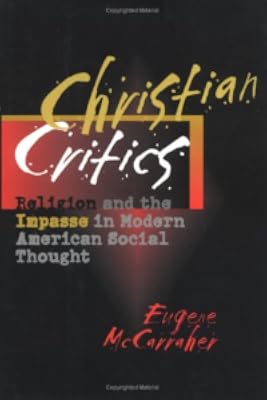
Eugene McCarraher is the author of Christian Critics: Religion and the Impasse in Modern American Social Thought. He contributes regularly to Commonweal, Hedgehog Review, and Raritan and also writes for Dissent and The Nation. He is Professor of Humanities and History at villanova University.
Awards and Honors
Distinctions
Observer Book of the Week (2019-12-22)
Common Knowledge
- Original language
- English
Classifications
- Genres
- Nonfiction, Economics, Religion & Spirituality, History, General Nonfiction, Business, Philosophy
- DDC/MDS
- 261.8 — Religion Christian organization, social work & worship Social theology and interreligious relations and attitudes Christianity and socioeconomic problems
- LCC
- HB501 .M443 — Social sciences Economic theory. Demography Economic theory. Demography Capital. Capitalism
- BISAC
Statistics
- Members
- 201
- Popularity
- 162,387
- Rating
- (3.67)
- Languages
- English
- Media
- Paper, Audiobook, Ebook
- ISBNs
- 5
- ASINs
- 2