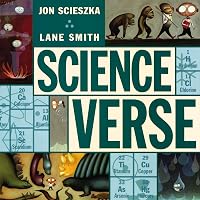
Science Verse
by Jon Scieszka 
On This Page
Description
When the teacher tells his class that they can hear the poetry of science in everything, a student is struck with a curse and begins hearing nothing but science verses that sound very much like some well-known poems.Tags
Recommendations

Member Reviews
This book teaches science while at the same time is full of fun, providing lots of laughs. Many of the rhymes are take-offs of common songs and poems kids may recognize, such as “Stopping By Woods on a Snowy Evening” by Robert Frost or “Jabberwocky” by Lewis Carroll. Some are short but still so clever, as this one on the dual form of light:
"Hey diddle diddle, what kind of riddle
Is this nature of light?
Sometimes it’s a wave,
Other times particle . . .
But which answer will be marked right?"
Similarly, the complexity of natural phenomena is elucidated in “What’s the Matter?” in which the authors begin by explaining:
"Miss Lucy had some matter.
She didn’t know its state.
She only had three choices,
So tried to get it straight. . show more . ."
My favorite is this riff on “The Night Before Christmas”:
"'Twas the night before Any Thing, and all through deep space,
Nothing existed -- time, matter, or place.
No stockings, no chimneys. It was hotter than hot.
Everything was compressed in one very dense dot.
When out of the nothing there appeared with a clatter
A fat guy with reindeer and something the matter.
His nose was all runny. He gave a sick hack.
"Oh, Dasher! Oh, Dancer! I can't hold it back!"
He huffled and snuffled and sneezed one AH-CHOO!
Then like ten jillion volcanoes, the universe blew.
That dense dot exploded, spewing out stars,
Earth, Venus, Jupiter, Uranus, and Mars,
Helium, hydrogen, the mountains and seas,
The chicken, the egg, the birds and the bees,
Yesterday's newspaper, tomorrow's burnt toast,
Protons and neutrons, your grandma's pork roast.
The universe expanded. The guy said with a wheeze,
'Who will ever believe the world started by sneeze?
So let's call it something much grander, all right?
Merry BIG BANG to all! And to all -- Gesundheit!'”
Whimsical illustrations by Lane Smith complement each poem, and a CD of Scieszka (“rhymes with Fresca”) reciting the poems is also included.
Evaluation: This utterly delightful book of science rhymes will delight readers of all ages. show less
"Hey diddle diddle, what kind of riddle
Is this nature of light?
Sometimes it’s a wave,
Other times particle . . .
But which answer will be marked right?"
Similarly, the complexity of natural phenomena is elucidated in “What’s the Matter?” in which the authors begin by explaining:
"Miss Lucy had some matter.
She didn’t know its state.
She only had three choices,
So tried to get it straight. . show more . ."
My favorite is this riff on “The Night Before Christmas”:
"'Twas the night before Any Thing, and all through deep space,
Nothing existed -- time, matter, or place.
No stockings, no chimneys. It was hotter than hot.
Everything was compressed in one very dense dot.
When out of the nothing there appeared with a clatter
A fat guy with reindeer and something the matter.
His nose was all runny. He gave a sick hack.
"Oh, Dasher! Oh, Dancer! I can't hold it back!"
He huffled and snuffled and sneezed one AH-CHOO!
Then like ten jillion volcanoes, the universe blew.
That dense dot exploded, spewing out stars,
Earth, Venus, Jupiter, Uranus, and Mars,
Helium, hydrogen, the mountains and seas,
The chicken, the egg, the birds and the bees,
Yesterday's newspaper, tomorrow's burnt toast,
Protons and neutrons, your grandma's pork roast.
The universe expanded. The guy said with a wheeze,
'Who will ever believe the world started by sneeze?
So let's call it something much grander, all right?
Merry BIG BANG to all! And to all -- Gesundheit!'”
Whimsical illustrations by Lane Smith complement each poem, and a CD of Scieszka (“rhymes with Fresca”) reciting the poems is also included.
Evaluation: This utterly delightful book of science rhymes will delight readers of all ages. show less
Cute and fun! The poems make basic science concepts accessible; some may even help students remember key ideas. Most of the poems are modelled on familiar motifs, adding a degree of intertexuality to tie them into language arts class, and the imagery is, as usual with Smith's work, engaging and layered.
Be sure to listen to the CD. You'll hear the poems read by Jon and Lane, with sound effects and extra voices.
Bonus for me (as a book editor): The "Call to the Editor" was priceless!
Be sure to listen to the CD. You'll hear the poems read by Jon and Lane, with sound effects and extra voices.
Bonus for me (as a book editor): The "Call to the Editor" was priceless!
Possibly one of the most genius books I've ever seen. It's a book of poetry. About science. And the poems are all based on famous poems or song lyrics. Which you don't know until the end, unless you recognize them, which I did. "Gobblegooky" is based on "Jabberwocky," by Lewis Carroll. "Dino-Sore" is based on "The Raven," by Edgar Allan Poe. "Astronaut Stopping by a Planet on a Snowy Evening"... you get the idea.
And, on top of everything, it's illustrated by Lane Smith who is brilliant and one of my very favorite illustrators. Really, this book couldn't be more awesome.
Jack be nimble, Jack be quick.
Jack jump over the combustion reaction of O2 heat fuel to form CO2 light heat exhaust.
And, on top of everything, it's illustrated by Lane Smith who is brilliant and one of my very favorite illustrators. Really, this book couldn't be more awesome.
Mr. Newton places a curse of the science verse on one of his students. Everything around him is a science verse, and he can't get rid of it. He discovers some of the worlds greatest scientific wonders. He learns of dinosaurs, food chains, the big bang, the planets, and many more. When he returns to class to discuss the solar system, he discovers that he is hearing regular sentences now and not verse. He realizes that the curse of the science verse is broken. All is good in his universe until he arrives to art class...
This book was incredibly clever. The poems were well done, and had good rhymes and rhythm in it. There were so many different science concepts presented throughout the story, and it was all accurate. Aspects of chemistry, show more biology, physical science were involved throughout the book. The illustrations were fun and kept the story humorous. This would be a great book to share with a science class. show less
This book was incredibly clever. The poems were well done, and had good rhymes and rhythm in it. There were so many different science concepts presented throughout the story, and it was all accurate. Aspects of chemistry, show more biology, physical science were involved throughout the book. The illustrations were fun and kept the story humorous. This would be a great book to share with a science class. show less
His teacher said, "You hear the poetry of science in all,"
which gave him a science curse, then asleep he falls.
Life's macros and micros come alive in his dreams,
Escape the science curse? He wont it seems.
He dreams of everything
like planets and dark matter,
food chains, and amebas,
and of space getting fatter.
Recognizable tunes-- limericks, songs, and famous poem puns,
this book all about science is far from ho-hum.
This little boy fell asleep in class and
dreamed of poems about evolution and mass.
Poem after poem in class is dreamt.
Then awoken by teacher, no purposeful attempt.
No more poems! For in regular sentences he thinks,
In great disbelief, he stares and then blinks.
For a test on the planets is the next day,
but the little dreamer is show more prepared anyway.
Next is art class where Mr. Picasso states,
All connects to art, to everything it relates.
Oh no! show less
which gave him a science curse, then asleep he falls.
Life's macros and micros come alive in his dreams,
Escape the science curse? He wont it seems.
He dreams of everything
like planets and dark matter,
food chains, and amebas,
and of space getting fatter.
Recognizable tunes-- limericks, songs, and famous poem puns,
this book all about science is far from ho-hum.
This little boy fell asleep in class and
dreamed of poems about evolution and mass.
Poem after poem in class is dreamt.
Then awoken by teacher, no purposeful attempt.
No more poems! For in regular sentences he thinks,
In great disbelief, he stares and then blinks.
For a test on the planets is the next day,
but the little dreamer is show more prepared anyway.
Next is art class where Mr. Picasso states,
All connects to art, to everything it relates.
Oh no! show less
After being cursed with science verse, a young boy imagines science themed poems about a number of topics, from the water cycle, to black holes, states of matter, evolution, the food chain and many more. Most of the poems parody a well known rhyme, song or poem (the parodies are indicated at the end of the book); for example, “Gobblegooky”, about nutrition and food additives, closely resembles Lewis Carroll's “Jabberwocky”. The non-realistic, colorful illustrations visually correspond to the concept in the poem, and are crammed with science details, such as a model of an electron, or a depiction of the planets and moons of the solar system. Though educational in theme and topic, the poems are irreverent in the way kids love: one show more speculates that dinosaurs were wiped out because they were bored to death by teachers. Nonsense such as a teacher-caused dinosaur apocalypse is always presented absurdly enough that no reader would accept silliness as scientific fact. There are some in-jokes that older kids with more science background will be able to better appreciate (for example, instead of a candlestick, Jack jumps over a combustion reaction), but the poems are a fun way to introduce readers to concepts and pique interest in science and poetry. This fun and unconventional take on science class would be good for upper level elementary students. show less
This book is an illustrated story told in poetic verse of a young boy’s interpretation of scientific concepts and phenomena. In this story, well known poems and nursery rhymes are reworked to portray various science topics from anatomy, to biology and physics, and chemistry. The verses are witty and sharp, occasionally breaking the form of the poem which adds to their humor. The text and illustrations are laid side by side on the pages. The illustrations are abstract cartoons that increase the silliness to the rhymes. The illustrations would attract older audiences with their abstract presentation and slightly darker interpretation of the poems. The book itself maintains the scientific theme with the periodic table of elements show more included on the end paper. An authors note can be found at the end of the book listed as “observations and conclusions,” that attributes many of the poems to their original creators. This book would be a humorous addition to a science themed story time or as an accompaniment to a science lesson. This book is recommended for purchase at a public or school library as a non-fiction or poetry selection. (Ages 7-10) show less
Members
- Recently Added By
Author Information

176+ Works 59,240 Members
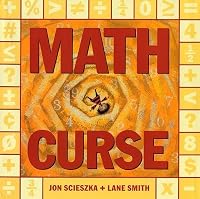
Jon Scieszka was born September 8, 1954 in Flint , Michigan. After he graduated from Culver Military Academy where he was a Lieutenant, he studied to be a doctor at Albion College. He changed career directions and attended Columbia University where he received a Master of Fine Arts degree in 1980. Before he became a full time writer, Scieszka was show more a lifeguard, painted factories, houses, and apartments and also wrote for magazines. He taught elementary school in New York for ten years as a 1st grade assistant, a 2nd grade homeroom teacher, and a computer, math, science and history teacher in 3rd - 8th grade. He decided to take off a year from teaching in order to work with Lane Smith, an illustrator, to develop ideas for children's books. His book, The Stinky Cheese Man received the 1994 Rhode Island Children's Book Award. Scieszka's Math Curse, illustrated by Lane Smith, was an American Library Association Notable Book in 1996; a Blue Ribbon Book from the Bulletin of the Center for Children's Books in 1995; and a Publisher's Weekly Best Children's Book in 1995. The Stinky Cheese Man received Georgia's 1997 Children's Choice Award and Wisconsin's The Golden Archer Award. Math Curse received Maine's Student Book Award, The Texas Bluebonnet Award and New Hampshire's The Great Stone Face Book Award in 1997. He was appointed the first National Ambassador for Young People's Literature by the Library of Congress in 2008. In 2014 his title, Frank Einstein and the Antimatter Motor made The New York Times Best Seller List. Frank Einstein and the Electro-Finger made the list in 2015. (Bowker Author Biography) show less
Jon Scieszka is a LibraryThing Author, an author who lists their personal library on LibraryThing.
All Editions
Awards and Honors
Awards
Distinctions
Common Knowledge
- Canonical title
- Science Verse
- Original publication date
- 2004
- Dedication
- TO? FOR? Six, eight. Who do we appreciate?
TO Jeri -- J. S.
TO Molly -- L. S. - First words
- On Wednesday in science class, Mr. Newton says, "You know, if you listen closely enough, you can hear the poetry of science in everything."
- Quotations
- Hey diddle diddle, what kind of riddle
Is this nature of light?
Sometimes it's a wave,
Other times particle...
But which answer will be marked right? - Last words
- (Click to show. Warning: May contain spoilers.)"Your art project must be your whole life."
- Original language
- English
Classifications
Statistics
- Members
- 1,308
- Popularity
- 18,608
- Reviews
- 100
- Rating
- (4.19)
- Languages
- English, Portuguese
- Media
- Paper
- ISBNs
- 4
- ASINs
- 2