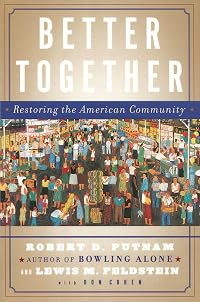
Better Together: Restoring the American Community
by Robert D. Putnam (Author), Lewis M. Feldstein (Author)
On This Page
Description
Offers a hopeful message about civic renewal with stories of a dozen places around the country where people are engaging in new forms of social activism and community renewal.Tags
Recommendations
















Member Reviews
This book profiles twelve organizations that have had success in building social capital. It discusses the strengths and weaknesses of the different approaches, with the hope of learning something about what does and doesn't work. The authors find that starting at the small group level, sharing stories, and bridging connections to larger groups all contribute to building communities and organizations that work better. Although reading it in 2014 I can tell that this book is starting to show some of its age (the Craigslist chapter was difficult to read b/c it was so out of date), the ideas are still useful and make me want to know what has been figured out since the book was written.
Even though I'm not planning to read Bowling Alone, and this is 'not quite as good' according to many reviewers, I might read this, if just for the hopefulness/ feel-good examples. It is at CC now.
Ratings
Members
- Recently Added By
Author Information

Robert D. Putnam is the Peter and Isabel Malkin Professor of Public Policy at Harvard University. A leading humanist and a renowned scientist, he has consulted for the last four U.S. Presidents. He has written fourteen books including Better Together: Restoring the American Community, Democracies in Flux: The Evolution of Social Capital in show more Contemporary Society, and Our Kids: The American Dream in Crisis. (Bowker Author Biography) show less
All Editions
Common Knowledge
- Original publication date
- 2003
- Quotations
- Getting individuals to articulate their needs and the possibilities they see and crating relationships that knit individuals into powerful groups is the core of the IAF's [Industrial Areas Foundation] work. Cortés lays out t... (show all)he principles underlying the organization's methods in his response to a college student who asked what 'motivates people to support a cause with actions as well as words': ' When I hear your question, what I think you're really saying is, "How can I convince people to do what's good? How do I get them to do what's right? How do I get them to follow my agenda?" That's not organizing. What I mean by organizing is getting you to recognize what's in your best interest. Getting you to recognize that you have a child, that you have a career and a life to lead, and that there are some things that are obstacles to the quality of your life. I need to get you to see how you can affect those things through relationships with other people.' p 16
'No permanent allies, no permanent enemies' is a core principle. p 19
"I learned a long time ago that anxiety is contagious." Sister Judy Donovan, qtd p 29
...the willingness of those in power to open the doors to citizen influence rather than protect their 'turf' is a critical element of the social-capital story. p 248
Using the social-capital lens allows us to see that in each of these cases the supposed inefficiency actually is essential for creating the virtuous circles of human connectivity that are basic to the organization's effective... (show all)ness and that have valuable spillover effect beyond the group itself... the 'process' is crucial to the product. pp 270-271
Crafting cross-cutting identities is a powerful way to enable connection across perceived diversity. That is, bridging may depend on finding, emphasizing, or creating a new dimension of similarity within which bonding can occ... (show all)ur. One often underestimated technique for creating new identities and bridging social distance, as well as for helping to create social capital in other ways, is telling stories. p 282
Classifications
- Genres
- Nonfiction, Sociology, General Nonfiction, Politics and Government, History
- DDC/MDS
- 306.0973 — Society, government, & culture Social sciences, sociology & anthropology Social Behavior - Dating, Marriage, Divorce Social history North America United States
- LCC
- HN65 .P877 — Social sciences Social history and conditions. Social problems. Social reform Social history and conditions. Social problems. By region or country
- BISAC
Statistics
- Members
- 377
- Popularity
- 83,165
- Reviews
- 2
- Rating
- (3.54)
- Languages
- English
- Media
- Paper, Ebook
- ISBNs
- 3
- ASINs
- 3