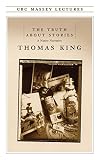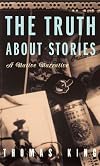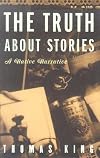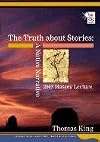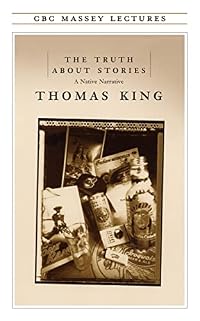
The Truth About Stories: A Native Narrative
by Thomas King
On This Page
Description
"In The Truth About Stories, Native novelist and scholar Thomas King explores how stories shape who we are and how we understand and interact with other people. From creation stories to personal experiences, historical anecdotes to social injustices, racist propaganda to works of contemporary Native literature, King probes Native culture's deep ties to storytelling." "Thomas King weaves events from his own life, as a child in California, an academic in Canada, and a Native North American, show more with a wide-ranging discussion of stories told by and about Indians." "That imaginative Indian that North Americans hold dear has been challenged by Native writers - N. Scott Momaday, Leslie Marmon Silko, Louis Owens, Robert Alexie, and others - who provide alternative narratives of the Native experience that question a past, create a present, and imagine a future. King reminds the reader, Native and non-Native, that storytelling carries with it social and moral responsibilities."--BOOK JACKET. show lessTags
Recommendations








Member Reviews
In 2003, Tom King presented a series of short stories as his contribution to the CBC Massey Lectures. The author’s premise was that “…We are all changed by every story we hear, by every story we tell”. Further, depending on the perspective of the story, we will take away a message. That take-away idea is what influences the listener, creates a way of looking at life that might improve on the old narrative. Or not. The message is conditional on the perspective of the chronicle. And the reception by the listener.
In my reading of the author’s stories, I was struck by how often Thomas King showed the reader/listener new ways to examine our collective history in North American colonisation, driven by religion and cultural show more differences. Views, for example, of the arrogance of European settlements which perpetuated intolerance and racism towards First Nation inhabitants. These chronicles of the centuries that have passed, tell us that attitudes haven’t changed. King uses imaginative stories to illustrate this proposition and by the end of the book, we have heard that the story you tell can be dangerous, because the narrative is incomplete or chooses a vengeful philosophy, or is unaccepting of humans who are culturally and physically different. A different story could have a different outcome, perhaps a more accepting philosophy by which to live.
Aside from these weighty matters, King has an incisive humour and brings an articulate rendering of “life on the rez” (urban or otherwise) from his own experiences. A particularly telling narrative that was amusing and cynical by turns is Let Me Entertain You. In this story, as in most of them, there are so many quotable passages. I urge you to read them. It’s a bittersweet tale, no matter which story you choose to examine. show less
In my reading of the author’s stories, I was struck by how often Thomas King showed the reader/listener new ways to examine our collective history in North American colonisation, driven by religion and cultural show more differences. Views, for example, of the arrogance of European settlements which perpetuated intolerance and racism towards First Nation inhabitants. These chronicles of the centuries that have passed, tell us that attitudes haven’t changed. King uses imaginative stories to illustrate this proposition and by the end of the book, we have heard that the story you tell can be dangerous, because the narrative is incomplete or chooses a vengeful philosophy, or is unaccepting of humans who are culturally and physically different. A different story could have a different outcome, perhaps a more accepting philosophy by which to live.
Aside from these weighty matters, King has an incisive humour and brings an articulate rendering of “life on the rez” (urban or otherwise) from his own experiences. A particularly telling narrative that was amusing and cynical by turns is Let Me Entertain You. In this story, as in most of them, there are so many quotable passages. I urge you to read them. It’s a bittersweet tale, no matter which story you choose to examine. show less
The written version of a series of broadcasts, all but the ultimate chapter which is unique to the book, begin with turtles all the way down and end with the reminder that you have taken on the burden of the chapter's truth -
"Just don't say in the years to come that you would have lived your life differently if only you had heard this story.
You've heard it now."
Some Native American stories, some biographical tales, some horror stories of what North American Europeans have done to, stolen from, made of, Native Americans - and are still busy doing, or not. No sweet nobility here, as his final chapter nails home, Thomas King knows how hollow our ethics are from the inside, as he has lived by them as well as beside them.
"Just don't say in the years to come that you would have lived your life differently if only you had heard this story.
You've heard it now."
Some Native American stories, some biographical tales, some horror stories of what North American Europeans have done to, stolen from, made of, Native Americans - and are still busy doing, or not. No sweet nobility here, as his final chapter nails home, Thomas King knows how hollow our ethics are from the inside, as he has lived by them as well as beside them.
Thomas King's collection of CBC Massey Lectures is a tightly constructed critique of North America's relationship, primarily the US, with First Nations people and a moving personal narrative. King brings himself into each of the five pieces in a way that elucidates his material and creates context for his anger and cynicism. There's hope, too, but not optimism, it's the belief that re-telling our stories can create a new future even if we're uncertain that future will come.
All the Massey Lecture books are worthwhile, but this is particularly wonderful. Indeed, I found it a brilliant, perspective-changing book. It should certainly be required reading for anyone who cares about stories, First Nations people, history, religion or politics (and particularly the Idle No More Movement). The light he shines on the machinations of government actions in the US and Canada against First Nations people is devastatingly bright.
King, whose novels I have loved just as much, is an erudite, deeply knowledgeable man of great wit, much of it gently subversive. He challenges the reader to open his heart, and ways of listening, by opening and ending each essay/story in the same way. Having had the honor of listening to a show more number of First Nations Elders and story-tellers over the years, I recognize the cadence and the method of teaching. King begins each piece with a re-telling of a creation story, which I won't repeat here except to say it's turtles all the way down... and ends with this directive: "Take this story. It's yours. do with it what you will. . . But don't say in the years to come that you would have lived your life differently if only you had heard this story. You've heard it now."
This simple sentence is, of course, much more profound than it appears at first reading. We are all changed by every story we hear, by ever story we tell. Stories are, King posits, what make us. They are us and we are them. The power of narrative -- for good or ill -- has never been more evident.
This is a book I'll be reading again and again. show less
King, whose novels I have loved just as much, is an erudite, deeply knowledgeable man of great wit, much of it gently subversive. He challenges the reader to open his heart, and ways of listening, by opening and ending each essay/story in the same way. Having had the honor of listening to a show more number of First Nations Elders and story-tellers over the years, I recognize the cadence and the method of teaching. King begins each piece with a re-telling of a creation story, which I won't repeat here except to say it's turtles all the way down... and ends with this directive: "Take this story. It's yours. do with it what you will. . . But don't say in the years to come that you would have lived your life differently if only you had heard this story. You've heard it now."
This simple sentence is, of course, much more profound than it appears at first reading. We are all changed by every story we hear, by ever story we tell. Stories are, King posits, what make us. They are us and we are them. The power of narrative -- for good or ill -- has never been more evident.
This is a book I'll be reading again and again. show less
Based on the author's Massey Lectures, this book is a moving look at the power story has to inform, transform, or bury people. The tales told range from the historical and sweeping, to the personal and shameful. They describe the damage that false stories can do to how a nation is perceived, and to how a nation perceives itself.
But while the author describes how the stories we listen to and tell shape our ability to perceive our world, each chapter ends with the invitation to take story and do as we wish with it - which adds a note of hope (and a sinking feeling of responsibility.)
But while the author describes how the stories we listen to and tell shape our ability to perceive our world, each chapter ends with the invitation to take story and do as we wish with it - which adds a note of hope (and a sinking feeling of responsibility.)
Each chapter of this collection of essays begins with a similar recounting of a storyteller presenting a traditional story to an audience. Like the "what's different" puzzles, or like oral stories themselves, each time there are a few changes in the details. And each chapter ends with the same message: 'Take this story. It's yours. Do with it what you wish....Just never say your life would have been different if only you had heard it...'
So, while it does include some traditional stories, King focuses more on how the white culture's own stories impacts their dealings with and expectations of Native Americans. And how people in general limit or expand their behavior because of the 'stories' they tell themselves. Although he is Canadian, show more he has enough knowledge of history to include references to United States to demonstrate that his insights are not unique to Canada. The book was a pleasant surprise (I was gifted the tape & had no expectations) as I'm always interested in learning about how others see the world and adapt to change.
Heard as audiobook with frequent interruptions, so my review is not as cohesive as several other LT reviews. show less
So, while it does include some traditional stories, King focuses more on how the white culture's own stories impacts their dealings with and expectations of Native Americans. And how people in general limit or expand their behavior because of the 'stories' they tell themselves. Although he is Canadian, show more he has enough knowledge of history to include references to United States to demonstrate that his insights are not unique to Canada. The book was a pleasant surprise (I was gifted the tape & had no expectations) as I'm always interested in learning about how others see the world and adapt to change.
Heard as audiobook with frequent interruptions, so my review is not as cohesive as several other LT reviews. show less
In The Truth about Stories, Thomas King, a Native novelist and professor of English at the University of Guelph in Ontario, Canada, explores creation stories, Native history, racism, and the image of the “Indian.” King is upfront with his opinion about narrative: “The truth about stories,” he claims, “is that that’s all we are” (2 and passim). We tell stories, he says, to inform ourselves about where we’re from, where we’re going, and who we are along the way. In this series of essays, originally delivered as the Massey Lectures at the University of Toronto, King is funny, eclectic, smart, searching, straightforward and, I’m convinced, right: we are our stories.
However, readers looking for evidence in support of show more King’s claim that we narrate our lives will have to look elsewhere. The Truth about Stories is highly subjective and anecdotal, and full of bold claims like this one: “‘You can’t understand the world without telling a story,’ the Anishinabe writer Gerald Vizenor tells us. ‘There isn’t any center to the world but a story’” (32). But one only has to look just outside of literary studies (where narrative theory is weak, bound, as it is, to an antiquated misconception of identity between “plot,” “story,” and “narrative”) to find powerful support for King’s claim. Narrative, Ochs and Capps write in an interdisciplinary review of the literature on the centrality and importance of story, “is born out of experience and gives shape to experience. In this sense, narrative and self are inseparable. Self is here broadly understood to be an unfolding reflective awareness of being-in-the-world, including a sense of one’s past and future…. We come to know ourselves as we use narrative to apprehend experiences and navigate relationships with others” (Annual Review of Anthropology 1996:20-21).
It’s precisely King’s subjectivity that makes The Truth about Stories so fascinating and worthwhile. The book is, in fact, composed entirely of stories, making it not only a primer on narrative concerns within the Native community but also a more general meta-commentary on the socio-political workings of narrative. Take, for example, the story of a character King names “Charm”: she’s a sort of subatomic particle, a quark, if you will, who cooperates in the process of the creation of Earth. Charm starts off on another planet. She’s a very curious woman and one day, while looking for something new and different to eat, she pokes her head into a “hole so she could get a better view” of what might be available there (13). But, of course, she falls through the hole, and down she goes “into the sky. Uh-oh, Charm thought to herself. That wasn’t to smart” (13). She falls toward the blue-green marble that is Earth: a planet covered entirely with water. Students of Native stories will instantly recognize this story as a version of the Mud Diver creation story. For once Charm splashes down on the watery Earth, all the animals—who really love living in the water—help Charm to find some mud upon which to stand.
This creation story, King points out, stands in stark contrast to the one found in Genesis:
A theologian might argue that these two creation stories are essentially the same. Each tells about the creation of the world and the appearance of human beings. But a storyteller would tell you that these two stories are quite different, for… the elements in Genesis create a particular universe governed by a series of hierarchies… that celebrate law, order, and good government, while in our Native story, the universe is governed by a series of co-operations… that celebrate equality and balance. (23-24)
Charm “falls” to Earth, but this creation of Earth as we know it is not the “Fall” as it is in Genesis. These are both stories, and as stories they inform our way of knowing: story is all we are not only ontologically (as Ochs and Capps imply in the passage cited above) but epistemologically as well. King avoids the obvious follow-on to this insight—which world would you rather live in?—because he doesn’t want to be “Thomas King the duck-billed platitude” (27). Neither does he claim that he’s stumbled on something new and original here. The onto-epistemological centrality of narrative, he suggests throughout, is ancient news to Natives. But it may be news to Western culture, since scholars in the Western tradition (such as “cranky old Jacque Derrida” [25]) have made a big pile of hay out of it in recent decades.
Of course, narrative can also be deceptive. Wars are started by telling lies, a pernicious genre of story that maims and kills. Knowledge, after all, is power, and narrative is epistemological. The history of North America is awash in a sea of narrative blood—but also real blood, the blood of Natives murdered and then buried under the shifting sands of white man’s lies. In The Truth about Stories King, himself half Native and half European, is particularly concerned with “the Indian… in mind” (chapter 2). It was a painful realization, he says, to grow up not looking Native (and in California, no less, where virtually all traces of Native culture have been assimilated by the image-machine of Western culture). The image-machine mows down everything in its path and “In the end, there is no reason for the Indian to be real. The Indian simply has to exist in our imagination. But for those of us who are Indians, this disjunction between reality and imagination is akin to life and death” (54). The semiotics of identity, then, “form[s] a kind of authenticity test, a racial-realty game that contemporary Native people are forced to play” (55). King, here, isn’t in the business of proffering solutions; he’s telling us what he knows about the world by telling us his stories. For anybody who has ever wondered and struggled with cultural identity (which far too few of us have), it’s easy to step into King’s shoes and keep the story going.
Another story he tells is one that cuts right through all real and imagined cultural boundaries, and it’s one he sums up in a single fragment: “Sanctioned Addictive Drugs and Banned Addictive Drugs” (157). Why, I wonder along with this deeply thoughtful writer, is the use of alcohol—by anybody’s measure clearly a toxin—merely sanctioned (that is, for use by those over 21 except while operating heavy machinery, such as cars) while cannabis—an ancient medicine—is banned? Why does Western culture continue to tell itself so many lies? Why, to return to the contrast between Charm’s cooperative mud divers and the Book of Genesis, are we stuck with brutal, hierarchical Yahweh when we could have gentle, neighbor-loving Jesus? It would be best to weep over these questions, I think, and to taste the salt of experience before rushing forth with policy decisions in lieu of considered answers. It would be best, I think, to read along with King as he suggest that “The magic of Native literature—as with other literatures—is not in the themes of the stories—identity, isolation, loss, ceremony, community, maturation, home—it is in the way meaning is refracted by cosmology, the way understanding is shaped by cultural paradigms” (112).
Thomas King, I read you loud and clear. I hope others will take up this little book and meditate on its various implications. I hope we’ll take King’s stories and do with them what we will, but not say “in the years to come that [we] would have lived [our] lives differently if only [we] had heard [his] stories” sooner (passim). We’ve heard them now.
[Originally published in Consciousness, Literature, and the Arts] show less
However, readers looking for evidence in support of show more King’s claim that we narrate our lives will have to look elsewhere. The Truth about Stories is highly subjective and anecdotal, and full of bold claims like this one: “‘You can’t understand the world without telling a story,’ the Anishinabe writer Gerald Vizenor tells us. ‘There isn’t any center to the world but a story’” (32). But one only has to look just outside of literary studies (where narrative theory is weak, bound, as it is, to an antiquated misconception of identity between “plot,” “story,” and “narrative”) to find powerful support for King’s claim. Narrative, Ochs and Capps write in an interdisciplinary review of the literature on the centrality and importance of story, “is born out of experience and gives shape to experience. In this sense, narrative and self are inseparable. Self is here broadly understood to be an unfolding reflective awareness of being-in-the-world, including a sense of one’s past and future…. We come to know ourselves as we use narrative to apprehend experiences and navigate relationships with others” (Annual Review of Anthropology 1996:20-21).
It’s precisely King’s subjectivity that makes The Truth about Stories so fascinating and worthwhile. The book is, in fact, composed entirely of stories, making it not only a primer on narrative concerns within the Native community but also a more general meta-commentary on the socio-political workings of narrative. Take, for example, the story of a character King names “Charm”: she’s a sort of subatomic particle, a quark, if you will, who cooperates in the process of the creation of Earth. Charm starts off on another planet. She’s a very curious woman and one day, while looking for something new and different to eat, she pokes her head into a “hole so she could get a better view” of what might be available there (13). But, of course, she falls through the hole, and down she goes “into the sky. Uh-oh, Charm thought to herself. That wasn’t to smart” (13). She falls toward the blue-green marble that is Earth: a planet covered entirely with water. Students of Native stories will instantly recognize this story as a version of the Mud Diver creation story. For once Charm splashes down on the watery Earth, all the animals—who really love living in the water—help Charm to find some mud upon which to stand.
This creation story, King points out, stands in stark contrast to the one found in Genesis:
A theologian might argue that these two creation stories are essentially the same. Each tells about the creation of the world and the appearance of human beings. But a storyteller would tell you that these two stories are quite different, for… the elements in Genesis create a particular universe governed by a series of hierarchies… that celebrate law, order, and good government, while in our Native story, the universe is governed by a series of co-operations… that celebrate equality and balance. (23-24)
Charm “falls” to Earth, but this creation of Earth as we know it is not the “Fall” as it is in Genesis. These are both stories, and as stories they inform our way of knowing: story is all we are not only ontologically (as Ochs and Capps imply in the passage cited above) but epistemologically as well. King avoids the obvious follow-on to this insight—which world would you rather live in?—because he doesn’t want to be “Thomas King the duck-billed platitude” (27). Neither does he claim that he’s stumbled on something new and original here. The onto-epistemological centrality of narrative, he suggests throughout, is ancient news to Natives. But it may be news to Western culture, since scholars in the Western tradition (such as “cranky old Jacque Derrida” [25]) have made a big pile of hay out of it in recent decades.
Of course, narrative can also be deceptive. Wars are started by telling lies, a pernicious genre of story that maims and kills. Knowledge, after all, is power, and narrative is epistemological. The history of North America is awash in a sea of narrative blood—but also real blood, the blood of Natives murdered and then buried under the shifting sands of white man’s lies. In The Truth about Stories King, himself half Native and half European, is particularly concerned with “the Indian… in mind” (chapter 2). It was a painful realization, he says, to grow up not looking Native (and in California, no less, where virtually all traces of Native culture have been assimilated by the image-machine of Western culture). The image-machine mows down everything in its path and “In the end, there is no reason for the Indian to be real. The Indian simply has to exist in our imagination. But for those of us who are Indians, this disjunction between reality and imagination is akin to life and death” (54). The semiotics of identity, then, “form[s] a kind of authenticity test, a racial-realty game that contemporary Native people are forced to play” (55). King, here, isn’t in the business of proffering solutions; he’s telling us what he knows about the world by telling us his stories. For anybody who has ever wondered and struggled with cultural identity (which far too few of us have), it’s easy to step into King’s shoes and keep the story going.
Another story he tells is one that cuts right through all real and imagined cultural boundaries, and it’s one he sums up in a single fragment: “Sanctioned Addictive Drugs and Banned Addictive Drugs” (157). Why, I wonder along with this deeply thoughtful writer, is the use of alcohol—by anybody’s measure clearly a toxin—merely sanctioned (that is, for use by those over 21 except while operating heavy machinery, such as cars) while cannabis—an ancient medicine—is banned? Why does Western culture continue to tell itself so many lies? Why, to return to the contrast between Charm’s cooperative mud divers and the Book of Genesis, are we stuck with brutal, hierarchical Yahweh when we could have gentle, neighbor-loving Jesus? It would be best to weep over these questions, I think, and to taste the salt of experience before rushing forth with policy decisions in lieu of considered answers. It would be best, I think, to read along with King as he suggest that “The magic of Native literature—as with other literatures—is not in the themes of the stories—identity, isolation, loss, ceremony, community, maturation, home—it is in the way meaning is refracted by cosmology, the way understanding is shaped by cultural paradigms” (112).
Thomas King, I read you loud and clear. I hope others will take up this little book and meditate on its various implications. I hope we’ll take King’s stories and do with them what we will, but not say “in the years to come that [we] would have lived [our] lives differently if only [we] had heard [his] stories” sooner (passim). We’ve heard them now.
[Originally published in Consciousness, Literature, and the Arts] show less
Members
- Recently Added By
Lists

Massey Lectures
6 works; 1 member
Author Information

Awards and Honors
Awards
Series
Belongs to Publisher Series
Common Knowledge
- Canonical title
- The Truth About Stories: A Native Narrative
- Original publication date
- 2003
- Dedication
- For Helen, who has heard these stories before
- First words
- There is a story I know.
- Last words
- (Click to show. Warning: May contain spoilers.)Just don't say in the years to come that you would have lived your life differently if only you had heard this story. You've heard it now.
Classifications
Statistics
- Members
- 583
- Popularity
- 50,000
- Reviews
- 12
- Rating
- (4.16)
- Languages
- English, French
- Media
- Paper, Audiobook, Ebook
- ISBNs
- 7
- UPCs
- 1
- ASINs
- 3