On This Page
Description
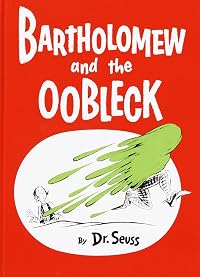
The King, tired of rain, snow, sun, and fog, commands his magicians to make something else come down from the sky, but when oobleck falls, in sticky greenish droplets, Bartholomew Cubbins shames the King and saves the kingdom.Tags
Recommendations

Member Recommendations
Member Reviews
Young Bartholomew Cubbins and King Derwin of Didd return in this amusing follow-up to their initial adventure, The 500 Hats of Bartholomew Cubbins. Now a page in the king's castle, Bartholomew is dismayed when the foolish King Derwin decides that snow, sun, rain and fog are boring, and that he wants something new to fall from the sky. Summoning his court magicians, the king commands them to create something new, in the way of weather, and that sinister cabal complies, brewing up a sticky, gooey green substance known as ooblek. Soon everyone in the castle and kingdom is stuck in greenish goo, from the humblest farmer to the king himself, paralyzed on his throne. It falls to Bartholomew to point out the obvious - that this is all the show more king's fault - and to demand an apology. For mysterious reasons, the simple words "I'm Sorry" have a magic all their own...
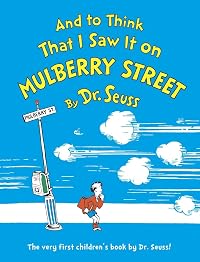
First published in 1949, some eleven years after the first story featuring Bartholomew Cubbins and King Derwin, Bartholomew and the Ooblek was Dr. Seuss' seventh picture-book, and it was awarded a Caldecott Honor in 1950. It was a perennial favorite in my childhood home, and many are the nights when I asked for it to be read to me, or read it on my own, once I was able. Something about that gooey, sticky ooblek was fascinating to me, as a girl - striking me as simultaneously frightening and funny. My present reread was prompted by my recently undertaken Dr. Seuss retrospective, in which I plan to read and review all forty-four of his classic picture-books, in chronological publication order. It is a project I began as an act of personal protest against the suppression of six of the author/artist's titles - And to Think That I Saw It on Mulberry Street, McElligot's Pool, If I Ran the Zoo, Scrambled Eggs Super!, On Beyond Zebra! and The Cat's Quizzer - by Dr. Seuss Enterprises. See my review of And to Think That I Saw It on Mulberry Street, to be found HERE, for a fuller exploration of my thoughts on that matter.
In any case, I found Bartholomew and the Ooblek every bit as engaging as I remembered, during this current reread. The story highlights the foolish hubris of King Derwin - also a theme in The 500 Hats of Bartholomew Cubbins - who imagines that he can improve upon nature, and have a better form of weather created through artificial means. One could read it as the hubris of humanity, so frequently thinking we can outdo nature, or the hubris of the elite - kings and other leaders imagining it is their right to make such far-reaching decisions by themselves. However one reads it, the consequences of the king's decision demonstrate that such actions have the potential to be immensely destructive, while the conclusion of the story highlights the important role that humility and repentance can play, in restoring harmony to human society, and to the wider world. Learning to admit our mistakes, and to apologize for them, is a difficult lesson sometimes, even for adults, so Dr. Seuss' entertaining little fable, which presents this process in such an amusing way, is most welcome. The accompanying artwork, done in black and white, with a sole color accent - green, for the ooblek - is immensely expressive. The limited color scheme really highlights the outlandish and surprising nature of the ooblek, and brilliantly complements the story. I can easily see why this was awarded a Caldecott Honor, despite the fact that it seems at first glance to be a retreat from Dr. Seuss' more colorful style, first seen in McElligot's Pool. Highly recommended to all picture-book readers, whether they enjoy unusual fairy-tale-style stories, or are fans of the creator. show less
First published in 1949, some eleven years after the first story featuring Bartholomew Cubbins and King Derwin, Bartholomew and the Ooblek was Dr. Seuss' seventh picture-book, and it was awarded a Caldecott Honor in 1950. It was a perennial favorite in my childhood home, and many are the nights when I asked for it to be read to me, or read it on my own, once I was able. Something about that gooey, sticky ooblek was fascinating to me, as a girl - striking me as simultaneously frightening and funny. My present reread was prompted by my recently undertaken Dr. Seuss retrospective, in which I plan to read and review all forty-four of his classic picture-books, in chronological publication order. It is a project I began as an act of personal protest against the suppression of six of the author/artist's titles - And to Think That I Saw It on Mulberry Street, McElligot's Pool, If I Ran the Zoo, Scrambled Eggs Super!, On Beyond Zebra! and The Cat's Quizzer - by Dr. Seuss Enterprises. See my review of And to Think That I Saw It on Mulberry Street, to be found HERE, for a fuller exploration of my thoughts on that matter.
In any case, I found Bartholomew and the Ooblek every bit as engaging as I remembered, during this current reread. The story highlights the foolish hubris of King Derwin - also a theme in The 500 Hats of Bartholomew Cubbins - who imagines that he can improve upon nature, and have a better form of weather created through artificial means. One could read it as the hubris of humanity, so frequently thinking we can outdo nature, or the hubris of the elite - kings and other leaders imagining it is their right to make such far-reaching decisions by themselves. However one reads it, the consequences of the king's decision demonstrate that such actions have the potential to be immensely destructive, while the conclusion of the story highlights the important role that humility and repentance can play, in restoring harmony to human society, and to the wider world. Learning to admit our mistakes, and to apologize for them, is a difficult lesson sometimes, even for adults, so Dr. Seuss' entertaining little fable, which presents this process in such an amusing way, is most welcome. The accompanying artwork, done in black and white, with a sole color accent - green, for the ooblek - is immensely expressive. The limited color scheme really highlights the outlandish and surprising nature of the ooblek, and brilliantly complements the story. I can easily see why this was awarded a Caldecott Honor, despite the fact that it seems at first glance to be a retreat from Dr. Seuss' more colorful style, first seen in McElligot's Pool. Highly recommended to all picture-book readers, whether they enjoy unusual fairy-tale-style stories, or are fans of the creator. show less
It's not bad, but it's also not what most readers today would recognize as Dr. Seuss: most of the prose doesn't rhyme, the art is sketchy and black-and-white (aside from the green element of the oobleck), and the moral at the end, despite being a good one (be grateful for what you've got), is unusually leaden for a Dr. Seuss story. That all makes it a very interesting curio, but it's not something most kids will want to read over and over. The most fun (and most Seussy) part is the chanting of the royal magicians.
Ok, a cool story about magic gone wrong, and a nifty fable about a king who needs to learn a lesson about hubris. But they do not work together - saying 'I'm sorry' is not going to clean up tons of hazardous waste. If it did, our environmental organizations would have a lot less work to do.
A very creative book for little children. This book is about a boy and a King. The boy observes and notices that the King is sick of the four natural weather patterns that come from the sky, the sunshine, rain, fog, and hail. The king summons the sorcerers to bring down the oobleck which brings frustration to the people of the palace. The oobleck adds to the fun of the story and shows us how it can frustrate something so worthy as a castle. The boy and the king come to a conclusion of apologizing so that the oobleck will go away. I recommend this book for K-3 graders.
Bored with rain, sun, fog, and snow, King Derwin of Didd summons his royal magicians to create something new and exciting to fall from the sky. What he gets is a storm of sticky green globs called Oobleck, which soon causes a royal mess. But with the assistance of the wise page boy Bartholomew, the king (along with young readers) learns that the simplest words can sometimes solve the biggest problems.
It's one of Dr. Seuss' classics. Bartholomew and the Oobleck is a story of learning from one's own mistakes. The clever Dr. Seuss rhymes are full of suspense and curiosity. Elementary students enjoy the mystery behind the substance of Oobleck. The pages are simple, with the green Oobleck being the only thing to add color to both pages.
I still haven't read the The 500 Hats of Bartholomew Cubbins, so I cannot compare this sequel to the aforementioned story. But for this follow-up, the lessons about having a sincere apology and on admitting his fault really makes a big difference. Being contented in life is another great lesson that this children's story book wants to impart to everyone.
Members
- Recently Added By
Lists

Caldecott Honor Books
296 works; 23 members

Books Read in 2023
5,638 works; 147 members

1970s
657 works; 23 members

Written and Illustrated By
805 works; 1 member
Author Information

799+ Works 359,665 Members
Theodor Seuss Geisel was born in Springfield, Massachusetts on March 2, 1904. He wrote and illustrated more than 45 picture books under the pseudonym Dr. Seuss. His first picture book, And to Think That I Saw It on Mulberry Street, was published in 1937. His other books included The Cat in the Hat, The Butter-Battle Book, The Lorax, The Bippolo show more Seed and Other Lost Stories, Fox in Socks: Dr. Seuss's Book of Tongue Tanglers, What Pet Should I Get?, and Oh, the Places You'll Go. In 1984, he received a Pulitzer Prize for his contributions to children's literature. He died of oral cancer on September 24, 1991 at the age of 87. (Bowker Author Biography) show less
Some Editions
Awards and Honors
Awards
Series

Belongs to Publisher Series
Work Relationships
Common Knowledge
- Canonical title
- Bartholomew and the Oobleck
- Alternate titles
- Bartholomew and the Oobleck
- Original publication date
- 1949
- People/Characters
- Bartholomew Cubbins
- Dedication
- For Kelvin C. Vanderlip, Jr.
- First words
- They still talk about it in the Kingdom of Didd as The-Year-the-King-Got-Angry-with-the-Sky.
- Last words
- (Click to show. Warning: May contain spoilers.)The King now knew that these four old-fashioned things... the rain, the sunshine, the fog and the snow... were good enough for any king in the world, especially for him, old King Derwin of Didd.
- Original language
- English
Classifications
Statistics
- Members
- 2,138
- Popularity
- 9,576
- Reviews
- 38
- Rating
- (4.07)
- Languages
- English, Hebrew, Spanish
- Media
- Paper, Audiobook, Ebook
- ISBNs
- 23
- ASINs
- 15