On This Page
Description
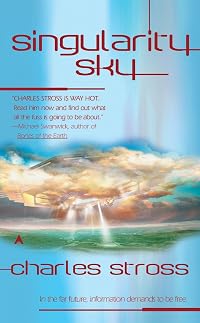
Hugo Award winner Charles Stross delivers a brilliant space opera replete with groundbreaking concepts and energized by an imaginative vision of the future. In the 21st century, the perfection of faster-than-light travel and the rise of a prodigious artificial intelligence known as the Eschaton altered the course of humankind. Now, far off in the vastness of space, the technology-eschewing New Republic is besieged by an alien information plague. Earth quickly sends a battle fleet-but is it show more coming to the rescue, or is a sinister plot in motion? show lessTags
Recommendations
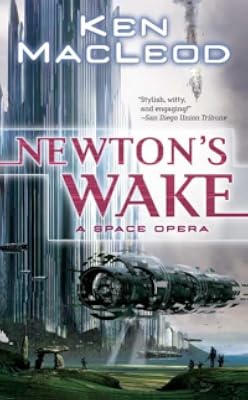
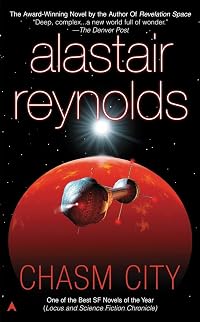
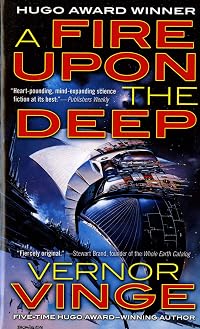
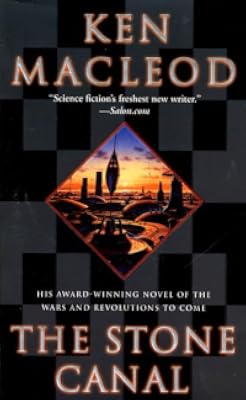

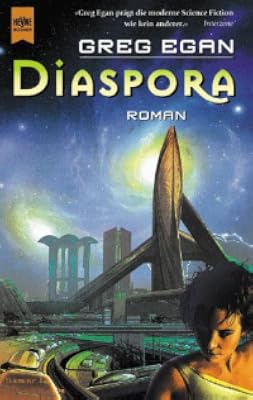
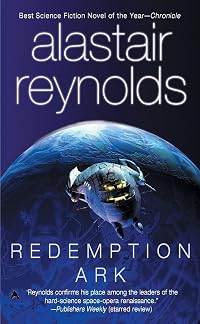

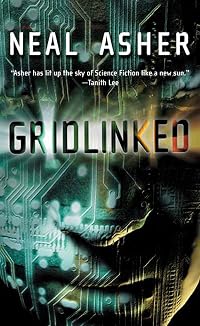
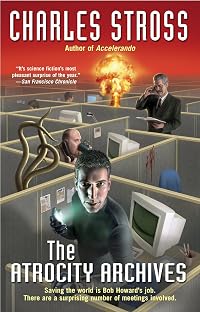


Member Recommendations
Member Reviews
Singularity Sky is where Stross gets it, chewing through the insulation of insufferable singulatarian techno-optimism to bite into the high voltage wire of Awesome that makes for a great and surprisingly deep space opera. The New Republic is a deliberate anachronism patterned after one of the Great Powers of the 19th century, and the bucolic colony of Rochard's World has fallen prey to The Festival, a self-replicating interstellar civilization that trades radical cyborg enhancements and nanotech cornucopias for folk tales. In response, the New Republic has dispatched it's proud battlefleet of heavily armed space cruisers on a course that threatens to trespass the Third Commandment. "I am the Eschaton. I am not your god. I am descended show more from you. Do not violate causality in my light cone. OR ELSE." It's up to a cynical warp-drive engineer and a UN diplomat to keep the hapless militarists of the New Republic from inviting a disaster from a god-like force they can't even begin to understanding. Great action, great characters, great cosmology, and a great book over all.
** 2022 Reread **
Yeah, Singularity Sky still slaps. Just one of my favorite books. Everything I've said above remains true. show less
** 2022 Reread **
Yeah, Singularity Sky still slaps. Just one of my favorite books. Everything I've said above remains true. show less
Okay, so the opening of this book is really damn solid: telephones raining down from the sky on a repressed backwater colony world, all of which say, "Entertain us." And from there it's all a bit...standard. And dull.
I get this feeling from Stross every time I read him, which is that he has great ideas in isolation, but no way to string them together to form an interesting and novel setting, culture, world, universe. Or plot. So what you get is a very standard book with some extremely shiny frippery grafted onto it: singularity! A wish-granting telephone repair system! Godlike beings obsessed with preserving causality! But it all boils down to the same sort of story Ian Fleming was telling in the 1950s.
I don't know. I found this mildly show more entertaining, but it didn't give me what I hope for from hard SF: new ideas, new worlds, new futures. And it didn't give me what I hope for from espionage and thriller novels: heart-pounding tension that compels me to keep turning the pages. And it didn't give me what I want from every novel: interesting characters who feel like people. What it did give me was some words to move my eyes over that reminded me of better things I've read. And for me that's not enough. show less
I get this feeling from Stross every time I read him, which is that he has great ideas in isolation, but no way to string them together to form an interesting and novel setting, culture, world, universe. Or plot. So what you get is a very standard book with some extremely shiny frippery grafted onto it: singularity! A wish-granting telephone repair system! Godlike beings obsessed with preserving causality! But it all boils down to the same sort of story Ian Fleming was telling in the 1950s.
I don't know. I found this mildly show more entertaining, but it didn't give me what I hope for from hard SF: new ideas, new worlds, new futures. And it didn't give me what I hope for from espionage and thriller novels: heart-pounding tension that compels me to keep turning the pages. And it didn't give me what I want from every novel: interesting characters who feel like people. What it did give me was some words to move my eyes over that reminded me of better things I've read. And for me that's not enough. show less
Definitely one of the best and most enjoyable of Stross' works. A fascinating mix of ideas and sub-plots, all carefully woven together. The kind of book you want give to a scifi "sceptic" and say "here - this is why I read the genre!"
(I realise all SF that deals with new/potential technology is going to date - probably badly - but here in 2024 the idea of the Eschaton - a super AI - makes for really interesting reading.)
(I realise all SF that deals with new/potential technology is going to date - probably badly - but here in 2024 the idea of the Eschaton - a super AI - makes for really interesting reading.)
If ever there was a book for which I am the target demographic, it's this one. The main themes of causality, cosmology, and singularity are my primary interests, and are dealt with better than just about anywhere else. Other authors tend to treat each subject in isolation, here they are treated holistically, and taken to the logical conclusion of how socio-economic and military-political systems are impacted by rapid technological advancement. The creativity and insight are off the charts.
That said, Stross's writing can be a bit rough around the edges. Scenes break unceremoniously, jumping POV without warning between paragraphs in the same chapter. There is a lot of exposition to explain the science and provide context, which is show more intensely interesting but probably not the best way to tell a story. He references many things, both real and fictional, and doesn't condescend to explicate much of it; for instance he assumes that his readers know what Hawking radiation is, how fission and fusion reactors work, know the difference between Radar and Lidar, etc.
He also can't seem to help but carried away with insanely imaginative ideas that quickly devolve into the surreal, such as fantastical appearances by Baba Yaga's walking hut and a person-sized sapient well-armed rabbit, that IMO detract from the otherwise well-grounded narrative. show less
That said, Stross's writing can be a bit rough around the edges. Scenes break unceremoniously, jumping POV without warning between paragraphs in the same chapter. There is a lot of exposition to explain the science and provide context, which is show more intensely interesting but probably not the best way to tell a story. He references many things, both real and fictional, and doesn't condescend to explicate much of it; for instance he assumes that his readers know what Hawking radiation is, how fission and fusion reactors work, know the difference between Radar and Lidar, etc.
He also can't seem to help but carried away with insanely imaginative ideas that quickly devolve into the surreal, such as fantastical appearances by Baba Yaga's walking hut and a person-sized sapient well-armed rabbit, that IMO detract from the otherwise well-grounded narrative. show less
This novel, Stross' first, is a space-operatic excursion into a universe of strangeness. Humanity has been scattered across the galaxy by an advanced intelligence from the future, the Eschaton, which may or may not be the ultimate development of humanity itself. In the five hundred years since that event, humanity has split into many different societies, many of which are in touch with distant Earth. Earth, meanwhile, has recovered from losing 90% of its population and concerns itself with trying to avoid further interventions by the Eschaton, which has warned humanity against trying to leverage the time paradoxes that faster-than-light travel can cause. This it takes a dim view of, and some populations been wiped out as a show more consequence.
This novel concentrates on one particular society, which brands itself the “New Republic” but which is actually a rigid monarchical state along the lines of the late Austro-Hungarian Empire. It has subjugated a number of other human colony worlds, and on one of them, Rochard's World, a neo-Marxist revolutionary group is close to seizing power from the New Republic when a trans-human polity, Festival, suddenly manifests itself and intervenes with a cargo cult-like ability to create advanced consumer goods in return for input – art, music, philosophy, entertainment or just plain stories. The New Republic gets wind of this and sends a space fleet to restore order. On that fleet are two people all the way from Earth: a space drive engineer on contract from Mikoyan i Gurevich and a United Nations weapons inspector on the lookout for people foolish enough to try to circumvent causality and with the mission of stopping them before they cause the Eschaton to descend on their civilization and descend on it hard. That's extinction-level event hard.
This is space opera in something of a steampunk mode. The New Republic's navy has a distinct Edwardian vibe to it; the ships are all mahogany panelling and gleaming brasswork inside, the uniforms are like something out of The Battleship Potemkin and some of the officers' attitudes are not much different. The forms of address used by lower ranked ratings are lifted straight out of Hasek's The Good Soldier Sjevk, though in truth it has to be said that unlike Hasek's story of the Dual Monarchy in World War I, the officers are, for the most part, competent but severely blinkered. (Though the Fleet Admiral is in his dotage, which doesn't help matters.) Which leads to the course of the fleet's mission going something like the Russo-Japanese War of 1904-05 (where, in case you weren't aware, a Tsarist Russian fleet left St.Petersberg to sail half-way round the world to attack Japan, encountered and sank a fleet of British fishing trawlers in the North Sea having mistaken them for Japanese torpedo boats, and eventually was defeated by the Japanese seven months later in the Battle of Tsushima.)
The engineer is assumed to be a spy (he is, but not for who anyone thinks); the UN inspector is worse, because she is - Shock! Horror! - a woman. (The New Republic's functionaries are nearly all very 19th Century in their attitudes.) Things are not helped by the presence of a member of the secret police, who is a recent recruit and seriously out of his depth.
Meanwhile, on Rochard's World, the neo-Bolshevik revolutionary cadres are coming into contact with some of the races that accompany Festival as it travels across the galaxy, contacting civilizations, and then seeding copies of itself to spread further. Things are getting distinctly strange.
The novel's style is quite distinct; it started out feeling like some of Stross' novellas from the early 2000s, packed full of ideas and throwing them off in all directions. Characterisation is competent: the naval officers, as I said, are out of Potemkin and Sjevk, the revolutionaries out of Eisenstein's October; whilst the engineer reminded me of Jonathan Harker, the protagonist in Bram Stoker's Dracula and the UN weapons inspector is reminiscent of no-one as much as Lola Montez, the femme fatale spy (based on a real person, though somewhat romanticised) in George Macdonald Fraser's Ruritanian Flashman novel Royal Flash.
I found this fun: other reviewers have not, mainly because they seem to have taken it too seriously and expected Military SF, a political story or a tale of first contact. It is at the same time all, and none, of these things.
This novel is the beginning a series of novels concerning the Eschaton and the universe it shaped. show less
This novel concentrates on one particular society, which brands itself the “New Republic” but which is actually a rigid monarchical state along the lines of the late Austro-Hungarian Empire. It has subjugated a number of other human colony worlds, and on one of them, Rochard's World, a neo-Marxist revolutionary group is close to seizing power from the New Republic when a trans-human polity, Festival, suddenly manifests itself and intervenes with a cargo cult-like ability to create advanced consumer goods in return for input – art, music, philosophy, entertainment or just plain stories. The New Republic gets wind of this and sends a space fleet to restore order. On that fleet are two people all the way from Earth: a space drive engineer on contract from Mikoyan i Gurevich and a United Nations weapons inspector on the lookout for people foolish enough to try to circumvent causality and with the mission of stopping them before they cause the Eschaton to descend on their civilization and descend on it hard. That's extinction-level event hard.
This is space opera in something of a steampunk mode. The New Republic's navy has a distinct Edwardian vibe to it; the ships are all mahogany panelling and gleaming brasswork inside, the uniforms are like something out of The Battleship Potemkin and some of the officers' attitudes are not much different. The forms of address used by lower ranked ratings are lifted straight out of Hasek's The Good Soldier Sjevk, though in truth it has to be said that unlike Hasek's story of the Dual Monarchy in World War I, the officers are, for the most part, competent but severely blinkered. (Though the Fleet Admiral is in his dotage, which doesn't help matters.) Which leads to the course of the fleet's mission going something like the Russo-Japanese War of 1904-05 (where, in case you weren't aware, a Tsarist Russian fleet left St.Petersberg to sail half-way round the world to attack Japan, encountered and sank a fleet of British fishing trawlers in the North Sea having mistaken them for Japanese torpedo boats, and eventually was defeated by the Japanese seven months later in the Battle of Tsushima.)
The engineer is assumed to be a spy (he is, but not for who anyone thinks); the UN inspector is worse, because she is - Shock! Horror! - a woman. (The New Republic's functionaries are nearly all very 19th Century in their attitudes.) Things are not helped by the presence of a member of the secret police, who is a recent recruit and seriously out of his depth.
Meanwhile, on Rochard's World, the neo-Bolshevik revolutionary cadres are coming into contact with some of the races that accompany Festival as it travels across the galaxy, contacting civilizations, and then seeding copies of itself to spread further. Things are getting distinctly strange.
The novel's style is quite distinct; it started out feeling like some of Stross' novellas from the early 2000s, packed full of ideas and throwing them off in all directions. Characterisation is competent: the naval officers, as I said, are out of Potemkin and Sjevk, the revolutionaries out of Eisenstein's October; whilst the engineer reminded me of Jonathan Harker, the protagonist in Bram Stoker's Dracula and the UN weapons inspector is reminiscent of no-one as much as Lola Montez, the femme fatale spy (based on a real person, though somewhat romanticised) in George Macdonald Fraser's Ruritanian Flashman novel Royal Flash.
I found this fun: other reviewers have not, mainly because they seem to have taken it too seriously and expected Military SF, a political story or a tale of first contact. It is at the same time all, and none, of these things.
This novel is the beginning a series of novels concerning the Eschaton and the universe it shaped. show less
An entertaining and easy read, and some really interesting themes that aren't typical of what sometimes seemed an excessive hard-science approach. I found the endless descriptions of battles in space just that - endless, and not useful in themselves or in moving the plot along. But that's the only real flaw in what was otherwise an entertaining read, and for many it won't even be a flaw.
Others have commented that there are almost too many ideas in here crowding for space, and in retrospect that seems a fair comment. One in particular struck me at the time of reading - the Festival is a magnificent, humorous and completely original concept that allows him to explore some interesting philosophical ideas almost effortlessly. Definitely show more worth a read and I will seek out some of his other stuff, but not quite up to the hyperbole of some of the cover notes. (Since I wrote this I've read quite a bit of Stross's other novels and I am more and more impressed as I go on. Still, this is not the best of them for me.) show less
Others have commented that there are almost too many ideas in here crowding for space, and in retrospect that seems a fair comment. One in particular struck me at the time of reading - the Festival is a magnificent, humorous and completely original concept that allows him to explore some interesting philosophical ideas almost effortlessly. Definitely show more worth a read and I will seek out some of his other stuff, but not quite up to the hyperbole of some of the cover notes. (Since I wrote this I've read quite a bit of Stross's other novels and I am more and more impressed as I go on. Still, this is not the best of them for me.) show less
This is one of the better pieces of singularity fiction I have encountered, despite the fact it dodges the hard problem of describing a post-singularity world by telling a tale from the point of view of the people the singularity left behind. The post-singularity intelligence(s) in the universe Stross built in Singularity Sky suppresses any ability of the pre-singularity entities in the universe to advance to a level where they may challenge it, or to perform any act that may threaten the events that led to the singularity-induced apotheosis of existing post-singularity intelligence(s). The post-singularity intelligence phenomenon influencing others is referred to as the Eschaton, and plays a significant role in how this tale unfolds, show more manipulating events from the shadows through the expedient of merely human agents in the thick of things.
In this particular story, a traveling pleasure palace civilization of sorts known as the Festival seems stuck forever in a peri-singularity state, never quite advancing to any level that may rival the Eschaton, and the actions of the Festival threatens the cultural control a backward, inconsistently anti-technology interstellar state exerts over its subject worlds. In response, the backward state seeks to undo the damage by employing causality-violating tactics to deal forcibly with the Festival, and agents of the Eschaton and of a more "enlightened" pseudo-anarchistic interstellar Earth-centric confederacy find themselves racing to save the lives of incredible numbers of people who will, if the backward state cannot be stopped, be wiped out by the Eschaton in its efforts to protect itself. It's a plotline made for people with an interest in the possibilities that face us in the future along an exponential technological advancement acceleration curve, and excellently executed. For that reason, I find it easily Stross' best book, of all of them that I have read.
If there is any flaw at all, it is that the Eschaton is too easily and blandly presented in a sympathetic light from time to time. show less
In this particular story, a traveling pleasure palace civilization of sorts known as the Festival seems stuck forever in a peri-singularity state, never quite advancing to any level that may rival the Eschaton, and the actions of the Festival threatens the cultural control a backward, inconsistently anti-technology interstellar state exerts over its subject worlds. In response, the backward state seeks to undo the damage by employing causality-violating tactics to deal forcibly with the Festival, and agents of the Eschaton and of a more "enlightened" pseudo-anarchistic interstellar Earth-centric confederacy find themselves racing to save the lives of incredible numbers of people who will, if the backward state cannot be stopped, be wiped out by the Eschaton in its efforts to protect itself. It's a plotline made for people with an interest in the possibilities that face us in the future along an exponential technological advancement acceleration curve, and excellently executed. For that reason, I find it easily Stross' best book, of all of them that I have read.
If there is any flaw at all, it is that the Eschaton is too easily and blandly presented in a sympathetic light from time to time. show less
Members
- Recently Added By
Lists

Favourite Science Fiction Books of the 21st Century
47 works; 8 members

Space Colonization
100 works; 26 members

Singularity
12 works; 1 member

Want to Read — open list
55 works; 2 members

Isaac Arthur’s Book Recommendations
98 works; 3 members
Author Information

120+ Works 45,564 Members
Born in Leeds, England, Charles Stross knew he wanted to be a science fiction writer from the age of six. Despite this, he went to university in London and qualified as a Pharmacist. He made his first writing sale to Interzone in 1986, and sold about a dozen stories elsewhere throughout the late 1980s and early 1990s. He now writes fiction show more full-time, has sold about 16 novels, has won one Hugo award and been nominated nearly a dozen times, and has been translated into about a dozen languages. He is the author of the Merchant Princes series. His latest book, The Revolution Business, is the fifth in this series. He lives in Edinburgh, Scotland, with his wife Feorag. (Bowker Author Biography) show less
Some Editions
Awards and Honors
Awards
Distinctions
Series

Belongs to Publisher Series
Чумацький шлях (2021)
Work Relationships
Is contained in
Common Knowledge
- Canonical title
- Singularity Sky
- Original title
- Singularity Sky
- Original publication date
- 2003-08
- People/Characters
- Rachel Mansour; Martin Springfield; Burya Rubenstein
- Important places
- Rochard's World
- First words
- The day war was declared, a rain of telephones fell clattering to the coblestones from the skies above Novy Petrograd.
- Last words
- (Click to show. Warning: May contain spoilers.)They weren't really lost: but that, as they say, is another story. And before I recount it, I have some wishes I would like you to grant me....
- Publisher's editor
- Buchanan, Ginjer
- Blurbers
- MacLeod, Ken; Dozois, Gardner; Swanwick, Michael; Kelly, James Patrick
- Original language
- English
Classifications
Statistics
- Members
- 3,186
- Popularity
- 5,472
- Reviews
- 74
- Rating
- (3.70)
- Languages
- 6 — English, Finnish, French, German, Spanish, Ukrainian
- Media
- Paper, Audiobook, Ebook
- ISBNs
- 23
- ASINs
- 9