On This Page
Description
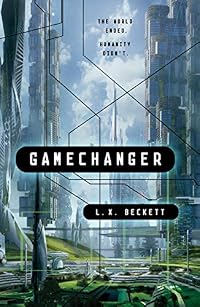
Rubi Whiting is a member of the Bounceback Generation, the first to be raised free of the troubles of the late-21st century. Now she works as a public defender to help troubled individuals with anti-social behavior. That's how she met Luciano Pox. But there's more to him than being a lightning rod for controversy. Rubi has to find out why the governments of the world want to bring Luce into custody, and why Luce is hell bent on stopping the recovery of the planet.Tags
Recommendations











Member Reviews
To cut to the chase, there were quite a few times when I wondered why I was persevering with this novel, as it's such a sprawl, and the main characters really don't achieve free-standing quality until very late in the game. This is without the added complication that more characters and conspiracies are being thrown at you up until the very end. That said, the reason you do continue is that the world Beckett has created in this work is the real main character, and to learn more about her setting is probably the real reason I continued forward.
As for Rubi Whiting, the apparent marquee character, I can see why some reviewers have described her as being a "Mary Sue." However, she is basically a politician running to be tribune of the show more people and she's true to type in terms of personality; that doesn't mean that I found her all that interesting.
Apart from that I could have also done without the RPG that's a story within the story and I still think that this book suffers from bloat, even if it's really two novels in one.
I'm still looking forward to the follow-up to see how Beckett deals with some of the conflicts she's set up. I applaud her for taking up the challenge of what comes after disaster and dystopia. show less
As for Rubi Whiting, the apparent marquee character, I can see why some reviewers have described her as being a "Mary Sue." However, she is basically a politician running to be tribune of the show more people and she's true to type in terms of personality; that doesn't mean that I found her all that interesting.
Apart from that I could have also done without the RPG that's a story within the story and I still think that this book suffers from bloat, even if it's really two novels in one.
I'm still looking forward to the follow-up to see how Beckett deals with some of the conflicts she's set up. I applaud her for taking up the challenge of what comes after disaster and dystopia. show less
Beckett, L. X. Gamechanger. The Bounceback No. 1. Tor, 2019.
I started L. X. Becket’s Gamechanger several times before it finally engaged me enough to finish it. But the book’s world finally hooked me. Set in the early 22nd century, it tells the story of a world on the cusp of a technological singularity called the Bounceback, following ecological and political disasters of the 21st century (called the Setback and the Clawback). The physical world is on a carbon economy, but most people spend their lives in a global virtual environment called the Sensorium, because that is where they can lead full lives without doing much damage to the biome. The virtual economy is based on positive strokes for prosocial acts and negative strikes for show more antisocial acts. Our heroine is a public defender and gaming star. There is a question about whether her current antisocial client may be an illegally uploaded consciousness or a rogue AI. But much of the book describes the interface between the gaming world and the meat world—think Ready Player One without so many allusions. My initial problem with the novel, I have decided, has to to with a figure-ground problem. It was often difficult for me to distinguish between details that were salient to the story and those that were simply filigree. 4 stars with reservations. show less
I started L. X. Becket’s Gamechanger several times before it finally engaged me enough to finish it. But the book’s world finally hooked me. Set in the early 22nd century, it tells the story of a world on the cusp of a technological singularity called the Bounceback, following ecological and political disasters of the 21st century (called the Setback and the Clawback). The physical world is on a carbon economy, but most people spend their lives in a global virtual environment called the Sensorium, because that is where they can lead full lives without doing much damage to the biome. The virtual economy is based on positive strokes for prosocial acts and negative strikes for show more antisocial acts. Our heroine is a public defender and gaming star. There is a question about whether her current antisocial client may be an illegally uploaded consciousness or a rogue AI. But much of the book describes the interface between the gaming world and the meat world—think Ready Player One without so many allusions. My initial problem with the novel, I have decided, has to to with a figure-ground problem. It was often difficult for me to distinguish between details that were salient to the story and those that were simply filigree. 4 stars with reservations. show less
**.5 DNF 20%
The premise is good and there are some interesting ideas, but the writing really didn't appeal to me. It felt like Beckett was trying too hard at the cool futuristic eco-cyberpunk thing, extending 2014 gaming slang 100 years into the future, with words like "hashtag" and "boomer" still in regular use. The worldbuilding mostly relies on a lengthy paragraph of dry exposition that precedes every scene. As does the plot progression. Between the contrived jargon-laden language, the clipped "too kool for skool" delivery, and the dull dialogue, it was hard to engage.
The plot itself revolved around a Black Mirror-esque society with dystopian social media ranking system based on gig work, immersive VR gaming, a rogue AI, the show more Interpol agent trying to catch it, and its lawyer trying to protect it. Add in action-packed scenes of terrorist attacks and other attempts to drum up some excitement, it simultaneously felt both chaotic and flat, and highly derivative despite the original elements. Maybe it eventually coalesced into a coherent story with a strong message about recovering from disaster, but I don't have the patience to slog through the remaining hundreds of pages to find out.
Merged review:
**.5 DNF 20%
The premise is good and there are some interesting ideas, but the writing really didn't appeal to me. It felt like Beckett was trying too hard at the cool futuristic eco-cyberpunk thing, extending 2014 gaming slang 100 years into the future, with words like "hashtag" and "boomer" still in regular use. The worldbuilding mostly relies on a lengthy paragraph of dry exposition that precedes every scene. As does the plot progression. Between the contrived jargon-laden language, the clipped "too kool for skool" delivery, and the dull dialogue, it was hard to engage.
The plot itself revolved around a Black Mirror-esque society with dystopian social media ranking system based on gig work, immersive VR gaming, a rogue AI, the Interpol agent trying to catch it, and its lawyer trying to protect it. Add in action-packed scenes of terrorist attacks and other attempts to drum up some excitement, it simultaneously felt both chaotic and flat, and highly derivative despite the original elements. Maybe it eventually coalesced into a coherent story with a strong message about recovering from disaster, but I don't have the patience to slog through the remaining hundreds of pages to find out. show less
The premise is good and there are some interesting ideas, but the writing really didn't appeal to me. It felt like Beckett was trying too hard at the cool futuristic eco-cyberpunk thing, extending 2014 gaming slang 100 years into the future, with words like "hashtag" and "boomer" still in regular use. The worldbuilding mostly relies on a lengthy paragraph of dry exposition that precedes every scene. As does the plot progression. Between the contrived jargon-laden language, the clipped "too kool for skool" delivery, and the dull dialogue, it was hard to engage.
The plot itself revolved around a Black Mirror-esque society with dystopian social media ranking system based on gig work, immersive VR gaming, a rogue AI, the show more Interpol agent trying to catch it, and its lawyer trying to protect it. Add in action-packed scenes of terrorist attacks and other attempts to drum up some excitement, it simultaneously felt both chaotic and flat, and highly derivative despite the original elements. Maybe it eventually coalesced into a coherent story with a strong message about recovering from disaster, but I don't have the patience to slog through the remaining hundreds of pages to find out.
Merged review:
**.5 DNF 20%
The premise is good and there are some interesting ideas, but the writing really didn't appeal to me. It felt like Beckett was trying too hard at the cool futuristic eco-cyberpunk thing, extending 2014 gaming slang 100 years into the future, with words like "hashtag" and "boomer" still in regular use. The worldbuilding mostly relies on a lengthy paragraph of dry exposition that precedes every scene. As does the plot progression. Between the contrived jargon-laden language, the clipped "too kool for skool" delivery, and the dull dialogue, it was hard to engage.
The plot itself revolved around a Black Mirror-esque society with dystopian social media ranking system based on gig work, immersive VR gaming, a rogue AI, the Interpol agent trying to catch it, and its lawyer trying to protect it. Add in action-packed scenes of terrorist attacks and other attempts to drum up some excitement, it simultaneously felt both chaotic and flat, and highly derivative despite the original elements. Maybe it eventually coalesced into a coherent story with a strong message about recovering from disaster, but I don't have the patience to slog through the remaining hundreds of pages to find out. show less
Big sprawling cyberpunk novel. Feels heavily indebted to Stephenson, with a layer of climate-crisis-modulated utopia thing on top. Has some interesting things going on, but felt pretty awkward on a number of levels—insistence on using "#" and "@", even in dialog; introducing actual off-world aliens who are actively invading, but then not really centering that over the VR game tournament storyline; and I found the AI sub-plots really aggravating for basic computer logistics issues. Does a neat job of investigating AI-mediated trauma, transhuman family dynamics, and a few other things, but ultimately the annoying outweighed the interesting, for me at least. Still, an author to watch.
I want to love this book. It has elements of sci-fi concepts and tropes that are easy wins with me. Yet, I just can't bring myself to give a shit about any of the characters. I'm 80% of the way through and I would be quietly appreciative if someone took it away.
It's not a bad book, it's just painfully unmemorable. Low stakes. Again, you could kill anyone in this book and I would experience no emotional reaction. I keep realizing that my thoughts are drifting and I have to go back to re-read pages.
There's never anything important in those pages.
It's not a bad book, it's just painfully unmemorable. Low stakes. Again, you could kill anyone in this book and I would experience no emotional reaction. I keep realizing that my thoughts are drifting and I have to go back to re-read pages.
There's never anything important in those pages.
Post-apocalypse, the recovery generations are trying to put the world back together using massively distributed referendum voting and pervasive surveillance to determine social credit (strokes for prosocial behavior like volunteering to help clean up a public space, strikes for abusive behavior). Rubi Whiting, a well known virtual gameplayer and would-be attorney, gets caught up in the case of an antisocial being who might not have a physical body, which would make him an illegal polter or even a more-illegal rogue AI. (Or maybe it's an alien!) Her love interest and game antagonist Gimlet, Gimlet’s child, and Rubi’s brilliant but heavily damaged father all get involved in various ways. I found the book sprawling and full of ideas show more about hope in a climate-ravaged world, but rarely connected with it, which may be either cause or consequence of the fact that it took me months to get through it. (Took it out of the library right before the coronavirus shutdown and so didn’t have to return it.) show less
Ratings
Members
- Recently Added By
Lists

Favorite Science Fiction by Women Authors
737 works; 202 members

2020 Hugo Eligible Novels
71 works; 12 members

Top Five Books of 2020
982 works; 350 members
LGBTQ+ Speculative Fiction
818 works; 51 members

Books Read in 2020
4,379 works; 124 members

hypatian_kat to-read
429 works; 3 members
Author Information
42+ Works 1,190 Members

A.M. Dellamonica is a LibraryThing Author, an author who lists their personal library on LibraryThing.
Some Editions
Awards and Honors
Awards
Series

Common Knowledge
- Original publication date
- 2019
- Publisher's editor
- Palmieri, Marco; Morgan, Christopher
Classifications
Statistics
- Members
- 172
- Popularity
- 189,578
- Reviews
- 6
- Rating
- (3.41)
- Languages
- English
- Media
- Paper, Audiobook, Ebook
- ISBNs
- 4
- ASINs
- 1