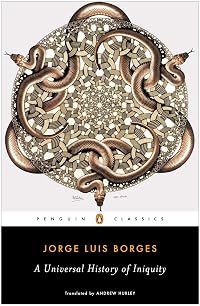
A Universal History of Infamy
by Jorge Luis Borges
On This Page
Description
Presents a collection of short stories that explore the activities of scoundrels and outlaws through the ages.Tags
Recommendations




























Member Recommendations


by anonymous user
Member Reviews
Like his beloved Shakespeare had done with Holinshed, though to much greater effect, a young Jorge Luis Borges delved into various histories he was fond of in order to source his own attempts at storytelling. A Universal History of Iniquity is the result; a mixed bag of tales about criminals, knife-fighters and other iniquitous types, set in the Wild West, ancient China, the Islamic world of the Arabian Nights, and anywhere else that takes Borges' fancy.
In truth, the stories are not all that impressive and show little of what Borges was to become. There is some erudition, and the background of knife-fighters and so on would become a mainstay of his writing, but – by Borges' own admission – these stories are "all just appearance", show more and under the racy blood-and-guts, "all the storm and lightning, there is nothing" (pg. 5). They were written for an apparently sensationalist Argentine newspaper and were "Saturday entertainments in the penny-dreadful vein," as Andrew Hurley's Afterword puts it (pg. 80).
In fact, this Afterword would have been better as a foreword: without someone to put them into context, these stories appear rather stale. I enjoyed them all, particularly the one about Billy the Kid ('The Disinterested Killer Bill Harrigan') and the later addition 'The Wizard That Was Made to Wait', but in truth this is all flavour without a meal. Though well-written, there is little to sustain a reader from a literary point of view, and the only interest comes from observing what was in effect Borges' apprenticeship into prose writing. Some, like 'Man on Pink Corner', which Borges considered his first real short story, give whispers of what was to come, but no full conversation. show less
In truth, the stories are not all that impressive and show little of what Borges was to become. There is some erudition, and the background of knife-fighters and so on would become a mainstay of his writing, but – by Borges' own admission – these stories are "all just appearance", show more and under the racy blood-and-guts, "all the storm and lightning, there is nothing" (pg. 5). They were written for an apparently sensationalist Argentine newspaper and were "Saturday entertainments in the penny-dreadful vein," as Andrew Hurley's Afterword puts it (pg. 80).
In fact, this Afterword would have been better as a foreword: without someone to put them into context, these stories appear rather stale. I enjoyed them all, particularly the one about Billy the Kid ('The Disinterested Killer Bill Harrigan') and the later addition 'The Wizard That Was Made to Wait', but in truth this is all flavour without a meal. Though well-written, there is little to sustain a reader from a literary point of view, and the only interest comes from observing what was in effect Borges' apprenticeship into prose writing. Some, like 'Man on Pink Corner', which Borges considered his first real short story, give whispers of what was to come, but no full conversation. show less
From his early years the Argentinian writer Jorge Luis Borges lived among books and languages, classical literature from many civilizations and cultures: Chinese, Persian, Nordic, Spanish, to name several. His greatest childhood memory was his father's library; he was reading Shakespeare in English at age 11; by the time he was an adult, Borges turned his mind into one vast library. Therefore, it is a bit ironic this bookish man chose to write an entire collection of tales about men of sheer action and where the action is immorality, wickedness, injustice and evil. And ‘A Universal History of Iniquity’ is a jewel. Unlike Borges's baroque writings, these nine short tales are straight-forward and make for easy reading. For the show more purposes of this review and to convey the flavor of the book, here are quotes with brief comments on two of the tales.
The Disinterested Killer Bill Harrigan
At the very beginning, Borges writes, "The almost-child who died at the age of twenty-one owing a debt to human justice for the deaths of twenty-one men - "not counting Mexicans." Yes, this is a tale of Billy the Kid. Iniquity, indeed; Borges gives us several vivid, memorable images of what it is like to kill for the hell of it. For instance, one notorious Mexican gunslinger and outlaw walks into a bar, a shot rings out, (no need for a second shot) and Billy picked up the conversation where he left off. And then in the words of Borges, "That night Billy lays his blanket out next to the dead man and sleeps - ostentatiously - until morning."
Monk Eastman, Purveyor of Iniquities
Here is a description of noted personalities from this urban tale, "The chaotic story takes place in the cellars of old breweries turned into Negro tenements, in a seedy, three-story New York City filed with gangs of thugs like the Swamp Angels, who would swarm out of the labyrinthine sewers on marauding expeditions; gangs of cutthroats like the Daybreak boys, who recruited precocious murderers of ten and eleven years old; brazen, solitary giants like the Plug Uglies, whose stiff bowler hats stuffed with wood and whose vast shirttails blowing in the wind of the slums might provoke a passerby's improbable smile, but who carried huge bludgeons in their right hands and long, narrow pistols; and gangs of street toughs like the Dead Rabbit gang, who entered into battle under the banner of their mascot impaled upon a pike. Its characters were men like Dandy Johnny Dolan, famed for his brilliantined forelock, the monkey-headed walking sticks he carried, and the delicate copper pick he wore on his thumb to gouge out his enemies' eyes: men like Kit Burns, who was known to bite the head off live rats; and men like blind Danny Lyons, a towheaded kid with huge dead eyes who pimped for three whores that proudly walked the streets for him."
I have included the long quote above for a specific reason: Borges was fascinated by the image and concept of labyrinths his entire life. However, such a labyrinth of unending perversion and violence was one Borges would never himself experience directly; rather, as a bookish, literary man, Borges entered this twisted human sewer through his imagination. And please keep in mind Borges was strongly influenced by the nineteenth century German philosopher, Arthur Schopenhauer. The nastiness and brutality of life outlined by Schopenhauer made an indelible impression on the sensitive author.
My guess is anyone reading this review is light-years away from entering a world where teenagers kill for the hell of it or cutthroat gangs hack and slice one another to pieces under the banner of an impaled dog or rabbit. But such worlds existed aplenty in the 19th and early 20th century and they still exist today. How to experience these violent worlds for yourself? One easy answer: let Jorge Luis Borges give you a guided tour. show less
The Disinterested Killer Bill Harrigan
At the very beginning, Borges writes, "The almost-child who died at the age of twenty-one owing a debt to human justice for the deaths of twenty-one men - "not counting Mexicans." Yes, this is a tale of Billy the Kid. Iniquity, indeed; Borges gives us several vivid, memorable images of what it is like to kill for the hell of it. For instance, one notorious Mexican gunslinger and outlaw walks into a bar, a shot rings out, (no need for a second shot) and Billy picked up the conversation where he left off. And then in the words of Borges, "That night Billy lays his blanket out next to the dead man and sleeps - ostentatiously - until morning."
Monk Eastman, Purveyor of Iniquities
Here is a description of noted personalities from this urban tale, "The chaotic story takes place in the cellars of old breweries turned into Negro tenements, in a seedy, three-story New York City filed with gangs of thugs like the Swamp Angels, who would swarm out of the labyrinthine sewers on marauding expeditions; gangs of cutthroats like the Daybreak boys, who recruited precocious murderers of ten and eleven years old; brazen, solitary giants like the Plug Uglies, whose stiff bowler hats stuffed with wood and whose vast shirttails blowing in the wind of the slums might provoke a passerby's improbable smile, but who carried huge bludgeons in their right hands and long, narrow pistols; and gangs of street toughs like the Dead Rabbit gang, who entered into battle under the banner of their mascot impaled upon a pike. Its characters were men like Dandy Johnny Dolan, famed for his brilliantined forelock, the monkey-headed walking sticks he carried, and the delicate copper pick he wore on his thumb to gouge out his enemies' eyes: men like Kit Burns, who was known to bite the head off live rats; and men like blind Danny Lyons, a towheaded kid with huge dead eyes who pimped for three whores that proudly walked the streets for him."
I have included the long quote above for a specific reason: Borges was fascinated by the image and concept of labyrinths his entire life. However, such a labyrinth of unending perversion and violence was one Borges would never himself experience directly; rather, as a bookish, literary man, Borges entered this twisted human sewer through his imagination. And please keep in mind Borges was strongly influenced by the nineteenth century German philosopher, Arthur Schopenhauer. The nastiness and brutality of life outlined by Schopenhauer made an indelible impression on the sensitive author.
My guess is anyone reading this review is light-years away from entering a world where teenagers kill for the hell of it or cutthroat gangs hack and slice one another to pieces under the banner of an impaled dog or rabbit. But such worlds existed aplenty in the 19th and early 20th century and they still exist today. How to experience these violent worlds for yourself? One easy answer: let Jorge Luis Borges give you a guided tour. show less
In his preface to the 1954 edition, Borges distanced himself somewhat from the book, which he gave as an example of the baroque, "when art flaunts and squanders its resources"; he wrote that the stories are "the irresponsible sport of a shy sort of man who could not bring himself to write short stories, and so amused himself by changing and distorting (sometimes without aesthetic justification) the stories of other men" and that "under all the storm and lightning, there is nothing."
Damn good distortion, though.
Damn good distortion, though.
From his early years the Argentinian writer Jorge Luis Borges lived among books and languages, classical literature from many civilizations and cultures: Chinese, Persian, Nordic, Spanish, to name several. His greatest childhood memory was his father's library; he was reading Shakespeare in English at age 11; by the time he was an adult, Borges turned his mind into one vast library. Therefore, it is a bit ironic this bookish man chose to write an entire collection of tales about men of sheer action and where the action is immorality, wickedness, injustice and evil. And ‘A Universal History of Iniquity’ is a jewel. Unlike Borges's baroque writings, these nine short tales are straight-forward and make for easy reading. For the show more purposes of this review and to convey the flavor of the book, here are quotes with brief comments on two of the tales.
The Disinterested Killer Bill Harrigan
At the very beginning, Borges writes, "The almost-child who died at the age of twenty-one owing a debt to human justice for the deaths of twenty-one men - "not counting Mexicans." Yes, this is a tale of Billy the Kid. Iniquity, indeed; Borges gives us several vivid, memorable images of what it is like to kill for the hell of it. For instance, one notorious Mexican gunslinger and outlaw walks into a bar, a shot rings out, (no need for a second shot) and Billy picked up the conversation where he left off. And then in the words of Borges, "That night Billy lays his blanket out next to the dead man and sleeps - ostentatiously - until morning."
Monk Eastman, Purveyor of Iniquities
Here is a description of noted personalities from this urban tale, "The chaotic story takes place in the cellars of old breweries turned into Negro tenements, in a seedy, three-story New York City filed with gangs of thugs like the Swamp Angels, who would swarm out of the labyrinthine sewers on marauding expeditions; gangs of cutthroats like the Daybreak boys, who recruited precocious murderers of ten and eleven years old; brazen, solitary giants like the Plug Uglies, whose stiff bowler hats stuffed with wood and whose vast shirttails blowing in the wind of the slums might provoke a passerby's improbable smile, but who carried huge bludgeons in their right hands and long, narrow pistols; and gangs of street toughs like the Dead Rabbit gang, who entered into battle under the banner of their mascot impaled upon a pike. Its characters were men like Dandy Johnny Dolan, famed for his brilliantined forelock, the monkey-headed walking sticks he carried, and the delicate copper pick he wore on his thumb to gouge out his enemies' eyes: men like Kit Burns, who was known to bite the head off live rats; and men like blind Danny Lyons, a towheaded kid with huge dead eyes who pimped for three whores that proudly walked the streets for him."
I have included the long quote above for a specific reason: Borges was fascinated by the image and concept of labyrinths his entire life. However, such a labyrinth of unending perversion and violence was one Borges would never himself experience directly; rather, as a bookish, literary man, Borges entered this twisted human sewer through his imagination. And please keep in mind Borges was strongly influenced by the nineteenth century German philosopher, Arthur Schopenhauer. The nastiness and brutality of life outlined by Schopenhauer made an indelible impression on the sensitive author.
My guess is anyone reading this review is light-years away from entering a world where teenagers kill for the hell of it or cutthroat gangs hack and slice one another to pieces under the banner of an impaled dog or rabbit. But such worlds existed aplenty in the 19th and early 20th century and they still exist today. How to experience these violent worlds for yourself? One easy answer: let Jorge Luis Borges give you a guided tour.
Young Jorge Luis Borges - Can you imagine young Borges as part of the New York City kids gang in the photo at the top? show less
The stories in 'A Universal History of Infamy' should perhaps not be taken too seriously. They were intended as light entertainment, Borges' first breakthrough in writing fiction for the public and he was having fun doing so.
Published between August 1933 and July 1935, the first collection was that of July 1935 with other light works from the period included. Three minor items from 1946 were added to the second edition in 1954. This English language translation might be regarded as simply completing the canon for fans.
The central seven stories are very entertaining indeed, probably largely untrustworthy as history but, in literary terms, showing a mischievous clarity of exposition that gives real pleasure as Borges gives us examples show more (without moralising over much) of human evil.
Borges early on loves the exotic, the 'other'. He has what might be thought of as an 'orientalist' turn of mind in literature and he presents his contribution to writing from a margin of his own - as a Spanish writer in a far-flung province of the Western cultural imperium (Argentina).
We also get a taste of the 'trickster' Borges enjoying the production of authentic-seeming pastiches of obscurer parts of a global literary and cultural tradition, much in the spirit of Lovecraft enjoying himself by inventing 'eldritch' tomes for the libraries of his weird characters.
Until this point, Borges had concentrated his undoubted intellect on poetry and essays so these literary experiments in learned fun do not come out of a vacuum (we must leave it to scholars of Argentinian literature to tell us more) but they are a fresh start.
Borges himself was fairly honest that the stories were to be seen as amusements. He was even reluctant to have them sanctified by translation. One suspects he was not impressed by the literary world's propensity to fandom but the stories are still worth reading on the terms he intended.
What can be said is that (allowing for the problem of translation ever being a true reflection of a writer in another language) he is masterful in the clarity of his prose and the light touch of his detached irony. Not everything is great outside the core stories but he did not intend them to be so.
The implication from Borges himself is that he wanted to jump from commentator on fiction to producer of it. These light experiments allowed him to put his toe in the water on his own terms with the option of deciding not to get too wet if the water proved too cold.
It did not and he was, we are very pleased to say, encouraged to go deeper into fiction, subsequently producing weird tales that amounted to fascinating thought experiments very different from those of Lovecraft but feeding the same hunger for something that was neither mere pulp nor overly elitist. show less
Published between August 1933 and July 1935, the first collection was that of July 1935 with other light works from the period included. Three minor items from 1946 were added to the second edition in 1954. This English language translation might be regarded as simply completing the canon for fans.
The central seven stories are very entertaining indeed, probably largely untrustworthy as history but, in literary terms, showing a mischievous clarity of exposition that gives real pleasure as Borges gives us examples show more (without moralising over much) of human evil.
Borges early on loves the exotic, the 'other'. He has what might be thought of as an 'orientalist' turn of mind in literature and he presents his contribution to writing from a margin of his own - as a Spanish writer in a far-flung province of the Western cultural imperium (Argentina).
We also get a taste of the 'trickster' Borges enjoying the production of authentic-seeming pastiches of obscurer parts of a global literary and cultural tradition, much in the spirit of Lovecraft enjoying himself by inventing 'eldritch' tomes for the libraries of his weird characters.
Until this point, Borges had concentrated his undoubted intellect on poetry and essays so these literary experiments in learned fun do not come out of a vacuum (we must leave it to scholars of Argentinian literature to tell us more) but they are a fresh start.
Borges himself was fairly honest that the stories were to be seen as amusements. He was even reluctant to have them sanctified by translation. One suspects he was not impressed by the literary world's propensity to fandom but the stories are still worth reading on the terms he intended.
What can be said is that (allowing for the problem of translation ever being a true reflection of a writer in another language) he is masterful in the clarity of his prose and the light touch of his detached irony. Not everything is great outside the core stories but he did not intend them to be so.
The implication from Borges himself is that he wanted to jump from commentator on fiction to producer of it. These light experiments allowed him to put his toe in the water on his own terms with the option of deciding not to get too wet if the water proved too cold.
It did not and he was, we are very pleased to say, encouraged to go deeper into fiction, subsequently producing weird tales that amounted to fascinating thought experiments very different from those of Lovecraft but feeding the same hunger for something that was neither mere pulp nor overly elitist. show less
A weird book, even in terms of the weirdness that is Borges' fiction. The first half feels dated, but the second half feels timelessly entertaining. Most of the book is a brief retelling of the biographies of notorious individuals from history, without much concern for the truth. These chapters are presented as dry biography and read a little bit like a Buzzfeed article. "10 historical criminals and what happened to them" or something like that. Comparing Borges to Buzzfeed is probably sacrilegious, so feel free to blame this on the translation or something, but this was an early work of Borges', and I think it shows. One must be mindful of that fact that the internet was not constantly creating iterations of the same broad facts for show more mindless consumption back when Borges was putting his spin on people like Billy the Kid and Ching Shih so what goes for old hat now was likely not so when he was experimenting. The context of the modern world being what it is now, there just wasn't much to these stories to elevate them from their biographical nature, even when those biographies were embellished and falsified.
The second part of the book, however, is much looser in format, and instead of reading like a wikipedia page we get some twists, some turns, some stronger personality, and a touch of that playful magic that Borges is so well known for. All but one of the very brief pieces in part two still declare themselves to be derivative. That is, they cite other texts as the source and claim only translation, but aside from the books cited actually being real, the stories being told are invented from whole cloth, magicians make multiple appearances. heaven is visited. There's an extremely brief description of an empire so dedicated to the accuracy of map making that they made a map at a 1:1 ratio of the entire territory in their possession. Stuff like that. It seems like once Borges stopped bothering the hew closely to reality at all he finally had the freedom to play and started coming up with the crazy and imaginative ideas that made him the father of Latin American Literature.
Unfortunately the second part of the book is significantly smaller than the first. That section redeemed my purchase, but I can't say that I enjoyed this one cover to cover at all. show less
The second part of the book, however, is much looser in format, and instead of reading like a wikipedia page we get some twists, some turns, some stronger personality, and a touch of that playful magic that Borges is so well known for. All but one of the very brief pieces in part two still declare themselves to be derivative. That is, they cite other texts as the source and claim only translation, but aside from the books cited actually being real, the stories being told are invented from whole cloth, magicians make multiple appearances. heaven is visited. There's an extremely brief description of an empire so dedicated to the accuracy of map making that they made a map at a 1:1 ratio of the entire territory in their possession. Stuff like that. It seems like once Borges stopped bothering the hew closely to reality at all he finally had the freedom to play and started coming up with the crazy and imaginative ideas that made him the father of Latin American Literature.
Unfortunately the second part of the book is significantly smaller than the first. That section redeemed my purchase, but I can't say that I enjoyed this one cover to cover at all. show less
I somehow managed to get a BA with a focus on comparative literature and continental philosophy and then a PhD with a focus on twentieth century literature without reading any Borges. How did that happen? Well, any time I tried to read South American 'magical realist' literature I broke out in hives of boredom, and I thought maybe Borges was to blame; in addition, I thought, and still think, that Borges might be responsible in part for recent developments in the anglo-american literature of conceit (you know, books called things like The Amazing Adventures of Kloofy Krumpleflugger, in which Kloofy Krumpleflugger has some kind of cute mental condition, a conflicted relationship with his mother, and is able to talk to animals--but which show more has absolutely no intellectual, emotional or ethical weight whatsoever outside a bland kind of liberalism).
Well, I was wrong, I know, I should have read him earlier. This collection is a charming nothing, which is exactly what I was looking for. The narrative voice is delightful, the stories slightly magical but really more or less straight retellings of traditional stories from the middle east and east asia, or nineteenth century tales of outlawry. And, somewhat confusingly, tales from Swedenborg (. Borges' 'original' tale, 'Man on Pink Corner,' is a'ight, but not as much fun as the others.
I fear I'll get less impressed by Borges if his work gets more serious than this; people who deal with 'universal themes' in a serious way are always unbearable. show less
Well, I was wrong, I know, I should have read him earlier. This collection is a charming nothing, which is exactly what I was looking for. The narrative voice is delightful, the stories slightly magical but really more or less straight retellings of traditional stories from the middle east and east asia, or nineteenth century tales of outlawry. And, somewhat confusingly, tales from Swedenborg (. Borges' 'original' tale, 'Man on Pink Corner,' is a'ight, but not as much fun as the others.
I fear I'll get less impressed by Borges if his work gets more serious than this; people who deal with 'universal themes' in a serious way are always unbearable. show less
Members
- Recently Added By
Lists

Books Read in 2014
2,343 works; 89 members

Books With Interesting Titles
173 works; 14 members

1930s
262 works; 5 members

Read in 2014
334 works; 11 members

Books With the Most Memorable Titles
478 works; 158 members
Author Information

863+ Works 58,687 Members
Born in Buenos Aires, Argentina, in 1899, Jorge Borges was educated by an English governess and later studied in Europe. He returned to Buenos Aires in 1921, where he helped to found several avant-garde literary periodicals. In 1955, after the fall of Juan Peron, whom he vigorously opposed, he was appointed director of the Argentine National show more Library. With Samuel Beckett he was awarded the $10,000 International Publishers Prize in 1961, which helped to establish him as one of the most prominent writers in the world. Borges regularly taught and lectured throughout the United States and Europe. His ideas have been a profound influence on writers throughout the Western world and on the most recent developments in literary and critical theory. A prolific writer of essays, short stories, and plays, Borges's concerns are perhaps clearest in his stories. He regarded people's endeavors to understand an incomprehensible world as fiction; hence, his fiction is metaphysical and based on what he called an esthetics of the intellect. Some critics have called him a mystic of the intellect. Dreamtigers (1960) is considered a masterpiece. A central image in Borges's work is the labyrinth, a mental and poetic construct, that he considered a universe in miniature, which human beings build and therefore believe they control but which nevertheless traps them. In spite of Borges's belief that people cannot understand the chaotic world, he continually attempted to do so in his writing. Much of his work deals with people's efforts to find the center of the labyrinth, symbolic of achieving understanding of their place in a mysterious universe. In such later works as The Gold of the Tigers, Borges wrote of his lifelong descent into blindness and how it affected his perceptions of the world and himself as a writer. Borges died in Geneva in 1986. (Bowker Author Biography) show less
Some Editions
Series
Belongs to Publisher Series
Work Relationships
Is contained in
Contains
Is replied to in
Has as a study
Common Knowledge
- Canonical title
- A Universal History of Infamy
- Original title
- Historia universal de la infamia
- Original publication date
- 1935
- Related movies
- Man on Pink Corner (1962 | IMDb); Singing Behind Screens (2003 | IMDb)
- Dedication
- I inscribe this book to S. D.: English, innumerable and an Angel. Also: I offer her that kernel of myself that I have saved, somehow — the central heart that deals not in words, traffics not with dreams and is untouched by... (show all) time, by joy, by adversities.
- First words
- I inscribe this book to S.D.: English, in-
numerable and an Angel. Also: I offer her
that kernel of myself hat I have saved,
somehow - the central heart that deals
not in words, trafics not with dreams
and ... (show all)is untouched by time, by joy, by
adversities.
Los ejercicios de prosa narrativa que integran este libro fueron ejecutados de 1933 a 1934.
Yo diría que barroco es aquel estilo que deliberadamente agota (o quiere agotar) sus posibilidades y que linda con su propia caricatura.
En 1517 el P. Bartolmé de las Casas tuvo mucha lástma de los indios que se extenuaban en los laboriosos infiernos de las minas de oro antillanas, y propuso al emperador Carlos V la importación de negros, que se extenuaran ... (show all)en los laboriosos infiernos de las minas de oro antillanas. - Last words
- (Click to show. Warning: May contain spoilers.)Pudo articular las palabras: "Yo soy vuestro Mahoma", e inmediatemente se hundió.
- Original language
- Spagnolo
Classifications
- Genres
- Fiction and Literature, General Fiction
- DDC/MDS
- 863.62 — Literature & rhetoric Spanish Literature Spanish fiction 20th Century 1900-1945
- LCC
- PQ7797 .B635 .H513 — Language and Literature French, Italian, Spanish and Portuguese literatures Spanish literature Provincial, local, colonial, etc. Spanish America
- BISAC
Statistics
- Members
- 1,628
- Popularity
- 13,835
- Reviews
- 32
- Rating
- (3.96)
- Languages
- 16 — Chinese, Czech, Danish, Dutch, English, French, German, Italian, Japanese, Polish, Portuguese, Romanian, Serbian, Croatian, Spanish, Turkish
- Media
- Paper, Audiobook, Ebook
- ISBNs
- 68
- ASINs
- 23