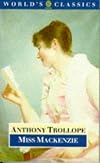
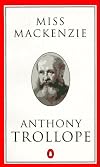
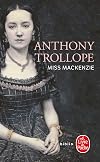
Miss Mackenzie
by Anthony Trollope
On This Page
Description
In the classic novel Miss Mackenzie, Trollope depicts Margaret Mackenzie, overwhelmed with money troubles, as she tries to assess the worth and motives of four very different suitors.Tags
Recommendations




















Member Reviews
Miss Mackenzie is in her mid-thirties, and naturally good, when she unexpectedly inherits around £10,000, enough to live comfortably in 1865. She moves to a fashionable watering-place, where she joins an evangelical church with a squinting but ambitious curate. Her brother's business partner shows up asking for a loan. And she spends the Christmas holidays with her uncle, aunt, and cousins, all of whom believe that the money she inherited rightfully belongs to them.
Trollope is at his most humorous in this novel with a complex plot. He gives minor characters names like Fuzzybell and Frigidy, and Miss Mackenzie's lawyers are Slow & Bideawhile. Although the modern mindset might boggle a little at the form that Miss Mackenzie's goodness show more takes, if you enjoy ironic Trollope, you should enjoy this one.
And, if you liked the Pallisers— Lady Glencora and the Duchess of St. Bungay make cameo appearances. show less
Trollope is at his most humorous in this novel with a complex plot. He gives minor characters names like Fuzzybell and Frigidy, and Miss Mackenzie's lawyers are Slow & Bideawhile. Although the modern mindset might boggle a little at the form that Miss Mackenzie's goodness show more takes, if you enjoy ironic Trollope, you should enjoy this one.
And, if you liked the Pallisers— Lady Glencora and the Duchess of St. Bungay make cameo appearances. show less
Until her brother’s death, Margaret Mackenzie’s world had been limited largely to the house she shared with her invalid brother and serving as his caregiver. Her brother’s death opens up a new world to Miss Mackenzie, as she inherits his modest fortune. There’s enough for her to set up a household in Littlebath, with one of her nieces as a companion. Although Margaret is long past the first blush of youth, she is not quite middle aged, and she soon finds herself with several suitors. It doesn’t take Margaret long to realize that her suitors seem to be more interested in her money than in herself. Nothing in her prior life has prepared her for the circumstances in which she finds herself. Then another abrupt change in show more Margaret’s fortune reinforces just how alone in the world she is.
I find Margaret to be one of Trollope’s most interesting heroines. Her courage and determination to face her problems head on seem to balance her lack of experience and social awkwardness. Several familiar faces from the Barsetshire and Palliser novels provided a pleasant surprise. show less
I find Margaret to be one of Trollope’s most interesting heroines. Her courage and determination to face her problems head on seem to balance her lack of experience and social awkwardness. Several familiar faces from the Barsetshire and Palliser novels provided a pleasant surprise. show less
Miss Mackenzie is an accidental spinster - she didn't intend to remain single her whole life, but also didn't actively seek a husband. When she comes into some money, there are hands-out relatives all around. As are three suitors: a cousin with plenty of children, a partner of Miss Mackenzie's widowed sister-in-law, and a squinty-eyed clergyman. When her financial circumstances change, the relatives find her unjustifiably needy, and display even more selfishness and manipulation. Until the very end, I thought this was going to be one of my favorite Trollopes, however, the ending seems ... um ... too small? There are plenty of Trollope's perfect, but almost miss-able, descriptions: There was a very old man who sat close wedged in between show more Mrs. Stumfold and another lady, by whose joint dresses he was almost obliterated. (In fact, there are two chapters in the book about parties; Trollope writes quite funny and memorable party chapters.) Overall, here is one of my favorite bits: She gave herself none of that personal credit which women are apt to take to themselves when they find that they are often sought in marriage. She looked upon her lovers as so many men to whom her income would be convenient, and felt herself to be almost under an obligation to them for their willingness to put up with the incumbrance which was attached to it. And here's another: "What a wicked old woman she was," virtuous readers will say ... "to endeavour to catch that poor old maid's fortune for her son!" But I deny she was (a) ... wicked old woman on that score. Why should not the two cousins marry, and do very well together with their joint means? Lady Ball intended to make a husband's wife of her. If much was to be taken, was not much also be given? show less
As always, wonderfully readable. The story begins with a simple premise: what if a woman emerged in mid-life with virtually no back-story, not much looks, but a reasonable fortune? It's a kind of fairy tale - Miss M is really too good to be true - but she gets our sympathy nonetheless, and on the way we have the foibles of all kinds of human character pinned to the wall, great comic set-pieces ( the Evangelical coterie, the charity jumble sale), twists and turns of plot all leading to a happy ending of Wildean proportions. Incidentally, Trollope seems to have it in fairly much for the clergy here; the villain of the piece is a minor curate, the Evangelicals hypocritical power freaks. The Barsetshire men of the cloth are innocents, by show more comparison. show less
Margaret Mackenzie inherits a modest fortune from her brother in her mid-thirties and moves to a spa town to begin her life. There she (not entirely intentionally) moves in strictly Evangelical circles and considers a proposal from a curate with a terrible squint. She also considers marrying her brother's business partner, despite the fact that he has cheated her out of thousands of pounds. She turns down a marriage proposal from her cousin, John Ball, a widower with 9 children, who regards her fortune as rightfully his. This first section is light and funny (especially about Evangelicals), although the reader is continually alarmed by Margaret's near-misses on the marriage front.
Then Margaret's brother dies, leaving his family show more financially ruined and it emerges that John Ball was right all along and Margaret's fortune must go to him. Margaret concedes this without demur and happily accepts when he asks her to marry him a second time. However, the engagement does not run smoothly. This second half and especially the last 100 pages seemed unnecessarily drawn out to me, but nevertheless, I thought it an excellent book, with more than usually complex (as in faulty) characters. Margaret spent most of the book nearly marrying people just because they asked her and John was very unheroic indeed. Personally I would rather scrub toilets than marry into a family including Lady Ball. show less
Then Margaret's brother dies, leaving his family show more financially ruined and it emerges that John Ball was right all along and Margaret's fortune must go to him. Margaret concedes this without demur and happily accepts when he asks her to marry him a second time. However, the engagement does not run smoothly. This second half and especially the last 100 pages seemed unnecessarily drawn out to me, but nevertheless, I thought it an excellent book, with more than usually complex (as in faulty) characters. Margaret spent most of the book nearly marrying people just because they asked her and John was very unheroic indeed. Personally I would rather scrub toilets than marry into a family including Lady Ball. show less
Solid AT but one of his most melancholy novels. The dreariness of our heroine's life made me a bit heartsore, having experienced some of her plight from time to time as a superfluous (i.e., unmarried) female who didn't marry until age 35. Okay - I wasn't nursing an invalid brother, wasn't sheltered and wasn't penniless, but our society still believes people should come in pairs. And I don't mean twins.
Surprise cameo by Lady Glencora late in the novel was a nice little extra, sort of like Sean Connery turning up as Richard the Lionheart at the end of the movie "Robin Hood: Prince of Thieves."
Surprise cameo by Lady Glencora late in the novel was a nice little extra, sort of like Sean Connery turning up as Richard the Lionheart at the end of the movie "Robin Hood: Prince of Thieves."
This was the story of Miss Mackenzie, an "old maid" who inherited money and the suitors who materialized with her new found wealth. It had some Austenish humor, which is good if you like Austen. Not one of my favorite Trollope's.
Members
- Recently Added By
Lists

Favourite 19th century fiction
257 works; 62 members

A Novel Cure
742 works; 23 members

Books Read in 2021
5,361 works; 113 members
Talk Discussions
Past Discussions
Group read: Miss Mackenzie by Anthony Trollope in 75 Books Challenge for 2022 (December 2022)
Author Information

347+ Works 50,570 Members
Anthony Trollope was born in London, England on April 24, 1815. In 1834, he became a junior clerk in the General Post Office, London. In 1841, he became a deputy postal surveyor in Banagher, Ireland. He was sent on many postal missions ending up as a surveyor general in the post office outside of London. His first novel, The Macdermots of show more Ballycloran, was published in 1847. His other works included Castle Richmond, The Last Chronicle of Barset, Lady Anna, The Two Heroines of Plumplington, and The Noble Jilt. He died after suffering from a paralytic stroke on December 6, 1882. (Bowker Author Biography) show less
Some Editions
Series
Belongs to Publisher Series
Work Relationships
Is contained in
Contains
Has the adaptation
Common Knowledge
- Canonical title
- Miss Mackenzie
- Original publication date
- 1865
- People/Characters
- Miss Margaret Mackenzie; Samuel Rubb, Jr.; Jeremiah Maguire; John Ball; Miss Todd; Miss Baker
- Important places
- London, England, UK
- First words
- I fear I must trouble my reader with some few details as to the early life of Miss Mackenzie,—details which will be dull in the telling, but which shall be as short as I can make them.
- Last words
- (Click to show. Warning: May contain spoilers.)But all these honours, and, what was better, all the happiness that came in her way, Lady Bell accepted thankfully, quietly, and with an enduring satisfaction, as it became such a woman to do.
Classifications
Statistics
- Members
- 468
- Popularity
- 65,149
- Reviews
- 14
- Rating
- (3.77)
- Languages
- English, French, Portuguese, Spanish
- Media
- Paper, Audiobook, Ebook
- ISBNs
- 56
- ASINs
- 17