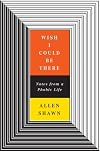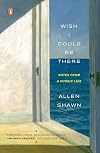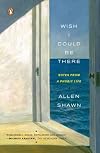
Wish I Could Be There: Notes From a Phobic Life
by Allen Shawn
On This Page
Description
"Allen Shawn is afraid of heights, water, fields, parking lots, tunnels, and unknown roads. He avoids subways, elevators, and bridges. He is afraid of both closed and open spaces and of any form of isolation--yet this is a memoir of enormous bravery. He is the son of New Yorker editor William Shawn and brother to playwright/actor Wallace Shawn. His twin sister is autistic. His father led a double life that introduced strict taboos to his household. Shawn examines these influences, his show more father's and mother's phobias, and his own struggle with agoraphobia with generosity, wit, and insight, interwoven with both Freudian psychology and cutting-edge brain research, attempting to decipher the psychological and biological puzzles that have plagued him for so long.--From publisher description."--From source other than the Library of Congress show lessTags
Recommendations



















Member Reviews
A wonderful, gracefully written book, on several levels.
First, even if you think you know what agoraphobia is, this book will probably tell you something more. I can see why many people probably think Allen Shawn has a mild version because he is able to drive (only not so far), teach at university, perform on occasion and visit his hometown of New York (as long as he doesn't drive through tunnels, take the subway, etc., etc.). He has two children, though he's now divorced. (Though he doesn't say, I believe he was married to NYer writer Jamaica Kincaid.)
So the catch-all "agoraphobia" is a constellation of phobias, as probably are most others. He explains it all very well--the theories, the symptoms, the legacies of the pre-human brain, show more the environmental reinforcers. He's such a graceful writer--rather maddening since he's a composer and pianist by profession. I used to write about behavioral science, and so often found myself just totting up possible causes or falling into the on the one hand or the other.
The book will also be of great interest because his father was William Shawn, the renowned editor of The New Yorker for so many years.
The father had many, more, of the same behaviors. He never traveled in a plane; after a honeymoon sojourn in Europe, he returned to New York and never got much farther, by train, than his hometown of Chicago. This is a man who never took a walk by himself, had to sit at the end of a row in a theater, needed always to have people around, who seemed to have a fear of nature. That's interesting in itself and points to the genetic inheritance.
But you can also see how the family dynamics may have upped the chances that Allen would inherit the fears, even if his brother, actor Wallace Shawn, did not. (As for Allen's twin sister, who seems to be autistic ... whew! who knows?)
To repeat myself, the writer gets this across so well without leaning too far in one direction or another. There were subjects that were off-topic in his father's presence: blood, disease, bodily functions. (How, in heaven's name did he edit articles on such matters?).
When Allen and his sister were toddlers, their father began a decades-long affair with the writer Lillian Roth (tho she's never named). Although Allen didn't learn about it until age 30, obviously it affected how his mother and father behaved. William even had a separate home phone just for Lillian's calls. (William always kept both women apprised of his location; how did that work?). The subtly detailed descriptions of his father actually become novelistic--just so well observed.
He says we all have some phobias, neuroses, or exaggerated fears. I was glad to see that he pointed out that mine, a fainting feeling, is common linked to the sight of blood and gore (well, actually, a mere description might do it.) Hmmm, how did that ever serve a positive function like the fight-or-flight reaction? show less
First, even if you think you know what agoraphobia is, this book will probably tell you something more. I can see why many people probably think Allen Shawn has a mild version because he is able to drive (only not so far), teach at university, perform on occasion and visit his hometown of New York (as long as he doesn't drive through tunnels, take the subway, etc., etc.). He has two children, though he's now divorced. (Though he doesn't say, I believe he was married to NYer writer Jamaica Kincaid.)
So the catch-all "agoraphobia" is a constellation of phobias, as probably are most others. He explains it all very well--the theories, the symptoms, the legacies of the pre-human brain, show more the environmental reinforcers. He's such a graceful writer--rather maddening since he's a composer and pianist by profession. I used to write about behavioral science, and so often found myself just totting up possible causes or falling into the on the one hand or the other.
The book will also be of great interest because his father was William Shawn, the renowned editor of The New Yorker for so many years.
The father had many, more, of the same behaviors. He never traveled in a plane; after a honeymoon sojourn in Europe, he returned to New York and never got much farther, by train, than his hometown of Chicago. This is a man who never took a walk by himself, had to sit at the end of a row in a theater, needed always to have people around, who seemed to have a fear of nature. That's interesting in itself and points to the genetic inheritance.
But you can also see how the family dynamics may have upped the chances that Allen would inherit the fears, even if his brother, actor Wallace Shawn, did not. (As for Allen's twin sister, who seems to be autistic ... whew! who knows?)
To repeat myself, the writer gets this across so well without leaning too far in one direction or another. There were subjects that were off-topic in his father's presence: blood, disease, bodily functions. (How, in heaven's name did he edit articles on such matters?).
When Allen and his sister were toddlers, their father began a decades-long affair with the writer Lillian Roth (tho she's never named). Although Allen didn't learn about it until age 30, obviously it affected how his mother and father behaved. William even had a separate home phone just for Lillian's calls. (William always kept both women apprised of his location; how did that work?). The subtly detailed descriptions of his father actually become novelistic--just so well observed.
He says we all have some phobias, neuroses, or exaggerated fears. I was glad to see that he pointed out that mine, a fainting feeling, is common linked to the sight of blood and gore (well, actually, a mere description might do it.) Hmmm, how did that ever serve a positive function like the fight-or-flight reaction? show less
This book is kind of an unholy union. Half of it is an interesting memoir about Allen Shawn's family, his life, and his phobias (and the intersections of the three). The other half is a relatively boring summary of neurological and psychological aspects of phobias.
The memoir part of it is, well, like I said: really interesting. Shawn's family background is fascinating. That's a little disingenuous, because I honestly think that almost anyone could write a good book about their family and childhood if they wrote honestly and well. But. Still. The family stuff was good. Even better, though, was Shawn's description of the development of his phobias and how they affect his life. He does a fabulous job of describing what phobias feel like show more and how he, as what we might call a high-functioning agoraphobic, lives and copes.
Unfortunately, there's not a lot of that, because much of the book is dedicated to the science side of things. If he'd been writing in depth about that, it would also have been interesting, but as it was, he kind of skims along the surface. He doesn't go into a lot of depth, and what he does cover is the stuff most people already know. There's nothing new in this information, and he's not a science writer, so it's not presented particularly well, either. A lot of the time I felt like he was using the science portion more as filler than as content, which was a pity, because he could have said a lot more about his family and his life (or a lot more interesting things about neurology and psychology, if he was more of that kind of person).
So the melding of the two types of book was unsuccessful. Still - the parts that were personal were good enough to make me glad I'd read the whole book. show less
The memoir part of it is, well, like I said: really interesting. Shawn's family background is fascinating. That's a little disingenuous, because I honestly think that almost anyone could write a good book about their family and childhood if they wrote honestly and well. But. Still. The family stuff was good. Even better, though, was Shawn's description of the development of his phobias and how they affect his life. He does a fabulous job of describing what phobias feel like show more and how he, as what we might call a high-functioning agoraphobic, lives and copes.
Unfortunately, there's not a lot of that, because much of the book is dedicated to the science side of things. If he'd been writing in depth about that, it would also have been interesting, but as it was, he kind of skims along the surface. He doesn't go into a lot of depth, and what he does cover is the stuff most people already know. There's nothing new in this information, and he's not a science writer, so it's not presented particularly well, either. A lot of the time I felt like he was using the science portion more as filler than as content, which was a pity, because he could have said a lot more about his family and his life (or a lot more interesting things about neurology and psychology, if he was more of that kind of person).
So the melding of the two types of book was unsuccessful. Still - the parts that were personal were good enough to make me glad I'd read the whole book. show less
An odd, interesting little book about being agoraphobic. He tells about his family - both of his parents had phobias - talks some about what science knows about phobias, and describes how he lives with his phobias. I think of myself as agoraphobic because I find reasons not to go places, but I rarely have the somatic symptoms he does: difficulty breathing, blacking out, digestive problems. It's sobering to read his descriptions of his life. Despite it all he's a successful composer and teacher, but he lives his life within narrow confines. I appreciated his willingness to talk about it.
This is not the typical memoir; it's very detailed, almost like a textbook. This guy is really smart, but sometimes I missed how much his disorder affected him emotionally.
Shawn’s examination of his agoraphobia and his family life as a possible “trigger” for his phobia reads like a rather strange blending of introspective analysis, family memories and a textbook spanning the scientific fields of neurosciences, evolution and psychotherapy. Shawn’s personal research journey is far reaching in both scope and time. I found it interesting to learn about the phobias of Emily Dickinson and Hans Christian Anderson, and found Shawn’s account of his twin sister Mary to be a very sad one. Whether Shawn’s phobia can be attributed, even partially, as being inherited from his high-strung father and overprotective mother is used to help connect the memoir side of this book with the science side. While Shawn show more attempts to come across as candid, his writing is restrained, almost rigid. In Shawn’s own words:
” In writing the book I came to the conclusion that the shame I originally felt at the prospect of writing it was a fear worth conquering. My hunch is that beneath the surface of even the most smoothly functioning lives (and families) there are always fissures – psychological crises, deficits, conflicts. By putting my own worst foot forward, as it were, I mean to challenge our assumptions about what a normal person is.”Overall, an interesting read if you are interesting in reading about a personal struggle to understand and overcome agoraphobia.
Notable Quote:show less
"However full of inner resources we may be and however many outer connections we may have, we as individuals are still absolutely, irrevocably singular. Our brief life span is bounded on all sides by nothingness. The living earth moves through the infinite dark."
Allen Shawn writes about being phobic. How his phobias shape his life, how he's tried to overcome them, and how knowing how his childhood environment shaped them doesn't relieve the tension.
Trying to explain how being phobic feels must be like trying to explain what a banana tastes like to someone who has never had the experience. While Wish I Could be There is an explanation, in layman's terms, of the research he's done on phobias, it is also filled with anecdotes of Shawn's experiences. And, it's the story of his family's secrets (Dad had two families) and his twin sister's autism and institutionalization at age 8, among other traumas. Told with care and curiosity, Allen Shawn explains his life as conductor, teacher and composer, all show more the while coping with his debilitating phobias.
Although somewhat academic in places, I liked reading about Shawn and his life. The parts about his twin are almost heart-breaking. show less
Trying to explain how being phobic feels must be like trying to explain what a banana tastes like to someone who has never had the experience. While Wish I Could be There is an explanation, in layman's terms, of the research he's done on phobias, it is also filled with anecdotes of Shawn's experiences. And, it's the story of his family's secrets (Dad had two families) and his twin sister's autism and institutionalization at age 8, among other traumas. Told with care and curiosity, Allen Shawn explains his life as conductor, teacher and composer, all show more the while coping with his debilitating phobias.
Although somewhat academic in places, I liked reading about Shawn and his life. The parts about his twin are almost heart-breaking. show less
I was dying to read this, based on the reviews, but was a little disappointed with the dryness of his writing, especially in the research sections (of which there were too many!). I guess the distancing goes along with the phobias. Highly interesting, nevertheless, especially if you skim the research parts.
Members
- Recently Added By
Author Information
9+ Works 444 Members
Allen Shawn grew up in New York City and currently lives in Vermont, where he is on the faculty of Bennington College. He started composing music at the age of ten, and has produced a large catalogue of orchestral, chamber, and piano works, as well as music for ballet, theater, and film. He performs frequently as a pianist, and he has contributed show more articles to The Atlantic Monthly. He is the father of Annie and Harold Shawn show less
Common Knowledge
- Original publication date
- 2007
- Epigraph
- Natural selection is the guiding agent of
evolution, but it is not an all-seeing and all-wise
pilot. It adapts, as best it can, a living species to
the environments prevailing in a given place at
a given time, bu... (show all)t it cannot know the future.
--Theodosius Dobzhansky, Evolution
They cannot scare me with their empty spaces
Between stars - on stars where no human race is.
I have it in me so much nearer home
To scare myself with my own desert places.
--Robert Frost, "Desert Places" - Dedication
- For Wall and for Mary
- First words
- I am driving down a dirt road in the woods to a friend's house.
Classifications
- Genres
- Biography & Memoir, Nonfiction, General Nonfiction
- DDC/MDS
- 616.85225 — Applied science & technology Medicine & health Diseases, Allergies, Skin Conditions Nervous Disorders: Autism, Anorexia, OCD Miscellaneous Neuroses Anxiety
- LCC
- RC552 .A44 .S534 — Medicine Internal medicine Internal medicine Neurosciences. Biological psychiatry. Neuropsychiatry Psychiatry Psychopathology Neuroses
- BISAC
Statistics
- Members
- 246
- Popularity
- 132,640
- Reviews
- 10
- Rating
- (3.27)
- Languages
- English, Portuguese
- Media
- Paper, Ebook
- ISBNs
- 4
- ASINs
- 3