On This Page
Description
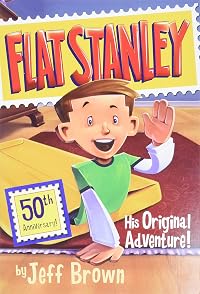
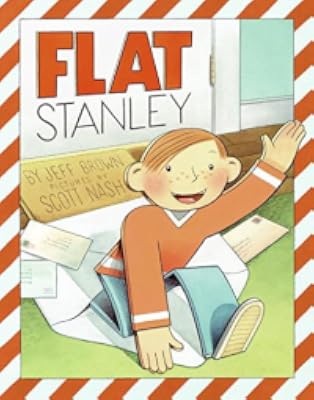
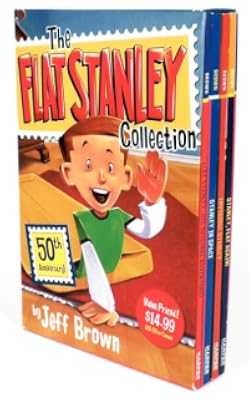
After a bulletin board falls on Stanley while he is sleeping, he finds that being flat has its advantages.Tags
Recommendations







Member Reviews
I was surprised at how appealing I found this silly story of a boy he is squished flat one day and makes the best of it. Maybe it's that all the adults -- doctors, parents, police, museum directors -- are all so consistently incompetent, so of course the kids have to step up when it comes to saving money, rescuing lost rings, stopping thieves, resolving sibling rivalry, and finding a cure.
Fun.
My only critique: I dislike stories where every member of the family gets a first name except the mother. Free Mrs. Lambchop from the patriarchy!
FOR REFERENCE:
Contents: Chapter 1. The Big Bulletin Board -- Chapter 2. Being Flat -- Chapter 3. Stanley the Kite -- Chapter 4. The Museum Thieves -- Chapter 5. Arthur's Good Idea
Fun.
My only critique: I dislike stories where every member of the family gets a first name except the mother. Free Mrs. Lambchop from the patriarchy!
FOR REFERENCE:
Contents: Chapter 1. The Big Bulletin Board -- Chapter 2. Being Flat -- Chapter 3. Stanley the Kite -- Chapter 4. The Museum Thieves -- Chapter 5. Arthur's Good Idea
Stanley Lambchop is an ordinary boy . . . was an ordinary boy . . . until the night the bulletin board fell on top of him while he was sleeping. When Mr. and Mrs. Lambchop lifted the board off Stanley, they discovered that he was flat.
At first, Stanley enjoyed being flat. He could slide under doors and do all sorts of things. He even slid through the sidewalk grating when his mother’s ring accidentally rolled between its bars. He mailed himself in an envelope to visit his friend, Thomas, in California. Stanley could roll himself up, and make himself into a kite for his younger brother, Arthur. [Arthur was jealous of all the things Stanley could do now that he was flat and tried to flatten himself by putting a great many volumes of the show more Encyclopedia Britannica on top of himself. It didn’t work.]
Mr. O. Jay Dart, director of the Famous Museum of Art, was upset because thieves were stealing paintings from the museum. Sneak thieves [the worst kind because they work by sneakery] are responsible, but the police have had no luck catching them.
Stanley comes up with a plan. But will it work? Will they catch the sneak thieves and save the paintings in the museum? And, most importantly, will Stanley stay flat forever?
Flat Stanley is destined to become the young reader’s favorite character. Although filled with whimsy and silliness, the clever story makes some important points about family, being brothers, coming to hasty conclusions, teamwork, and judging people by their differences.
“Flat Stanley” has spawned a plethora of Flat Stanley adventures as well as imaginative school projects in which students create a flat figure of themselves and then send themselves in the mail to have adventures [my granddaughter’s flat-self went to the playground, the movies, and grocery-shopping, then visited a local classroom . . . now her flat-self is proudly displayed on my bookcase].
The target audience here is ages six through ten; however, the narrative is a bit lengthy, so perhaps not appropriate for the youngest readers unless read in installments. Some of the humor may be more at the parental level, but the improbability is sure to make every young reader giggle. This is definitely a book that children will ask to read again and again.
Highly recommended. show less
At first, Stanley enjoyed being flat. He could slide under doors and do all sorts of things. He even slid through the sidewalk grating when his mother’s ring accidentally rolled between its bars. He mailed himself in an envelope to visit his friend, Thomas, in California. Stanley could roll himself up, and make himself into a kite for his younger brother, Arthur. [Arthur was jealous of all the things Stanley could do now that he was flat and tried to flatten himself by putting a great many volumes of the show more Encyclopedia Britannica on top of himself. It didn’t work.]
Mr. O. Jay Dart, director of the Famous Museum of Art, was upset because thieves were stealing paintings from the museum. Sneak thieves [the worst kind because they work by sneakery] are responsible, but the police have had no luck catching them.
Stanley comes up with a plan. But will it work? Will they catch the sneak thieves and save the paintings in the museum? And, most importantly, will Stanley stay flat forever?
Flat Stanley is destined to become the young reader’s favorite character. Although filled with whimsy and silliness, the clever story makes some important points about family, being brothers, coming to hasty conclusions, teamwork, and judging people by their differences.
“Flat Stanley” has spawned a plethora of Flat Stanley adventures as well as imaginative school projects in which students create a flat figure of themselves and then send themselves in the mail to have adventures [my granddaughter’s flat-self went to the playground, the movies, and grocery-shopping, then visited a local classroom . . . now her flat-self is proudly displayed on my bookcase].
The target audience here is ages six through ten; however, the narrative is a bit lengthy, so perhaps not appropriate for the youngest readers unless read in installments. Some of the humor may be more at the parental level, but the improbability is sure to make every young reader giggle. This is definitely a book that children will ask to read again and again.
Highly recommended. show less
Flat Stanley is a staple book in the elementary classroom, being the focus of many class read alouds and letter writing projects. Since my second grader was reading it at school, we decided to include the book as part of our nightly reading sessions at home. In the story, Flat Stanley is a young kid who becomes flat after the poster board beside his bed falls on him during the night. No worries, though, Stanley is still in perfect health, he's just flat as a board. The book proceeds to details the adventures that a flat boy can encounter, from flying as a kite to posing as a work of fine art and capturing art thieves. The story is quite unbelievable, but Stanley's antics were manic enough to delight my daughters. I read in the author's show more synopsis that the story originated as a night time adventure made up for the author's children, and knowing its origin helped me understand some of the book's outrageous nature. Bedtime stories are frequently wild and unimaginable. Personally, I found Flat Stanley to be more than a little ridiculous and old-fashioned, but certainly creative, and my children unreservedly enjoyed it. show less
At over 50 years old, "Flat Stanley" is a story and character that has truly stood the test of time. The story begins with the Lambchop family waking up to some shocking news, Stanley has been crushed by a bulletin board! The family is in distress until they uncover something extraordinary, Stanley is perfectly fine - except for being half an inch thick. Now flat, Stanley is able to do many unbelievable things like travel via mail cross country, be flown as a kite, and catch thieves in the act while posing as a painting. In the end, though, people start making fun of Stanley for looking different, so his brother blows him back up with a bicycle pump. As a fantasy, "Flat Stanley" is a very strong example, because there's no explicit show more "magic" necessarily happening, he's just a regular boy who was impossible misshapen. Setting the story in an otherwise plausible world, students could connect to the emotions Stanley experiences, especially at the end when he is bullied. This book would be an excellent way to begin a discussion with your class - or school - about differences and bullying, but it would also be a fun way to talk about what unique qualities we all have that make us unique.
Media: ink/pencil show less
Media: ink/pencil show less
.I love this classic story by Jeff Brown. I remember really enjoying the adventures of flat Stanley when I was a little kid, especially the art and stories. Flat Stanley is a great story about a child who was flattened by a bulletin board and is now able to go on all sorts of weird adventures due to his new found flat physique. One aspect of the writing style that I really enjoy is that the narrative plays out like a movie scene. I am able to visualize everything that happens in the story even without looking at the pictures. I also really love that Jeff Brown bolds his paralleled writing. For example, he bolded the words “Being flat could be fun,” and “Being flat could be exciting.” His writing is extremely expressive and by show more adding bolded sentences, different fonts and onomatopoeias, he made the writing all the more engaging. Finally, I love the bright colors and clear, detailed drawings of the art in the story. It really supports the feel of the story and helps the reader visualize what is going on in the story. I was really reminded of why I loved this book so much as a child. show less
I know this one is really popular with the kids, but I just couldn't let go. I kept looking at Stanley as a kid with a horrible disability. It did, however, have the perfect ingredients for a chapter book for young kids - jealous little brother, flying (cool, even if you do get tangled in a tree) and ridiculous save by little brother that leads to reconciliation. Added bonus, the parents aren't stupid or cruel, but they do let the kids solve their own problems.
Whimsical and imaginative, Mr Brown presents a ridiculous situation in the most of fact way Ana them runs with it. Stanley is mailed in an envelope, he is flown like a kite, and in the end he is re-inflated like a flat tire. But his family is lovely.
Members
- Recently Added By
Published Reviews
ThingScore 100
What's the story?
Flat as a pancake, smashed by a bulletin board, Stanley uses his new shape to gain attention, but he soon learns the downside of being different. Jeff Brown's sophisticated humor keeps adults entertained, while kids identify with Stanley's feelings and enjoy his adventures. The illustration style, though dated, is expressive and funny. Brown's understanding of childhood show more emotions is as highly tuned as his humorous, understated writing style: "Mr. Dart stood back a few feet and stared at him for a moment. 'Oh well,' he said, 'it may not be art, but I know what I like.'"
The lesson about the perils of going to extremes for attention is subtly conveyed, as Stanley is teased and rejected by his peers and Mom delivers a heavy-handed lecture about accepting other's differences, including racial and religious ones. Younger siblings will relate to Arthur's jealousy, too. show less
added by ReneHohls
After a bulletin board fell on him and decreased his thickness to one-half an inch, Stanley's life changed in peculiar ways. His younger, well-rounded brother was jealous of flat Stanley, who could fit under closed doors, slip down sidewalk grates, be carried bundle-form, or flown as a kite,-- and who was finally proclaimed a ""flat here"" for being instrumental in uncovering a pair of show more thieves. The listening group will enjoy Stanley's bizarre perspective on the world. show less
added by ReneHohls
Lists

1001 Children's Books You Must Read Before You Grow Up
774 works; 101 members

CCE 1000 Good Books List
1,033 works; 12 members

4th Grade Books
312 works; 5 members

Unshelved Book Clubs
579 works; 5 members

Books About Boys
175 works; 15 members
Author Information

64+ Works 38,097 Members
Born in New York City, Jeff Brown has worked on the editorial staffs of The New Yorker and the Saturday Evening Post, and his stories have appeared in these magazines and many others. Mr. Brown is the author of several other books about the Lambchop family Scott Nash is cofounder of Big Blue Dot. He has illustrated many children's books. Like show more Stanley Lambchop, Scott is the oldest child in his family. He lives with his wife, Nancy, also an artist, and their very sweet dog, Bear, on Peaks Island off the coast of Maine show less
Some Editions
Awards and Honors
Series

Work Relationships
Is contained in
Has the adaptation
Is abridged in
Has as a student's study guide
Has as a teacher's guide
Common Knowledge
- Original publication date
- 1964
- People/Characters
- Stanley Lambchop; Arthur Lambchop (brother of Stanley Lambchop); George Lambchop (father of Stanley Lambchop); Harriet Lambchop (mother of Stanley Lambchop); Dr. Dan; O. Jay Dart (museum director)
- Important places
- Famous Museum of Art, USA
- Dedication
- For J.C. and Tony
- First words
- Breakfast was ready. "I will go wake up the boys," Mrs. Lambchop said to her husband, George Lambchop.
- Last words
- (Click to show. Warning: May contain spoilers.)It had been a long and tiring day. Very soon all the Lambchops were asleep.
- Original language
- English
Classifications
Statistics
- Members
- 9,637
- Popularity
- 1,072
- Reviews
- 95
- Rating
- (3.75)
- Languages
- English, French, German, Spanish
- Media
- Paper, Audiobook, Ebook
- ISBNs
- 69
- ASINs
- 28