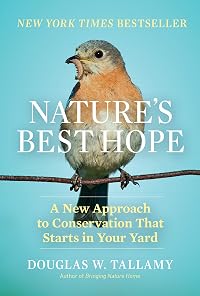
Nature's Best Hope: A New Approach to Conservation That Starts in Your Yard
by Douglas W. Tallamy
On This Page
Description
"Douglas W. Tallamy's first book, Bringing Nature Home, awakened thousands of readers to an urgent situation: wildlife populations are in decline because the native plants they depend on are fast disappearing. His solution? Plant more natives. In this new book, Tallamy takes the next step and outlines his vision for a grassroots approach to conservation. Nature's Best Hope shows how homeowners everywhere can turn their yards into conservation corridors that provide wildlife habitats. Because show more this approach relies on the initiatives of private individuals, it is immune from the whims of government policy. Even more important, it's practical, effective, and easy--you will walk away with specific suggestions you can incorporate into your own yard. If you're concerned about doing something good for the environment, Nature's Best Hope is the blueprint you need. By acting now, you can help preserve our precious wildlife--and the planet--for future generations."--provided by publisher. show lessTags
Recommendations

Member Reviews
Consider me converted to the idea that we need to restore native plants to our respective regions. Tallamy's book lays out all the reasons that native plants are important - vital - to our conservation efforts. This book is great because he convinced me that even my small yard can make a difference. Most books on conservation and environment leave me feeling completely overwhelmed and hopeless, but here is something that I can do that should help.
The crux of Tallamy's argument is that we need to stop thinking of nature as someplace we visit and create habitats in our own yards, workplaces, and common neighborhood areas. He talks about plants that support specific caterpillars that support specific birds and how that circle is the show more bedrock of a healthy environment. And it sounds doable. Replacing non-native ornamentals with native plants, reducing lawn, leaving leaf litter, and adding a small clean water source - these are things that everyone can do.
This book is not really a "how-to" book; it is a book to convince you and to give you the arguments to convince your neighbors. I did read plenty of reviews that complained about this. But, for me, I'd heard a little about the benefits of native plants but had never known all the reasons why they are so important. This book was an important step for me in really being able to name the benefits of returning native plants to our landscaping.
I highly recommend reading this book if you are new to this concept or want clearly laid out reasoning about why it's important. show less
The crux of Tallamy's argument is that we need to stop thinking of nature as someplace we visit and create habitats in our own yards, workplaces, and common neighborhood areas. He talks about plants that support specific caterpillars that support specific birds and how that circle is the show more bedrock of a healthy environment. And it sounds doable. Replacing non-native ornamentals with native plants, reducing lawn, leaving leaf litter, and adding a small clean water source - these are things that everyone can do.
This book is not really a "how-to" book; it is a book to convince you and to give you the arguments to convince your neighbors. I did read plenty of reviews that complained about this. But, for me, I'd heard a little about the benefits of native plants but had never known all the reasons why they are so important. This book was an important step for me in really being able to name the benefits of returning native plants to our landscaping.
I highly recommend reading this book if you are new to this concept or want clearly laid out reasoning about why it's important. show less
The title of this book, Nature’s Best Hope, might lead one to believe there’s a miracle cure for the environmental destruction perpetrated by humans. But look closer, and you’ll notice a subtitle: A New Approach to Conservation that Starts in Your Yard. Yes, that’s right: each and every one of us plays a part in restoring our ecosystems. And doing so is important not just because our favorite wildlife species depend on it, but because ultimately the human race does, as well.
Today, there is very little undeveloped land on our planet. Protected lands, while important, represent only a small portion of total acreage. Every tract of land that is turned into residential developments also results in associated commercial corridors. show more This leaves only small, isolated areas for wildlife. And both the size and the isolation contribute to reduced birth rates and increased mortality among our wildlife.
Douglas Tallamy, a professor of entomology and wildlife ecology, has spent his career working to understand the role of insects and plants in creating biodiversity. In this book he advocates for creating ecological corridors through the actions of individual landowners. The highest-impact actions we can take are to reduce the size of our lawns and increase the footprint of native plants.
Prior to reading this book, I had a vague understanding of native plants as “good,” but could not have explained why. I now have a better understanding of the importance of insects and caterpillars in the food webs that sustain wildlife, and the essential role native plants play as a food source for those insects and caterpillars. As home gardeners, we have been trained by years of tradition to prefer certain trees and ornamentals which are non-native and therefore do nothing to build and sustain our wildlife populations. In fact there are often equally attractive native alternatives, and nurseries and garden centers are increasingly offering these varieties. Each region also has a small number of “keystone” plants: a critical few with huge impact.
It may not be practical -- or even desirable -- to rip out and replace all of the non-native plants in your garden. But each of us can make a start, for example by replacing some of our lawn with native trees or shrubs, and removing invasive plants. We don’t have to do it all, but we do have to do something. show less
Today, there is very little undeveloped land on our planet. Protected lands, while important, represent only a small portion of total acreage. Every tract of land that is turned into residential developments also results in associated commercial corridors. show more This leaves only small, isolated areas for wildlife. And both the size and the isolation contribute to reduced birth rates and increased mortality among our wildlife.
Douglas Tallamy, a professor of entomology and wildlife ecology, has spent his career working to understand the role of insects and plants in creating biodiversity. In this book he advocates for creating ecological corridors through the actions of individual landowners. The highest-impact actions we can take are to reduce the size of our lawns and increase the footprint of native plants.
Prior to reading this book, I had a vague understanding of native plants as “good,” but could not have explained why. I now have a better understanding of the importance of insects and caterpillars in the food webs that sustain wildlife, and the essential role native plants play as a food source for those insects and caterpillars. As home gardeners, we have been trained by years of tradition to prefer certain trees and ornamentals which are non-native and therefore do nothing to build and sustain our wildlife populations. In fact there are often equally attractive native alternatives, and nurseries and garden centers are increasingly offering these varieties. Each region also has a small number of “keystone” plants: a critical few with huge impact.
It may not be practical -- or even desirable -- to rip out and replace all of the non-native plants in your garden. But each of us can make a start, for example by replacing some of our lawn with native trees or shrubs, and removing invasive plants. We don’t have to do it all, but we do have to do something. show less
This is one of my favorite non-fiction books of the year. Before reading it, I was aware of the ‘native plants’ movement, but had no idea why native plants are vital to your backyard’s ecosystem.
It’s not enough to plant a tree in your yard and believe you are doing your best for the environment by capturing extra CO2.
A native tree may have up to 500 native insects that have evolved in the same area and are dependent on consuming the native flora. Without the native insects, specifically the native caterpillars, native birds will also have nothing to feed their young, as baby birds cannot digest the bird seed you’ve so helpfully put in your feeder to encourage more birds.
While planting a non-native tree may provide beauty and show more shade, the non-native tree may have no insects able to consume it. It’s the reason why some beautifully planted tree-lined city streets may be a desert for nesting birds. It’s also the reason that kudzu has taken off and growing unrestricted- so far there has been only one US insect found that eats it. And this insect also causes a dead-end as no birds native to the kudzu-infested areas eat this insect.
It all comes down to ‘connectivity’, and the ecological web that has evolved in a given area through tens of thousands of years of co-existence.
Removing a bit of your carefully landscaped but ecologically sterile lawn and adding a few native trees and plants as well as leaving some litter beneath them to provide habitat for insects is essential for both local and migrating birds. If you can convince your neighbors to do the same, you’ve got the beginning of what Tallamy has dubbed Homegrown National Parks.
Tallamy includes a list in the final chapter, outlining what steps we can take to begin the process of creating a more environmentally friendly yard beginning with baby steps that we can all achieve. show less
It’s not enough to plant a tree in your yard and believe you are doing your best for the environment by capturing extra CO2.
A native tree may have up to 500 native insects that have evolved in the same area and are dependent on consuming the native flora. Without the native insects, specifically the native caterpillars, native birds will also have nothing to feed their young, as baby birds cannot digest the bird seed you’ve so helpfully put in your feeder to encourage more birds.
While planting a non-native tree may provide beauty and show more shade, the non-native tree may have no insects able to consume it. It’s the reason why some beautifully planted tree-lined city streets may be a desert for nesting birds. It’s also the reason that kudzu has taken off and growing unrestricted- so far there has been only one US insect found that eats it. And this insect also causes a dead-end as no birds native to the kudzu-infested areas eat this insect.
It all comes down to ‘connectivity’, and the ecological web that has evolved in a given area through tens of thousands of years of co-existence.
Removing a bit of your carefully landscaped but ecologically sterile lawn and adding a few native trees and plants as well as leaving some litter beneath them to provide habitat for insects is essential for both local and migrating birds. If you can convince your neighbors to do the same, you’ve got the beginning of what Tallamy has dubbed Homegrown National Parks.
Tallamy includes a list in the final chapter, outlining what steps we can take to begin the process of creating a more environmentally friendly yard beginning with baby steps that we can all achieve. show less
Nature’s Best Hope: A New Approach to Conservation That Starts in Your Yard, is an excellent look at what the average person can do on an extremely local basis, to make their yard healthier. The qualifier is that you have to be able to change things up in that yard, by owning it or having a tolerant landlord, and have the resources and abilities to make the changes. Within a few pages you will have read of a basic first step—get rid of 50% of your lawn. He also starts referring to all those backyard changes as creating our newest national park, HOMEGROWN NATIONAL PARK. The author is most direct and straightforward. “Humans are not genetically programmed to care about the future.” “In this book I will not be asking for show more sacrifices that will build a better world later on. I will suggest actions that heal our damaged landscapes right now, actions that create immediate, short-term gains for humans.” The book is a very comprehensive look at climate, vegetation (native versus import), and compatibility. The kind of compatibility that he goes deeply into was an element that I have never paid that much attention to in my many yard/garden improvements. Like so many, I get surrounded by all manner of luscious plants at a greenhouse or home and garden place, and I’m quickly thinking perennial or annual, sun/shade and water requirements, colors and size, and not how all the elements work together to create an environment that helps other plants, the insects, and maybe some wildlife in your new evolving ecosystem.
So many of us have been trained to cringe and look for the spray when we think of insects—other than those pretty butterflies and bees. And wildlife in our yards is seen as a rare intruder, a pest, and mostly destructive—unless it’s really cute. All of this is very limiting when it comes to a new environment that you’re trying to create, something that works together. Tallamy clearly lays out how native plants not only have an advantage for growing better in the climate they’re most familiar with, but how they have so many more relationships with the other native plants, insects, and wild critters. Most of the sexiest plants (most striking and colorful) that first catch your eye in the garden shop, evolved to grow best hundreds and thousands of miles away from your yard. The author shows how good local plants are for insects and wildlife and how long—if ever—it takes for new non-natives to work well and in harmony. He writes about a reed that’s been in the United States for over 500 years, but it still only supports a tiny percentage (5%) of the insects that it supported in its native European homeland. Interconnectivity is the key, between plants, insects, and animals—in all directions.
People’s relationship with the natural world is completely different from most the days of my youth spent in the fields, woods, and waterways of Vermont. “Parents who shoo the kids out the door in the morning with instructions to be home by lunchtime are more likely to be arrested for child abuse than praised for good parenting.” That freedom was how I spent much of my youth. Tallamy writes, “Today most people live in what I call the great suburban/urban matrix, and we hardly interact with the natural world. Unfortunately, our ignorance of nature has led to a dangerous indifference about its fate.”
Allow me the lazy way, as I list these lines and quotes from Nature’s Best Hope. show less
So many of us have been trained to cringe and look for the spray when we think of insects—other than those pretty butterflies and bees. And wildlife in our yards is seen as a rare intruder, a pest, and mostly destructive—unless it’s really cute. All of this is very limiting when it comes to a new environment that you’re trying to create, something that works together. Tallamy clearly lays out how native plants not only have an advantage for growing better in the climate they’re most familiar with, but how they have so many more relationships with the other native plants, insects, and wild critters. Most of the sexiest plants (most striking and colorful) that first catch your eye in the garden shop, evolved to grow best hundreds and thousands of miles away from your yard. The author shows how good local plants are for insects and wildlife and how long—if ever—it takes for new non-natives to work well and in harmony. He writes about a reed that’s been in the United States for over 500 years, but it still only supports a tiny percentage (5%) of the insects that it supported in its native European homeland. Interconnectivity is the key, between plants, insects, and animals—in all directions.
People’s relationship with the natural world is completely different from most the days of my youth spent in the fields, woods, and waterways of Vermont. “Parents who shoo the kids out the door in the morning with instructions to be home by lunchtime are more likely to be arrested for child abuse than praised for good parenting.” That freedom was how I spent much of my youth. Tallamy writes, “Today most people live in what I call the great suburban/urban matrix, and we hardly interact with the natural world. Unfortunately, our ignorance of nature has led to a dangerous indifference about its fate.”
Allow me the lazy way, as I list these lines and quotes from Nature’s Best Hope. show less
It is so easy to be pessimistic about our planet’s future when Australian Prime Minister Scott Morrison is vowing to criminalize climate change boycotts and “radical protests” and Trump withdraws from the Paris Climate Agreement. Bees are dying and butterflies are disappearing and our recycling is ending up in landfills. So, reading Nature’s Best Hope was a breath of fresh air. Tallamy doesn’t just tell us the problem, he tells us what we can do, how to do it, and assures us that we can make a difference.
The thing is, even if governments are resistant to doing what is necessary, people are eager to act. Change is possible. Look how quickly people switched from aerosol to pump spray. Only the belligerent continue to use show more incandescent bulbs. People would do more if they knew what to do and Tallamy explains something they can do that would be transformative if enough folks did it.
You see, those of us who have yards could create a “Homegrown National Park” with native plants that are friendly to bugs and birds, we could make sure there is loose enough soil for burrowing and enough mess for nesting. He points to the High Line planting in the middle of Manhattan and the amazing diversity of life it sustains.
Nature’s Best Hope is a book every single person should read. Most books about the problems the world faces are 95% problem and 5% solution, usually they have a solution that requires a political maturity unknown in this country. Nature’s Best Hope is the opposite of this; it is all about solutions and far easier solutions than people might think. Tallamy is a realist, he explains how to work with homeowner associations and not upset the neighbors, yet still foster the resurgence of many species of birds and insects.
He writes with a comfortable tone, serious, but not hectoring. He shares his own mistakes and does an extraordinary job of crediting the work of others, even his own students. It is so rare to read a hopeful book, that it makes me want to read again and again. He makes changing our horrible trajectory seem so possible and plausible that I want to get started yesterday.
Nature’s Best Hope will be released February 4th. I received an ARC from the publisher through Shelf Awareness.
Nature’s Best Hope at Timber Press | Workman Publishing
Douglas W. Tallamy Bringing Nature Home author site
https://tonstantweaderreviews.wordpress.com/2020/01/09/9781604699005/ show less
The thing is, even if governments are resistant to doing what is necessary, people are eager to act. Change is possible. Look how quickly people switched from aerosol to pump spray. Only the belligerent continue to use show more incandescent bulbs. People would do more if they knew what to do and Tallamy explains something they can do that would be transformative if enough folks did it.
You see, those of us who have yards could create a “Homegrown National Park” with native plants that are friendly to bugs and birds, we could make sure there is loose enough soil for burrowing and enough mess for nesting. He points to the High Line planting in the middle of Manhattan and the amazing diversity of life it sustains.
Nature’s Best Hope is a book every single person should read. Most books about the problems the world faces are 95% problem and 5% solution, usually they have a solution that requires a political maturity unknown in this country. Nature’s Best Hope is the opposite of this; it is all about solutions and far easier solutions than people might think. Tallamy is a realist, he explains how to work with homeowner associations and not upset the neighbors, yet still foster the resurgence of many species of birds and insects.
He writes with a comfortable tone, serious, but not hectoring. He shares his own mistakes and does an extraordinary job of crediting the work of others, even his own students. It is so rare to read a hopeful book, that it makes me want to read again and again. He makes changing our horrible trajectory seem so possible and plausible that I want to get started yesterday.
Nature’s Best Hope will be released February 4th. I received an ARC from the publisher through Shelf Awareness.
Nature’s Best Hope at Timber Press | Workman Publishing
Douglas W. Tallamy Bringing Nature Home author site
https://tonstantweaderreviews.wordpress.com/2020/01/09/9781604699005/ show less
This is a well-written argument for creating a native plant environment in your own yard and advocating for the removal of invasive species from our public lands. Most importantly it tackles the cultural obstacles we currently face when making this change and arms you with the means to change your local mindset to allow for this change. All the points are thoroughly researched and detailed with the exception of his argument for slowing population growth. This one error for some reason is not backed up in the book and comes off more as a Thanos screed than a scientist's advice. But regardless, the remainder of the book is a wonderful guide (with gorgeous pictures) for how to genuinely do your part to save the world.
Feels like a companion book to Bringing Nature Home. About how important it is for everyone to do something to support wildlife, specifically “the small things that run the world”- the insects- because they are the base of so much other life on earth. It’s about why you should remove invasive plants- and exactly why they are so damaging to the environment, making entire systems collapse or become sterile- and what types of plants you should choose to replace them. The author reiterates over and over through this book which half a dozen shrub, perennial and tree species will provide food and shelter for the greatest number of insects, and thus birds (specifically to the Eastern United States). He points out that it doesn’t matter show more how small your yard is, or how few resources you have- just starting by removing one invasive, or by planting one native that feeds insects and/or birds, will start a change. Notes how even a small yard can be an oasis for wildlife in the middle of a built-up city, bringing in birds and other creatures from miles around. His biggest points seem to be: make your lawn smaller, plant more natives- but not just any native- ones that are keystone species- and remove as many destructive, invasive plants as you can. Other helpful tips about how to support native bees, and how to make a yard full of unfamiliar, native plants that others might call weeds, visually acceptable to the neighbors. It’s nice that in the back, the author has a kind of question-and-answer section, where he addresses common objections people have to making the changes to their yards and landscapes that he recommends. My copy is full of photographs, which I really appreciate, especially of all the birdlife and interesting caterpillars. It’s surprisingly heavy, though, as a physical object. The paper feels thick, the binding very sturdy. But I might have read it slower than usual, because sometimes it felt like such a weight in my hands. show less
Members
- Recently Added By
Lists

Recommended Nature Writing
346 works; 180 members

Habitat Hero books
37 works; 1 member
Author Information

9+ Works 1,775 Members
Douglas W. Tallamy is Professor and Chair of the Department of Entomology and Wildlife Ecology at the University of Delaware in Newark, Delaware.
Awards and Honors
Common Knowledge
- Canonical title
- Nature's Best Hope: A New Approach to Conservation That Starts in Your Yard
- Original publication date
- 2020
- Blurbers
- Kolbert, Elizabeth
Classifications
- Genres
- Home & Garden, Science & Nature, Nonfiction, General Nonfiction
- DDC/MDS
- 635.9 — Applied science & technology Agriculture Garden crops (Horticulture) Flowers and ornamental plants
- LCC
- SB439 .T277 — Agriculture Horticulture. Plant propagation. Plant breeding Plant culture Flowers and flower culture. Ornamental plants Classes of plants
- BISAC
Statistics
- Members
- 497
- Popularity
- 60,642
- Reviews
- 13
- Rating
- (4.36)
- Languages
- English
- Media
- Paper, Audiobook, Ebook
- ISBNs
- 12
- ASINs
- 4