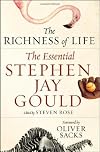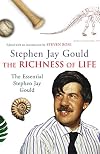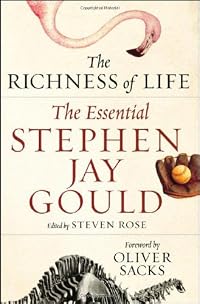
The Richness of Life: The Essential Stephen Jay Gould
by Stephen Jay Gould, Steven Rose (Editor)
On This Page
Description
Collects forty-four key segments from the late paleontologist and evolutionary biologist's books, papers, and essays, in a collection that includes an assortment of previously unpublished articles and speeches.Tags
Recommendations





Member Reviews
This is a very useful selection from the writings of the late Stephen Jay Gould, with an excellent introduction by Steven Rose. It does not correspond exactly with my choice of Gould's best and most important pieces, but it's hard to criticise the editors when Gould's output was so large and varied. It is certainly a good starting point for anyone who is new to Gould, and will no doubt lead them to look at his other work.
Gould's output falls into four main areas. Firstly, there is his contribution to evolutionary theory: he developed (with Niles Eldredge) the theory of punctuated equilibrium (linked to the concept of species selection); he emphasised that evolutionary history consists of a branching bush, not a ladder of progress; he show more argued that chance (or rather "contingency") plays a large part in evolutionary history; he contended that not every feature of an organism can be explained by functional adaptationism; and he showed that organs can often be adapted and used for purposes which are different from the ones they first evolved to perform.
Secondly, Gould saw that science is a human activity which is influenced by the social, historical and ideological context in which it takes place. His historical biographies of scientists always show them to be products of their times. In this context Gould is also excellent at showing the dialectical interaction between theory and factual evidence in the development of scientific knowledge.
The third area of Gould's work is his lifelong battle against those crude biologically deterministic theories (such as sociobiology and evolutionary psychology) which try to explain away human behaviour as being mainly determined by our genes. An example of what Gould was up against is Richard Dawkins. Dawkins refers to living creatures as "lumbering robots" programmed by their genes. And in an interview published in "New Statesman" (26th March 1999), while discussing cloning, Dawkins said: "Cloning Saddam Hussein would be horrible. Cloning David Attenborough, or someone we all admire, might be fine."
This is the sort of genetic determinism that Gould demolishes. Does Dawkins really think that the nastiness of the dead dictator and the niceness of the admirable Attenborough are simply the result of their genes, and nothing to do with their upbringing, experiences, social circumstances and life-history? Gould has pointed out that nature's clones (identical twins) have already shown us that having identical genes does not mean having the same personality.
Unlike Dawkins, Gould has a grasp of the subtle and complex interaction between our genetic potentiality and the environmental factors which play an enormous part in making us what we are. Gould also points out the real danger of genetic determinism: it suggests that social problems and inequalities are the inevitable result of our biology rather than things that we can put right.
Fourthly and finally, Gould has written about the relationship between science and religion. Gould (an agnostic) believed that there need be no inevitable conflict between the two as long as each sticks to its own sphere and leaves the other alone. Religion should leave science to get on with explaining nature, and science should leave moral debates to religion. I think Gould is on shaky ground here. He is understating the conflict between science and religion; he is playing down the reactionary role that religion still plays in society; and he is failing to analyse the SOCIAL roots of morality. He rightly says that we should not leave moral decisions just to scientists, but I would also say that we shouldn't leave them to priests either!
Nevertheless, even though I am an atheist myself, I do not believe that Richard Dawkins' crude version of atheism is any better than Gould's "softness" on religion. Dawkins is like the philosophers of the Enlightenment in that he thinks that religious beliefs can be dispelled by directly confronting them with rational, scientific arguments. He fails to understand that atheists have to do more than just show religion to be superstitious nonsense: it is necessary to understand its social roots and to get rid of the oppressive and alienating social conditions which make people turn to what Marx, in the famous "opium of the people" passage, called "the sigh of the oppressed creature, the heart of a heartless world and the soul of soulless circumstances."
Gould is one of my favourite writers. He is not perfect. His writing style (especially in his later books) can at times be repetitive and self-indulgent. But he is always worth reading: he never fails to make you think. I thoroughly recommend this book. show less
Gould's output falls into four main areas. Firstly, there is his contribution to evolutionary theory: he developed (with Niles Eldredge) the theory of punctuated equilibrium (linked to the concept of species selection); he emphasised that evolutionary history consists of a branching bush, not a ladder of progress; he show more argued that chance (or rather "contingency") plays a large part in evolutionary history; he contended that not every feature of an organism can be explained by functional adaptationism; and he showed that organs can often be adapted and used for purposes which are different from the ones they first evolved to perform.
Secondly, Gould saw that science is a human activity which is influenced by the social, historical and ideological context in which it takes place. His historical biographies of scientists always show them to be products of their times. In this context Gould is also excellent at showing the dialectical interaction between theory and factual evidence in the development of scientific knowledge.
The third area of Gould's work is his lifelong battle against those crude biologically deterministic theories (such as sociobiology and evolutionary psychology) which try to explain away human behaviour as being mainly determined by our genes. An example of what Gould was up against is Richard Dawkins. Dawkins refers to living creatures as "lumbering robots" programmed by their genes. And in an interview published in "New Statesman" (26th March 1999), while discussing cloning, Dawkins said: "Cloning Saddam Hussein would be horrible. Cloning David Attenborough, or someone we all admire, might be fine."
This is the sort of genetic determinism that Gould demolishes. Does Dawkins really think that the nastiness of the dead dictator and the niceness of the admirable Attenborough are simply the result of their genes, and nothing to do with their upbringing, experiences, social circumstances and life-history? Gould has pointed out that nature's clones (identical twins) have already shown us that having identical genes does not mean having the same personality.
Unlike Dawkins, Gould has a grasp of the subtle and complex interaction between our genetic potentiality and the environmental factors which play an enormous part in making us what we are. Gould also points out the real danger of genetic determinism: it suggests that social problems and inequalities are the inevitable result of our biology rather than things that we can put right.
Fourthly and finally, Gould has written about the relationship between science and religion. Gould (an agnostic) believed that there need be no inevitable conflict between the two as long as each sticks to its own sphere and leaves the other alone. Religion should leave science to get on with explaining nature, and science should leave moral debates to religion. I think Gould is on shaky ground here. He is understating the conflict between science and religion; he is playing down the reactionary role that religion still plays in society; and he is failing to analyse the SOCIAL roots of morality. He rightly says that we should not leave moral decisions just to scientists, but I would also say that we shouldn't leave them to priests either!
Nevertheless, even though I am an atheist myself, I do not believe that Richard Dawkins' crude version of atheism is any better than Gould's "softness" on religion. Dawkins is like the philosophers of the Enlightenment in that he thinks that religious beliefs can be dispelled by directly confronting them with rational, scientific arguments. He fails to understand that atheists have to do more than just show religion to be superstitious nonsense: it is necessary to understand its social roots and to get rid of the oppressive and alienating social conditions which make people turn to what Marx, in the famous "opium of the people" passage, called "the sigh of the oppressed creature, the heart of a heartless world and the soul of soulless circumstances."
Gould is one of my favourite writers. He is not perfect. His writing style (especially in his later books) can at times be repetitive and self-indulgent. But he is always worth reading: he never fails to make you think. I thoroughly recommend this book. show less
«The Richness of Life» is a big book (600+) pages, and requires attentive reading. The book is a comprehensive, commemorative volume presenting a representative selection of the essays of Stephen Jay Gould. Despite the fact that his essays in the area of Natural History are very scientific Gould has always enjoyed a wide readership and his premature death was lamented. The main focus of nearly all essays is Darwin's theory of evolution, either through the fossil record or diversity of animal forms. A number of essays are very theoretical. I did not enjoy reading this volume as much as I had anticipated. It appears to be rather heavy-handed. The original volumes of essays published in Gould's lifetime seem to be lighter and more readable.
A varied collection. Ranging form the short and punchy columns he published in Scientific American to extracts from his highly technical works.
As I have previous remarked, I much prefer the former over the latter. For me, when Gould uses three words instead of one I wince and don't particularly marvel at the poetry. But others do.
His writing sometimes lacks the brevity, clarity and force of Dawkins and I can occasionally get tangled up in how he is delivering his message to the detriment of the message itself.
From now on I will indulge myself in his pithy essays.
As I have previous remarked, I much prefer the former over the latter. For me, when Gould uses three words instead of one I wince and don't particularly marvel at the poetry. But others do.
His writing sometimes lacks the brevity, clarity and force of Dawkins and I can occasionally get tangled up in how he is delivering his message to the detriment of the message itself.
From now on I will indulge myself in his pithy essays.
Gould is a more prolific author since his death than some people are in their entire lives. This book contains a collection of various essays on natural history and evolution contained in his prior works, both academic and popular. Everything in this book has been previously published, but really, who among Gould fans could resist picking up this book? A very human work, accompanied by a delightful glimpse of the man through Oliver Sack's forward. Some of the academic writing was heavy sledding for me, however it made sense in the context of the book.
I probably didn't understand it, but I have not found this collection of essays illuminating as I had expected. I didn't even find them interesting. Sorry about that :(
Ratings
Members
- Recently Added By
Author Information

116+ Works 30,428 Members
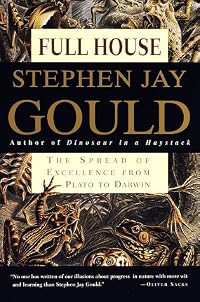
Born in New York City in 1941, Stephen Jay Gould received his B.A. from Antioch College in New York in 1963 and a Ph.D. in paleontology from Columbia University in 1967. Gould spent most of his career as a professor at Harvard University and curator of invertebrate paleontology at Harvard's Museum of Comparative Zoology. His research was mainly in show more the evolution and speciation of land snails. Gould was a leading proponent of the theory of punctuated equilibrium. This theory holds that few evolutionary changes occur among organisms over long periods of time, and then a brief period of rapid changes occurs before another long, stable period of equilibrium sets in. Gould also made significant contributions to the field of evolutionary developmental biology, most notably in his work, Ontogeny and Phylogeny. An outspoken advocate of the scientific outlook, Gould had been a vigorous defender of evolution against its creation-science opponents in popular magazines focusing on science. He wrote a column for Natural History and has produced a remarkable series of books that display the excitement of science for the layperson. Among his many awards and honors, Gould won the National Book Award and the National Book Critics Circle Award. His titles include; Ever Since Darwin, The Panda's Thumb, Hen's Teeth and Horse's Toes, Time's Arrow, Time's Cycle, Wonderful Life: The Burgess Shale and the Nature of History, The Structure of Evolutionary Theory and Full House: The Spread of Excellence from Plato to Darwin. Stephen Jay Gould died on May 20, 2002, following his second bout with cancer. (Bowker Author Biography) show less

Steven Rose is Professor of Biology and Director of the Brain and Behavior Research Group at The Open University, and is a Visiting Professor in the Department of Anatomy and Developmental Biology at University College London.
All Editions
Classifications
Statistics
- Members
- 412
- Popularity
- 74,933
- Reviews
- 5
- Rating
- (3.74)
- Languages
- English
- Media
- Paper
- ISBNs
- 4
- ASINs
- 2