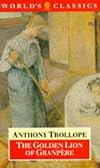
The Golden Lion of Granpère
by Anthony Trollope
On This Page
Description
This stirring portrait of a nineteenth-century French farming family is a must-read for fans of emotionally resonant historical fiction. Written by Anthony Trollope, known for his keen insight into the sweeping social, economic, cultural, and historical trends that can impact family relationships, this engaging tale is sure to please..
Tags
Recommendations






















Member Reviews
A beautiful edition, but very much a "lesser" Trollope. Too short, too direct in its plotting. Just a little too thin for me.
I suppose I can say he did a good job with this because I found myself thoroughly annoyed with almost everyone in this shorter work. Michel Voss, bossy and petulant, George, equally petulant and stubborn, and Marie, making pretty much everyone miserable. It's a rather simple little love story, made much more complicated by everyone working at cross purposes to each other.
This also had only three LibriVox readers and all wonderful. I never once squawked out a mispronounced word and there was nothing in the way of badly put on accents. Yippee!
This also had only three LibriVox readers and all wonderful. I never once squawked out a mispronounced word and there was nothing in the way of badly put on accents. Yippee!
Second cousins by marriage George and Marie grow up together at the inn at Granpere and fall in love, but are separated by George's father Michel (for shadowy never fully explained reasons). George is sent away to run an inn in a town a few hours away and fails to communicate with Marie for an entire year. Thinking she has been forgotten, Marie reluctantly agrees to marry Adrian, a linen merchant from Basle. George finally pulls his finger out and then Marie tries to break off her engagement.
That is really the whole of the plot pf this (fortunately short) novel. Trollope clearly was an early practitioner of the "this could all have been avoided with one frank conversation" romance trope. The character of Michel (apart from Trollope's show more insistence on his love for Marie being demonstrated in persecution and verbal abuse) was well-done and the ending, where everyone is desperate to get rid of poor Adrian was very funny. George was a bit grumpy to poor Madame Faragon and uncommunicative to every one else. Otherwise repetitive and made me want to shout "Why don't you just say what you think?" at the characters all the time. show less
That is really the whole of the plot pf this (fortunately short) novel. Trollope clearly was an early practitioner of the "this could all have been avoided with one frank conversation" romance trope. The character of Michel (apart from Trollope's show more insistence on his love for Marie being demonstrated in persecution and verbal abuse) was well-done and the ending, where everyone is desperate to get rid of poor Adrian was very funny. George was a bit grumpy to poor Madame Faragon and uncommunicative to every one else. Otherwise repetitive and made me want to shout "Why don't you just say what you think?" at the characters all the time. show less
This is the last of Trollope's experiments in shorter novels with continental settings, and I'm just as happy. Like the other two (_Nina Balatka_ and _Linda Tressel_), this contains some excellent character studies, but I miss the inclusion of a larger picture of some aspect of society.
everyone in this novel is their own worse enemy, never saying what they want, what they mean, just assuming others think, want understand the same. but maybe that's the way we are.
Ratings
Members
- Recently Added By
Author Information

344+ Works 50,713 Members
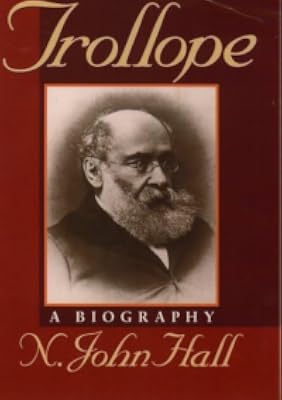
Anthony Trollope was born in London, England on April 24, 1815. In 1834, he became a junior clerk in the General Post Office, London. In 1841, he became a deputy postal surveyor in Banagher, Ireland. He was sent on many postal missions ending up as a surveyor general in the post office outside of London. His first novel, The Macdermots of show more Ballycloran, was published in 1847. His other works included Castle Richmond, The Last Chronicle of Barset, Lady Anna, The Two Heroines of Plumplington, and The Noble Jilt. He died after suffering from a paralytic stroke on December 6, 1882. (Bowker Author Biography) show less
Some Editions
Series
Belongs to Publisher Series
Everyman's Library (761)
Work Relationships
Common Knowledge
- Canonical title
- The Golden Lion of Granpère
- Original publication date
- 1872 (serial: Good Words) (serial: Good Words); 1872 (William Tinsley) (William Tinsley)
- First words
- Up among the Vosges mountains in Lorraine, but just outside the old half-German province of Alsace, about thirty miles distant from the new and thoroughly French baths of Plombieres, there lies the village of Granpere.
Classifications
Statistics
- Members
- 242
- Popularity
- 134,953
- Reviews
- 5
- Rating
- (3.38)
- Languages
- English, French
- Media
- Paper, Ebook
- ISBNs
- 43
- ASINs
- 18