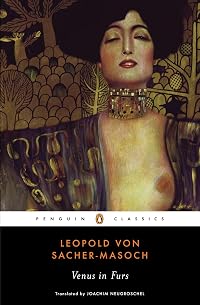
Venus in Furs
by Leopold von Sacher-Masoch
On This Page
Description
Venus in Furs tells the story of a young man who signs his life over to an older woman in a binding contract. This contract forms the basis of their relationship to each other, in which he is entirely bound to obey her, even should she tell him to kill himself.Austrian author Leopold Sacher-Masoch thus gave birth to the concept of "masochism", which describes the sexual, fetishistic infliction of pain and humiliation under the terms of a contract, implied or real. Venus in Furs was his most show more famous novel and comes under the first part of his Legacy of Cain series, Love.
. show less
Tags
Recommendations





























Member Recommendations


Member Reviews
In between Westerns, and awaiting my used copy of McCarthy's "The Crossing" from Alibris, I decided to read something completely different to keep my senses sharp. And, boy, did I pick a pink-welted doozy. However, I was unprepared for how funny "Venus in Furs" actually is:
“Whip me,” I begged, “whip me without mercy.”
Wanda swung the whip, and hit me twice. “Are you satisfied now?”
“No.”
“Seriously, no?”
And how well written:
"Stay among your northern fogs and Christian incense; let us pagans remain under the debris, beneath the lava; do not disinter us."
Or just whip-crackingly quotable:
"I have a vague feeling now that such a thing as beauty without thorn and love of the senses without torment does exist."
Much like George show more Bataille's "Story of the Eye" (though less extreme), I am pleasantly surprised that its contribution to literature isn't just a new term in a lexicon of perversion. Now, you'll excuse me while I play ottoman to my mistress's stilettos. show less
“Whip me,” I begged, “whip me without mercy.”
Wanda swung the whip, and hit me twice. “Are you satisfied now?”
“No.”
“Seriously, no?”
And how well written:
"Stay among your northern fogs and Christian incense; let us pagans remain under the debris, beneath the lava; do not disinter us."
Or just whip-crackingly quotable:
"I have a vague feeling now that such a thing as beauty without thorn and love of the senses without torment does exist."
Much like George show more Bataille's "Story of the Eye" (though less extreme), I am pleasantly surprised that its contribution to literature isn't just a new term in a lexicon of perversion. Now, you'll excuse me while I play ottoman to my mistress's stilettos. show less
From a certain literary perspective, "Venus in Furs" is a failure of a novel. Two rich, excessively cultured Europeans go on and on in a stiff, maddeningly formal tone, discecting their relationship and their complexes while neglecting to take their clothes off. It doesn't sound like a good time, does it?. But "Venus in Furs" is an accomplishment of sorts: while it can't be said to be a complete description of human sexuality, it provides a pretty good analysis of one very particular corner of it. Maybe you need to live there already to get it, but it's all there: the curious, paradoxical mixture of self-abnegation and egoism that drives most masochists, the combination of fear and intense desire that drives men who prefer a certain show more kind of strong-willed woman, and a general preference for extremes and drama. Modern readers may quibble with the author's take on the female character (inconstant, flighty) or race relations (decidedly exoticist), but it's hard to argue that he didn't know the terrain of his own desire. And desire's what this one's all about, really. The novel's by turns sumptous and shockingly physical, but its focus never strays much from the topic of beauty, even if it's a sort of beauty that's, ahem, somewhat unconventional. It's clear that the author, precious has he might be, doesn't just get a sexual thrill from seeing Wanda, the domme herself, bedecked in fur, but also real aesthetic pleasure: his references to European master painters aren't there by accident. Wanda herself is also a more comoplex character than one might expect. She's often very conscious of her own pleasure, the book asks whether Severin created her -- like a sexual version of Frankenstein's monster -- or if the games that they play merely brought out some dormant facet of her personality. Anyway, she never hesitates to call Severin's bluff, challenging him in ways that he finds both unconfortable and less than sexy. There's no "topping from below" from Wanda. The translation of my version seemd a good one, too: its lush and suitably ornate while maintaining a trace of what I'd like to imagine is a little Teutonic rigor. In a few scenes, the novel hits a perfect balance between sexy and cold-bloodedly terrifying. "Memorable" doesn't even begin to describe them. Finally, I got the sense that "Venus in Furs" is a better novel than it strictly has to be. The author probably deserves our praise for taking a subject that's ripe for cheap exploitation and writing a quality novel about it instead. It's recommended to a certain audience, and you know who you are. Perverts, suprasensualits, and raincoat-wearing sex creeps: this one's for you. show less
“Shiny, shiny, shiny boots of leather/Whiplash girlchild in the dark/Comes in bells, your servant, don't forsake him/Strike, dear mistress, and cure his heart.” The Velvet Underground performed “Venus in Furs” in their 1967 self-titled album. The song was about the novel of the same name, written in 1870 by an Austrian history professor named Leopold von Sacher-Masoch. Many more people have heard of the psychological condition than read his book, although this might change with the popularity of Fifty Shades of Grey. Venus in Furs is a literary ur-text, a book that establishes a genre and its conventions. (The Lord of the Rings is an ur-text of the epic fantasy genre.)
Masoch’s name is forever linked with another erotic show more philosopher, the Marquis de Sade. The nineteenth century German sexologist Richard von Krafft-Ebing linked the two writers together when he used the term sadomasochism to describe a particular sexual peculiarity involving pain and power. Krafft-Ebing wrote Psychopathia Sexualis in 1886 and inventories over 200 case studies. This work is the reason people lump together Masoch’s work with Sade’s, despite each author espousing radically different philosophies and writing styles. Masoch’s style is more symbolic and impressionistic, lacking the verbal crudity and explicitness of Sade.
Venus in Furs is the story of a man named Severin and his desire to become the slave of Wanda. Masoch planned the novel as part of a larger work called The Legacy of Cain. (Unlike the works of Sade, most of Masoch’s works have not been translated.) In a book length essay entitled Masoch: Coldness and Cruelty, French philosopher Gilles Deleuze explains how masochistic fantasies occur throughout Masoch’s work, but these scenes were linked to ethnic rituals and patriotic sentiment. Masoch lived in the Austro-Hungarian Empire, a multiethnic monarchy that had been ruled by the Hapsburg dynasty since the sixteenth century. In his other works, Masoch wrote about the empire’s various ethnic minorities.
The central narrative is what makes people uncomfortable. Not only does Severin reduce himself to the status of slave, but also he does so willfully. The term slavery should be properly qualified in this context. In the world of Venus in Furs and in the BDSM community at large, slaves and masters are roles. Temporary and theatrical, Severin makes him a slave through her signing a contract. Unlike the torture porn of Fifty Shades of Grey, which exists more within the Sadean universe, Severin and Wanda create ritualized tablueas. Deleuze relates how these scenes have the frozen quality of photography, then a burgeoning technology.
What is one to make of a situation where an individual willfully dehumanizes him or herself? It is a tricky subject, investigated by psychologists and literary theorists. However, unlike chattel slavery or international sex trafficking, these contractual situations have a definite termination. It is also another means for individuals to receive personal satisfaction. The discomfort comes when readers or self-righteous politicians feel the need to judge Severin’s kinks. Just because his desire to be enslaved superficially resembles America’s peculiar institution doesn’t make it morally wrong like American slavery. In fact, connecting the two is both intellectually dishonest and inaccurate. (America’s fetish for sexual regulation, repression, and oppression is causing enough heartache and hypocrisy this election cycle.)
So what does Venus in Furs tell us about being human? Masoch illustrates the linkages between power and desire. One should not prejudge the predilections of others, except where health and minors are concerned. Being human also means that some of our fellow beings don’t automatically desire to be the dominant figure. Some, like Masoch, desire to be the subservient member of the scenario. But one shouldn’t see this behavior as existing in a psychological vacuum, since Masoch tied his literary works with his commitment to championing the rights of ethnic minorities within the Austro-Hungarian empire. With Venus in Furs the personal is the political.
https://driftlessareareview.com/2012/09/21/cclap-fridays-on-being-human-venus-in... show less
Masoch’s name is forever linked with another erotic show more philosopher, the Marquis de Sade. The nineteenth century German sexologist Richard von Krafft-Ebing linked the two writers together when he used the term sadomasochism to describe a particular sexual peculiarity involving pain and power. Krafft-Ebing wrote Psychopathia Sexualis in 1886 and inventories over 200 case studies. This work is the reason people lump together Masoch’s work with Sade’s, despite each author espousing radically different philosophies and writing styles. Masoch’s style is more symbolic and impressionistic, lacking the verbal crudity and explicitness of Sade.
Venus in Furs is the story of a man named Severin and his desire to become the slave of Wanda. Masoch planned the novel as part of a larger work called The Legacy of Cain. (Unlike the works of Sade, most of Masoch’s works have not been translated.) In a book length essay entitled Masoch: Coldness and Cruelty, French philosopher Gilles Deleuze explains how masochistic fantasies occur throughout Masoch’s work, but these scenes were linked to ethnic rituals and patriotic sentiment. Masoch lived in the Austro-Hungarian Empire, a multiethnic monarchy that had been ruled by the Hapsburg dynasty since the sixteenth century. In his other works, Masoch wrote about the empire’s various ethnic minorities.
The central narrative is what makes people uncomfortable. Not only does Severin reduce himself to the status of slave, but also he does so willfully. The term slavery should be properly qualified in this context. In the world of Venus in Furs and in the BDSM community at large, slaves and masters are roles. Temporary and theatrical, Severin makes him a slave through her signing a contract. Unlike the torture porn of Fifty Shades of Grey, which exists more within the Sadean universe, Severin and Wanda create ritualized tablueas. Deleuze relates how these scenes have the frozen quality of photography, then a burgeoning technology.
What is one to make of a situation where an individual willfully dehumanizes him or herself? It is a tricky subject, investigated by psychologists and literary theorists. However, unlike chattel slavery or international sex trafficking, these contractual situations have a definite termination. It is also another means for individuals to receive personal satisfaction. The discomfort comes when readers or self-righteous politicians feel the need to judge Severin’s kinks. Just because his desire to be enslaved superficially resembles America’s peculiar institution doesn’t make it morally wrong like American slavery. In fact, connecting the two is both intellectually dishonest and inaccurate. (America’s fetish for sexual regulation, repression, and oppression is causing enough heartache and hypocrisy this election cycle.)
So what does Venus in Furs tell us about being human? Masoch illustrates the linkages between power and desire. One should not prejudge the predilections of others, except where health and minors are concerned. Being human also means that some of our fellow beings don’t automatically desire to be the dominant figure. Some, like Masoch, desire to be the subservient member of the scenario. But one shouldn’t see this behavior as existing in a psychological vacuum, since Masoch tied his literary works with his commitment to championing the rights of ethnic minorities within the Austro-Hungarian empire. With Venus in Furs the personal is the political.
https://driftlessareareview.com/2012/09/21/cclap-fridays-on-being-human-venus-in... show less
Such a notorious book. . . but it turned out to be not at all what I expected.
Severin is a romantic, intellectual, and -- to use his own word -- suprasensual young man who yearns to be owned and abused by a beautiful and cruel woman. However the woman who becomes his partner in passion, Wanda, isn't interested in cruelty. She simply wants to love him, and would prefer that he be the one with the power. But he keeps insisting that she become a "cruel despot," whip him, and humiliate him. He describes in detail the torments he wants to endure -- but when she finally agrees and gives him exactly what he has begged for, he gets angry and rails and weeps about how horrible she is. But when she threatens to stop being cruel, or to end the show more relationship, he drops to his knees and begs her to forgive him and continue to treat him as her slave. (Eventually I wanted to slap him myself!) Wanda herself, although motivated initially by a desire to please Severin, ends up enjoying her tyranny, but that pleasure always seems secondary to her desire to please.
By the standards of today's erotica, this is a very tame book. There are no explicitly sexual scenes. The whippings have enough detail to make it easy to visualize, but are more about the psychological impact than the physical.
To me, the most objectionable aspect of the book was its dismissal of women as non-rational, utterly "natural" and animalistic beings who can't be relied on because they are creatures of whim. But that was so obviously a product of the time, and the beliefs of a man whose own rationality is suspect (however intelligent he might be) that I ended up simply laughing at those passages.
This was a book club read, and we had an interesting discussion about consent, manipulation, and what it means to pursue a fantasy to its fullest extent. Sometimes we get more than we bargained for, but that doesn't mean it wasn't worth the experience. I ended up quoting a lyric from Rent: "Might as well dance a tango to hell. At least you'll have tango'd at all." show less
Severin is a romantic, intellectual, and -- to use his own word -- suprasensual young man who yearns to be owned and abused by a beautiful and cruel woman. However the woman who becomes his partner in passion, Wanda, isn't interested in cruelty. She simply wants to love him, and would prefer that he be the one with the power. But he keeps insisting that she become a "cruel despot," whip him, and humiliate him. He describes in detail the torments he wants to endure -- but when she finally agrees and gives him exactly what he has begged for, he gets angry and rails and weeps about how horrible she is. But when she threatens to stop being cruel, or to end the show more relationship, he drops to his knees and begs her to forgive him and continue to treat him as her slave. (Eventually I wanted to slap him myself!) Wanda herself, although motivated initially by a desire to please Severin, ends up enjoying her tyranny, but that pleasure always seems secondary to her desire to please.
By the standards of today's erotica, this is a very tame book. There are no explicitly sexual scenes. The whippings have enough detail to make it easy to visualize, but are more about the psychological impact than the physical.
To me, the most objectionable aspect of the book was its dismissal of women as non-rational, utterly "natural" and animalistic beings who can't be relied on because they are creatures of whim. But that was so obviously a product of the time, and the beliefs of a man whose own rationality is suspect (however intelligent he might be) that I ended up simply laughing at those passages.
This was a book club read, and we had an interesting discussion about consent, manipulation, and what it means to pursue a fantasy to its fullest extent. Sometimes we get more than we bargained for, but that doesn't mean it wasn't worth the experience. I ended up quoting a lyric from Rent: "Might as well dance a tango to hell. At least you'll have tango'd at all." show less
"You interest me. Most men are very commonplace, without verve or poetry. In you there is a certain depth and capacity for enthusiasm and a deep seriousness, which delight me. I might learn to love you." (20)
This line really jumped out at me, because it's just what I imagine a lot of nerds imagine some lady will say to them some day. And they'll be like yeah! I have a depth and capacity for enthusiasm! I was just waiting for someone to notice! I bet nerds really like this book, which was written by a nerd and then translated to English by a different nerd.
You know that old defunct Tumblr, "Nice Guys Of OK Cupid"? It was a collection of dating profiles from guys who were all "I'm so nice, why don't any women love me? I would treat a show more woman like a goddess but I guess they don't want to be treated like goddesses, they all want some asshole instead! Women are such bitches, because they don't love me!"
Masoch can't stop quoting this one line from Goethe, "You must be hammer or anvil." He thinks that "Woman demands that she can look up to a man, but one like [our dorktagonist Severin] who voluntarily places his neck under foot, she uses as a welcome plaything, only to toss it aside when she is tired of it." (105)
The problem here isn't with Severin's (or Masoch's) particular fetish, which is to have ladies whip them. That's fine, man, have your fun. The problem is that he extends it to some kind of conclusion about human nature that's not at all true. Women do not by nature demand either to look up to a man or toy with them. (Men aren't like that either.) That's a dumb idea. Here's another thing that's not true: "Man even when he is selfish or evil always follows principles, woman never follows anything but impulses." (43)
And it's boring! God, for a book about whipping there is none too much whipping. Instead there's a whole lot of him begging to be her slave, and then her treating him vaguely slave-y, and then him getting all indignant, and then her all "Well see, you're being a dick about it," and then him being all "Oh, you're mad at me, treat me like a slave," and then we circle back around to the beginning like fifty times. Wahhhhh.
If you flip the characters' genders in your head while you're reading, the book goes an awful lot like that 50 Shades thing does. (I know more or less how it goes from hearing a million readers and feminists get all pissy about it. It's hard to tell who's more offended about that book - readers or feminists.) But there's a funny twist at the end (spoilers follow for this and I think 50 Shades too): you'd expect a female protagonist to win over the guy and be with him (one way or another). But here, she just dumps him. She's all "I can easily imagine belonging to one man for my entire life, but he would have to be a whole man, a man who would dominate me, who would subjugate me by his innate strength" (23) and then she runs off with a dude who's just like that. So Masoch's kink assumes that one who has it isn't enough to satisfy a woman. That's weird, and probably kindof a bummer for him.
So this is a book about a self-defeating fetish for being controlled, born out of a weird hatred and fear for women. It's unpleasant, and boring, and all too familiar because I still hear that shit today, from miserable nerds.
Lame, dudes. Lame. show less
This line really jumped out at me, because it's just what I imagine a lot of nerds imagine some lady will say to them some day. And they'll be like yeah! I have a depth and capacity for enthusiasm! I was just waiting for someone to notice! I bet nerds really like this book, which was written by a nerd and then translated to English by a different nerd.
You know that old defunct Tumblr, "Nice Guys Of OK Cupid"? It was a collection of dating profiles from guys who were all "I'm so nice, why don't any women love me? I would treat a show more woman like a goddess but I guess they don't want to be treated like goddesses, they all want some asshole instead! Women are such bitches, because they don't love me!"
Masoch can't stop quoting this one line from Goethe, "You must be hammer or anvil." He thinks that "Woman demands that she can look up to a man, but one like [our dorktagonist Severin] who voluntarily places his neck under foot, she uses as a welcome plaything, only to toss it aside when she is tired of it." (105)
The problem here isn't with Severin's (or Masoch's) particular fetish, which is to have ladies whip them. That's fine, man, have your fun. The problem is that he extends it to some kind of conclusion about human nature that's not at all true. Women do not by nature demand either to look up to a man or toy with them. (Men aren't like that either.) That's a dumb idea. Here's another thing that's not true: "Man even when he is selfish or evil always follows principles, woman never follows anything but impulses." (43)
And it's boring! God, for a book about whipping there is none too much whipping. Instead there's a whole lot of him begging to be her slave, and then her treating him vaguely slave-y, and then him getting all indignant, and then her all "Well see, you're being a dick about it," and then him being all "Oh, you're mad at me, treat me like a slave," and then we circle back around to the beginning like fifty times. Wahhhhh.
If you flip the characters' genders in your head while you're reading, the book goes an awful lot like that 50 Shades thing does. (I know more or less how it goes from hearing a million readers and feminists get all pissy about it. It's hard to tell who's more offended about that book - readers or feminists.) But there's a funny twist at the end (spoilers follow for this and I think 50 Shades too): you'd expect a female protagonist to win over the guy and be with him (one way or another). But here, she just dumps him. She's all "I can easily imagine belonging to one man for my entire life, but he would have to be a whole man, a man who would dominate me, who would subjugate me by his innate strength" (23) and then she runs off with a dude who's just like that. So Masoch's kink assumes that one who has it isn't enough to satisfy a woman. That's weird, and probably kindof a bummer for him.
So this is a book about a self-defeating fetish for being controlled, born out of a weird hatred and fear for women. It's unpleasant, and boring, and all too familiar because I still hear that shit today, from miserable nerds.
Lame, dudes. Lame. show less
"The moral of the tale is this: whoever allows himself to be whipped, deserves to be whipped."
By today's standards, "Venus" is rather PG-13 and more about soul-crushing emotional dependency than a portrayal of scintillating sexual role playing. Regardless, the characters are a bit like objects in a painting - beautifully illustrated on the surface but lacking personal depth - and it's never clear what Wanda's or Severine's true emotions are. Is there any authentic connection lurking underneath the layers of their sub-dom relationship or is their attraction limited to their inversely proportional desires?
And so it goes with Venus in Furs... I'm a bit surprised someone hasn't turned Sacher-Masoch's tale of love, desire, and S&M into a show more full-on Marie Antoinette-style Hollywood punk-rock costume drama. Seriously, can't you picture a titian-hair Kirsten Dunst administering the shiny, shiny, shiny boots of leather to Jason Schwartzman while Johnny Thunders' Hurt Me gently cascades in the background? ;-)
Fortunately, this one is a quick read, so you can easily satisfy your curiosity and be done with it. show less
By today's standards, "Venus" is rather PG-13 and more about soul-crushing emotional dependency than a portrayal of scintillating sexual role playing. Regardless, the characters are a bit like objects in a painting - beautifully illustrated on the surface but lacking personal depth - and it's never clear what Wanda's or Severine's true emotions are. Is there any authentic connection lurking underneath the layers of their sub-dom relationship or is their attraction limited to their inversely proportional desires?
And so it goes with Venus in Furs... I'm a bit surprised someone hasn't turned Sacher-Masoch's tale of love, desire, and S&M into a show more full-on Marie Antoinette-style Hollywood punk-rock costume drama. Seriously, can't you picture a titian-hair Kirsten Dunst administering the shiny, shiny, shiny boots of leather to Jason Schwartzman while Johnny Thunders' Hurt Me gently cascades in the background? ;-)
Fortunately, this one is a quick read, so you can easily satisfy your curiosity and be done with it. show less
Que maravilha seria ler isso em 1870! Severin é um caso fascinante e preciso ler os textos de Freud sobre Masoch imediatamente. Mas o que impressiona mesmo é o quanto Masoch foi um proto-feminista que pregava os direitos iguais para as mulheres, só assim os relacionamentos seriam em pé de igualdade sem que houvessem posições de submissão ou poderio. Estou encantada e fatalmente o lerei novamente daqui cinco anos...
Members
- Recently Added By
Lists

Erotic Fiction
53 works; 5 members

Books Read in 2017
4,249 works; 130 members

Kink Classics
15 works; 3 members

Literature which inspired Pop songs
85 works; 9 members

Books Read in 2007
326 works; 8 members

Books Read in 2016
4,666 works; 197 members

A Novel Cure
742 works; 23 members

Best literature ever!
39 works; 1 member
Author Information

118+ Works 2,970 Members
Some Editions
Awards and Honors
Series
Belongs to Publisher Series
Work Relationships
Is contained in
Common Knowledge
- Canonical title
- Venus in Furs
- Original publication date
- 1870
- People/Characters
- Wanda von Dunajew; Severin von Kusiemski; Gregor; Countess Sobol; Prince Corsini; Alex Papadopolis
- Important places
- Carpathian Mountains
- Important events
- 19th century
- Epigraph
- God did punish him. and deliver him into the hands of a woman.
- Judith 16:7 - First words
- My company was charming.
- Quotations
- "If the foundation of marriage depends on equality and agreement, it is likewise true that the greatest passions rise out of opposites. We are such opposites, almost enemies. That is why my love is part hate, part fear. In ... (show all)such a relation only one can be hammer and the other anvil. I wish to be the anvil. I cannot be happy when I look down upon the woman I love. I want to adore a woman, and this I can only do when she is cruel towards me."
"I really believe," said Wanda thoughtfully, "that your madness is nothing but a demonic, unsatisfied sensuality. Our unnatural way of life must generate such illnesses. Were you less virtuous, you would be completely... (show all) sane."
Never feel secure with the woman you love, for there are more dangers in woman's nature than you imagine. Women are neither as good as their admirers and defenders maintain, nor as bad as their enemies m... (show all)ake them out to be. Woman's character is characterlessness. The best woman will momentarily go down into the mire, and the worst unexpectedly rises to deeds of greatness and goodness and puts to shame those that despise her. No woman is so good or so bad, but that an any moment she is capable of the most diabolical as well as of the most divine, of the filthiest as well as of the purest, thoughts, emotions, and actions.
"I believe," she said, "that to hold a man permanently, it is vitally important not to be faithful to him. What honest woman has ever been as devotedly loved as a hetaira?"
A slap in the face is more effective than ten lectures. It makes you understand very quickly, especially when the instruction is by the way of a small woman's hand.
"Woman! Goddess! Are you without a heart—can't you love," exclaimed the German, "don't you even know, what it means to love, to be consumed with desire and passion, can't you even imagine what I suffer? Have you no pity for... (show all) me?"
"No!" she replied proudly and mockingly, "but I have the whip." - Last words
- (Click to show. Warning: May contain spoilers.)I had to smile, and as I fell to musing the beautiful woman suddenly stood before me in her velvet jacket trimmed with ermine, with the whip in her hand. And I continued to smile at the woman I had once loved so insanely, at the fur-jacket that had once so entranced me, at the whip, and ended by smiling at myself and saying: The cure was cruel, but radical; but the main point is, I have been cured.
- Original language
- German
- Disambiguation notice
- This work contains only "Venus in furs"--please don't combine it with editions containing other stories, or graphic novel adaptations.
Classifications
Statistics
- Members
- 1,843
- Popularity
- 11,756
- Reviews
- 30
- Rating
- (3.44)
- Languages
- 18 — Czech, Danish, Dutch, English, Estonian, Finnish, French, German, Hebrew, Italian, Japanese, Lithuanian, Norwegian (Bokmål), Polish, Portuguese, Russian, Spanish, Swedish
- Media
- Paper, Audiobook, Ebook
- ISBNs
- 217
- UPCs
- 1
- ASINs
- 38