
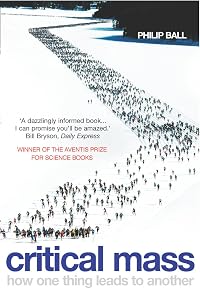
Critical Mass: How One Thing Leads to Another
by Philip Ball
On This Page
Description
"Critical mass asks the question, Why is society the way it is? How does it emerge from a morass of individual interactions? Are there laws of nature that guide human affairs? Is anything inevitable about the ways humans behave and organize themselves, or do we have complete freedom in creating our societies? In short, just how, in human affairs, does one thing lead to another?" "In searching for answers, the science writer Philip Ball argues that we can enlist help from a seemingly unlikely show more source: physics. The first person to think this way was the seventeenth-century English philosopher Thomas Hobbes. His approach, described in Leviathan, was based not on utopian wishful thinking, but rather on Galileo's mechanics; it was an attempt to construct a moral and political theory from scientific first principles. Although his solution - absolute monarchy - is unappealing today, Hobbes sparked a new way of thinking about human behavior in looking for the "scientific" rules of society. Adam Smith, Immanuel Kant, Auguste Comte, and John Stuart Mill pursued this same idea from different political perspectives."--Jacket. show lessTags
Recommendations



















Member Reviews
‘Critical Mass’ is another non-fiction book that I’ve been meaning to read for about a decade. In fact, I read the chapter on traffic behaviour in 2012 to see if it would be relevant to my PhD. It wasn't, not directly at least. Having finally read the whole thing, I think I'd have gained more from the experience in 2009. As it was, I found it rather odd and intermittently frustrating. The central thesis is broad and elastic in the extreme. Ball begins with a potted history of Western political philosophy, then leaps into physics under the broad umbrella of complexity theories. A central idea that repeatedly occurs is that of phase transition: how these occur in substances in water and also, seemingly, in human contexts like road show more traffic. Ball draws parallels between physical science and social science in a variety of contexts, bringing in a range of theories and methodologies that I’ve comes across or used in the past decade. In some sections he makes very sensible points; in others the content has dated considerably in the 15 years since publication; in others the analysis is reductive. Nonetheless, I found the whole thing readable enough and it does mention a great many topics that interest me: snowflake formation! Economic theory! Traffic behaviour! Utopian literature! Even the French Revolution gets name-checked, albeit in a simplistic fashion that got on my nerves (...it wasn't 'Robespierre's Terror'). On the other hand, in 2004 Ball called out derivatives as wrongly priced and high-risk due to misunderstanding of market fluctuations, which do not follow a Gaussian distribution. So kudos on predicting the financial crisis, there.
I struggled to understand the overall purpose of the book, as it covered so much ground and intersected with such a range of disciplines. Complexity is not, in itself, a specific topic. There is undoubtedly interesting material, however the whole reads now as trying to be a bit ahead of its time. Searching for physical laws in behavioural data is a mainstream idea with the advent of big data, however that data is controlled by the big tech companies and therefore largely inaccessible to researchers. Where it is used to understand behaviour by the firms that control it, the aim is profit maximisation rather than identification of behavioural laws. To generalise, machine learning with big data is a black box filled with layers of correlations. It can be used to make predictions about behaviour, but not to explain why behaviour occurs. And as Ball comments, making predictions about future fluctuations in a market then acting upon them changes the dynamic of the market, requiring further predictions to be made, etc. Oil markets are a classic example here. Fluctuations in the current price of oil occur in part due to changing expectations about the future price of oil. As he puts it, ‘The act of predicting the future (if it is taken at all seriously) is likely to change it’.
Ball certainly provides a good critique of oversimplified neoclassical economic models and Homo Economicus in chapter 9. He also explains power laws neatly in Chapter 10, which was helpful as I teach students about the 80:20 Pareto Rule in business contexts. On the other hand, chapter 14 is titled ‘The Colonisation of Culture’ yet discusses models of cultural spread that are completely ahistorical and ignore colonialism completely. Such models seem not just pointless but insulting. The assumption that a culture adopts a feature of an adjacent culture based on its similarity is a ridiculous way to look at history. In the 18th and 19th centuries, I don’t think Africa, Asia, and Oceania chose to adopt European features because of their similarity to existing cultures! Pretty sure they were aggressively conquered, their indigenous cultures suppressed, and their resources stolen. Models that assume social and cultural change always occurs ‘from the bottom up’ through the interaction of agents in grids do not seem remotely aligned with observable reality, any more than neoclassical economic models that treat technological and environmental change as exogenous (external to the economy). I remain to be convinced of the merits of agent-based modelling more generally, although I have colleagues working on it. While a complex nonlinear system can certainly emerge from a simple rules-based setup, I agree with Ball’s caveat that, ‘Some social scientists remain uneasy, suspecting that any particular agent-based model of a social phenomenon risks coming to conclusions that depend on the underlying assumptions. [...] Such models can hardly be expected to provide a sound basis for policy until we can distinguish what is contingent from what is robust.’ The current approach is to throw in as much data as possible, which can create further problems of data-cleaning, bias, and inaccurate measurement.
Another minor point that got up my nose concerned the tragedy of the commons. This concept is often stretched to infer that human being cannot manage natural resources communally without destroying them. This is obviously not the case, as in pre-capitalist times, and under capitalism in some places, doing so was and still is essential to survival. Equating common grazing land in Medieval Europe with 21st century overfishing is nonsensical. The difference is a powerful profit motive, which is not the immutable natural law that economists say it is. Managing land did not always mean exhausting it for short-term gain and the phrase 'tragedy of the commons' needs to be used with more specificity. George Monbiot has much more to say on this topic in [b:Out of the Wreckage: A New Politics in the Age of Crisis|32171783|Out of the Wreckage A New Politics in the Age of Crisis|George Monbiot|https://i.gr-assets.com/images/S/compressed.photo.goodreads.com/books/1498931739l/32171783._SX50_.jpg|52808178].
The chapters on the internet and social network analysis read in 2019 as endearingly dated. Apparently, ‘it was estimated at the end of 2002 that there were around 3 billion documents then available on the WWW’. Bless. It’s quite impressive that Ball manages to explain the principles of social network analysis (which I’ve come across because a PhD student I supervise is using it) without having social media to reference. Nowadays anyone can get a developer account on twitter, download a huge file of tweets, and use R or similar software to map the network their interconnections represent. At least they could last time I checked. So chapter 16 introduces the theory well, but the application is sadly out of date. I expect there’s plenty of more recent research comparing social media user networks with yeast metabolic networks. Presumably the increasing algorithmic meddling in social media feeds to encourage ‘engagement’ has a measurable impact on this, possibly even changing the nature of such networks. (Thankfully twitter can still be forced to stop this by selecting ‘Latest Tweets’.)
More intriguing was the application of game theory principles to the trenches of the First World War, although I’m wary of simplistic applications of game theory principles. This is nonetheless an interesting point:
The striking thing here is how unusual this situation is in history. The Western European battlelines of WWI hardly moved for years; both sides had very similar weapons and tactics; neither side was fighting in defense of a specific location, for ideology, or for survival. It was thus an even more pointless war than most, which might be what makes it more amenable to interpretation through game theory.
Chapters like this are interesting in isolation, however I remain doubtful of how well the whole book hangs together. If written 5 to 10 years later and infused with use of big data, it would be a lot more cohesive. However I do greatly respect Ball’s distrust of the deterministic social engineering that some of his examples could easily lead to:
Tell that to ‘smart city’ advocates. Remaining skeptical and ambivalent about the social implications of the material he presents is the only sensible choice, but one that then calls the structure of the book into question. Had ‘Critical Mass’ claimed the route to utopia is the application of physical laws to social problems, I would have rejected it out of hand. The book is more subtle than that, which makes it worth reading but does not prevent various flaws. Of the theories and examples Ball presents, though, some are manifestly more credible and useful than others. His initial discussion of the Enlightenment is thoughtful, albeit not original. The explanations of concepts from physics and maths are consistently clear and readable. I’d be wary of recommending it, as certain parts have aged badly and the whole is less relevant 15 years later. I also don’t think it needed to be quite so long. show less
I struggled to understand the overall purpose of the book, as it covered so much ground and intersected with such a range of disciplines. Complexity is not, in itself, a specific topic. There is undoubtedly interesting material, however the whole reads now as trying to be a bit ahead of its time. Searching for physical laws in behavioural data is a mainstream idea with the advent of big data, however that data is controlled by the big tech companies and therefore largely inaccessible to researchers. Where it is used to understand behaviour by the firms that control it, the aim is profit maximisation rather than identification of behavioural laws. To generalise, machine learning with big data is a black box filled with layers of correlations. It can be used to make predictions about behaviour, but not to explain why behaviour occurs. And as Ball comments, making predictions about future fluctuations in a market then acting upon them changes the dynamic of the market, requiring further predictions to be made, etc. Oil markets are a classic example here. Fluctuations in the current price of oil occur in part due to changing expectations about the future price of oil. As he puts it, ‘The act of predicting the future (if it is taken at all seriously) is likely to change it’.
Ball certainly provides a good critique of oversimplified neoclassical economic models and Homo Economicus in chapter 9. He also explains power laws neatly in Chapter 10, which was helpful as I teach students about the 80:20 Pareto Rule in business contexts. On the other hand, chapter 14 is titled ‘The Colonisation of Culture’ yet discusses models of cultural spread that are completely ahistorical and ignore colonialism completely. Such models seem not just pointless but insulting. The assumption that a culture adopts a feature of an adjacent culture based on its similarity is a ridiculous way to look at history. In the 18th and 19th centuries, I don’t think Africa, Asia, and Oceania chose to adopt European features because of their similarity to existing cultures! Pretty sure they were aggressively conquered, their indigenous cultures suppressed, and their resources stolen. Models that assume social and cultural change always occurs ‘from the bottom up’ through the interaction of agents in grids do not seem remotely aligned with observable reality, any more than neoclassical economic models that treat technological and environmental change as exogenous (external to the economy). I remain to be convinced of the merits of agent-based modelling more generally, although I have colleagues working on it. While a complex nonlinear system can certainly emerge from a simple rules-based setup, I agree with Ball’s caveat that, ‘Some social scientists remain uneasy, suspecting that any particular agent-based model of a social phenomenon risks coming to conclusions that depend on the underlying assumptions. [...] Such models can hardly be expected to provide a sound basis for policy until we can distinguish what is contingent from what is robust.’ The current approach is to throw in as much data as possible, which can create further problems of data-cleaning, bias, and inaccurate measurement.
Another minor point that got up my nose concerned the tragedy of the commons. This concept is often stretched to infer that human being cannot manage natural resources communally without destroying them. This is obviously not the case, as in pre-capitalist times, and under capitalism in some places, doing so was and still is essential to survival. Equating common grazing land in Medieval Europe with 21st century overfishing is nonsensical. The difference is a powerful profit motive, which is not the immutable natural law that economists say it is. Managing land did not always mean exhausting it for short-term gain and the phrase 'tragedy of the commons' needs to be used with more specificity. George Monbiot has much more to say on this topic in [b:Out of the Wreckage: A New Politics in the Age of Crisis|32171783|Out of the Wreckage A New Politics in the Age of Crisis|George Monbiot|https://i.gr-assets.com/images/S/compressed.photo.goodreads.com/books/1498931739l/32171783._SX50_.jpg|52808178].
The chapters on the internet and social network analysis read in 2019 as endearingly dated. Apparently, ‘it was estimated at the end of 2002 that there were around 3 billion documents then available on the WWW’. Bless. It’s quite impressive that Ball manages to explain the principles of social network analysis (which I’ve come across because a PhD student I supervise is using it) without having social media to reference. Nowadays anyone can get a developer account on twitter, download a huge file of tweets, and use R or similar software to map the network their interconnections represent. At least they could last time I checked. So chapter 16 introduces the theory well, but the application is sadly out of date. I expect there’s plenty of more recent research comparing social media user networks with yeast metabolic networks. Presumably the increasing algorithmic meddling in social media feeds to encourage ‘engagement’ has a measurable impact on this, possibly even changing the nature of such networks. (Thankfully twitter can still be forced to stop this by selecting ‘Latest Tweets’.)
More intriguing was the application of game theory principles to the trenches of the First World War, although I’m wary of simplistic applications of game theory principles. This is nonetheless an interesting point:
So the choice was simple. Either you fought each other constantly, bombarding the enemy trenches with artillery fire and deploying snipers to pick off anyone foolish enough to put their head above the parapet - while enduring the same treatment from the other side. Or you held fire on the tacit understanding that the enemy would do the same - and meanwhile you hoped to be relieved from the front before the next push came. In the one case you endured fear of sudden death at any moment; in the other you had a quiet life and some hope of going home at the end of it. [...] The fighting was, in other words, conducted on a tit-for-tat basis. Such exchanges are a lethal form of communication: they say, “We will do as we are done by.” This is at the same time both a threat and an olive branch, for it also implies that non-aggression will be greeted with the same.
The striking thing here is how unusual this situation is in history. The Western European battlelines of WWI hardly moved for years; both sides had very similar weapons and tactics; neither side was fighting in defense of a specific location, for ideology, or for survival. It was thus an even more pointless war than most, which might be what makes it more amenable to interpretation through game theory.
Chapters like this are interesting in isolation, however I remain doubtful of how well the whole book hangs together. If written 5 to 10 years later and infused with use of big data, it would be a lot more cohesive. However I do greatly respect Ball’s distrust of the deterministic social engineering that some of his examples could easily lead to:
The notion that we could ever construct a scientific ‘utopia theory’ is, then, doomed to absurdity. Certainly, a ‘physics of society’ can provide nothing of the sort. One does not build an ideal world from scientifically based traffic planning, market analysis, criminology, network design, game theory, and the gamut of other ideas discussed in this book.
Tell that to ‘smart city’ advocates. Remaining skeptical and ambivalent about the social implications of the material he presents is the only sensible choice, but one that then calls the structure of the book into question. Had ‘Critical Mass’ claimed the route to utopia is the application of physical laws to social problems, I would have rejected it out of hand. The book is more subtle than that, which makes it worth reading but does not prevent various flaws. Of the theories and examples Ball presents, though, some are manifestly more credible and useful than others. His initial discussion of the Enlightenment is thoughtful, albeit not original. The explanations of concepts from physics and maths are consistently clear and readable. I’d be wary of recommending it, as certain parts have aged badly and the whole is less relevant 15 years later. I also don’t think it needed to be quite so long. show less
Why is society organized the way it is? Is it possible to use some of the laws of the physical universe to understand why and how national economies, stock and commodity markets, companies and clubs organize the way they do? Can physics provides "laws" of human nature that are as useful and universal as those of mechanics? Does the critical point in a phase diagram have analogies in human behavior? Veteran science writer and physicist/chemist Philip Ball writes very well, as evidenced by Elegant Solutions, which was one of my picks last year. He also thinks very well, as evidenced by this creative application to sociology of concepts familiar to physicists and chemists. Of course, social scientists have always tried to be as show more "scientific" as possible, using mathematical models, statistical analysis and, more recently, computer simulations to understand the human situation and to predict its future. Critical Mass uses a different approach: using whole concepts in physics for insight into economics, urban planning, and the self-organization of human networks. This is a very original and thought-provoking book; it has been recognized with the 2005 Aventis Prize for Science Books, bestowed annually by the Royal Society for Chemistry. show less
This book asks whether there are underlying natural laws that govern the endeavours of humans in the same way that natural laws govern processes in nature, such as the growth of snow crystals, phase shifts between liquid and gas, and the way in which metal changes from being magnetised to non-magnetised when heated. To help him address this question Ball introduces tools commonly used in the physical sciences to analyse and simulate natural processes.
In the initial chapters the author describes the history of social science, economics and statistics. He tells how tools of the state, statistics, were adopted in the physical sciences. Then ball looks at processes in human society such as the formation of traffic jams, the pattern of show more movement in a crowd trying to escape a burning building, the growth pattern of cities, Internet morphology and what it owes to The Cold War years. In all these areas he demonstrates common traits that can be used to analyse and understand the processes in operation.
Ball describes the application of these tools in the natural sciences and then reports on how they have been used in the analysis of human behaviour and such things as the movement of share prices in the stock market.
It is Ball’s contention that there are fundamental patterns that describe many behaviours and trends in human endeavour, from the voting patterns in elections, through the distribution of wealth in nations, to the boom and bust nature of the world’s economies, and that understanding of these fundamentals will improve decision making and planning.
He also reports on simulations carried out to assess the effectiveness and otherwise of different forms of government, i.e. dictatorship, democracy, etc… This is most enlightening and interesting.
While he claims these tools can help us describe process behaviour and help us, he warns against the idea that they can necessarily be used to predict behaviour.
The above paragraphs do scant justice to this book. It is the first non-fiction book I have read in a long time that I was loath to put down. It is vast in scope and presents information at a level that the majority of readers will find accessible. This is a thought provoking book that I will be returning to time and again. show less
In the initial chapters the author describes the history of social science, economics and statistics. He tells how tools of the state, statistics, were adopted in the physical sciences. Then ball looks at processes in human society such as the formation of traffic jams, the pattern of show more movement in a crowd trying to escape a burning building, the growth pattern of cities, Internet morphology and what it owes to The Cold War years. In all these areas he demonstrates common traits that can be used to analyse and understand the processes in operation.
Ball describes the application of these tools in the natural sciences and then reports on how they have been used in the analysis of human behaviour and such things as the movement of share prices in the stock market.
It is Ball’s contention that there are fundamental patterns that describe many behaviours and trends in human endeavour, from the voting patterns in elections, through the distribution of wealth in nations, to the boom and bust nature of the world’s economies, and that understanding of these fundamentals will improve decision making and planning.
He also reports on simulations carried out to assess the effectiveness and otherwise of different forms of government, i.e. dictatorship, democracy, etc… This is most enlightening and interesting.
While he claims these tools can help us describe process behaviour and help us, he warns against the idea that they can necessarily be used to predict behaviour.
The above paragraphs do scant justice to this book. It is the first non-fiction book I have read in a long time that I was loath to put down. It is vast in scope and presents information at a level that the majority of readers will find accessible. This is a thought provoking book that I will be returning to time and again. show less
This is a super book.
Philip Ball, a self-confessed liberal - more on that later - is first and foremost a scientist (a former staffer on Nature magazine), and his brief here is to canvas the application of statistical scientific explanations of physical phenomena, such as phase transitions in liquids and solids, by analogy to human behaviour.
This is a splendid enterprise, not just because it is a very imaginative application of established knowledge to novel fields of enquiry, which to my mind is always a worthwhile endeavour (whether or not the results are useful, we're better off if someone has done the intellectual exercise than if they haven't), but also because it grasps a fundamental point which social scientists almost always show more miss: It is what a population will *actually* do which matters, not what it *ought* to do, or what *we'd like it* to do.
Politics is the pursuit these latter questions, and it is almost always pursued in ignorance of scientific data describing the former, and a central point of Ball's book is that this is a dreadful shame. And so it is.
A complaint one sees levied against Ball's book is that it misses the critical distinction between physical particles - which are all identical, except for a few key easily measured properties - and humans who, in almost every respect, are entirely different from each other. But this misses the point: the very beauty of statistical physics is that you can draw inferences about how a large mass of particles behave without knowing or measuring *anything* about the behaviour (vector, spin, magnetism, whatever) of any given particle. And so it is with people: Ball's argument is to say, on the basis of the statistical evidence, from the markets, from patterns on university lawns, from trajectories of individuals navigating a corridor: we can make inferences about what a group of people will do knowing nothing about their individual motives, in the same way we can about particles without knowing their vector or spin. At that level, people are *not* significantly different: people *do* behave like particles. Therefore these fundamental differences between people, which may be real (but may be not - for all we know, these "special qualities" we cherish may be a product of human chauvinism) are not material to how we behave en masse.
As Ball moves on, his subject resolves slowly to focus on social interaction within a society, and the interesting work on game theory and iterated prisoner's dilemma by Axelrod and others, all of which tend to suggest, in spite of centuries of supposition to the contrary, that if left to their own devices and allowed to act selfishly, folks will tend to get on with each other - in life, co-operative strategies will tend to be more successful than uncooperative ones, so people naturally inclined to cooperate will tend to flourish. This is contra Marx, Hobbes and so forth, but stands to reason when you think about it: if this principle were not true at the most fundamental evolutionary level, it is hard to see how we would be here to argue about it.
Despite that, Ball's liberalism does show through, and in odd ways, in a couple of places. One result suggested by research is that many distributions in society - sizes of incomes, cities, businesses and so on) will tend to be arranged according to a power law, rather than a normal distribution (that is, there will be a large number with a broadly similar size, and a very few with a very much larger size). Traditional social-liberal orthodoxy is that this is a bad thing, and by implication Ball thinks so:
"This is not to say that power law disparities in the free market are inevitable. But it does suggest that, if we decide they are undesirable, we shall probably need to restrict some of the freedom with which the market operates."
Unobjectionable, centrist sentiment you might say. But hold on: a free market assumes the free participation of everyone in the market (otherwise, it wouldn't be a free market). Now, if that market arranges itself according to a power law, then must that not be precisely what "we" - the participants in the market - have decided, by our very own actions, *is* desirable? We have, all by our own actions, unwittingly colluded to make one city very big, or one company very rich - if that is truly not want we want, we can move, or we can buy a different product. By Ball's own argument, there is no better indication of what "we" decide is what we want. As soon as someone starts talking about what "we" want, overriding the judgment of the market (which, statistically, describes how we collectively behave without needing to measure individual vectors, spins or magnetisms, remember) it seems to me we are in very dangerous territory.
Ball, I think, realises this and never dares more than a wistful look in this direction. In any case, it is certainly not enough to deprive this book of five stars: a thoroughly enjoyable and enlightening read. show less
Philip Ball, a self-confessed liberal - more on that later - is first and foremost a scientist (a former staffer on Nature magazine), and his brief here is to canvas the application of statistical scientific explanations of physical phenomena, such as phase transitions in liquids and solids, by analogy to human behaviour.
This is a splendid enterprise, not just because it is a very imaginative application of established knowledge to novel fields of enquiry, which to my mind is always a worthwhile endeavour (whether or not the results are useful, we're better off if someone has done the intellectual exercise than if they haven't), but also because it grasps a fundamental point which social scientists almost always show more miss: It is what a population will *actually* do which matters, not what it *ought* to do, or what *we'd like it* to do.
Politics is the pursuit these latter questions, and it is almost always pursued in ignorance of scientific data describing the former, and a central point of Ball's book is that this is a dreadful shame. And so it is.
A complaint one sees levied against Ball's book is that it misses the critical distinction between physical particles - which are all identical, except for a few key easily measured properties - and humans who, in almost every respect, are entirely different from each other. But this misses the point: the very beauty of statistical physics is that you can draw inferences about how a large mass of particles behave without knowing or measuring *anything* about the behaviour (vector, spin, magnetism, whatever) of any given particle. And so it is with people: Ball's argument is to say, on the basis of the statistical evidence, from the markets, from patterns on university lawns, from trajectories of individuals navigating a corridor: we can make inferences about what a group of people will do knowing nothing about their individual motives, in the same way we can about particles without knowing their vector or spin. At that level, people are *not* significantly different: people *do* behave like particles. Therefore these fundamental differences between people, which may be real (but may be not - for all we know, these "special qualities" we cherish may be a product of human chauvinism) are not material to how we behave en masse.
As Ball moves on, his subject resolves slowly to focus on social interaction within a society, and the interesting work on game theory and iterated prisoner's dilemma by Axelrod and others, all of which tend to suggest, in spite of centuries of supposition to the contrary, that if left to their own devices and allowed to act selfishly, folks will tend to get on with each other - in life, co-operative strategies will tend to be more successful than uncooperative ones, so people naturally inclined to cooperate will tend to flourish. This is contra Marx, Hobbes and so forth, but stands to reason when you think about it: if this principle were not true at the most fundamental evolutionary level, it is hard to see how we would be here to argue about it.
Despite that, Ball's liberalism does show through, and in odd ways, in a couple of places. One result suggested by research is that many distributions in society - sizes of incomes, cities, businesses and so on) will tend to be arranged according to a power law, rather than a normal distribution (that is, there will be a large number with a broadly similar size, and a very few with a very much larger size). Traditional social-liberal orthodoxy is that this is a bad thing, and by implication Ball thinks so:
"This is not to say that power law disparities in the free market are inevitable. But it does suggest that, if we decide they are undesirable, we shall probably need to restrict some of the freedom with which the market operates."
Unobjectionable, centrist sentiment you might say. But hold on: a free market assumes the free participation of everyone in the market (otherwise, it wouldn't be a free market). Now, if that market arranges itself according to a power law, then must that not be precisely what "we" - the participants in the market - have decided, by our very own actions, *is* desirable? We have, all by our own actions, unwittingly colluded to make one city very big, or one company very rich - if that is truly not want we want, we can move, or we can buy a different product. By Ball's own argument, there is no better indication of what "we" decide is what we want. As soon as someone starts talking about what "we" want, overriding the judgment of the market (which, statistically, describes how we collectively behave without needing to measure individual vectors, spins or magnetisms, remember) it seems to me we are in very dangerous territory.
Ball, I think, realises this and never dares more than a wistful look in this direction. In any case, it is certainly not enough to deprive this book of five stars: a thoroughly enjoyable and enlightening read. show less
As a student (not a very good one, arguably :) of social sciences, I've been more than a little disturbed by what I've seen as trying to "prescribe" how people "must" behave using statistical inferences. This book finally made me understand that social science has nothing to do with prescription, or even with figuring out what is going on in individual human minds. Rather, there are two questions: a) How people tend to behave in certain circumstances b) If they behave that way, what happens.
Also, it sparked my interest in using models to study behaviour.
The last, but not the least, it is quite easy and entertaining to read - popular science at it's finest.
Also, it sparked my interest in using models to study behaviour.
The last, but not the least, it is quite easy and entertaining to read - popular science at it's finest.
a very well written introduction to a few important ideas from physics that have been used to model and explain facts in the social sciences. I liked the author's pedagogical insistence on certain themes. for example, I had never understood that phase transitions can be seen as the signature of processes where a lot of items almost simultaneously interact with their neighbors and so transitively with one another. similarly for power law distributions. the second part of the book (the internet and its patterns of connectivity) veers into territory that is very extensively covered by a large number of very good recent books and so I found it somehow less interesting/informative.
Excellent book if you're looking to explore the theoretical underpinnings of living in the world. Very engaging - think of "Freakonomics" on steroids. A good science background in the reader leads to lots of 'a-ha' moments.
Members
- Recently Added By
Author Information

41+ Works 6,147 Members
Philip Ball is a freelance writer who lives in London. He worked for over twenty years as an editor for Nature, writes regularly in the scientific and popular media, and has authored many books on the interactions of the sciences, the arts, and the wider culture, including, most recently, Serving the Reich: The Struggle for the Soul of Physics show more under Hitler, also published by the University of Chicago Press. show less
Awards and Honors
Awards
Notable Lists
Common Knowledge
- Canonical title
- Critical Mass: How One Thing Leads to Another
Classifications
Statistics
- Members
- 1,166
- Popularity
- 21,451
- Reviews
- 15
- Rating
- (3.68)
- Languages
- 5 — English, Polish, Portuguese, Russian, Spanish
- Media
- Paper, Ebook
- ISBNs
- 12
- ASINs
- 7