Summa of the Summa
by Thomas Aquinas
On This Page
Description
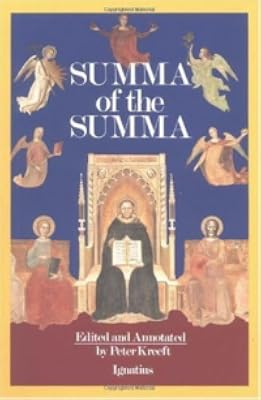
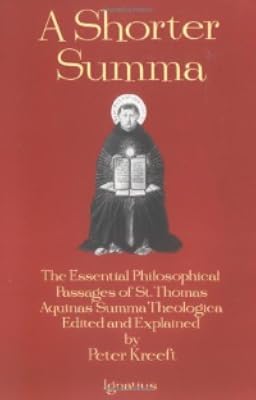
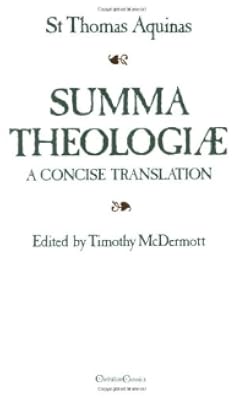
Saint Thomas Aquinas is universally recognized as one of the greatest philosophers who ever lived. His writings combine the two fundamental ideals of philosophical writing: clarity and profundity. He is a master of metaphysics and technical terminology, yet so full of both theoretical and practical wisdom. He is the master of common sense. His major work, the Summa Theologica, is timeless, but particularly important today because of his synthesis of faith and reason, revelation and show more philosophy, and the Biblical and the classical Greco-Roman heritages. This unique book combines selected essential philosophical passages from Thomas' Summa with footnotes and explanations by Kreeft, a popular Thomist teacher and writer. Kreeft selected those passages from Thomas that are intrinsically important, non-technical enough to be intelligible to modern readers, and most likely to be used in a class or by independent readers who want to study the Summa on their own. Kreeft's detailed footnotes explain difficult or technical passages and call attention to points of particular significance for the modern reader. This book is the most intelligent, clear, and useful access to Saint Thomas in print. Includes a glossary and an index. - Publisher. show lessTags
Recommendations



Member Reviews
I think Peter Kreeft is my go-to guy for dumbed down philosophy. I thoroughly enjoyed his condensed version of Blaise Pascal's Pensées and now I relied heavily on his footnotes to make sense of Thomas Aquinas' Summa Theologica. Well, this edited version of the Summa. It was difficult reading because a) Aquinas is so much smarter than I, and b) the Summa is, in one sense, a reference book. For both of those same reasons, I'm putting this book on my shelf. It provides a myriad of thoughts to ponder.
--J.
--J.
A shortened version of Kreeft's much larger Summa of the Summa, which in turn was a shortened version of the Summa Theologica. TheSumma is certainly the greatest, most ambitious, most rational book of theology ever written. In it, there is also much philosophy, which is selected, excerpted, arranged, introduced, and explained in footnotes here by Kreeft, a popular Thomist teacher and writer.
Selections of Aquinas with commentary.
Ratings
Members
- Recently Added By
Lists

Recommendations by Peter Kreeft
45 works; 4 members
Author Information

2,194+ Works 27,848 Members
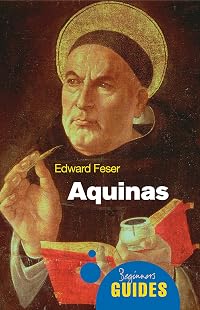
Thomas Aquinas, the most noted philosopher of the Middle Ages, was born near Naples, Italy, to the Count of Aquino and Theodora of Naples. As a young man he determined, in spite of family opposition to enter the new Order of Saint Dominic. He did so in 1244. Thomas Aquinas was a fairly radical Aristotelian. He rejected any form of special show more illumination from God in ordinary intellectual knowledge. He stated that the soul is the form of the body, the body having no form independent of that provided by the soul itself. He held that the intellect was sufficient to abstract the form of a natural object from its sensory representations and thus the intellect was sufficient in itself for natural knowledge without God's special illumination. He rejected the Averroist notion that natural reason might lead individuals correctly to conclusions that would turn out false when one takes revealed doctrine into account. Aquinas wrote more than sixty important works. The Summa Theologica is considered his greatest work. It is the doctrinal foundation for all teachings of the Roman Catholic Church. show less
All Editions
Work Relationships
Is an abridged version of
Common Knowledge
- Canonical title
- Summa of the Summa
- People/Characters
- Thomas Aquinas
- Important events
- Middle Ages; 13th century
- First words
- St. Thomas Aquinas is certainly one of the greatest philosophers who ever lived, (to my mind, he is *the* greatest), for at least eight reasons: truth, common sense, practicality, clarity, profundity, orthodoxy, medievalism, ... (show all)and modernity.
- Canonical DDC/MDS
- 230.2
- Canonical LCC
- BX1749 .T515 1990
Classifications
- Genres
- Religion & Spirituality, Nonfiction, Philosophy, General Nonfiction
- DDC/MDS
- 230.2 — Religion Christianity Christianity Pre-reformation and Roman Catholic
- LCC
- BX1749 .T515 — Philosophy, Psychology and Religion Christian Denominations Christian Denominations Catholic Church Theology. Doctrine. Dogmatics
- BISAC
Statistics
- Members
- 813
- Popularity
- 33,930
- Reviews
- 3
- Rating
- (4.07)
- Languages
- English
- Media
- Paper, Ebook
- ISBNs
- 3
- UPCs
- 1
- ASINs
- 2