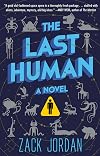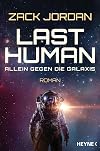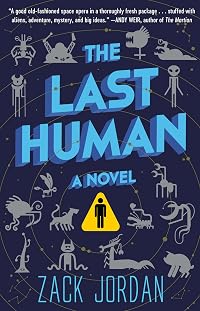
The Last Human: A Novel
by Zack Jordan
On This Page
Description
"Most days, Sarya doesn't feel like the most terrifying creature in the galaxy. Most days, she's got other things on her mind. Like hiding her identity among the hundreds of alien species roaming the corridors of Watertower Station. Or making sure her adoptive mother doesn't casually eviscerate one of their neighbors. Again. And most days, she can almost accept that she'll never know the truth--that she'll never know why humanity was deemed too dangerous to exist. Or whether she really show more is--impossibly--the lone survivor of a species destroyed a millennium ago. That is, until an encounter with a bounty hunter and a miles-long kinetic projectile leaves her life and her perspective shattered. Thrown into the universe at the helm of a stolen ship--with the dubious assistance of a rebellious spacesuit, an android death enthusiast on his sixtieth lifetime, and a ball of fluff with an IQ in the thousands--Sarya begins to uncover an impossible truth. What if humanity's death and her own existence are simply two moves in a demented cosmic game, one played out by vast alien intellects? Stranger still, what if these mad gods are offering Sarya a seat at their table--and a second chance for humanity?"-- show lessTags
Recommendations





Member Reviews
I was immediately hooked on the concept of an enormous galaxy-wide Network of aliens living and cooperating ... but fearing one species above all else: Humans. You know... because we break things. Get all tribal and s**t. We like to exploit weaknesses in others and lord over their spoils because we're a**holes.
Turns out, our main character is the last of this dastardly breed, growing up small in a huge network of Dyson Spheres with countless old alien species categorized in a hierarchy based on Tiered Intelligence.
Most of the book is rather fun and filled with all the normal Coming of Age stuff of discovery and adventure and breaking out of the rigid hierarchy while trying to get a grip on BEING the big bad that everyone is shivering in show more their boots about. A little girl should never have to be such a horrible monster. ; ;
I really enjoyed this book, but I'll be perfectly honest, I didn't LOVE it until the last third came rolling around. The whole Tiered Intelligence bit made it a real joy to read. What does it really mean? Networking, of course. Many, many collections of minds within other collections of minds. The more minds, the higher the Tier. When we get to the top Tier, we're dealing with the mind that can CREATE a full network of Dyson Spheres... and much more.
So what's the real story about? What is this little last human's fate?
NOT TELLING! Muahahahahahahaha... but it's awesome. Really awesome. :)
I loved the whole thing about game theory, biological emulation, and hawks vs doves. :) show less
Turns out, our main character is the last of this dastardly breed, growing up small in a huge network of Dyson Spheres with countless old alien species categorized in a hierarchy based on Tiered Intelligence.
Most of the book is rather fun and filled with all the normal Coming of Age stuff of discovery and adventure and breaking out of the rigid hierarchy while trying to get a grip on BEING the big bad that everyone is shivering in show more their boots about. A little girl should never have to be such a horrible monster. ; ;
I really enjoyed this book, but I'll be perfectly honest, I didn't LOVE it until the last third came rolling around. The whole Tiered Intelligence bit made it a real joy to read. What does it really mean? Networking, of course. Many, many collections of minds within other collections of minds. The more minds, the higher the Tier. When we get to the top Tier, we're dealing with the mind that can CREATE a full network of Dyson Spheres... and much more.
So what's the real story about? What is this little last human's fate?
NOT TELLING! Muahahahahahahaha... but it's awesome. Really awesome. :)
I loved the whole thing about game theory, biological emulation, and hawks vs doves. :) show less
This was a very definite five star read. It was a very cheap purchase and I had pretty low expectations, but this had me gripped from start to finish. Considering that the last science fiction novel I read was the execrable Seveneves (as reviewed in LO!11), this was a wonderful, crazy, no holds barred, breath of fresh air. Sarya is the last surviving human in a galaxy populated by an interactive community comprising millions of intelligent species and associated artificial intelligences. The Network allows for faster than light travel between solar systems and transfer of information and data. Humans have been eradicated from the galaxy as the species proved too dangerous and waged war on the other civilisations. Sarya has only survived show more as she has been adopted and given a fake registration as a member of a vicious hunting species called the Widows, who played a key role in the removal of humanity. When her human identity is accidentally revealed, her home is destroyed by a bounty hunter, plunging Sarya into a desperate journey across the galaxy, manipulated by higher intelligences, hell bent on a heady mixture of human-Widow revenge and keen to restore the reputation and future of the human species. This book was tremendous fun, incredibly imaginative and was very much in the vein of the best of Iain M Banks Culture novels, without being a direct rip off. I think this is a first novel for Jordan who the publisher states "is a compulsive learner and creator. He holds half an art degree, two thirds of a music degree, and about a quarter of a philosophy degree." show less
I finished The Last Human, Zack Jordan’s debut novel and had to stop to wonder what the hell it was I just read. What started out as a clever, interesting story about what appears to be the last human in the universe and her relatively miserable existence devolves into an utter mess with twist after twist meant to prove certain characters’ superior intelligence over everyone/thing else. It gets into some weird shit, folks.
I hate when good books go bad like this. I mean, Sarya’s adopted mother is some sort of gigantic, evolved black widow spider, and I LIKED that character. This is me – someone who could barely get past any scene with Aragog in the Harry Potter books and still cannot watch those scenes in the movies, and I show more believe Senya the Widow is one of the book’s strongest and most enjoyable characters. Such promise!
The problem lies in the fact that in Mr. Jordan’s universe, each species has an intelligence level assigned to it. Most creatures hover around tier two. Tier threes are rare, and tier fours are almost nonexistent, but they exist. Mr. Jordan tries to play with these intelligence levels by showing how a rare tier three creature manipulates the lower tiers with ease – because they think of cause and effect and plan things so much farther in advance. Then we meet not one but two tier fours, and the story essentially dies. From what I can understand, the tier fours spent hundreds of thousands of years plotting and planning against each other, using Sarya as their conduit in order to control the universe. Basically, no one has free will because someone or something else already plotted out their life for them. No, thank you.
What makes it worse is that Mr. Jordan uses descriptors that make no sense given his world. In a novel where there are multiple universes, billions of species, and the technology that makes faster than light travel possible, to have Sarya compare something to cancer eating cells is mystifying. One would imagine that there is no such thing as cancer, or any illness, given the technology that allows all species to cohabitate on space centers together. And yet, she compares something to a body riddled with cancer, and that is just one example.
I admire what Mr. Jordan attempts to do in The Last Human. It really does start out so well. The opening chapter with Sarya and her mother had me stifling my laughter so that I didn’t wake up my husband (I started reading it around midnight). Unfortunately, the story becomes a victim of its own cleverness. In attempting to create characters that are 144 times more intelligent than humans, Mr. Jordan loses the plot. Making things worse, his world-building is extremely weak, and he forgets things like science that would help readers understand his world a little more. Instead, we are thrust into Sarya’s world with no clear picture of what that world is. There is no doubt that The Last Human is an ambitious debut. Sadly, it is not a good one. show less
I hate when good books go bad like this. I mean, Sarya’s adopted mother is some sort of gigantic, evolved black widow spider, and I LIKED that character. This is me – someone who could barely get past any scene with Aragog in the Harry Potter books and still cannot watch those scenes in the movies, and I show more believe Senya the Widow is one of the book’s strongest and most enjoyable characters. Such promise!
The problem lies in the fact that in Mr. Jordan’s universe, each species has an intelligence level assigned to it. Most creatures hover around tier two. Tier threes are rare, and tier fours are almost nonexistent, but they exist. Mr. Jordan tries to play with these intelligence levels by showing how a rare tier three creature manipulates the lower tiers with ease – because they think of cause and effect and plan things so much farther in advance. Then we meet not one but two tier fours, and the story essentially dies. From what I can understand, the tier fours spent hundreds of thousands of years plotting and planning against each other, using Sarya as their conduit in order to control the universe. Basically, no one has free will because someone or something else already plotted out their life for them. No, thank you.
What makes it worse is that Mr. Jordan uses descriptors that make no sense given his world. In a novel where there are multiple universes, billions of species, and the technology that makes faster than light travel possible, to have Sarya compare something to cancer eating cells is mystifying. One would imagine that there is no such thing as cancer, or any illness, given the technology that allows all species to cohabitate on space centers together. And yet, she compares something to a body riddled with cancer, and that is just one example.
I admire what Mr. Jordan attempts to do in The Last Human. It really does start out so well. The opening chapter with Sarya and her mother had me stifling my laughter so that I didn’t wake up my husband (I started reading it around midnight). Unfortunately, the story becomes a victim of its own cleverness. In attempting to create characters that are 144 times more intelligent than humans, Mr. Jordan loses the plot. Making things worse, his world-building is extremely weak, and he forgets things like science that would help readers understand his world a little more. Instead, we are thrust into Sarya’s world with no clear picture of what that world is. There is no doubt that The Last Human is an ambitious debut. Sadly, it is not a good one. show less
I received this book through NetGalley.
This refreshingly-original science fiction novel follows a teenage girl, the only human known to exist. She’s been raised by Widow, a spider-like entity from a matriarchal society with a passion for murder. The first chapters hooked me right away with the odd juxtaposition of personalities: the very alien Widow, who has come to love this confounding, revolting human, who is very much a teenage girl who wants to fit in with the myriad of alien species on station, but can’t. She cannot have access to the god-like Network as they do, or even let it be known that she’s human. She’s livening under the identity of another species because humans are known to be scary and extinct.
She lives in show more anonymity until her school field trip is interrupted by the arrival of a higher intelligence that not only knows what she is, but presents the ultimate temptation: want to meet other humans?
Everything goes wrong from there, of course. This is a book loaded with action and revelations. Sometimes it goes a bit too mind-bendy and the bad guys are a bit too willing to explain in a handy monologue, but the novel held my interest all the way through. Really, it’s a fun romp through space, with a lot of innovative new spins on old tropes. show less
This refreshingly-original science fiction novel follows a teenage girl, the only human known to exist. She’s been raised by Widow, a spider-like entity from a matriarchal society with a passion for murder. The first chapters hooked me right away with the odd juxtaposition of personalities: the very alien Widow, who has come to love this confounding, revolting human, who is very much a teenage girl who wants to fit in with the myriad of alien species on station, but can’t. She cannot have access to the god-like Network as they do, or even let it be known that she’s human. She’s livening under the identity of another species because humans are known to be scary and extinct.
She lives in show more anonymity until her school field trip is interrupted by the arrival of a higher intelligence that not only knows what she is, but presents the ultimate temptation: want to meet other humans?
Everything goes wrong from there, of course. This is a book loaded with action and revelations. Sometimes it goes a bit too mind-bendy and the bad guys are a bit too willing to explain in a handy monologue, but the novel held my interest all the way through. Really, it’s a fun romp through space, with a lot of innovative new spins on old tropes. show less
The Last Human is an intriguing sci-fi debut that has a serious case of over-reach. When I began it, I knew nothing except the blurb and that it knocked my friend Geoff’s mind sideways, and I looked forward to the experience. I would agree in that the first third was riveting, the second third interesting, although completely different, and the remaining section a bit too esoteric for my tastes.
One of the initial catchy concepts is the interplay of adopted culture between Shenya the Widow, “a void-cold killer,” and Sarya, the Daughter. The opening scene of Sarya essentially throwing a temper tantrum before a tour is perfection, conveying the species differences, introducing the reader to the pervasive Network, and anchoring it in show more very familiar emotion.
“Her daughter glares at the floor without answering. Shenya the Widow narrowly restrains a click of approval. On the one blade, this is a Widow rage–a towering and explosive wrath–and it is beautiful. One spends so much energy attempting to install traditional values in a young and coalescing mind, and it is always rewarding to see effort yield results. But on another blade, well… insolence is insolence, is it not?”
As the book progresses, Sarya becomes obsessed with finding the last members of Humanity, and takes a number of twists in that journey. I would say philosophically, it remains the journey of a young/new adult person; a quest that is understood only in terms that are limited by learning and experience.
The book is divided into five ‘tiers,’ each following a different development in her journey. However, the idea of the tier designation paralleling her personal growth doesn’t fit well, and it feels contrived to forcing a philosophical plot. To elaborate without spoilers, tiers are supposed to be tied to intelligence, though there isn’t always great consensus on what ‘intelligence’ is. For the story purpose, “just remember that each tier multiplies the previous by twelve. For example, a two is approximately twelve times as intelligent as a one, a three is one hundred-forty-times as a one, and so on.” Tiers are divided into 1 to 6, tier one being baseline ‘pre-culture sentient beings’ that are above wildlife but not citizens, and sixth tier being a semi-theoretical possibility. So Sarya’s growth/challenges in each section sort of follow the tier rankings, but only awkwardly, and at the expense of coherence in plot.
The first three tiers were amazing: I was astounded at the world-building, at the dark culture clash between Human and Widow, and at the ragtag crew escaping the Watchtower station. However, as the story segued into Tier Four, it veered out of control and felt like a different story altogether, one I was much less interested in. Side characters were abandoned. Concrete plot became about metaphysical debates. I found Sarya's entrance into the great debate of freedom somewhat simplistic, especially when she reached 'Tier 5,' and realized she may have been a pawn of the Network all along. I appreciate that Jordan was trying to raise meta issues on agency and cooperation, but it was all so forced and simplistic. Truly, at the level of a young person.
It’s an amazing debut, but might be too inconsistent a story to find a fan niche. On the other hand, the big sci-fi greats do it all the time, so why shouldn’t Jordan? It might very well appeal to fans of Stephenson and Reynolds. Five stars for the beginning, two for the last third; we’ll average it out to three stars.
My thanks to Netgalley and Random House-Ballantine for an advance reader copy. show less
One of the initial catchy concepts is the interplay of adopted culture between Shenya the Widow, “a void-cold killer,” and Sarya, the Daughter. The opening scene of Sarya essentially throwing a temper tantrum before a tour is perfection, conveying the species differences, introducing the reader to the pervasive Network, and anchoring it in show more very familiar emotion.
“Her daughter glares at the floor without answering. Shenya the Widow narrowly restrains a click of approval. On the one blade, this is a Widow rage–a towering and explosive wrath–and it is beautiful. One spends so much energy attempting to install traditional values in a young and coalescing mind, and it is always rewarding to see effort yield results. But on another blade, well… insolence is insolence, is it not?”
As the book progresses, Sarya becomes obsessed with finding the last members of Humanity, and takes a number of twists in that journey. I would say philosophically, it remains the journey of a young/new adult person; a quest that is understood only in terms that are limited by learning and experience.
The book is divided into five ‘tiers,’ each following a different development in her journey. However, the idea of the tier designation paralleling her personal growth doesn’t fit well, and it feels contrived to forcing a philosophical plot. To elaborate without spoilers, tiers are supposed to be tied to intelligence, though there isn’t always great consensus on what ‘intelligence’ is. For the story purpose, “just remember that each tier multiplies the previous by twelve. For example, a two is approximately twelve times as intelligent as a one, a three is one hundred-forty-times as a one, and so on.” Tiers are divided into 1 to 6, tier one being baseline ‘pre-culture sentient beings’ that are above wildlife but not citizens, and sixth tier being a semi-theoretical possibility. So Sarya’s growth/challenges in each section sort of follow the tier rankings, but only awkwardly, and at the expense of coherence in plot.
The first three tiers were amazing: I was astounded at the world-building, at the dark culture clash between Human and Widow, and at the ragtag crew escaping the Watchtower station. However, as the story segued into Tier Four, it veered out of control and felt like a different story altogether, one I was much less interested in. Side characters were abandoned. Concrete plot became about metaphysical debates.
It’s an amazing debut, but might be too inconsistent a story to find a fan niche. On the other hand, the big sci-fi greats do it all the time, so why shouldn’t Jordan? It might very well appeal to fans of Stephenson and Reynolds. Five stars for the beginning, two for the last third; we’ll average it out to three stars.
My thanks to Netgalley and Random House-Ballantine for an advance reader copy. show less
Conceptually 5 stars, but the execution is at best 3. Starts off strong, but then the story flounders for far too long, before finally coalescing again towards the end.
Throughout, the pacing was off, and characters would abruptly pop up and then unceremoniously fade away as the plot called for them, with all the grace of a middle school Shakespeare production.
After the excellent opening, we are hit with almost the exact same escape sequence and thought process and encounter repeated 3x. Although this was deliberate, each one taking place on a different "tier" it ended up feeling like groundhog day, more drudgery than evolution, doing loops in a parking lot rather than ascending a spiral ramp. We get it, it's scary to be chased by an show more alien with long sharp pointy teeth, we don't need 3 pages of exposition interrupting the flow. Meanwhile, huge cataclysmic events taking place off stage are barely given a sentence or two of attention. It ended up being confusing to follow and quite frustrating, since the actual content was so good.
There is a terrific examination of intelligence, AI, a vivid depiction of what it would feel like to be uplifted from a lowly tier 2 base-model human to a superintelligent tier 4 transhuman, augmented with neural interfaces, external memories, a smart exosuit, an annoying telepathic digital personal assistant, etc. All while exploring a galaxy filled with thousands of civilizations, warring near-omnipotent entities, interstellar networks, and assorted mind-blowing advanced technologies too lengthy and complicated to discuss here.
With such weighty subject matter perhaps it's inevitable for the story to end up a bit of mess, but it would have been nice if the writing were able to keep up with the ideas. show less
Throughout, the pacing was off, and characters would abruptly pop up and then unceremoniously fade away as the plot called for them, with all the grace of a middle school Shakespeare production.
After the excellent opening, we are hit with almost the exact same escape sequence and thought process and encounter repeated 3x. Although this was deliberate, each one taking place on a different "tier" it ended up feeling like groundhog day, more drudgery than evolution, doing loops in a parking lot rather than ascending a spiral ramp. We get it, it's scary to be chased by an show more alien with long sharp pointy teeth, we don't need 3 pages of exposition interrupting the flow. Meanwhile, huge cataclysmic events taking place off stage are barely given a sentence or two of attention. It ended up being confusing to follow and quite frustrating, since the actual content was so good.
There is a terrific examination of intelligence, AI, a vivid depiction of what it would feel like to be uplifted from a lowly tier 2 base-model human to a superintelligent tier 4 transhuman, augmented with neural interfaces, external memories, a smart exosuit, an annoying telepathic digital personal assistant, etc. All while exploring a galaxy filled with thousands of civilizations, warring near-omnipotent entities, interstellar networks, and assorted mind-blowing advanced technologies too lengthy and complicated to discuss here.
With such weighty subject matter perhaps it's inevitable for the story to end up a bit of mess, but it would have been nice if the writing were able to keep up with the ideas. show less
Jordan, Zack. The Last Human. Del Rey, 2020.
The Last Human is set in the far future a thousand years or more since anyone in the galaxy has seen a human being, all of whom were eradicated by the Network of galactic civilization for not controlling their violent impulse and generally playing well with others. But there is one surviving member of the species, a young girl living on as large space station. She is an outcast there, in part because she is protected by a huge arachnoid creature, who, despite having killed the girl’s human parents, will attack and kill anyone who bothers her adopted daughter. One reason the daughter’s life is difficult is that every gadget and appliance on the space station has an AI that is inefficient show more and annoying. I don’t know for sure, but I think Zack Jordan must be a fan or Cory Doctorow, or if he isn’t, he should be. He certainly seems to share Doctorow’s worry about corporate and government misuse of the Internet of Things. In The Last Human, not only is network surveillance ubiquitous, it is dangerous. One character is badly injured by a Sanitation Station that tries to eat him, and our heroine is repeatedly thrown out of her pressure suit when it malfunctions or decides she is not the registered owner. When the space station has to be evacuated, she finds herself on a spaceship with a mismatched crew of aliens, androids, Ais, and bots. The story that follows takes her literally into the black hole of the Network that runs galactic civilization. The end of the novel is not as tightly written as I could wish, but this is a very good first novel. show less
The Last Human is set in the far future a thousand years or more since anyone in the galaxy has seen a human being, all of whom were eradicated by the Network of galactic civilization for not controlling their violent impulse and generally playing well with others. But there is one surviving member of the species, a young girl living on as large space station. She is an outcast there, in part because she is protected by a huge arachnoid creature, who, despite having killed the girl’s human parents, will attack and kill anyone who bothers her adopted daughter. One reason the daughter’s life is difficult is that every gadget and appliance on the space station has an AI that is inefficient show more and annoying. I don’t know for sure, but I think Zack Jordan must be a fan or Cory Doctorow, or if he isn’t, he should be. He certainly seems to share Doctorow’s worry about corporate and government misuse of the Internet of Things. In The Last Human, not only is network surveillance ubiquitous, it is dangerous. One character is badly injured by a Sanitation Station that tries to eat him, and our heroine is repeatedly thrown out of her pressure suit when it malfunctions or decides she is not the registered owner. When the space station has to be evacuated, she finds herself on a spaceship with a mismatched crew of aliens, androids, Ais, and bots. The story that follows takes her literally into the black hole of the Network that runs galactic civilization. The end of the novel is not as tightly written as I could wish, but this is a very good first novel. show less
Members
- Recently Added By
Author Information
1 Work 379 Members
Some Editions
Common Knowledge
- Original publication date
- 2020-03-24
- Important places
- space station
Classifications
Statistics
- Members
- 379
- Popularity
- 82,572
- Reviews
- 18
- Rating
- (3.40)
- Languages
- English, German
- Media
- Paper, Audiobook, Ebook
- ISBNs
- 14
- ASINs
- 4