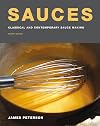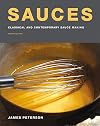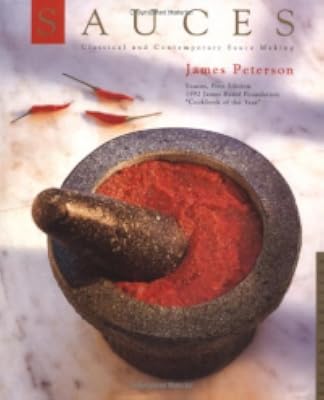
Sauces: Classical and Contemporary Sauce Making
by James Peterson
On This Page
Description
The acclaimed authority on sauce making, completely updated and, for the first time, featuring invaluable step-by-step color photographs. Every good cook knows that a great sauce is one of the easiest ways to make an exemplary dish. Since its James Beard Award-winning first edition, James Peterson's Sauces has remained the go-to reference for professionals and sophisticated home cooks, with nearly 500 recipes and detailed explanations of every kind of sauce. This new edition, published show more nearly ten years after the previous one, tacks with today's movement toward lighter, fresher flavors and preparations and modern cooking methods, while also elucidating the classic sauces and techniques that remain a foundation of excellence in the kitchen. The updated, streamlined design also features, for the first time, full-color photos that clearly show these essential sauces at every step-bringing the author's expertise to life like never before. show lessTags
Recommendations






Member Reviews
This book lost a star because there is no American barbecue sauce recipe. I believe that barbecue sauce is the quintessential American sauce and it should have been included. You could argue that tomato ketchup and yellow mustard are the most American sauces, but there aren't recipes for those in this cookbook either. You could also say that ranch dressing is the most American sauce of them all, but you won't find that amongst the "salad sauces". The only sauce from the Americas is Mexican salsa and there's not even a chimichurri sauce.
What this cookbook is great for are ALL of the classical French & (mostly western) European sauces, cheffy fine-dining sauces, molecular gastronomical sauces, medieval European sauces!!!, a whole chapter show more of Asian sauces, and Italian pasta sauces. Many of the sauce recipes have a recipe to show how to use the sauce in a finished dish. Quite a lot of the sauces have suggestions for how they can be improved with all of the chemicals of molecular gastronomy, but the majority of the recipes can be made with ingredients available at your neighborhood grocery store plus an average liquor store if you avoid the recipes that call for truffles and sea urchin.
For me, the book is worth the purchase price for the medieval, renaissance-era, and other historical recipes. That was a pleasant surprise to find in the book! Despite being a book geared toward chefs, the recipes aren't too complicated. show less
What this cookbook is great for are ALL of the classical French & (mostly western) European sauces, cheffy fine-dining sauces, molecular gastronomical sauces, medieval European sauces!!!, a whole chapter show more of Asian sauces, and Italian pasta sauces. Many of the sauce recipes have a recipe to show how to use the sauce in a finished dish. Quite a lot of the sauces have suggestions for how they can be improved with all of the chemicals of molecular gastronomy, but the majority of the recipes can be made with ingredients available at your neighborhood grocery store plus an average liquor store if you avoid the recipes that call for truffles and sea urchin.
For me, the book is worth the purchase price for the medieval, renaissance-era, and other historical recipes. That was a pleasant surprise to find in the book! Despite being a book geared toward chefs, the recipes aren't too complicated. show less
This book is the deepest and most comprehensive book on classical sauce making, history and trivia that you can find in a single volume. As Professorx's review says, it is definitely geared toward the professional chef (which is why I love it: it's so hard to find cookbooks for professionals that aren't actually culinary school textboks). Peterson always seems to be on his game no matter the culinary topic, and SAUCES is no exception. With the history and origins of so many sauces explained, this book is as much a literary adventure as it is an instructional manual. As a bonus for the more experimental cooks out there, Peterson includes several recipes and techniques for recreating truly medieval and ancient sauces, from pigeon show more dressings to gold-plated chickens to Roman garum.
As I said though, it is a book on classical sauce-making; though it contains several dozen pages on Asian and Indian sauces, these final chapters lack the depth and polish of the rest of the book (and make no mention at all of Middle Eastern or African sauces). It's probably a matter of space constraints more than anything; these regions have their own incredibly diverse techniques and histories. Perhaps someday Peterson can devote a volume to them exclusively (unless I beat him to it :)
Despite those omissions, SAUCES remains a solid 5 out of 5 stars and one of the most useful books in my kitchen. Highly recommended. show less
As I said though, it is a book on classical sauce-making; though it contains several dozen pages on Asian and Indian sauces, these final chapters lack the depth and polish of the rest of the book (and make no mention at all of Middle Eastern or African sauces). It's probably a matter of space constraints more than anything; these regions have their own incredibly diverse techniques and histories. Perhaps someday Peterson can devote a volume to them exclusively (unless I beat him to it :)
Despite those omissions, SAUCES remains a solid 5 out of 5 stars and one of the most useful books in my kitchen. Highly recommended. show less
Amazon.com
Back in 1991, when the first edition of Sauces was published, it's as though James Peterson said, "Okay, this is what we know so far. Where do you want to go from here?" The "what we know so far" part started with the Greeks and Romans, moved through the Middle Ages, into the Renaissance, through the 17th and 18th centuries, and right on into time as we know it, time that can be tasted in the sauce.
The "where do you want to go" part continues to evolve, as it always will, but remains just as evident in the way we sauce our creations, both elegant and fundamental. In the second edition of Sauces, released seven years after the first, the "we" has expanded beyond Frenchmen and their disciples, and now includes the broader range show more of flavors experienced by Italians as pasta sauces, as well as New World cooks and their counterparts in the Middle East and throughout greater Asia. The solid base from which all this grows, however, remains the lessons learned in the French kitchen--and a better kitchen for such lessons has never been developed.
To cook is one thing, to sauce another. The right sauce lifts the right dish to a wholly different plateau of dining than would be the case if the cook didn't bother. This can be a humble pasta sauce created as a perfect balance of ingredients on hand, or a carefully considered sauce the ingredients of which have been developed at the stove over days, not mere hours.
In the sauce can be seen the reflection of the cook. There is no room to hide. In the well-crafted sauce can be found the ultimate expression of simplicity, which leaves even less room to hide. It is James Peterson's great talent that he can draw the home cook and professional cook into his dialogue on sauces, and teach them both how to stay afloat in such shallow waters.
Peterson gives the reader--in close to 600 pages, mind you--the continuum on which sauces have been based in culinary history. He gives the reader the kitchen science that allows sauces to work. He gives the reader the techniques necessary to follow along where many a cook has already whisked up a splendid creation. But most of all, he gives the reader permission to go ahead and be creative, to cut loose with knowledge and technique in hand and discover for oneself the way an inkling of a flavor idea can find its way to a dish and make the combined ingredients lift off the plate. Or not. Finding out what doesn't work can be just as important.
This is a book that can be taken to bed and savored, page by page, sauce by sauce. It is a book that should be on the shelf in any kitchen, professional or homebody alike. It is not a book to ever gather dust and need dusting. --Schuyler Ingle show less
Back in 1991, when the first edition of Sauces was published, it's as though James Peterson said, "Okay, this is what we know so far. Where do you want to go from here?" The "what we know so far" part started with the Greeks and Romans, moved through the Middle Ages, into the Renaissance, through the 17th and 18th centuries, and right on into time as we know it, time that can be tasted in the sauce.
The "where do you want to go" part continues to evolve, as it always will, but remains just as evident in the way we sauce our creations, both elegant and fundamental. In the second edition of Sauces, released seven years after the first, the "we" has expanded beyond Frenchmen and their disciples, and now includes the broader range show more of flavors experienced by Italians as pasta sauces, as well as New World cooks and their counterparts in the Middle East and throughout greater Asia. The solid base from which all this grows, however, remains the lessons learned in the French kitchen--and a better kitchen for such lessons has never been developed.
To cook is one thing, to sauce another. The right sauce lifts the right dish to a wholly different plateau of dining than would be the case if the cook didn't bother. This can be a humble pasta sauce created as a perfect balance of ingredients on hand, or a carefully considered sauce the ingredients of which have been developed at the stove over days, not mere hours.
In the sauce can be seen the reflection of the cook. There is no room to hide. In the well-crafted sauce can be found the ultimate expression of simplicity, which leaves even less room to hide. It is James Peterson's great talent that he can draw the home cook and professional cook into his dialogue on sauces, and teach them both how to stay afloat in such shallow waters.
Peterson gives the reader--in close to 600 pages, mind you--the continuum on which sauces have been based in culinary history. He gives the reader the kitchen science that allows sauces to work. He gives the reader the techniques necessary to follow along where many a cook has already whisked up a splendid creation. But most of all, he gives the reader permission to go ahead and be creative, to cut loose with knowledge and technique in hand and discover for oneself the way an inkling of a flavor idea can find its way to a dish and make the combined ingredients lift off the plate. Or not. Finding out what doesn't work can be just as important.
This is a book that can be taken to bed and savored, page by page, sauce by sauce. It is a book that should be on the shelf in any kitchen, professional or homebody alike. It is not a book to ever gather dust and need dusting. --Schuyler Ingle show less
Another masterpiece on the art of cooking from James Beard Award-winning author James Peterson. This is one of the few books on cooking that I continually return to. Making great sauce is an extremely difficult skill, at least for me, yet James Peterson has presented all of the classical sauces in an easy, and accessible, manner. It is a book that I highly recommend to all aspiring chefs.
An outstanding book - 1) systemises the art (mystery?) of sauce-making, 2) is accessible to both the professional and non-professional reader, 3) Notable section on making stocks which has wider application beyond the matter in hand.
How and why of any sauce you might need.
This seems like a good reference book for sauces. Can anyone suggest others that they think are just as good if not better?
Members
- Recently Added By
Author Information

21 Works 3,931 Members
James Peterson, a California native, learned to cook in France and later served an apprenticeship in the kitchen of three-star chef Georges Blanc. In 1979 he moved to New York and opened the West Village restaurant Le Petit Robert, where he served rustic French food until 1984. For the last 16 years Peterson has been teaching cooking at the French show more Culinary Institute and at Peter Kump's Cooking School, and is often a guest speaker at cooking schools around the country show less
Classifications
- Genres
- Food & Cooking, Nonfiction, General Nonfiction
- DDC/MDS
- 641.814 — Applied science & technology Home economics & family management Food, Cooking & Recipes / Meals, Picnics Cooking specific kinds of dishes and preparing beverages Cooking side dishes, sauces, garnishes Sauces, Relishes, Dressings
- LCC
- TX819 .A1 .P47 — Technology Home economics Home economics Cooking
- BISAC
Statistics
- Members
- 886
- Popularity
- 30,658
- Reviews
- 8
- Rating
- (3.91)
- Languages
- English
- Media
- Paper, Ebook
- ISBNs
- 8
- UPCs
- 3
- ASINs
- 3