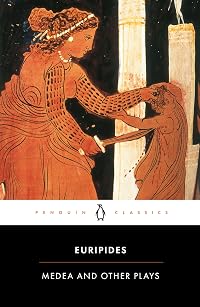
Medea and Other Plays: Medea / Hecabe / Electra / Heracles
by Euripides
On This Page
Description
Euripides was a brilliant and powerful innovator within the traditional framework of Attic drama.Tags
Recommendations















Member Reviews
MEDEA: This is all about rage and revenge. Medea, wronged by Jason (of Argonaut fame), seeks a bloody revenge that hurts her as much as it hurts him.
HECABE: Another rage/revenge tale. The wife of Priam, former queen of Troy, seeks revenge against the Argives who killed and/or captured her children.
ELECTRA: And yet another r/r story. The daughter of Clytemnestra and sister of Orestes seeks revenge on her mother and her mother's lover for the death of her father by urging Orestes to kill them both.
HERACLES: This one seems out of place. For one thing, it isn't about female rage and revenge. It is about the brutality of one man, a hero, who is afflicted with madness by the gods and who then murders his own wife and children. Afterwards, show more beset by remorse and sorrow, he finds support and friendship with another man.
The Greek dramatists seem to be aware of how their patriarchal society leads to the oppression and emotional trauma of women, who then seek bloody justice from their oppressors. I'm not sure what the fourth play is saying about their society--that men are forced to do heinous things at the hands of the gods? That they can only find true companionship and understanding with other men? I found Heracles to be the least engaging. There doesn't seem to be a reason for his actions (other than the gods). Maybe Euripides is trying to say that no one, regardless of their position in society, has power over their destiny.
Anyway, I enjoy these ancient plays, and seeing how humanity has been grappling with questions of power and fate for millenia. show less
HECABE: Another rage/revenge tale. The wife of Priam, former queen of Troy, seeks revenge against the Argives who killed and/or captured her children.
ELECTRA: And yet another r/r story. The daughter of Clytemnestra and sister of Orestes seeks revenge on her mother and her mother's lover for the death of her father by urging Orestes to kill them both.
HERACLES: This one seems out of place. For one thing, it isn't about female rage and revenge. It is about the brutality of one man, a hero, who is afflicted with madness by the gods and who then murders his own wife and children. Afterwards, show more beset by remorse and sorrow, he finds support and friendship with another man.
The Greek dramatists seem to be aware of how their patriarchal society leads to the oppression and emotional trauma of women, who then seek bloody justice from their oppressors. I'm not sure what the fourth play is saying about their society--that men are forced to do heinous things at the hands of the gods? That they can only find true companionship and understanding with other men? I found Heracles to be the least engaging. There doesn't seem to be a reason for his actions (other than the gods). Maybe Euripides is trying to say that no one, regardless of their position in society, has power over their destiny.
Anyway, I enjoy these ancient plays, and seeing how humanity has been grappling with questions of power and fate for millenia. show less
Greek playwright number three! There are four plays in this book.
Medea: This seems to set the tone for the anthology. The intro mentions Euripides seems to be concerned with vengeance, but I'd go a bit further and suggest his primary theme is female wrath. Medea is the brutal pinnacle of female wrath, willing to kill her own children, her husband's new bride, and the bride's father in order to destroy her faithless husband's life. Then she leaves in a chariot pulled by dragons. Epic.
Hecabe: Concerns the fate of Troy's queen in the wake of the fall of Troy. Reduced to slavery, her children dead, she still finds a way to extract violent vengeance on a man who wronged her. There's some tension here between the Greek world-view and our show more modern sensibilities. Agamemnon comments on how "unlucky" poor Hecabe is - when he is the very man who burned her city, killed her family and enslaved her! To the ancient Greeks all this was the doing of the gods - had they not willed Troy to fall, it never would have - but a modern audience is likely to find Agamemnon disingenuous. There's another funny-weird moment, when Agamemnon comes across the commotion, sees Hecabe's victim crawling from her tent, blinded and furious...and basically tells the guy "Chill out dude, I need to hear both sides of the story." My man, how can someone who just had their eyes stabbed out be expected to chill??
Electra: This is the third version of this episode I've read, and in some places responds specifically to Sophocles' version. The sensible sister disappears in Euripides' telling - there's no room for a moderating female character in this battle of vengeance between Electra and Clytaemnestra. Orestes instead serves as the voice for moderation, the hapless young man caught between these two battling women. While so many characters in the play insist that Clytaemnestra's death is just, the mood of the play seems to suggest otherwise. Perhaps if Electra had been more willing to hear out her mother, the bloodshed could have been avoided. Or, perhaps, the gods demanded Clytaemnestra must die, regardless of human reservations.
Heracles: This story opens with Megara, her children, and her elderly father in law praying for salvation from the invaders ravaging her city. It seemed out of place at first, as it appeared to be a classic tale of the strong oppressing the weak. But then Iris and Madness appear, both female deities, sent by Hera to bring Heracles down in his moment of triumph. There's a couple of those human moments that remind us that despite the thousands of years that separate us, we share a common humanity with the ancient Greeks. First is Heracles' fatherly gentleness with his sons, the other is the comforting friendship Theseus shows when Heracles is at his lowest. We might have completely different world-views, but friendship and love for one's children are a constant.
I find the preoccupation with female rage very interesting. I've commented before that Greek art seems to acknowledge the humanity of women, and the artists seem to be aware that women suffer at the hands of men and the patriarchal society they live under. Perhaps these works represent a fear - of what might happen should their wives or mothers or daughters one day refuse to take the abuse patiently, and instead decide to take revenge. show less
Medea: This seems to set the tone for the anthology. The intro mentions Euripides seems to be concerned with vengeance, but I'd go a bit further and suggest his primary theme is female wrath. Medea is the brutal pinnacle of female wrath, willing to kill her own children, her husband's new bride, and the bride's father in order to destroy her faithless husband's life. Then she leaves in a chariot pulled by dragons. Epic.
Hecabe: Concerns the fate of Troy's queen in the wake of the fall of Troy. Reduced to slavery, her children dead, she still finds a way to extract violent vengeance on a man who wronged her. There's some tension here between the Greek world-view and our show more modern sensibilities. Agamemnon comments on how "unlucky" poor Hecabe is - when he is the very man who burned her city, killed her family and enslaved her! To the ancient Greeks all this was the doing of the gods - had they not willed Troy to fall, it never would have - but a modern audience is likely to find Agamemnon disingenuous. There's another funny-weird moment, when Agamemnon comes across the commotion, sees Hecabe's victim crawling from her tent, blinded and furious...and basically tells the guy "Chill out dude, I need to hear both sides of the story." My man, how can someone who just had their eyes stabbed out be expected to chill??
Electra: This is the third version of this episode I've read, and in some places responds specifically to Sophocles' version. The sensible sister disappears in Euripides' telling - there's no room for a moderating female character in this battle of vengeance between Electra and Clytaemnestra. Orestes instead serves as the voice for moderation, the hapless young man caught between these two battling women. While so many characters in the play insist that Clytaemnestra's death is just, the mood of the play seems to suggest otherwise. Perhaps if Electra had been more willing to hear out her mother, the bloodshed could have been avoided. Or, perhaps, the gods demanded Clytaemnestra must die, regardless of human reservations.
Heracles: This story opens with Megara, her children, and her elderly father in law praying for salvation from the invaders ravaging her city. It seemed out of place at first, as it appeared to be a classic tale of the strong oppressing the weak. But then Iris and Madness appear, both female deities, sent by Hera to bring Heracles down in his moment of triumph. There's a couple of those human moments that remind us that despite the thousands of years that separate us, we share a common humanity with the ancient Greeks. First is Heracles' fatherly gentleness with his sons, the other is the comforting friendship Theseus shows when Heracles is at his lowest. We might have completely different world-views, but friendship and love for one's children are a constant.
I find the preoccupation with female rage very interesting. I've commented before that Greek art seems to acknowledge the humanity of women, and the artists seem to be aware that women suffer at the hands of men and the patriarchal society they live under. Perhaps these works represent a fear - of what might happen should their wives or mothers or daughters one day refuse to take the abuse patiently, and instead decide to take revenge. show less
Suddenly seized by a desire to re-read this play by Euripides written in 431BC. But had to wait till I found it in an op shop. I found the Penguin Classics translation by Philip Vellacott. Such a savage story that gives me considerable pause for thought. Easy to see how Medea is currently embraced as a heroine but she has a long history of killing. The play becomes more nuanced if we see her as a barbarous murderer capable of anything. In many ways what I like about it (the play) is the lack of redemption or even justice. Although, she considers killing her sons part of her quest for justice. There is a moment where she wavers. Somehow, I'd like to zoom in on that as the pivotal moment. Much to think about here. No wonder it's still show more talked about nearly 2,500 years later. Think I'll read about Jason next or (if I can find it) Rachel Cusk's version. There's The Golden Fleece by Robert Graves. show less
The play "Electra" was my choice as a re-read, from way back in 2004, to fulfill a LT group challenge. It concerns events in the life of Electra, daughter of Agamemnon and Clymnestra and her desire for revenge.
Electra is be-moaning her fate, that of an unwanted daughter who is forced to marry beneath her station to a field worker. She has been separated from her brother, Orestes, for a decade; has seen her sister, Iphigenia, killed by her father, Agamemnon; and her mother, Clymnestra, marry Aegisthus in an adulterous affair. And oh yes, when Agamemnon makes it home with a second wife, Cassandra, Clymnestra has him killed so that she can continue her own affair/marriage to Aegisthus.
So Electra has no love lost for her mother and show more step-father, and a great deal of self-pity. In the introduction, Vellacott seems to point to her self-pity as her one indulgence in her life. I would posit her self-pity as a normal reaction to an extraordinarily traumatizing series of life events.
At any rate, she is re-united with her dear Orestes and agrees with his decision to kill Aeschylus as an act of vengeance. And once this deed is done, they also conspire to also kill their mother for the crimes she has committed. It seems that Orestes, while reluctant to commit matricide, has received a message via a Phoeban oracle to fully revenge his father's death. And it is Electra who urges him to commit this act of revenge and listen to the gods' words instead of to his love for his mother.
What Euripedes does with this final act of revenge is to point out the futility of their deed. They are both ravaged and wracked with guilt over the double murder, even though their anger at their mother (especially) was justified. And Electra is as much the instigator of their mother's murder as the Phoeban oracle was, and now both she and Orestes will have to live with this deed for the rest of their lives. And they will also be separated, so their longed-for reunion is quickly over. show less
Electra is be-moaning her fate, that of an unwanted daughter who is forced to marry beneath her station to a field worker. She has been separated from her brother, Orestes, for a decade; has seen her sister, Iphigenia, killed by her father, Agamemnon; and her mother, Clymnestra, marry Aegisthus in an adulterous affair. And oh yes, when Agamemnon makes it home with a second wife, Cassandra, Clymnestra has him killed so that she can continue her own affair/marriage to Aegisthus.
So Electra has no love lost for her mother and show more step-father, and a great deal of self-pity. In the introduction, Vellacott seems to point to her self-pity as her one indulgence in her life. I would posit her self-pity as a normal reaction to an extraordinarily traumatizing series of life events.
At any rate, she is re-united with her dear Orestes and agrees with his decision to kill Aeschylus as an act of vengeance. And once this deed is done, they also conspire to also kill their mother for the crimes she has committed. It seems that Orestes, while reluctant to commit matricide, has received a message via a Phoeban oracle to fully revenge his father's death. And it is Electra who urges him to commit this act of revenge and listen to the gods' words instead of to his love for his mother.
What Euripedes does with this final act of revenge is to point out the futility of their deed. They are both ravaged and wracked with guilt over the double murder, even though their anger at their mother (especially) was justified. And Electra is as much the instigator of their mother's murder as the Phoeban oracle was, and now both she and Orestes will have to live with this deed for the rest of their lives. And they will also be separated, so their longed-for reunion is quickly over. show less
53. Medea & Other Plays: Medea, Hecabe, Electra, Heracles by Euripides, translated by Philip Vellacott
translation 1963
format: 200 page Penguin Classics paperback, 1968 reprint
acquired: 2006, from my neighbor
read: Aug 20-25
rating: 3 stars
Reading all these Greek tragedies, in a sort of sum affect, makes the Greek mythological stories seem ridiculous. I think this especially true with Euripides. There is this sort of un-serious element, a sense of mockery. Each of the three tragic Greek playwrights finds the most extreme, hardest to fathom elements of the mythology, and foregrounds it in their plays. And, it just seems that in same way Hollywood today mocks our religious and moral background, undermining in sum, even if not in intention, show more Greek drama undermines Ancient Greek beliefs and moral standards.
Well, that was a bit convoluted. I'm trying to compensate, because this book didn't offer much to me. Medea was a re-read. Hecabe was forgettable, Heracles is over-dramatic and Electra has it's own issues. Not my favorite plays.
Medea 431 bce
This is really a great and disturbing play and re-reading it does add a bit, but doesn't make it any more pleasant. Reviewed on my thread here
Hecabe (aka Hecuba) 424 bce
Hecabe is Hector's mother. So, she loses everything in the Trojan war and lives a bit to suffer through it. That's the setting here. She has to experience watching her last daughter, Polyxena, condemned to be a human sacrifice to Achilles. Then, immediately after, she learns of the murder of her one remaining son, Polydorus, who had been sent off to another kingdom for protection. He was murdered by his protector, King Polymestor of Thrace. Lots of inadequate dramatic words. All is not lost, as Hecabe gets a chance to get revenge on Polymestor. Her fellow Trojan woman slaves will set a trap, blind Polymestor and kill his sons. So, at least it's a happy ending...
Electra 420 bce
The Sophocles play of this same name is powerful, and complex and interesting. With that in mind, I found this play bewildering in its plainness. At one point Euripides makes fun of a scene in Aeschylus's play with Electra, The Libations Bearers. It's legitimately funny and it's all told straight, with only sarcastic humor. After that scene, I tried to read sarcasm into the entire remaining play...and it all made perfect sense. I guess a lesson is one should be careful not to take these too seriously.
Heracles 416 bce
Heracles probably deserves some more reflection, but it was so over-dramatic, like a constant high pitched scream, that the thought-provoking affect was lost one me.
With Heracles away, we watch his wife, Megara, human father, Amphitryon, and his children deal with being condemned to pubic execution. They go back and forth between hope and acceptance. At the last moment Heracles arrives and saves them. But, then, immediately, the Goddess Iris has the goddess Madness drive Heracles into an insane episode where he kills his wife and children. An accountant might point out that he came out one family member ahead, Amphitryon lives.
In the emotional fall out, Heracles goes through emotional episodes that include an expression of doubt of all the gods, since gods can only do good. He is doubting what is essential to his own existence, as his real father is Zeus. (I should point out that the actors seem a bit uncertain on this).
There is a lot going on in the play. Notable is, first, how the family responds to being condemned to die, and, second, the doubt in the belief in the gods expressed by Heracles. Euripides is supposedly reflecting his times and the tangled debate going on in and around 5th-century bce Athens about what to believe. This is interesting, and maybe I will get something out of it on a re-read, but right now I need a play with less melodrama.
2016
https://www.librarything.com/topic/226898#5707016 show less
translation 1963
format: 200 page Penguin Classics paperback, 1968 reprint
acquired: 2006, from my neighbor
read: Aug 20-25
rating: 3 stars
Reading all these Greek tragedies, in a sort of sum affect, makes the Greek mythological stories seem ridiculous. I think this especially true with Euripides. There is this sort of un-serious element, a sense of mockery. Each of the three tragic Greek playwrights finds the most extreme, hardest to fathom elements of the mythology, and foregrounds it in their plays. And, it just seems that in same way Hollywood today mocks our religious and moral background, undermining in sum, even if not in intention, show more Greek drama undermines Ancient Greek beliefs and moral standards.
Well, that was a bit convoluted. I'm trying to compensate, because this book didn't offer much to me. Medea was a re-read. Hecabe was forgettable, Heracles is over-dramatic and Electra has it's own issues. Not my favorite plays.
Medea 431 bce
This is really a great and disturbing play and re-reading it does add a bit, but doesn't make it any more pleasant. Reviewed on my thread here
Hecabe (aka Hecuba) 424 bce
Hecabe is Hector's mother. So, she loses everything in the Trojan war and lives a bit to suffer through it. That's the setting here. She has to experience watching her last daughter, Polyxena, condemned to be a human sacrifice to Achilles. Then, immediately after, she learns of the murder of her one remaining son, Polydorus, who had been sent off to another kingdom for protection. He was murdered by his protector, King Polymestor of Thrace. Lots of inadequate dramatic words. All is not lost, as Hecabe gets a chance to get revenge on Polymestor. Her fellow Trojan woman slaves will set a trap, blind Polymestor and kill his sons. So, at least it's a happy ending...
Electra 420 bce
The Sophocles play of this same name is powerful, and complex and interesting. With that in mind, I found this play bewildering in its plainness. At one point Euripides makes fun of a scene in Aeschylus's play with Electra, The Libations Bearers. It's legitimately funny and it's all told straight, with only sarcastic humor. After that scene, I tried to read sarcasm into the entire remaining play...and it all made perfect sense. I guess a lesson is one should be careful not to take these too seriously.
Heracles 416 bce
Heracles probably deserves some more reflection, but it was so over-dramatic, like a constant high pitched scream, that the thought-provoking affect was lost one me.
With Heracles away, we watch his wife, Megara, human father, Amphitryon, and his children deal with being condemned to pubic execution. They go back and forth between hope and acceptance. At the last moment Heracles arrives and saves them. But, then, immediately, the Goddess Iris has the goddess Madness drive Heracles into an insane episode where he kills his wife and children. An accountant might point out that he came out one family member ahead, Amphitryon lives.
In the emotional fall out, Heracles goes through emotional episodes that include an expression of doubt of all the gods, since gods can only do good. He is doubting what is essential to his own existence, as his real father is Zeus. (I should point out that the actors seem a bit uncertain on this).
There is a lot going on in the play. Notable is, first, how the family responds to being condemned to die, and, second, the doubt in the belief in the gods expressed by Heracles. Euripides is supposedly reflecting his times and the tangled debate going on in and around 5th-century bce Athens about what to believe. This is interesting, and maybe I will get something out of it on a re-read, but right now I need a play with less melodrama.
2016
https://www.librarything.com/topic/226898#5707016 show less
She’s killed two people to protect the man she loves. She’s followed him into exile in a foreign land. But now her hero husband has dumped her for a younger model (who happens to be the King’s daughter) so she determines to take her revenge. First she poisons the new bride and the bride’s father and then slays her own sons.
It sounds like the plot of a TV drama or even a Polanski film. With its theme of gender relations and female oppression in a patriarchal society, it sounds very twentieth century. But it’s actually a play that’s more than 2,000 years old.
Diana Rigg’s portrayal of Medea in 1993 was described as ‘the performance of her life’
Medea, written in 431BC by the Greek dramatist Euripedes, is based on the show more legendary story of Jason (the leader of the Argonauts’s quest to gain the Golden Fleece) and his vengeful wife Medea. It was performed in a competition as part of a religious festival to the god Dionysus held in Athens.
Although the play reflects the stylistic elements of traditional Greek tragedy that the original audience would have expected ( such as the Chorus who reflect on and amplify the events they witness, and the hymn of praise to Athens) , it was not well received. Euripedes actually came last in the competition. One theory is that the theme was considered too radical, blurring the boundaries of conventional gender and social roles and undermining Jason’s role as heroic figure. For instead of a Jason who is the honourable and brave Greek hero, the accusations levelled against him by Medea show us a figure who is disloyal and self interested. He’s conveniently forgotten that she saved his life and in doing so was forced to leave her homeland.
For modern audiences, her desire to see Jason suffer would be understandable though the means she uses wouldn’t be generally acceptable. But less easy to comprehend is her act of infanticide against two children who have little part to play in her marriage breakdown. The only reason she gives for such a shocking act is that she is saving them from a greater fate they would experience if she were to flee the country and leave them behind. Presumably she thinks they would be killed in revenge for her own actions – so it would be bettter for her to be their killer than anyone else. Other characters suggest she is deranged and mad yet she shows little sign of this when she has her big shown down with Jason, arguing very coherently why she sees his marriage as a supreme act of betrayal. The play thus raises an important question – are there some circumstances under which it would be justifiable – or acceptable – for a mother to kill her children? Equally important is the question of whether such individuals should be punished for their action – Medea escapes from any form of justice since the play ends with her riding away in a chariot to start a new life in Athens.
There isn’t much subtlety in this play; it’s a full on study of a woman who is hell bent on revenge and systematically sets about achieving it. As to be expected, it’s full of references to Gods and prevailing beliefs that are no longer relevant for today’s society – but the themes and questions it raises are still pertinent.
Electra:
Patricide, matricide, a brother and his sister reunited after decades but then forced to part: the story of Electra and her brother Orestes features in plays by three of the leading Greek dramatists. The only version I’ve read is by Euripides so I can’t comment on how it compares to the plays by Sophocles or Aeschylus.
The framework of the story is straightforward: on his return from Troy, Agammemnon, King of Argos was killed by Aegisthus who then married the widow Clytemnestra. Her son Orestes was secretly sent abroad to keep him out of harm; her daughter Electra was married off to a peasant. After 11 years or so in exile, Orestes returns determined for revenge and tracks down his sister. The two kill King and Queen but instead of being rewarded for their actions, retribution awaits them in the shape of Zeus’ twin sons. Orestes is despatched to Athens to stand trial and his sister is married off to his best friend and told the leave Argos.
There are a few puzzling elements of Euripedes’ play however which seem to exist just to move the plot along but tell us nothing much about the characters. One of them happens when Orestes and Electra meet again but don’t initially recognise each other. Eventually the penny drops but it seems to take them a fair time and then suddenly, they hatch this plot. It’s all wrapped out without much ceremony or a great deal of debate. A kind of “hello brother, good to see you after all these years. You’ve come to kill the King? Off you go then and I’ll get Clytemnestra to my house so I can kill her.”
This approach means it’s hard to relate to either character. Euripides could have posed an interesting question – what makes a person kill, not out of sudden burst of anger, but out of a desire for revenge harboured over many years. But we don’t get to see that question played out or much real debate between the two offspring about the reasons for their murderous intent. Electra seems just as determined as her brother to exact revenge yet, the play shows that at the final moment she drops the sword and it’s Orestes who steps in to kill Clytemnestra having already seen off Aegisthus. Why Electra fails at the exact moment when she supposedly is about to fulfil her desire, is never explained.
This was the second play by Euripides I’ve now read as part of my Classics Club list. After the passion and drama of Medea, my expectations were high for another explosive drama but all I encountered was the literary equivalent of a damp squib. show less
It sounds like the plot of a TV drama or even a Polanski film. With its theme of gender relations and female oppression in a patriarchal society, it sounds very twentieth century. But it’s actually a play that’s more than 2,000 years old.
Diana Rigg’s portrayal of Medea in 1993 was described as ‘the performance of her life’
Medea, written in 431BC by the Greek dramatist Euripedes, is based on the show more legendary story of Jason (the leader of the Argonauts’s quest to gain the Golden Fleece) and his vengeful wife Medea. It was performed in a competition as part of a religious festival to the god Dionysus held in Athens.
Although the play reflects the stylistic elements of traditional Greek tragedy that the original audience would have expected ( such as the Chorus who reflect on and amplify the events they witness, and the hymn of praise to Athens) , it was not well received. Euripedes actually came last in the competition. One theory is that the theme was considered too radical, blurring the boundaries of conventional gender and social roles and undermining Jason’s role as heroic figure. For instead of a Jason who is the honourable and brave Greek hero, the accusations levelled against him by Medea show us a figure who is disloyal and self interested. He’s conveniently forgotten that she saved his life and in doing so was forced to leave her homeland.
For modern audiences, her desire to see Jason suffer would be understandable though the means she uses wouldn’t be generally acceptable. But less easy to comprehend is her act of infanticide against two children who have little part to play in her marriage breakdown. The only reason she gives for such a shocking act is that she is saving them from a greater fate they would experience if she were to flee the country and leave them behind. Presumably she thinks they would be killed in revenge for her own actions – so it would be bettter for her to be their killer than anyone else. Other characters suggest she is deranged and mad yet she shows little sign of this when she has her big shown down with Jason, arguing very coherently why she sees his marriage as a supreme act of betrayal. The play thus raises an important question – are there some circumstances under which it would be justifiable – or acceptable – for a mother to kill her children? Equally important is the question of whether such individuals should be punished for their action – Medea escapes from any form of justice since the play ends with her riding away in a chariot to start a new life in Athens.
There isn’t much subtlety in this play; it’s a full on study of a woman who is hell bent on revenge and systematically sets about achieving it. As to be expected, it’s full of references to Gods and prevailing beliefs that are no longer relevant for today’s society – but the themes and questions it raises are still pertinent.
Electra:
Patricide, matricide, a brother and his sister reunited after decades but then forced to part: the story of Electra and her brother Orestes features in plays by three of the leading Greek dramatists. The only version I’ve read is by Euripides so I can’t comment on how it compares to the plays by Sophocles or Aeschylus.
The framework of the story is straightforward: on his return from Troy, Agammemnon, King of Argos was killed by Aegisthus who then married the widow Clytemnestra. Her son Orestes was secretly sent abroad to keep him out of harm; her daughter Electra was married off to a peasant. After 11 years or so in exile, Orestes returns determined for revenge and tracks down his sister. The two kill King and Queen but instead of being rewarded for their actions, retribution awaits them in the shape of Zeus’ twin sons. Orestes is despatched to Athens to stand trial and his sister is married off to his best friend and told the leave Argos.
There are a few puzzling elements of Euripedes’ play however which seem to exist just to move the plot along but tell us nothing much about the characters. One of them happens when Orestes and Electra meet again but don’t initially recognise each other. Eventually the penny drops but it seems to take them a fair time and then suddenly, they hatch this plot. It’s all wrapped out without much ceremony or a great deal of debate. A kind of “hello brother, good to see you after all these years. You’ve come to kill the King? Off you go then and I’ll get Clytemnestra to my house so I can kill her.”
This approach means it’s hard to relate to either character. Euripides could have posed an interesting question – what makes a person kill, not out of sudden burst of anger, but out of a desire for revenge harboured over many years. But we don’t get to see that question played out or much real debate between the two offspring about the reasons for their murderous intent. Electra seems just as determined as her brother to exact revenge yet, the play shows that at the final moment she drops the sword and it’s Orestes who steps in to kill Clytemnestra having already seen off Aegisthus. Why Electra fails at the exact moment when she supposedly is about to fulfil her desire, is never explained.
This was the second play by Euripides I’ve now read as part of my Classics Club list. After the passion and drama of Medea, my expectations were high for another explosive drama but all I encountered was the literary equivalent of a damp squib. show less
Collected here are Alcestis, Medea, Children of Heracles, and Hippolytus. I thoroughly enjoyed reading all of them. Euripides has a style that is very accessible and his skill at exploring the motives of actions shines, particularly in Medea. Even if you don’t agree with the final actions of characters, it is easy to see how they feel forced to act the way they do. The plots were a bit too convenient at times, but that is true to the genre.
Members
- Recently Added By
Author Information

1,345+ Works 34,154 Members
Euripides was born in Attica, Greece probably in 480 B.C. He was the youngest of the three principal fifth-century tragic poets. In his youth he cultivated gymnastic pursuits and studied philosophy and rhetoric. Soon after he received recognition for a play that he had written, Euripides left Athens for the court of Archelaus, king of Macedonia. show more Fragments of about fifty-five plays survive. Among his best-known plays are Alcestis, Medea and Philoctetes, Electra, Iphigenia in Tauris, The Trojan Women, and Iphigenia in Aulis Iphigenia. He died in Athens in 406 B.C. (Bowker Author Biography) show less
Some Editions
Series
Belongs to Publisher Series
Penguin Classics (L129)
Work Relationships
Contains
Has as a student's study guide
Has as a teacher's guide
Common Knowledge
- Canonical title
- Medea and Other Plays: Medea / Hecabe / Electra / Heracles
- Original publication date
- 431 BCE (Medea) (Medea); 425 BCE (Hecabe) (Hecabe); 415 BCE (Electra) (Electra); ?420 BCE (Heracles) (Heracles)
- People/Characters
- Medea; Jason [Argonaut]; Hecabe; Creon; Odysseus; Aegeus (show all 23); Agamemnon; Tutor; Electra; Nurse; Orestes; Clytemnestra; Polyxena; Hercules; Ghost of Polydorus; Megara; Polymestor; Pylades; Amphitryon; Lycus; Idris; Theseus; Chorus
- Important places
- Corinth, Greece; Thrace, Greece; Argos, Greece; Thebes, Greece
- First words
- Of the four plays in this volume, three have in common a point of special interest for their first audience.
Introduction (Penguin Classics ed.).
NURSE: If only they had never gone!
Medea.
POLYDORUS: From sombre caverns of the secret earth, from gates
Of darkness where, far from the company of gods,
Hades governs his colony - from the d... (show all)ead come I.
Hecabe.
PEASANT: Argos the ancient! River Inachus!
Electra.
AMPHITRYTON: Is there a man living who has not heard of me -
Amphitryton of Argos, whose bed welcomed Zeus?
Heracles.
(Penguin Classics ed.). - Last words
- (Click to show. Warning: May contain spoilers.)Latinism in Hellene affairs is almost always to be deplored.
Introduction (Penguin Classics ed.).
(Click to show. Warning: May contain spoilers.)CHORUS: With mourning and with many tears we go;
For we today have lost our noblest friend.
(Penguin Classics ed.). - Disambiguation notice
- This work combines Medea with Hecabe, Electra, and Herakles. Please do not combine with works containing a differing selection of plays.
Classifications
- Genre
- Fiction and Literature
- DDC/MDS
- 882.01 — Literature & rhetoric Classical & modern Greek literatures Classical Greek dramatic poetry and drama standard subdivisions; collections; history, description, critical appraisal; Specific periods Ancient period to ca. 499
- LCC
- PA3975 .A2 — Language and Literature Greek language and literature. Latin language and literature Greek literature Individual authors Euripedes
- BISAC
Statistics
- Members
- 1,817
- Popularity
- 11,976
- Reviews
- 12
- Rating
- (3.92)
- Languages
- English
- Media
- Paper, Ebook
- ISBNs
- 12
- UPCs
- 1
- ASINs
- 16