On This Page
Description
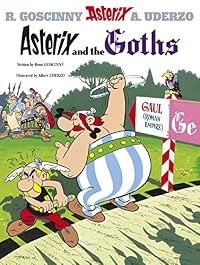
Asterix and Obelix escort Getafix to the druids' annual conference in the Forest of the Carnutes. Little do they know that the Goths are lying in ambush, ready to kidnap the Druid of the Year - who of course is Getafix! But what with Gauls, Goths and Romans all at odds, it's hard to tell friend from foe... until Goths begin fighting Goths in the Asterixian Wars.Tags
Recommendations
























Member Reviews
After two rather disappointing issues, Asterix and Obelix's third adventure 'Asterix and the Goths' turned out to be a brilliant work. This issue's storyline is a bit complex. The druid Getafix wins the title 'Druid of the year' and became the target of the Goths from Germania, the very neighbouring state of the Roman occupied Gaul. The barbarian Goths kidnapped the druid and kept him captive. They want him to make them the magic potion that can give them superhuman strength. In order to conquer the Gaul and Germania, Goths need that superhuman strength. It's now totally up to Asterix and Obelix to rescue the druid and get him back to the village. In the rescue mission, they get involved in so many complex happenings; one incident leads show more them to another. This issue is a very funny one. Subtle jokes are cracked very often. Another important thing is the naming of the characters. Naming a Brit Valuaddetax (Value Added Tax), a German Electric or Euphoric is a very clever idea and these names also almost suggest the attributes of the respective characters. Very intellectual and very enjoying storyline. I particularly loved the ending of the story where our protagonists broke the unity of their enemies by engaging them in fighting one another using their greed for power and made it certain that they will not be disturbed in many years by the Goths.
A true classic comic book. Books like this can make the lives of children more enjoyable and let's not forget about the historical references as well. At times they can be quite didactic as well. Great work by René Goscinny and Albert Uderzo. show less
A true classic comic book. Books like this can make the lives of children more enjoyable and let's not forget about the historical references as well. At times they can be quite didactic as well. Great work by René Goscinny and Albert Uderzo. show less
This review is written with a GPL 4.0 license and the rights contained therein shall supersede all TOS by any and all websites in regards to copying and sharing without proper authorization and permissions. Crossposted at WordPress, Blogspot, & Librarything by Bookstooge’s Exalted Permission
Title: Asterix and the Goths
Series: Asterix #3
Authors: Goscinny & Uderzo
Translators: Bell & Hockridge
Rating: 4 of 5 Stars
Genre: Comics
Pages: 51
Words: 3K
Synopsis:
From Wikipedia.org
Asterix and Obelix, nervous about Getafix traveling alone to the annual druids' conference in the Forest of the Carnutes, accompany him on his journey and remain outside the forest during the conference. Meanwhile, on the Roman Empire's border, two legionaries are captured show more by a band of Goths (Tartaric, Esoteric, Atmospheric, Prehistoric, and Choleric), intending to kidnap the Druid of the Year and use his skills to conquer Gaul and Rome.[3]
En route to the Forest, Asterix, Obelix, and Getafix meet another druid, Valueaddedtax, who uses his magical powers to convince the Romans to let them pass. At the edge of the Forest of the Carnutes, Getafix and his friend leave Asterix and Obelix for the druid's conference. Unaware that the Goth band is hiding nearby, the druids enter their inventions in a contest, in which Getafix wins the "Golden Menhir" prize with his potion, which gives superhuman strength. As he leaves his colleagues, the Goths take him prisoner. Asterix and Obelix, fearing for their friend's safety after they do not see him leave the Forest, enter the woods and find a Visigoth helmet (actually a pickelhaube like those worn by Germans during the first years of World War I). They instantly set out towards the east (thoroughly confusing Obelix) to rescue Getafix.
Unfortunately, they run into another Roman patrol, which spots the helmet Asterix is carrying and mistakes them for Goths (who are wanted for assaulting Roman border guards). Obelix and Asterix easily defeat the Romans, but the Roman general is informed of the incident and sends out pictures of Asterix and Obelix with a reward for their capture.
Asterix has the bright idea of disguising himself and Obelix as Romans and ambush two legionaries, stealing their armor and weapons and leaving them tied up and gagged. Two other legionaries, searching for the Goths, come across our heroes, in which Obelix's laughter at what they should say if they meet other Romans almost blows his and Asterix's cover. Soon after, the two legionaries spot the two tied-up Romans and mistake them for Asterix and Obelix, "a fat one and a little one". Thinking another Legionary captured them and has gone for reinforcements, they decide to take the reward, and take the prisoners to the general's tent. When the captives are ungagged, however, the full story comes out, and the Romans promptly begin capturing each other left and right, believing each other to be Goths, much to the disappointment of the General. Asterix and Obelix, back in Gaulish clothing, are completely untouched, along with the Goths, who approach the border.
The Goths cross the Roman Empire's border back into Germania, stunning a young legionary whose eagerness to report an invasion becomes a running gag. (He initially reports an "invasion" of Goths invading the Goths, then an invasion of Gauls crossing into Germania — which his centurion dismisses as their territory is not the one being invaded—, and then finally reports the Gauls returning to Gaul, which causes him to get 8 days inside). They present the druid first to a customs officer, who at first refuses to let them through on charges of importing foreign goods. Eventually, the Goths present Getafix to their Gothic chieftain, Metric, calls in a Gaulish-Gothic translator, Rhetoric, who is threatened to be executed if he does not convince Getafix to cooperate and brew magic potion. Although Getafix flatly refuses, Rhetoric lies and says that he has agreed to do so in a week's time, at the New Moon.
Meanwhile, Asterix and Obelix also stun the young legionary and enter the Gothic lands. While running into a Gothic border patrol, Obelix stupidly uses the cover up names he and Asterix used for their Roman disguises, making the patrol think the Gauls are Romans. After Asterix and Obelix beat up the patrol, they disguise themselves as Goths by attacking two of them, infiltrating their barracks as members of the army. They escape from the Gothic army, but are soon captured again by the Goths and thrown in jail along with Rhetoric, who was also trying to flee. Although they are thrown in prison, Obelix easily breaks the door (another running gag) and they flee, taking Rhetoric with them to question. While at first he pretends to speak only Gothic, Rhetoric accidentally reveals that he can speak Gaulish and is forced to spill the beans. While trying to sneak into the Gothic town, Rhetoric screams and attracts a patrol. Although Asterix and Obelix beat up the patrol, they surrender to the last standing man to be brought to the Chief.
The Gauls are brought before Metric. Getafix reveals that he can actually speak Gothic and informs Metric that Rhetoric had been deceiving him. Once again, Rhetoric is thrown in jail with the Gauls, and they are all sentenced to execution. Asterix, Obelix and Getafix devise a scheme in which many Goths are given magic potion, so that they spend time and energy fighting each other for chieftainship instead of invading Gaul and Rome, making Rhetoric play a part in it. Under the pretext of cooking a last Gaulish soup, Getafix gives the jailer a list of ingredients and brews the potion when he acquires them. During the public execution, Rhetoric asks to go first. Full of magic potion, he resists all attempts at torture, and beats up Metric, throwing him in jail and making himself Chieftain of the Goths. The Gauls visit Metric in his prison, and give him magic potion. As the two Chieftains had the same magic potion in them, a direct fight proves futile and each storms off, promising to raise an army.
The Gauls wander around the town, giving potions to any Goth who looks browbeaten and who would be glad of a chance of power (their first two candidates being Electric, who is poor and has to sweep up streets, and Euphoric, who is being bossed about by his dictator-like wife). The would-be Chieftains each raise an army, and a confusing set of conflicts begins, known as the "Asterixian Wars", thus successfully sowing so much discord in Germania that the tribes be more occupied with fighting each other rather than trying to invade other countries.
Although their peace-keeping mission probably created more casualties than a Gothic invasion of Rome would, the three Gauls make it back to Gaul, again running into the over-eager young legionary at the border, return home confident and are welcomed with open arms by the village, who throw their usual banquet in celebration.
My Thoughts:
This made for a great read on a Saturday morning. Sitting on our old comfy couch, eating Stouffer's fried mac&cheese poppers while drinking diet Mt Dew and reading about gauls beating the stuffing out of Romans, Ostrogoths and Visigoths. What more could you ask for?
Light hearted fun is all these stories offer and so if you only expect that, you'll be fine. I think my problems that I experienced with the previous book was that I was expecting something more inline with a series of novels, where characters grow and change and the world is explained more and more. Here, Asterix is Asterix, Obelix is Obelix and that's just the way they're going to be.
The names of various Gauls, Romans and Goths continues to be as amusing as ever. It did however make me want to investigate the older translations of these to see what they were then. Because it might be a case of the translators making up their own jokes and that would really color my view of the whole thing.
★★★★☆ show less
Title: Asterix and the Goths
Series: Asterix #3
Authors: Goscinny & Uderzo
Translators: Bell & Hockridge
Rating: 4 of 5 Stars
Genre: Comics
Pages: 51
Words: 3K
Synopsis:
From Wikipedia.org
Asterix and Obelix, nervous about Getafix traveling alone to the annual druids' conference in the Forest of the Carnutes, accompany him on his journey and remain outside the forest during the conference. Meanwhile, on the Roman Empire's border, two legionaries are captured show more by a band of Goths (Tartaric, Esoteric, Atmospheric, Prehistoric, and Choleric), intending to kidnap the Druid of the Year and use his skills to conquer Gaul and Rome.[3]
En route to the Forest, Asterix, Obelix, and Getafix meet another druid, Valueaddedtax, who uses his magical powers to convince the Romans to let them pass. At the edge of the Forest of the Carnutes, Getafix and his friend leave Asterix and Obelix for the druid's conference. Unaware that the Goth band is hiding nearby, the druids enter their inventions in a contest, in which Getafix wins the "Golden Menhir" prize with his potion, which gives superhuman strength. As he leaves his colleagues, the Goths take him prisoner. Asterix and Obelix, fearing for their friend's safety after they do not see him leave the Forest, enter the woods and find a Visigoth helmet (actually a pickelhaube like those worn by Germans during the first years of World War I). They instantly set out towards the east (thoroughly confusing Obelix) to rescue Getafix.
Unfortunately, they run into another Roman patrol, which spots the helmet Asterix is carrying and mistakes them for Goths (who are wanted for assaulting Roman border guards). Obelix and Asterix easily defeat the Romans, but the Roman general is informed of the incident and sends out pictures of Asterix and Obelix with a reward for their capture.
Asterix has the bright idea of disguising himself and Obelix as Romans and ambush two legionaries, stealing their armor and weapons and leaving them tied up and gagged. Two other legionaries, searching for the Goths, come across our heroes, in which Obelix's laughter at what they should say if they meet other Romans almost blows his and Asterix's cover. Soon after, the two legionaries spot the two tied-up Romans and mistake them for Asterix and Obelix, "a fat one and a little one". Thinking another Legionary captured them and has gone for reinforcements, they decide to take the reward, and take the prisoners to the general's tent. When the captives are ungagged, however, the full story comes out, and the Romans promptly begin capturing each other left and right, believing each other to be Goths, much to the disappointment of the General. Asterix and Obelix, back in Gaulish clothing, are completely untouched, along with the Goths, who approach the border.
The Goths cross the Roman Empire's border back into Germania, stunning a young legionary whose eagerness to report an invasion becomes a running gag. (He initially reports an "invasion" of Goths invading the Goths, then an invasion of Gauls crossing into Germania — which his centurion dismisses as their territory is not the one being invaded—, and then finally reports the Gauls returning to Gaul, which causes him to get 8 days inside). They present the druid first to a customs officer, who at first refuses to let them through on charges of importing foreign goods. Eventually, the Goths present Getafix to their Gothic chieftain, Metric, calls in a Gaulish-Gothic translator, Rhetoric, who is threatened to be executed if he does not convince Getafix to cooperate and brew magic potion. Although Getafix flatly refuses, Rhetoric lies and says that he has agreed to do so in a week's time, at the New Moon.
Meanwhile, Asterix and Obelix also stun the young legionary and enter the Gothic lands. While running into a Gothic border patrol, Obelix stupidly uses the cover up names he and Asterix used for their Roman disguises, making the patrol think the Gauls are Romans. After Asterix and Obelix beat up the patrol, they disguise themselves as Goths by attacking two of them, infiltrating their barracks as members of the army. They escape from the Gothic army, but are soon captured again by the Goths and thrown in jail along with Rhetoric, who was also trying to flee. Although they are thrown in prison, Obelix easily breaks the door (another running gag) and they flee, taking Rhetoric with them to question. While at first he pretends to speak only Gothic, Rhetoric accidentally reveals that he can speak Gaulish and is forced to spill the beans. While trying to sneak into the Gothic town, Rhetoric screams and attracts a patrol. Although Asterix and Obelix beat up the patrol, they surrender to the last standing man to be brought to the Chief.
The Gauls are brought before Metric. Getafix reveals that he can actually speak Gothic and informs Metric that Rhetoric had been deceiving him. Once again, Rhetoric is thrown in jail with the Gauls, and they are all sentenced to execution. Asterix, Obelix and Getafix devise a scheme in which many Goths are given magic potion, so that they spend time and energy fighting each other for chieftainship instead of invading Gaul and Rome, making Rhetoric play a part in it. Under the pretext of cooking a last Gaulish soup, Getafix gives the jailer a list of ingredients and brews the potion when he acquires them. During the public execution, Rhetoric asks to go first. Full of magic potion, he resists all attempts at torture, and beats up Metric, throwing him in jail and making himself Chieftain of the Goths. The Gauls visit Metric in his prison, and give him magic potion. As the two Chieftains had the same magic potion in them, a direct fight proves futile and each storms off, promising to raise an army.
The Gauls wander around the town, giving potions to any Goth who looks browbeaten and who would be glad of a chance of power (their first two candidates being Electric, who is poor and has to sweep up streets, and Euphoric, who is being bossed about by his dictator-like wife). The would-be Chieftains each raise an army, and a confusing set of conflicts begins, known as the "Asterixian Wars", thus successfully sowing so much discord in Germania that the tribes be more occupied with fighting each other rather than trying to invade other countries.
Although their peace-keeping mission probably created more casualties than a Gothic invasion of Rome would, the three Gauls make it back to Gaul, again running into the over-eager young legionary at the border, return home confident and are welcomed with open arms by the village, who throw their usual banquet in celebration.
My Thoughts:
This made for a great read on a Saturday morning. Sitting on our old comfy couch, eating Stouffer's fried mac&cheese poppers while drinking diet Mt Dew and reading about gauls beating the stuffing out of Romans, Ostrogoths and Visigoths. What more could you ask for?
Light hearted fun is all these stories offer and so if you only expect that, you'll be fine. I think my problems that I experienced with the previous book was that I was expecting something more inline with a series of novels, where characters grow and change and the world is explained more and more. Here, Asterix is Asterix, Obelix is Obelix and that's just the way they're going to be.
The names of various Gauls, Romans and Goths continues to be as amusing as ever. It did however make me want to investigate the older translations of these to see what they were then. Because it might be a case of the translators making up their own jokes and that would really color my view of the whole thing.
★★★★☆ show less
It is really surprising to see how quickly the Asterix albums get quite good, and while this is not as good as The Golden Sickle (namely due to some of the content which I believe drags it down somewhat) this album is still gold. Asterix and the Goths carries on from where The Golden Sickle ends. Asterix and Obelix have just returned from Lutetia with Getafix's sickle, and Getafix now gets ready to travel to the Forest of Carnutes for the Druid Convention. However, at the same time, some Goths cross the frontier into the Roman Empire to kidnap the druid that is elected the greatest druid for the year. This turns out to be Getafix, thanks to his magic potion. Asterix and Obelix must then travel to the land of the Goths to attempt to show more locate him and rescue him.
It is very clear in this album that the Goths are the Germans, and they are not portrayed all that well. They are painted as barbarians who fight amongst themselves and are planning on using the druidic magic to invade and conquer the Roman Empire. This is a theme that has popped up in a previous book, where a centurion discovers the magic potion, and tries to steal it for himself so that he might overthow Ceaser and rule the Empire. The thing is is that the Gauls and the Goths were effectively the same race. The Gauls were not French, they came a lot later: the Gauls, like the Goths, were Celtic. That is beside the point though because Asterix is not meant to be reflective of the time, but rather of modern society.
It does make me wonder, though, how it is that a story set in Ancient Rome can be reflective of the modern world. While Rome brought about civilisation, it is not as if France of 1963 was ruled by any foreign powers. Yes, throughout her history, France had been subject to numerous foreign invaders, but they themselves were also the invader, particularly during the Napoleonic Wars. Maybe the idea is that the Gauls are representative of the ordinary people and the Romans are representative of government. I suspect, and I know that it is true here in Australia, that when you go out into the rural regions, there is a much stronger distrust of government than there is in the city. I guess that is why the Liberal and National party tend to do a lot better in the country.
The end of the book was a little silly and quite amusing. It was silly because they start a war amongst the Goths by giving a select few a swig of the potion, and when they discovered that they are equally invincible, they raise armies to then slog it out. However, when the potion wears off, they are still at war and are now relying on their armies. What struck me was that the Goths did not spend the next few hundred years, as suggested, fighting amongst themselves. While they were disorganised tribes, they still were able to band together and drive out the Romans during the reign of Augustus. While that was not the height of the Roman empire, it was a massive defeat that drove them back over the Rhine, where they pretty much remained until the empire collapsed. I don't think Rome ever managed to conquer Germania (though the did manage to conquer Dacia).
The last thing I wish to mention is the little scene at the end which was really amusing, and really brings out Obelix's character. Somebody makes a comment about a 'free hand' and then about a page later Obelix suddenly cries out, 'I get it, a free hand!' and bursts out laughing, and ends up spending the rest of the album laughing about the 'free hand'. In a way me, as the reader, had no idea what was so funny, nor what was meant about the free hand, but having Obelix rolling around on the ground in hysteria was just golden. I probably should write something about the village, but there are plenty of more Asterix books to read, and I guess I will wait until I get around to reading them (or at least ordering them from Amazon). show less
It is very clear in this album that the Goths are the Germans, and they are not portrayed all that well. They are painted as barbarians who fight amongst themselves and are planning on using the druidic magic to invade and conquer the Roman Empire. This is a theme that has popped up in a previous book, where a centurion discovers the magic potion, and tries to steal it for himself so that he might overthow Ceaser and rule the Empire. The thing is is that the Gauls and the Goths were effectively the same race. The Gauls were not French, they came a lot later: the Gauls, like the Goths, were Celtic. That is beside the point though because Asterix is not meant to be reflective of the time, but rather of modern society.
It does make me wonder, though, how it is that a story set in Ancient Rome can be reflective of the modern world. While Rome brought about civilisation, it is not as if France of 1963 was ruled by any foreign powers. Yes, throughout her history, France had been subject to numerous foreign invaders, but they themselves were also the invader, particularly during the Napoleonic Wars. Maybe the idea is that the Gauls are representative of the ordinary people and the Romans are representative of government. I suspect, and I know that it is true here in Australia, that when you go out into the rural regions, there is a much stronger distrust of government than there is in the city. I guess that is why the Liberal and National party tend to do a lot better in the country.
The end of the book was a little silly and quite amusing. It was silly because they start a war amongst the Goths by giving a select few a swig of the potion, and when they discovered that they are equally invincible, they raise armies to then slog it out. However, when the potion wears off, they are still at war and are now relying on their armies. What struck me was that the Goths did not spend the next few hundred years, as suggested, fighting amongst themselves. While they were disorganised tribes, they still were able to band together and drive out the Romans during the reign of Augustus. While that was not the height of the Roman empire, it was a massive defeat that drove them back over the Rhine, where they pretty much remained until the empire collapsed. I don't think Rome ever managed to conquer Germania (though the did manage to conquer Dacia).
The last thing I wish to mention is the little scene at the end which was really amusing, and really brings out Obelix's character. Somebody makes a comment about a 'free hand' and then about a page later Obelix suddenly cries out, 'I get it, a free hand!' and bursts out laughing, and ends up spending the rest of the album laughing about the 'free hand'. In a way me, as the reader, had no idea what was so funny, nor what was meant about the free hand, but having Obelix rolling around on the ground in hysteria was just golden. I probably should write something about the village, but there are plenty of more Asterix books to read, and I guess I will wait until I get around to reading them (or at least ordering them from Amazon). show less
My first Astérix comic and probably the first of many I will read. It's a very quick read, although I did try to read slower in an attempt to ferret out some of the inevitable puns. I enjoyed all the character names and the fact that the Goths speak in Gothic lettering. Très divertissant!
In this third installment Asterix rescues Getafix from the goths and an important strategic tactic is demonstrated. It is to your benefit when your enemies are spending resources to fight one another instead of you.
An Asterix and Obelix adventure in which the Druid Getafix is kidnaped by the Goths for his magic potion which makes the drinker invincible. Our boys, of course, hustle to the rescue. Mildly diverting.
Seven out of ten. CBR format.
Getaflix has been kidnapped, by a band of Goths. The two Gauls set off to recover him.
Members
- Recently Added By
Lists

1960s, Best books published therein
254 works; 22 members

Books Read in 2022
5,164 works; 113 members

Books Read in 2024
4,623 works; 126 members
Author Information


Albert Uderzo was born on April 25, 1927 in Fismes, France as Alberto Aleondro Uderzo. In 1940, when he was just 13, he worked for Paris Publishing Society where he learned the basics for his profession - designing text and letters and editing photos. During World War II he worked on a farm and later as a furniture maker with his father. His show more drawing skills were put aside until 1945 when he entered a comic strip competition and later worked on a cartoon film titled Clic Clac. In the mean time he moved to Paris and worked on the magazine O.K. where he created several comics such as Arys Buck and Belloy. It was then that he met Rene Goscinny and the two worked on new comic book characters like Ompah-pah, Jehan Pistolet and Luc Junior. In 1959 they started a magazine called Pilote aimed at older children. It was the first issue that introduced the character Asterix and it was a big hit. By 1967 the comic became so popular that they decided to devote all their time to the series. Albert Uderzo was the illustator of all thirty Asterix adventures and the writer of the last eight adventures. show less
Some Editions
Series

Belongs to Publisher Series
Großer Asterix-Band (VII)
Tout Goscinny (1963, Astérix 3)
Work Relationships
Is contained in
Asterix Omnibus 01: Asterix the Gaul #1, Asterix and the Golden Sickle #2, Asterix and the Goths #3 by René Goscinny
De avonturen van Asterix de Galliër. [1]: De Galliër ; Het gouden snoeimes ; De Gothen ; De gladiatoren by René Goscinny
Asterix collectie I: 1 de Galliër, 2 het gouden snoeimes, 3 en de Gothen, 4 en de gladiatoren, 5 en de ronde van Gallia, 6 en Cleopatra by Albert Uderzo
Asterix - Werkedition mit Lexikon - Band 7 und 8 - Asterix und die Goten / Asterix bei den Briten by René Goscinny
Asterix bind 3: Asterix og goterne : Asterix og styrkedråpene : Asterix som gladiator : Asterix - Gallia rundt by Goscinny
ASTERIX THE CONQUEROR 3 IN 1 POCKET (TITLES 4, 5 and 6) CLEOPATRA, GOTHS AND GLADIATOR BIND UP HODDER ... and the Goths", "Asterix the Gladiator" by René Goscinny
Julens store Asterix 2020 : Inneholder klassikerne Asterix og Kleopatra / Asterix og goterne by René Goscinny
Has the adaptation
Common Knowledge
- Canonical title
- Asterix and the Goths
- Original title
- Astérix et les Goths
- Alternate titles*
- Astérix : Astérix et les Goths
- Original publication date
- 1961
- People/Characters
- Asterix; Obelix; Dogmatix; Vitalstatistix; Valueaddedtax; Tartaric (show all 28); Suffix; Satiric; Rhetoric; Prehistoric; Prefix; Metric; Marcus Ubiquitus; Lyric; Julius Monotonus; Getafix; Gastroenteritus; Euphoric; Esoteric; Electric; Eccentric; Choleric; Cantankerus; Cadaverus; Cacofonix; Botanix; Atmospheric; Arteriosclerosus
- Important places
- Germany
- Important events
- Roman Empire
- First words*
- In dem kleinen Dorf unsrer grossen gallischen Helden trifft Miraculix, der Druide, letzte Vorbereitungen für seine Reise in den Karnutenwald.
- Last words*
- (Click to show. Warning: May contain spoilers.)Gebt ihm schnell noch ein Wildschwein, sonst erzählt er's noch einmal!
- Original language
- French
- Canonical DDC/MDS
- 741.5944
*Some information comes from Common Knowledge in other languages. Click "Edit" for more information.
Classifications
- Genre
- Graphic Novels & Comics
- DDC/MDS
- 741.5944 — Arts & recreation Drawing & decorative arts Drawing Comic books, graphic novels, fotonovelas, cartoons, caricatures, comic strips History, geographic treatment, biography European France & Monaco
- LCC
- PN6747 — Language and Literature Literature (General) Literature (General) Collections of general literature Comic books, strips, etc.
- BISAC
Statistics
- Members
- 2,026
- Popularity
- 10,268
- Reviews
- 17
- Rating
- (4.00)
- Languages
- 26 — Afrikaans, Catalan, Czech, Danish, Dutch, English, Finnish, French, Frisian, German, Galician, Greek, Hungarian, Indonesian, Italian, Norwegian (Bokmål), Norwegian, Polish, Russian, Croatian, Slovak, Spanish, Swedish, Turkish, Welsh, Portuguese (Brazil)
- Media
- Paper, Ebook
- ISBNs
- 92
- ASINs
- 27